
Unlocking Potential with 360° Laser Scanning Ranging Radar
Explore how 360° laser scanning ranging radar revolutionizes industries with precise, all-around sensing for autonomous vehicles, automation, and more.

Introduction
Imagine a technology that allows devices to see their surroundings in every direction with pinpoint accuracy. 360° Laser Scanning Ranging Radar is revolutionizing industries by offering comprehensive spatial awareness through rapid, precise measurements. As businesses and technology sectors evolve, understanding and leveraging this technology is becoming increasingly critical.
In this article, we will explore the fundamentals of 360° laser scanning ranging radar, its practical applications, emerging market trends, benefits, and the challenges it faces. By the end, you’ll appreciate why this technology is a game changer across multiple industries and how it’s shaping the future of sensing and automation.
Technology Overview: What is 360° Laser Scanning Ranging Radar?
At its core, a 360° Laser Scanning Ranging Radar combines laser scanning and radar technology to create a panoramic, high-precision map of the environment. Unlike traditional radars that often operate within limited angles, this system continuously scans all around—360 degrees—capturing detailed distance measurements and object positions in real-time.
Key components include:
- Laser Scanning: Utilizes laser beams that sweep across an area to measure distances based on the time it takes for light to reflect back (Time-of-Flight or ToF technology).
- Ranging Radar: Employs radio waves to detect objects and measure their distance, speed, and angle, providing robust detection in various weather and lighting conditions.
By integrating these two, the system can overcome limitations of each technology alone, offering superior spatial resolution, longer detection ranges, and more reliable data under diverse environmental conditions. The result is a comprehensive, three-dimensional understanding of surroundings—crucial for automation, navigation, and safety applications.
Industry Applications & Use Cases
The versatility of 360° laser scanning ranging radar makes it invaluable across multiple sectors:
- Autonomous Vehicles: Self-driving cars and drones use this technology to detect obstacles, pedestrians, and other vehicles in real-time, enabling safe navigation and collision avoidance. For instance, Waymo’s autonomous fleet leverages 360° lidar and radar fusion to achieve high-definition environmental mapping.
- Industrial Automation: Robotics in manufacturing plants employ 360° scanning to safely operate alongside humans, identify parts, and monitor environments for hazards.
- Security & Surveillance: Facilities can deploy these systems for perimeter security, monitoring large areas without blind spots, and detecting intrusions swiftly—even in low-light or harsh weather conditions.
- Mapping and Surveying: Geospatial professionals use 360° laser scanning ranging radar to create accurate 3D maps for construction, urban planning, and disaster management, improving project accuracy and reducing time.
One notable success story is the use of 360° laser scanning radar by the Port of Rotterdam, which enhanced automated container handling and reduced accidents through precise spatial awareness of moving equipment and personnel.
Market Trends & Growth Drivers
The demand for 360° laser scanning ranging radar is growing rapidly. According to recent industry reports, the global laser scanning market is expected to surpass $4 billion by 2027, with a CAGR of over 12%.
Several factors fuel this growth:
- Rise in Autonomous Systems: Increasing adoption of autonomous vehicles, drones, and robotics drives demand for reliable 360° sensing technologies.
- Advancements in Sensor Fusion: Combining radar and laser scanning enhances performance, creating new opportunities for innovation and integration.
- Infrastructure Modernization: Smart cities and Industry 4.0 initiatives require precise environmental mapping and monitoring, boosting market uptake.
- Regulatory Support: Safety regulations in automotive and industrial sectors push for improved sensing and collision avoidance systems.
Moreover, miniaturization and cost reductions in laser and radar hardware are making these systems more accessible to smaller businesses and emerging markets.
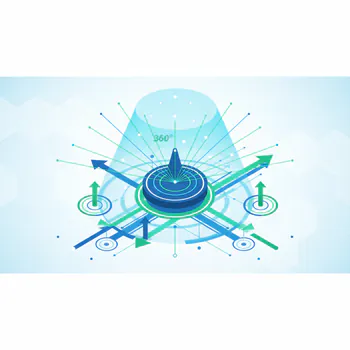
Market Trends & Growth Drivers
Benefits & Advantages
Businesses embracing 360° laser scanning ranging radar enjoy multiple benefits:
- Comprehensive Spatial Awareness: Unlike partial scanning systems, a full 360° view eliminates blind spots, improving operational safety and decision-making.
- High Precision and Reliability: Laser scanning offers millimeter-level accuracy, while radar ensures performance under adverse weather, enabling consistent sensing.
- Reduced Operational Costs: Automation facilitated by this technology lowers labor costs, minimizes downtime, and enhances productivity.
- Enhanced Safety: In industries like automotive and manufacturing, accurate object detection and mapping prevent accidents and ensure compliance with safety standards.
- Strong ROI: Investing in 360° laser scanning ranging radar often results in faster project completion, fewer errors, and improved asset management, offering tangible financial returns.
Ultimately, companies gain a significant competitive edge by integrating this advanced sensing technology into their workflows.
Challenges & Future Outlook
Despite its promise, 360° laser scanning ranging radar faces challenges:
- Cost and Complexity: High-quality systems can be expensive and require expertise for installation and maintenance.
- Data Processing Demands: The vast amount of data generated necessitates powerful computing and efficient algorithms for real-time analysis.
- Environmental Limitations: While radar performs well in poor visibility, laser scanning can be affected by heavy rain, fog, or dust.
However, ongoing research focuses on addressing these issues. Innovations in AI-driven data processing, sensor miniaturization, and hybrid sensing models promise to enhance performance and affordability.
Looking ahead, the integration of 360° laser scanning ranging radar with 5G connectivity and edge computing will unlock new capabilities, such as real-time remote monitoring and more responsive autonomous systems. We can expect broader adoption across emerging sectors like agriculture, logistics, and smart infrastructure.
Conclusion
The transformative impact of 360° laser scanning ranging radar is clear: from autonomous vehicles to industrial automation, its ability to deliver precise, all-around spatial awareness is reshaping how machines perceive and interact with the world.
As the market continues to expand and technology advances, businesses that adopt and innovate with this sensing solution will unlock significant operational efficiencies, safety enhancements, and competitive advantages.
To stay ahead, organizations should monitor evolving trends, invest in pilot projects, and collaborate with technology providers to tailor 360° laser scanning ranging radar systems to their unique needs. The future belongs to those who can harness the full power of comprehensive, real-time environmental sensing.
Need More Details on Market Players and Competitors?
Tagged in