
Global Dollar Stores Market - Global Outlook 2021-2034
Global Dollar Stores Market is segmented by Application (Food, Household, Party, Personal Care, Cleaning, Toys, Stationery, Hardware), Type (Variety, Grocery, Discount, Specialty, Seasonal, Closeout, Specialty, Ethnic), and Geography (North America, LATAM, West Europe, Central & Eastern Europe, Northern Europe, Southern Europe, East Asia, Southeast Asia, South Asia, Central Asia, Oceania, MEA)
Pricing
Report Overview
Industry Overview
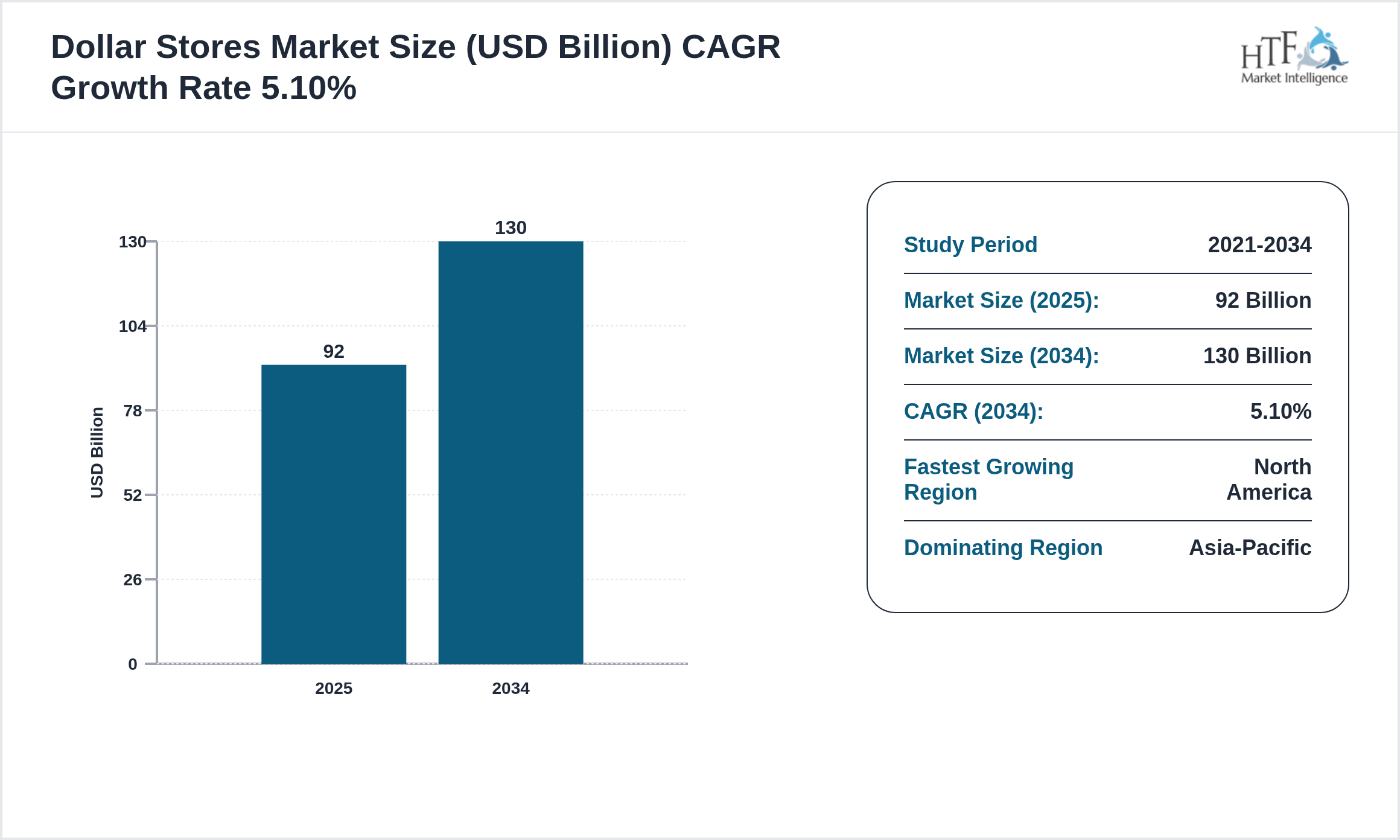
The Dollar Stores market is witnessing significant growth and is expected to expand at a CAGR of 5.10% during the forecast period from 2025 to 2034. This growth is primarily driven by increasing technological advancements, rising consumer demand, and expanding applications across various industries. Businesses are increasingly adopting innovative solutions to improve operational efficiency, enhance customer experiences, and gain a competitive advantage, further fueling market expansion.
Source: HTF Market Intelligence (HTF MI)
The Dollar Stores market comprises discount retail chains specializing in low-cost consumer products including household goods packaged food cleaning supplies personal care items seasonal merchandise stationery and basic convenience products sold at highly competitive price points. The market scope includes fixed-price retail formats value retail chains discount neighborhood stores closeout merchandise outlets and low-cost convenience retailers serving urban and rural populations. The report evaluates retail operations supply-chain optimization merchandising strategies consumer affordability trends and private-label product penetration while excluding luxury retail and wholesale cash-and-carry operations. Primary growth catalysts include inflation-driven value purchasing behavior rising low-income consumer dependency rapid expansion of discount retail infrastructure and increasing demand for affordable daily essentials. Demand-side dynamics are influenced by price-sensitive purchasing patterns economic uncertainty convenience-focused shopping behavior and growing penetration in underserved regions. Supply-side transformation includes centralized distribution networks automated inventory replenishment data-driven merchandising systems and private-label sourcing expansion. Technological evolution involves AI-powered demand forecasting digital checkout systems smart shelf monitoring technologies supply-chain analytics platforms and omnichannel discount retail integration enhancing operational scalability and customer retention
The research study Dollar Stores Market gives readers information on tactical business choices and strategic planning that affect and stabilize the growth prediction in the Dollar Stores market. However, a few disruptive trends will have opposite and significant effects on the distribution among players and the growth of the Dollar Stores market. To give further advice on why certain developments in the Dollar Stores market would have a significant impact and specifically why these trends can be taken into account when determining the market's trajectory and industry participants' strategic plans.
Key Highlights
• The Dollar Stores is growing at a CAGR of 5.10% during the forecasted period of 2025 to 2034
• Year-on-year growth for the market is 4.70%.
• Asia-Pacific dominated the market share in 2025
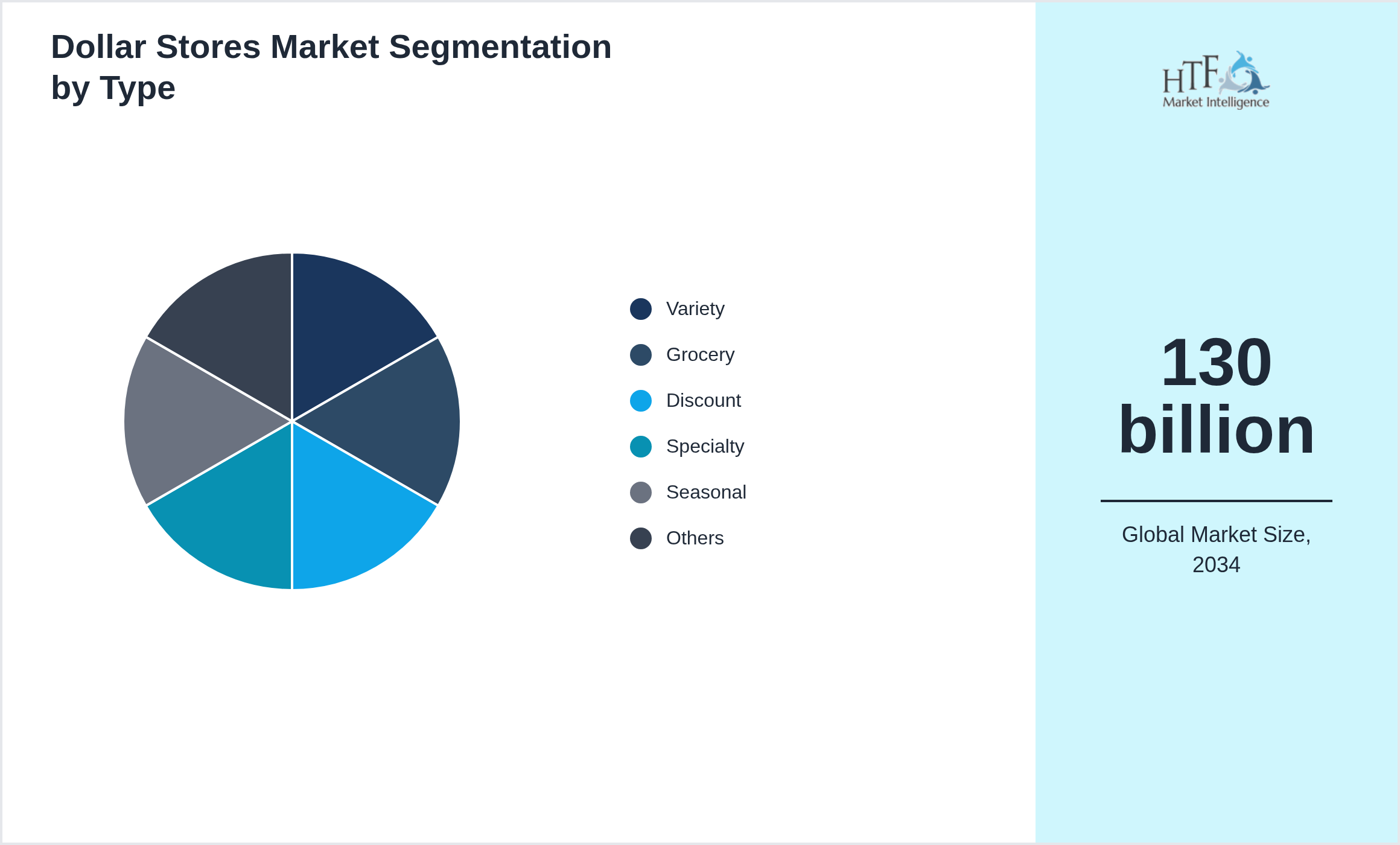
• Based on type, the market is bifurcated into the Variety, Grocery, Discount, Specialty, Seasonal, Closeout, Specialty, Ethnic segment, which dominated the market share during the forecasted period
• Based on application, the market is segmented into Application Food, Household, Party, Personal Care, Cleaning, Toys, Stationery, Hardware as the fastest-growing segment.
• North America, LATAM, West Europe, Central & Eastern Europe, Northern Europe, Southern Europe, East Asia, Southeast Asia, South Asia, Central Asia, Oceania, MEA import/export in terms of K tons, K units, and metric tons will be provided if applicable, based on industry best practices.
Market Dynamics Highlighted
What Growth Drivers are Powering Demand in the Dollar Stores Market?
- • Economic uncertainty and cost-conscious consumer behavior drive dollar store popularity Expansion in underserved and rural areas fuels market growth Advances in private label products help maintain low prices Drivers: economic factors geographic expansion private labels.
- • Trends include diversification of product assortments beyond basic goods Increased adoption of digital payment systems for convenience Growing emphasis on localized inventory tailored to community needs Trends: product diversification digital payments local focus.
Why does the Dollar Stores Market Face Growth Challenges?
Dollar Stores Market Segment Highlighted
Segmentation by Type
- • Variety
- • Grocery
- • Discount
- • Specialty
- • Seasonal
- • Closeout
- • Specialty
- • Ethnic
Segmentation by Application
- • Food
- • Household
- • Party
- • Personal Care
- • Cleaning
- • Toys
- • Stationery
- • Hardware
![Dollar Stores Market trend by end use applications [Food, Household, Party, Personal Care, Cleaning, Toys, Stationery, Hardware]](https://htf-insight.s3.us-east-1.amazonaws.com/generated-charts/chart-pie-and-donut-chart-application-4366727-dollar-stores-market-1779123096130-1779123099366-96ddf84acce62503.png)
Key Players
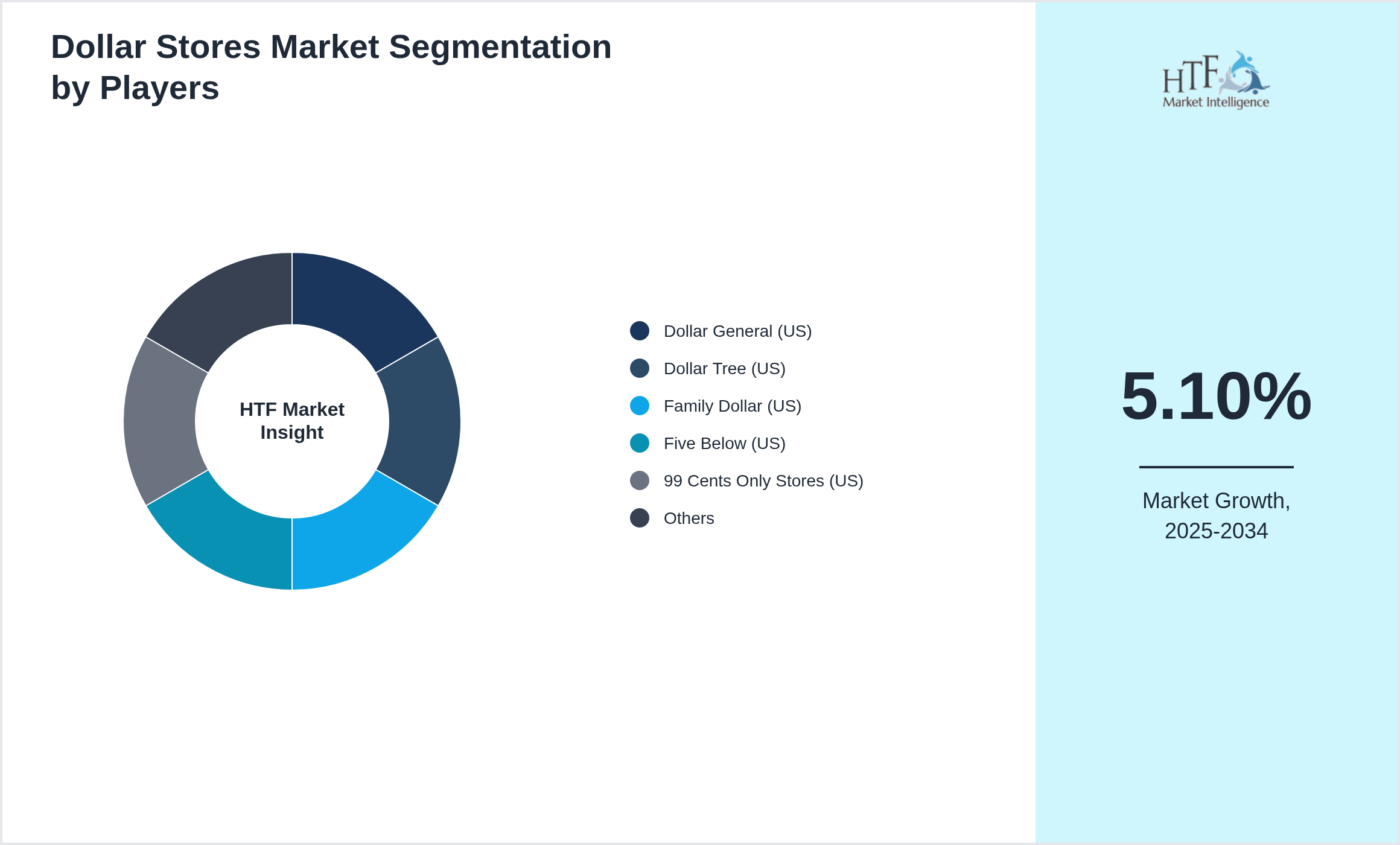
The companies featured in this profile were selected based on insights from primary experts, evaluating their market penetration, product offerings, and geographical reach. By targeting emerging markets, these companies aim to leverage new opportunities, enhance their competitive advantage, and drive revenue growth. This approach not only aligns with their overall business objectives but also positions them to respond effectively to the evolving demands of consumers in these regions. Several key players in the Dollar Stores market are strategically focusing on expanding their operations in developing regions to capture a larger market share, particularly as the year-on-year growth rate for the market stands at 4.70%.
- • Dollar General (US)
- • Dollar Tree (US)
- • Family Dollar (US)
- • Five Below (US)
- • 99 Cents Only Stores (US)
- • ALDI (Germany)
- • Lidl (Germany)
- • Miniso (China)
- • Daiso (Japan)
- • Bodega Latina (US)
- • Dollarama (Canada)
- • Greenbrier International (US)
- • The Warehouse Group (New Zealand)
- • Poundland (UK)
- • Dealz (Ireland)
- • Action (Netherlands)
- • EuroGiant (Spain)
- • Tiger (Denmark)
- • Dealz (Ireland)
- • No Frills (Canada)
- • Netto (Germany)
- • Aldi Süd (Germany)
- • Aldi Nord (Germany)
- • Netto Marken-Discount (Germany)
- • Target (US)
- • Walmart (US)
- • Big Lots (US)
Regional Insight
The Asia-Pacific dominant region currently dominates the market share, fueled by increasing consumption, population growth, and sustained economic progress, which collectively enhance market demand. Conversely, the North America is growing rapidly, driven by significant infrastructure investments, industrial expansion, and rising consumer demand.
- North America
- LATAM
- West Europe
- Central & Eastern Europe
- Northern Europe
- Southern Europe
- East Asia
- Southeast Asia
- South Asia
- Central Asia
- Oceania
- MEA
- • North America dominates the Dollar Stores market through extensive discount retail networks price-sensitive consumer behavior and large-scale suburban and rural penetration. The United States remains the largest regional market supported by inflation-driven spending patterns high demand for low-cost household essentials and efficient private-label sourcing systems. Major dollar store chains continue expanding through small-format stores data-driven inventory management and localized merchandising strategies. Rising demand for affordable groceries seasonal products and daily essentials continues strengthening commercial resilience during economic uncertainty
- • Europe demonstrates moderate growth in discount retailing due to increasing consumer focus on affordability private-label products and budget-conscious shopping behavior. Germany the United Kingdom and Eastern European countries continue witnessing expansion of low-cost retail chains and value-oriented convenience stores. Inflationary pressure supply-chain optimization and rising urban discount retail adoption continue supporting steady commercial development. Investments in automated warehousing digital payment systems and cross-border sourcing improve operational efficiency across the regional market
- • Asia Pacific records strong growth due to expanding middle-income populations rapid urbanization and increasing acceptance of organized discount retail formats. China India Indonesia and the Philippines continue witnessing growth in low-cost retail chains serving price-sensitive consumers. Regional operators benefit from local sourcing advantages high-volume distribution systems and low operating costs. Rising inflation and changing consumption habits continue increasing demand for affordable household goods packaged foods and personal care products across metropolitan and semi-urban areas
- • Middle East markets are gradually expanding through increasing population growth value-based shopping trends and organized retail development across Gulf economies. Budget-focused retail formats continue attracting expatriate populations and middle-income consumers seeking affordable imported and locally sourced products. Investments in logistics hubs retail infrastructure and private-label sourcing continue strengthening commercial opportunities for discount retail operators
Market Entropy
Merger & Acquisition
- • Jan 2024: Dollar General acquired ValueMart Chains to expand retail footprint globally.
- • Sep 2024: Dollar Tree partnered with BudgetStore Labs to integrate supply chain efficiency.
- • Feb 2025: Family Dollar merged with RetailFlex Solutions to strengthen discount retail portfolios.
Patent Analysis
- • Dollar Stores companies continue expanding trademark registrations for private-label household products discount retail formats value-based shopping programs and store-exclusive consumer goods to strengthen competitive positioning in price-sensitive retail markets. Patent innovation remains focused on supply-chain automation smart shelving systems retail analytics software energy-efficient store equipment and inventory optimization technologies that improve operational scalability and cost efficiency. Copyright protections increasingly apply to e-commerce catalogues digital promotional campaigns store layout designs loyalty applications and AI-powered pricing systems supporting omnichannel retail strategies. Retail operators also invest in proprietary procurement technologies and automated warehouse management platforms protected through software copyrights and trade secret frameworks. Growing demand for budget-friendly sustainable products and digital discount platforms continues encouraging intellectual property development within low-cost retail ecosystems
Investment and Funding Scenario
- • The Dollar Stores market is attracting significant investment activity due to rising price-sensitive consumer behavior inflation-driven demand for low-cost retail formats and rapid expansion into underserved suburban and rural markets. Discount retail chains are securing institutional funding to accelerate store openings automate inventory systems and improve private-label product offerings. Venture capital participation is increasing among retail technology startups providing AI-based pricing optimization demand forecasting and low-cost supply-chain management solutions tailored for value retailers. Joint ventures between regional wholesalers and discount store operators are strengthening procurement efficiency and expanding low-cost product availability. Shareholding acquisitions involving local discount chains are becoming increasingly common as major retail corporations seek to expand market share within the budget retail segment. Financial institutions are providing long-term commercial loans for warehouse expansion cold storage integration and supply-chain automation to support high-volume retail operations. Investment activities also include expansion of digital commerce channels and click-and-collect services aimed at integrating physical discount stores with online shopping convenience. Large retail investors are financing private-label manufacturing partnerships to improve margins and reduce dependency on external suppliers. Seed-funded startups are introducing AI-powered shelf monitoring systems cashier-less checkout technologies and predictive inventory tools designed specifically for discount retail operations. Sustainability-linked financing is additionally supporting energy-efficient store modernization recyclable packaging adoption and waste reduction initiatives across large store networks. Private equity-backed consolidation among regional discount retailers is improving operational scalability procurement leverage and geographic expansion capabilities. International retail groups are also investing in emerging-market discount store models to capitalize on rising middle-income populations and increasing consumer preference for affordable household and grocery products
Report Infographics
| Report Features | Details |
| Base Year | 2025 |
| Based Year Market Size (2025) | 92 billion |
| Historical Period | 2021 to 2025 |
| CAGR (2025 to 2034) | 5.10% |
| Forecast Period | 2026 to 2034 |
| Forecasted Period Market Size (2034) | 130 billion |
| Scope of the Report |
By Type, By Application, By Region |
| Companies Covered | Dollar General (US), Dollar Tree (US), Family Dollar (US), Five Below (US), 99 Cents Only Stores (US), ALDI (Germany), Lidl (Germany), Miniso (China), Daiso (Japan), Bodega Latina (US), Dollarama (Canada), Greenbrier International (US), The Warehouse Group (New Zealand), Poundland (UK), Dealz (Ireland), Action (Netherlands), EuroGiant (Spain), Tiger (Denmark), Dealz (Ireland), No Frills (Canada), Netto (Germany), Aldi Süd (Germany), Aldi Nord (Germany), Netto Marken-Discount (Germany), Target (US), Walmart (US), Big Lots (US) |
| Customization Scope | 15% Free Customization
Want to Buy Specific Sections of This Report?
|
| Delivery Format | PDF and Excel through Email |
The Top-Down and Bottom-Up Approaches
The top-down approach begins with a broad theory or hypothesis and breaks it down into specific components for testing. This structured, deductive process involves developing a theory, creating hypotheses, collecting and analyzing data, and drawing conclusions for Dollar Stores Market. It is particularly useful when there is substantial theoretical knowledge, but it can be rigid and may overlook new phenomena developing in Dollar Stores Industry.
Conversely, the bottom-up approach starts with specific data or observations, from which broader generalizations and theories were developed in Dollar Stores Industry. This inductive process involves collecting detailed data, analyzing it for patterns, developing hypotheses, formulating theories, and validating them with additional data identified for Dollar Stores Market. While this approach is flexible and encourages the discovery of new phenomena, it can be time-consuming and less structured.
Regulatory Framework
The healthcare sector is overseen by various regulatory bodies that ensure the safety, quality, and efficacy of health services and products. In the United States, the U.S. Department of Health and Human Services (HHS) plays a crucial role in protecting public health and providing essential human services. Within HHS, the Food and Drug Administration (FDA) regulates food, drugs, and medical devices, ensuring they meet safety and efficacy standards. The Centers for Disease Control and Prevention (CDC) focuses on disease control and prevention, conducting research, and providing health information to protect public health.
Research enthusiast focused on transforming data uncovering into actionable insights through data-driven decision-making.