
Organic Tannins Market Current & Forecast Sizing Trend
Global Organic Tannins Market is segmented by Application (Pharmaceuticals, Cosmetics, Food & Beverages, Leather Processing, Textile), Type (Hydrolyzed Tannins, Condensed Tannins, Ellagic Tannins, Gallotannins, Tannic Acid), and Geography (North America, LATAM, West Europe, Central & Eastern Europe, Northern Europe, Southern Europe, East Asia, Southeast Asia, South Asia, Central Asia, Oceania, MEA)
Pricing
Report Overview
Industry Overview
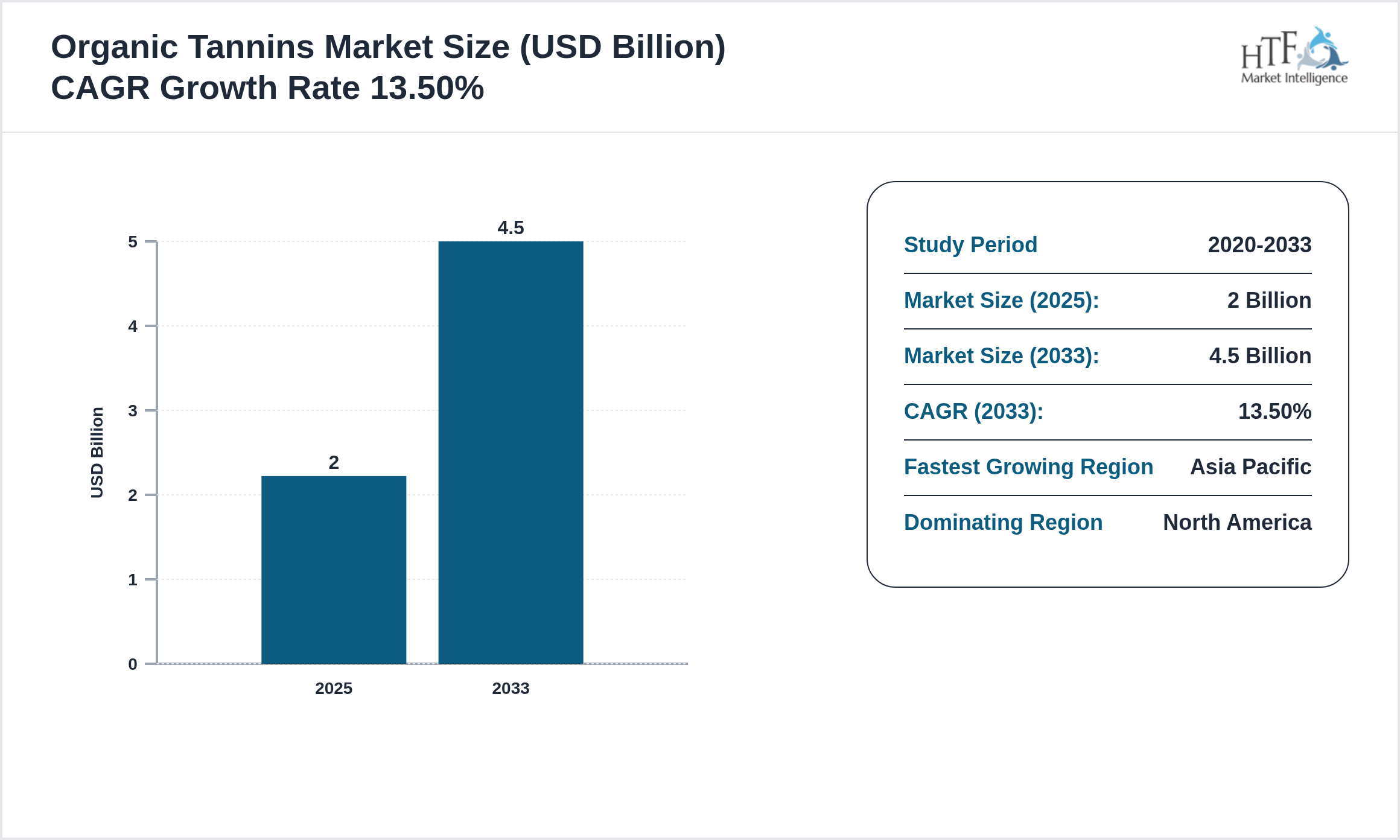
The Organic Tannins market is witnessing significant growth and is expected to expand at a CAGR of 13.50% during the forecast period from 2025 to 2033. This growth is primarily driven by increasing technological advancements, rising consumer demand, and expanding applications across various industries. Businesses are increasingly adopting innovative solutions to improve operational efficiency, enhance customer experiences, and gain a competitive advantage, further fueling market expansion.
Source: HTF Market Intelligence (HTF MI)
Organic tannins are naturally occurring polyphenolic compounds found in various plants, including oak, chestnut, and gall nuts. Tannins are used in a wide range of applications, including pharmaceuticals, cosmetics, and food & beverages. Their antioxidant properties make them beneficial for health, while their use in leather processing provides eco-friendly alternatives to traditional chemicals. As consumers increasingly seek natural and sustainable products, the demand for organic tannins is growing.
The research study Organic Tannins Market gives readers information on tactical business choices and strategic planning that affect and stabilize the growth prediction in the Organic Tannins market. However, a few disruptive trends will have opposite and significant effects on the distribution among players and the growth of the Organic Tannins market. To give further advice on why certain developments in the Organic Tannins market would have a significant impact and specifically why these trends can be taken into account when determining the market's trajectory and industry participants' strategic plans.
Key Highlights
• The Organic Tannins is growing at a CAGR of 13.50% during the forecasted period of 2025 to 2033
• Year-on-year growth for the market is 10.60%.
• North America dominated the market share in 2025
• Based on type, the market is bifurcated into the Hydrolyzed Tannins, Condensed Tannins, Ellagic Tannins, Gallotannins, Tannic Acid segment, which dominated the market share during the forecasted period
• Based on application, the market is segmented into Application Pharmaceuticals, Cosmetics, Food & Beverages, Leather Processing, Textile as the fastest-growing segment.
• North America, LATAM, West Europe, Central & Eastern Europe, Northern Europe, Southern Europe, East Asia, Southeast Asia, South Asia, Central Asia, Oceania, MEA import/export in terms of K tons, K units, and metric tons will be provided if applicable, based on industry best practices.
Market Dynamics Highlighted
Market Driver
The Organic Tannins market is experiencing significant growth due to various factors.
- • Growing Demand For Natural Anti-Oxidants
- • Expansion Of Plant-Based Food & Beverages
- • Rising Awareness About Skin Benefits
- • Need For Eco-Friendly Leather Processing
- • Increase In Demand For Natural Cosmetics Drive Growth.
Market Trend
The Organic Tannins market is growing rapidly due to various factors.
- • Development Of Sustainable Tannin Extraction Methods
- • Use Of Tannins In Functional Foods
- • Focus On Eco-Friendly Leather
- • Increased Use In Organic Cosmetics
- • Rising Use Of Tannins In Herbal Medicine Are Trends.
Opportunity
The Organic Tannins has several opportunities, particularly in developing countries where industrialization is growing.
Challenge
The market for fluid power systems faces several obstacles despite its promising growth possibilities.
Organic Tannins Market Segment Highlighted
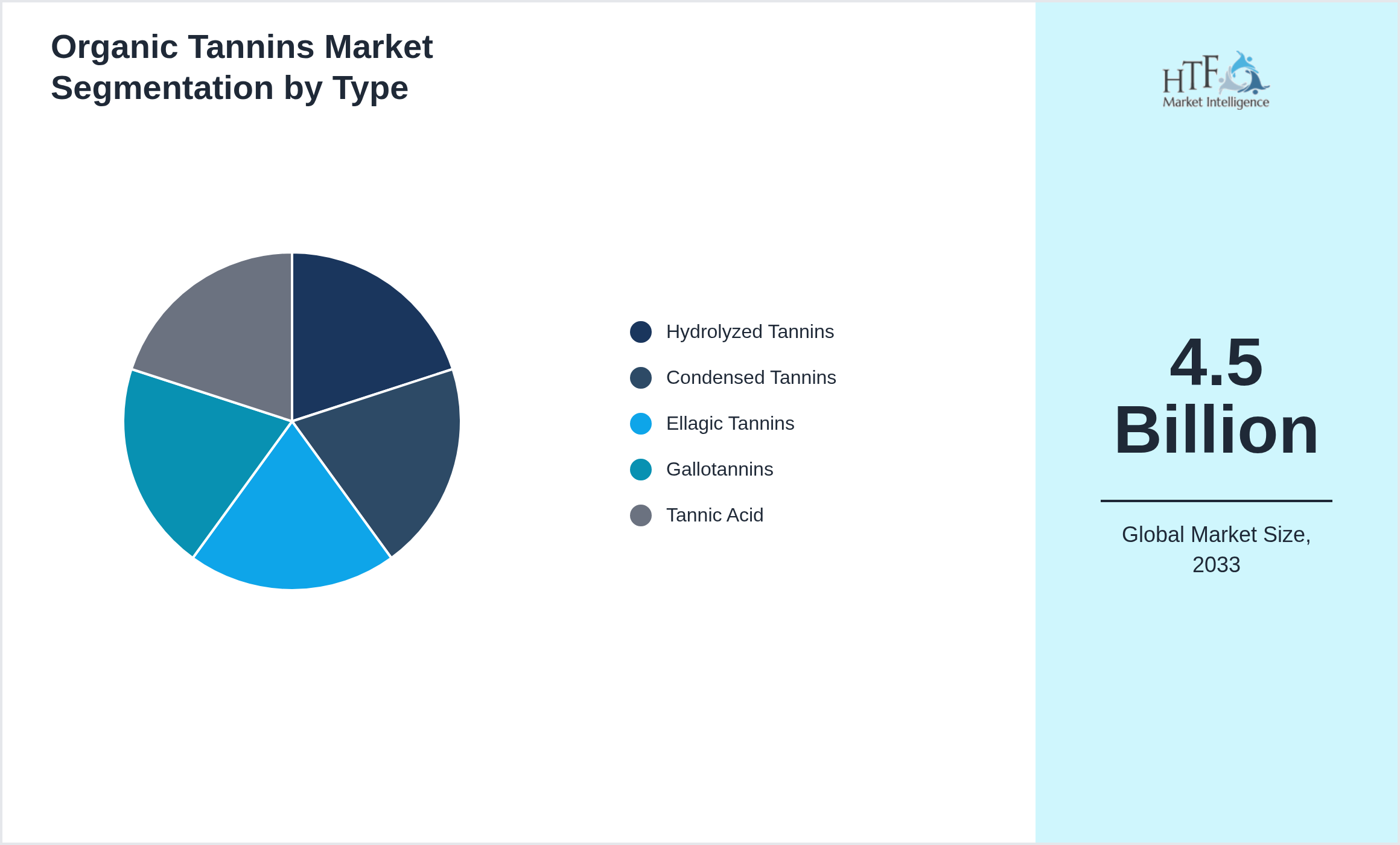
Segmentation by Type
- • Hydrolyzed Tannins
- • Condensed Tannins
- • Ellagic Tannins
- • Gallotannins
- • Tannic Acid
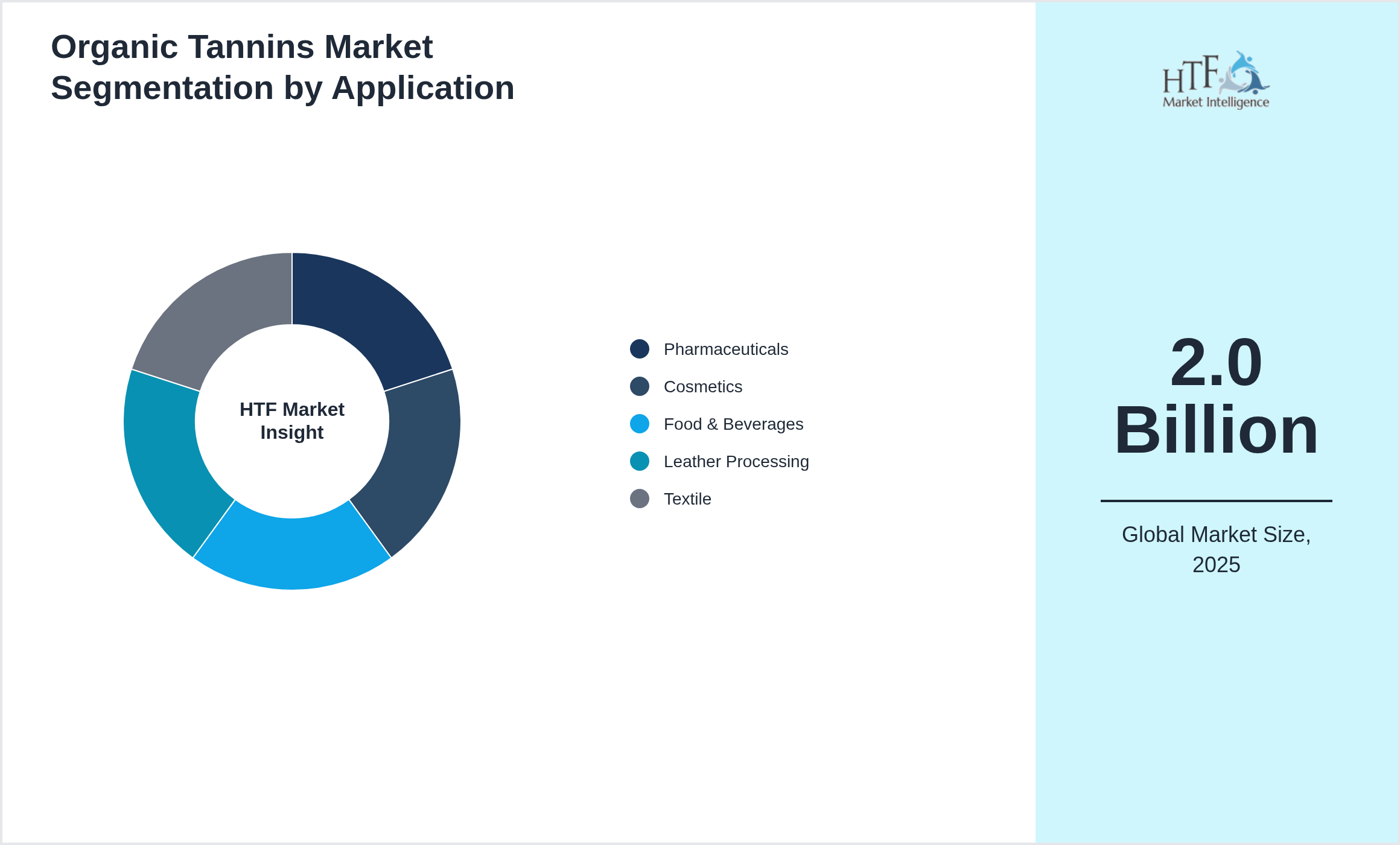
Segmentation by Application
- • Pharmaceuticals
- • Cosmetics
- • Food & Beverages
- • Leather Processing
- • Textile
Key Players
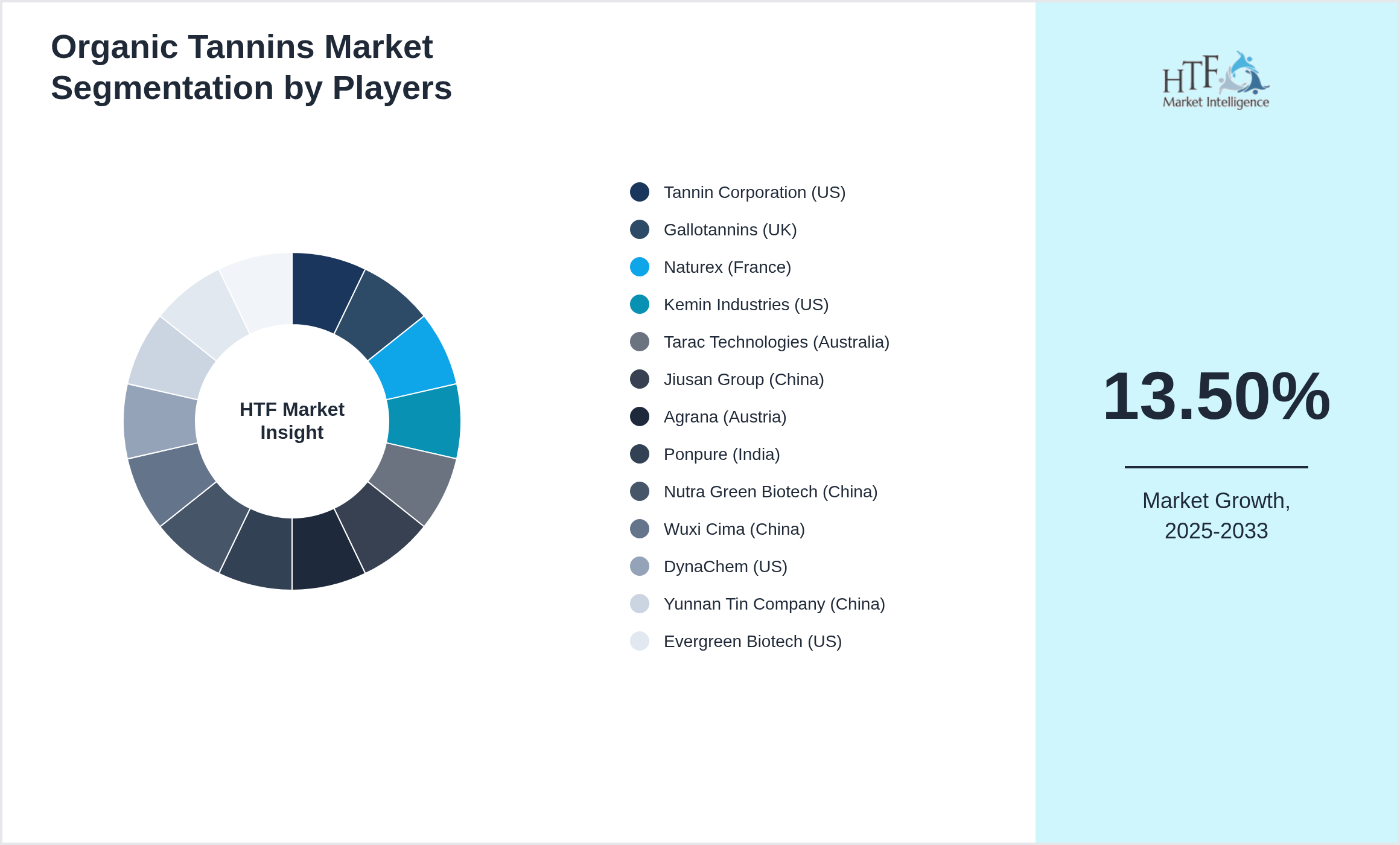
The companies featured in this profile were selected based on insights from primary experts, evaluating their market penetration, product offerings, and geographical reach. By targeting emerging markets, these companies aim to leverage new opportunities, enhance their competitive advantage, and drive revenue growth. This approach not only aligns with their overall business objectives but also positions them to respond effectively to the evolving demands of consumers in these regions. Several key players in the Organic Tannins market are strategically focusing on expanding their operations in developing regions to capture a larger market share, particularly as the year-on-year growth rate for the market stands at 10.60%.
- • Tannin Corporation (US)
- • Gallotannins (UK)
- • Naturex (France)
- • Kemin Industries (US)
- • Tarac Technologies (Australia)
- • Jiusan Group (China)
- • Agrana (Austria)
- • Ponpure (India)
- • Nutra Green Biotech (China)
- • Wuxi Cima (China)
- • DynaChem (US)
- • Yunnan Tin Company (China)
- • Evergreen Biotech (US)
- • Biolife (China)
Regional Insight
The North America dominant region currently dominates the market share, fueled by increasing consumption, population growth, and sustained economic progress, which collectively enhance market demand. Conversely, the Asia Pacific is growing rapidly, driven by significant infrastructure investments, industrial expansion, and rising consumer demand.
- North America
- LATAM
- West Europe
- Central & Eastern Europe
- Northern Europe
- Southern Europe
- East Asia
- Southeast Asia
- South Asia
- Central Asia
- Oceania
- MEA
- • Organic Tannins
Market Entropy
Merger & Acquisition
- • March 2023: TanninTech acquired by NutraChem
Patent Analysis
- • Regulations on the use of natural additives
Investment and Funding Scenario
- • Patents focus on the extraction
Report Infographics
| Report Features | Details |
| Base Year | 2025 |
| Based Year Market Size (2025) | 2.0 Billion |
| Historical Period | 2020 to 2025 |
| CAGR (2025 to 2033) | 13.50% |
| Forecast Period | 2026 to 2033 |
| Forecasted Period Market Size (2033) | 4.5 Billion |
| Scope of the Report |
By Type, By Application, By Region |
| Companies Covered | Tannin Corporation (US), Gallotannins (UK), Naturex (France), Kemin Industries (US), Tarac Technologies (Australia), Jiusan Group (China), Agrana (Austria), Ponpure (India), Nutra Green Biotech (China), Wuxi Cima (China), DynaChem (US), Yunnan Tin Company (China), Evergreen Biotech (US), Biolife (China) |
| Customization Scope | 15% Free Customization
Want to Buy Specific Sections of This Report?
|
| Delivery Format | PDF and Excel through Email |
The Top-Down and Bottom-Up Approaches
The top-down approach begins with a broad theory or hypothesis and breaks it down into specific components for testing. This structured, deductive process involves developing a theory, creating hypotheses, collecting and analyzing data, and drawing conclusions. It is particularly useful when there is substantial theoretical knowledge, but it can be rigid and may overlook new phenomena.
Conversely, the bottom-up approach starts with specific data or observations, from which broader generalizations and theories are developed. This inductive process involves collecting detailed data, analyzing it for patterns, developing hypotheses, formulating theories, and validating them with additional data. While this approach is flexible and encourages the discovery of new phenomena, it can be time-consuming and less structured.
Regulatory Framework
The healthcare sector is overseen by various regulatory bodies that ensure the safety, quality, and efficacy of health services and products. In the United States, the U.S. Department of Health and Human Services (HHS) plays a crucial role in protecting public health and providing essential human services. Within HHS, the Food and Drug Administration (FDA) regulates food, drugs, and medical devices, ensuring they meet safety and efficacy standards. The Centers for Disease Control and Prevention (CDC) focuses on disease control and prevention, conducting research, and providing health information to protect public health.
Research enthusiast focused on transforming data uncovering into actionable insights through data-driven decision-making.