
Global AI-Driven Health Insurance Analytics Market - Global Outlook 2020-2033
Global AI-Driven Health Insurance Analytics Market is segmented by Application (Payer Systems, Hospital Networks, Health Analytics Firms, Government Health Programs, Insurtech Platforms), Type (Predictive Analytics, Fraud Detection, Claims Optimization, Risk Stratification, AI-Driven Underwriting), and Geography (North America, LATAM, West Europe, Central & Eastern Europe, Northern Europe, Southern Europe, East Asia, Southeast Asia, South Asia, Central Asia, Oceania, MEA)
Pricing
Report Overview
Industry Overview
The North America, LATAM, West Europe, Central & Eastern Europe, Northern Europe, Southern Europe, East Asia, Southeast Asia, South Asia, Central Asia, Oceania, MEA AI-Driven Health Insurance Analytics market was valued at 4.8 billion in 2024 and is expected to reach 14.2 billion by 2020, growing at a compound annual growth rate (CAGR) of 14.60% over the forecast period.
AI-driven health insurance analytics uses artificial intelligence to analyze large datasets for predicting health risks, detecting fraud, and optimizing claim processes. By integrating real-time analytics and predictive modeling, insurers improve cost efficiency, risk assessment accuracy, and customer satisfaction. It enables insurers to tailor policies, reduce operational inefficiencies, and enhance health outcomes. This technology transforms traditional insurance systems into adaptive, data-driven ecosystems.
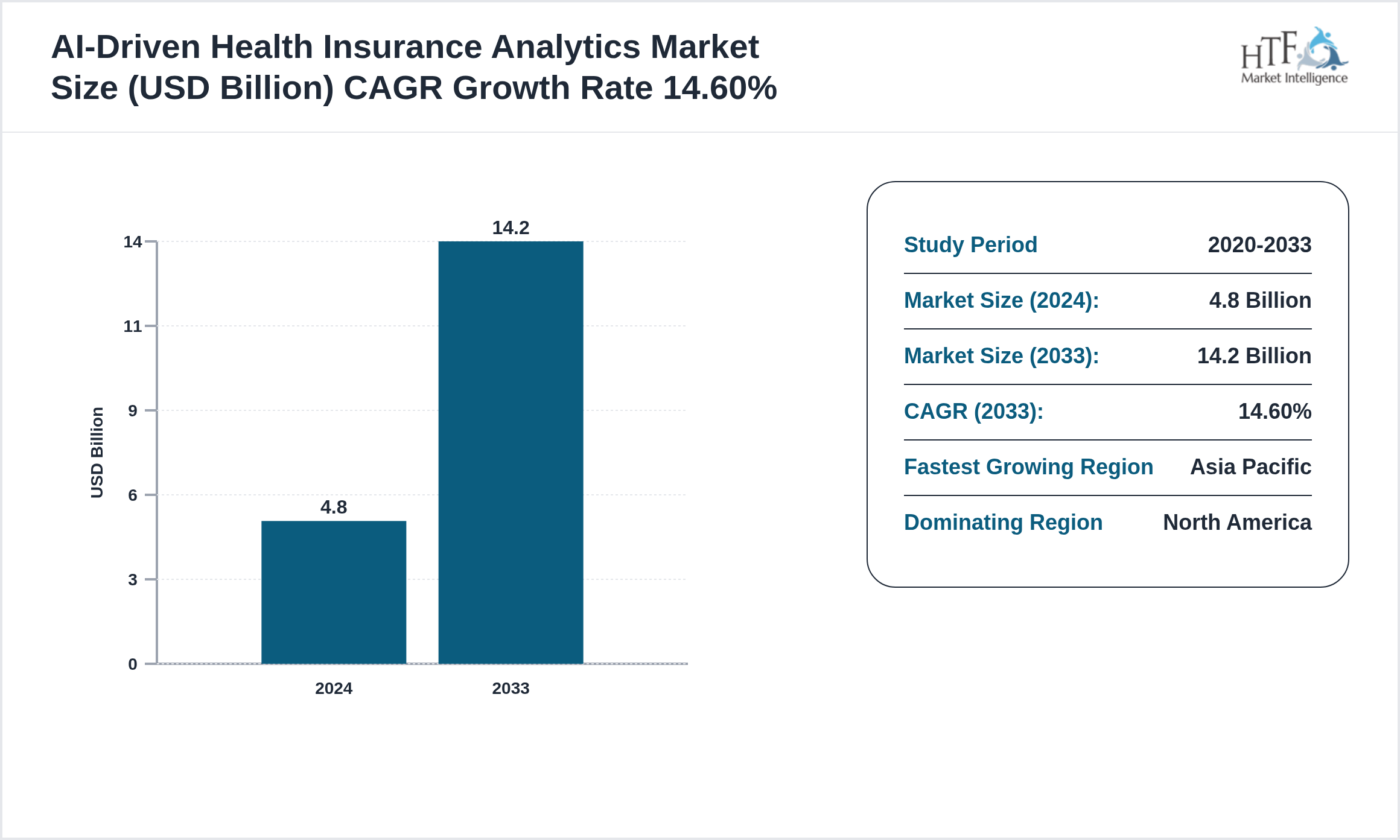
Source: HTF Market Intelligence (HTF MI)
The North America, LATAM, West Europe, Central & Eastern Europe, Northern Europe, Southern Europe, East Asia, Southeast Asia, South Asia, Central Asia, Oceania, MEA insurance industry is a cornerstone of economic stability, offering risk management solutions across various sectors, including life, health, property, and casualty. The industry is undergoing a transformative phase, driven by technological advancements such as artificial intelligence, automation, and digital platforms. These innovations are reshaping customer expectations, pushing insurers to enhance user experiences through personalized policies and faster claims processing.
AI-Driven Health Insurance Analytics Market Dynamics
Influencing Trend:
- • AI integration with health data
- • Cloud-based analytics platforms
- • Real-time decision support
- • Regulatory-driven AI adoption
- • Personalized policy pricing
- • Growing adoption of AI in risk prediction
- • Rising healthcare data availability
- • Need to curb fraud
- • Efficiency in claims management
- • Value-based healthcare transformation
- • Data privacy concerns
- • Integration with legacy systems
- • High implementation cost
- • Lack of skilled professionals
- • Complex regulatory frameworks
- • AI for fraud detection
- • Advanced health risk modeling
- • Expansion in emerging markets
- • Predictive wellness analytics
- • Partnerships between payers and AI vendors
If you need any specifications, please suggest
Regional Insight
The North America currently holds a significant share of the market, primarily due to several key factors: increasing consumption rates, a burgeoning population, and robust economic momentum. These elements collectively drive demand, positioning this region as a leader in the market. On the other hand, Asia Pacific is rapidly emerging as the fastest-growing area within the industry. This remarkable growth can be attributed to swift infrastructure development, the expansion of various industrial sectors, and a marked increase in consumer demand. These dynamics make this region a crucial player in shaping future market growth. In our report, we cover a comprehensive analysis of the regions and countries, including
- North America
- LATAM
- West Europe
- Central & Eastern Europe
- Northern Europe
- Southern Europe
- East Asia
- Southeast Asia
- South Asia
- Central Asia
- Oceania
- MEA
Market Segmentation
Segmentation by Type
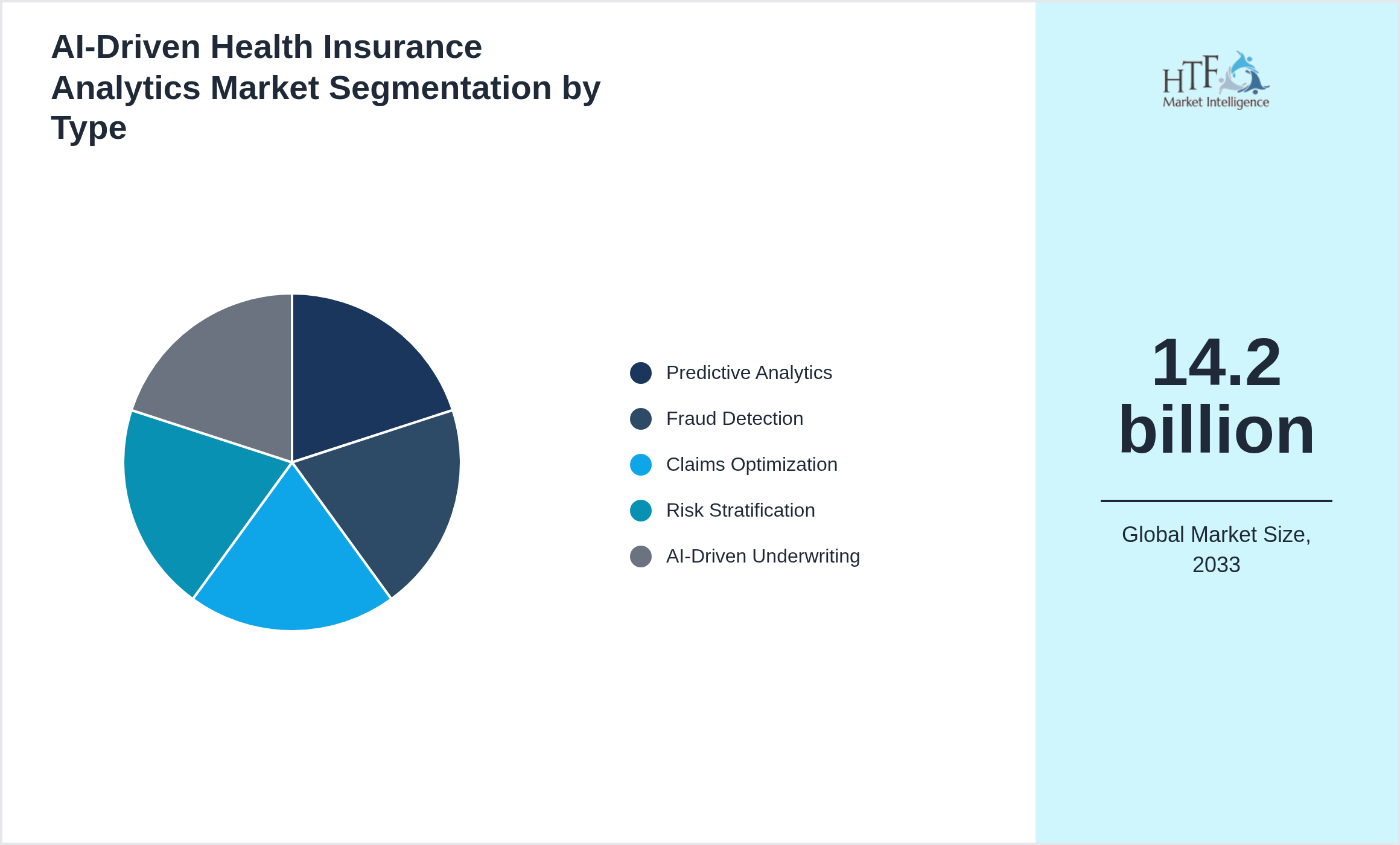
- • Predictive Analytics
- • Fraud Detection
- • Claims Optimization
- • Risk Stratification
- • AI-Driven Underwriting
Segmentation by Application
Segmentation by Application
- • Payer Systems
- • Hospital Networks
- • Health Analytics Firms
- • Government Health Programs
- • Insurtech Platforms
![AI-Driven Health Insurance Analytics Market trend by end use applications [Payer Systems, Hospital Networks, Health Analytics Firms, Government Health Programs, Insurtech Platforms]](https://htf-insight.s3.us-east-1.amazonaws.com/generated-charts/chart-pie-and-donut-chart-application-4393845-na-1762009521269-1762009526566-3c95a0b96917c86f.png)
Key Players
The companies highlighted in this profile were selected based on insights from primary experts and an evaluation of their market penetration, product offerings, and geographical reach.
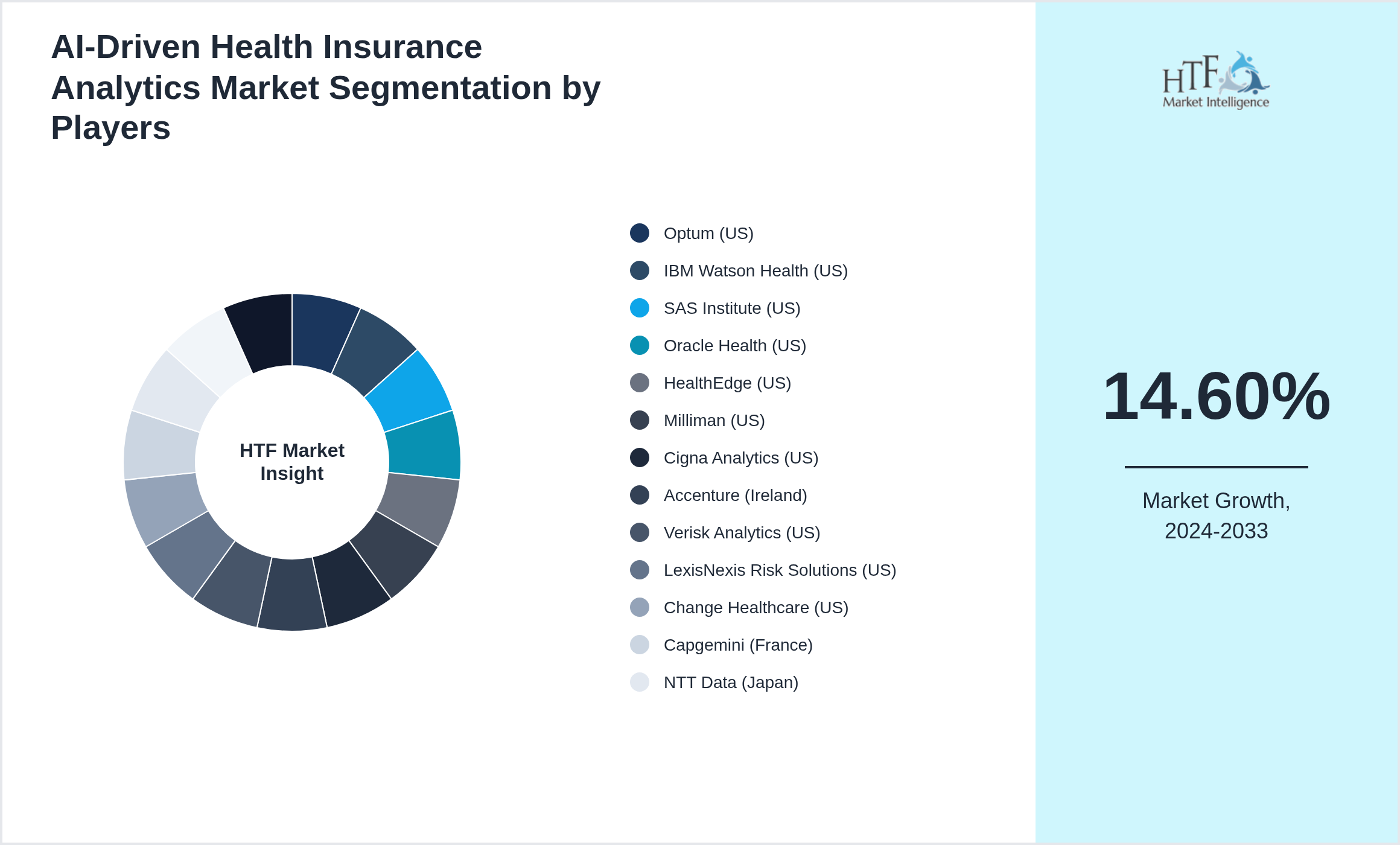
- • Optum (US)
- • IBM Watson Health (US)
- • SAS Institute (US)
- • Oracle Health (US)
- • HealthEdge (US)
- • Milliman (US)
- • Cigna Analytics (US)
- • Accenture (Ireland)
- • Verisk Analytics (US)
- • LexisNexis Risk Solutions (US)
- • Change Healthcare (US)
- • Capgemini (France)
- • NTT Data (Japan)
- • Tata Consultancy Services (India)
- • Cognizant (US)
{
Market Entropy
Marger & Acquisition
Regulatory Landscape
Patent Analysis
Investment Funding
Regional Analysis
Market Highlights
|
Report Features |
Details |
|
Base Year |
2024 |
|
Based Year Market Size |
4.8 billion |
|
Historical Period |
2020 |
|
CAGR (2024to 2033) |
14.60% |
|
Forecast Period |
2033 |
|
Forecasted Period Market Size (2033) |
14.2 billion |
|
Scope of the Report |
By |
|
Companies Covered |
Optum (US), IBM Watson Health (US), SAS Institute (US), Oracle Health (US), HealthEdge (US), Milliman (US), Cigna Analytics (US), Accenture (Ireland), Verisk Analytics (US), LexisNexis Risk Solutions (US), Change Healthcare (US), Capgemini (France), NTT Data (Japan), Tata Consultancy Services (India), Cognizant (US) |
|
Companies Covered |
Optum (US), IBM Watson Health (US), SAS Institute (US), Oracle Health (US), HealthEdge (US), Milliman (US), Cigna Analytics (US), Accenture (Ireland), Verisk Analytics (US), LexisNexis Risk Solutions (US), Change Healthcare (US), Capgemini (France), NTT Data (Japan), Tata Consultancy Services (India), Cognizant (US) |
|
Customization Scope |
15% Free Customization (For EG) |
|
Delivery Format |
PDF and Excel through Email |
Research Methodology
The research methodology for studying the insurance industry combines both qualitative and quantitative approaches. It begins with secondary research, gathering data from industry reports, government publications, and regulatory filings to understand market trends and dynamics. This is followed by primary research, involving interviews and surveys with industry stakeholders, such as insurers and regulators, to capture insights on market challenges and customer behavior. Quantitative analysis includes examining market size, growth rates, and segmentation by product type and geography. Competitive analysis and trend evaluation are conducted to assess key players and emerging industry shifts, culminating in forecasts and actionable insights for strategic planning.