
Airport Navigation Apps Market - Global Growth Opportunities 2020-2033
Global Airport Navigation Apps Market is segmented by Application (Passenger guidance), Type (Indoor maps, AR navigation, AI routing, Accessibility apps, Multilingual), and Geography (North America, LATAM, West Europe, Central & Eastern Europe, Northern Europe, Southern Europe, East Asia, Southeast Asia, South Asia, Central Asia, Oceania, MEA)
Pricing
Report Overview
Key Values Provided by a Airport Navigation Apps Market
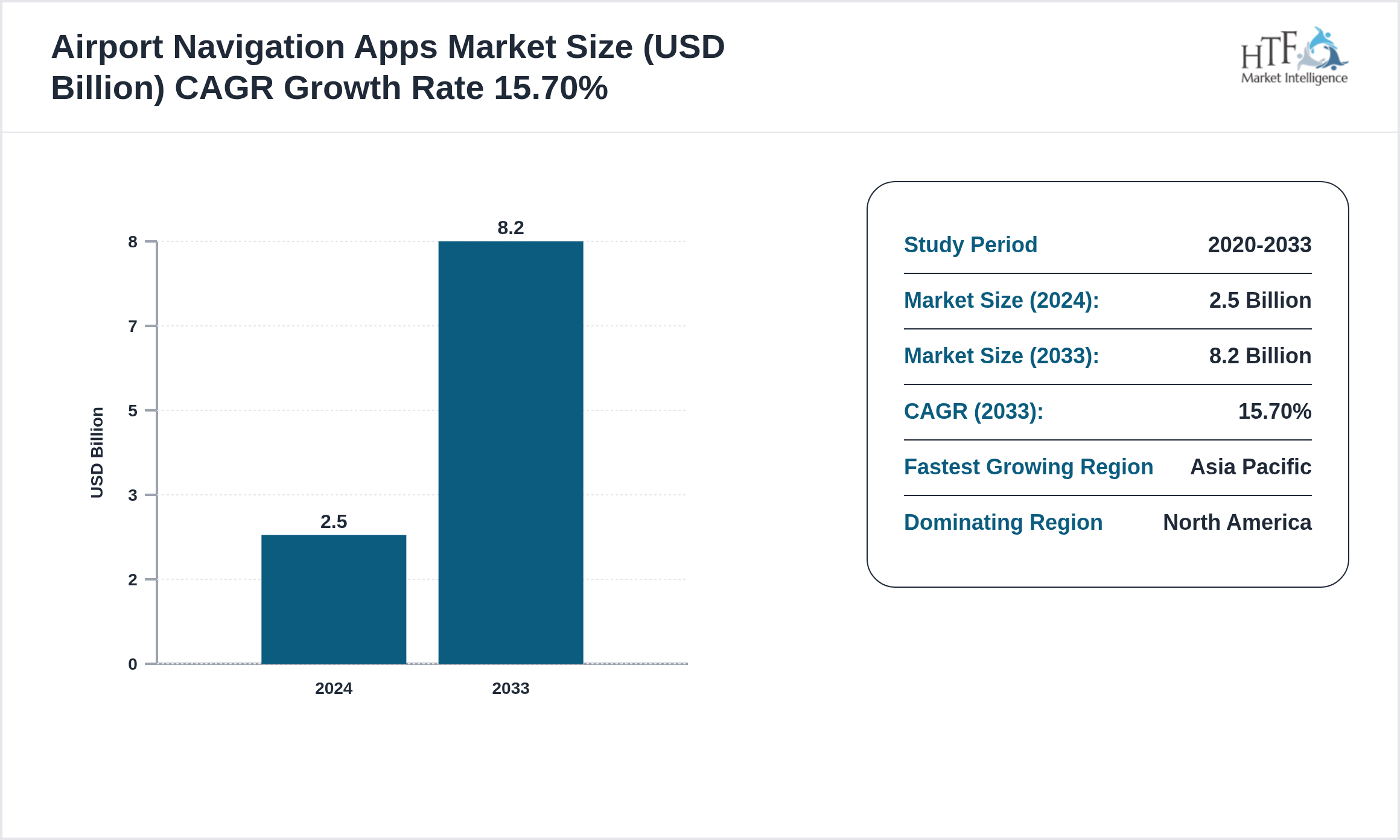
The Airport Navigation Apps market was valued at 2.5 billion in 2024 and is expected to reach 8.2 billion by 2020, growing at a compound annual growth rate (CAGR) of 15.70% over the forecast period.
Airport Navigation Apps are intelligent mobile and digital wayfinding platforms designed to assist passengers in navigating airport terminals, boarding gates, retail zones, lounges, transportation hubs, and security checkpoints through real-time mapping and location-based services. These applications integrate indoor positioning systems, GPS technologies, AI-driven recommendations, augmented reality guidance, multilingual support, and cloud-based passenger engagement systems to enhance traveler convenience and airport operational coordination. The market includes mobile airport assistant applications, beacon-enabled navigation systems, digital terminal mapping software, smart passenger communication tools, and integrated airport mobility platforms. Increasing airport complexity, rising international passenger volumes, and demand for personalized travel experiences are driving investment in advanced navigation ecosystems. AI-powered route optimization, real-time crowd monitoring, retail recommendation engines, and flight synchronization capabilities are enabling airports to improve passenger flow management, reduce missed connections, and increase commercial revenue generation from retail and hospitality services
Source: HTF Market Intelligence (HTF MI)
A Airport Navigation Apps market research study provides invaluable data-driven insights that allow businesses to make informed decisions based on accurate market trends, customer behaviors, and competitor analysis. These reports help organizations better understand the evolving needs of their target audience, enabling more customer-focused strategies.
Market Dynamics
Influencing Trend:
- • Indoor positioning technologies AI-based route optimization and augmented reality navigation features are emerging as major trends within airport navigation apps. Airports increasingly integrate real-time crowd monitoring multilingual assistance and personalized travel recommendations into digital navigation platforms. Beacon technology Bluetooth-based positioning systems and cloud-connected passenger analytics improve navigation accuracy and operational insights. Integration with airport retail systems food ordering platforms and transportation booking services creates a more connected passenger ecosystem. Voice-guided navigation biometric-linked passenger journeys and predictive delay notifications are becoming increasingly common across smart airport applications
- • Increasing airport complexity rising passenger expectations for seamless travel experiences and growing smartphone usage are major factors driving airport navigation app adoption globally. Airports increasingly deploy digital wayfinding solutions to reduce passenger confusion improve terminal efficiency and enhance customer satisfaction. Demand for real-time navigation gate updates and location-based services has increased significantly as airports expand terminal infrastructures and passenger volumes. Airlines and airport operators also benefit from improved passenger flow management reduced missed flights and enhanced commercial engagement through integrated retail and service recommendations within navigation platforms
- • Infrastructure limitations indoor positioning inaccuracies and cybersecurity concerns create significant challenges for airport navigation app deployment. Large and crowded airport environments can reduce location tracking accuracy and negatively impact user experience. Integration with existing airport IT systems and real-time operational databases often requires substantial investment and technical coordination. Passenger concerns regarding location tracking and personal data collection create privacy-related adoption barriers. Frequent airport layout changes multilingual support requirements and continuous software updates further increase operational complexity. Competition from airline-specific applications and inconsistent internet connectivity within airport terminals also affect widespread platform utilization
- • Expansion of smart airport ecosystems increasing international travel and rising investments in passenger digitalization create strong growth opportunities for airport navigation app developers. Airports in emerging markets upgrading infrastructure and passenger engagement systems present significant untapped deployment potential. Integration with retail advertising loyalty programs and premium concierge services creates new monetization opportunities for application providers. Growth in AI-powered personalization and predictive passenger assistance enhances value-added service potential. Partnerships with airlines mobility service providers and hospitality companies further expand integrated travel ecosystem opportunities while supporting long-term user engagement and recurring digital revenue generation
The North America Dominant Region currently dominates the market share, fueled by increasing consumption, population growth, and sustained economic progress, which collectively enhance market demand. Conversely, the {FASTEST GROWING REGION} is rapidly becoming the fastest-growing region, driven by significant infrastructure investments, industrial expansion, and rising consumer demand.
- North America
- LATAM
- West Europe
- Central & Eastern Europe
- Northern Europe
- Southern Europe
- East Asia
- Southeast Asia
- South Asia
- Central Asia
- Oceania
- MEA
Competitive Insights
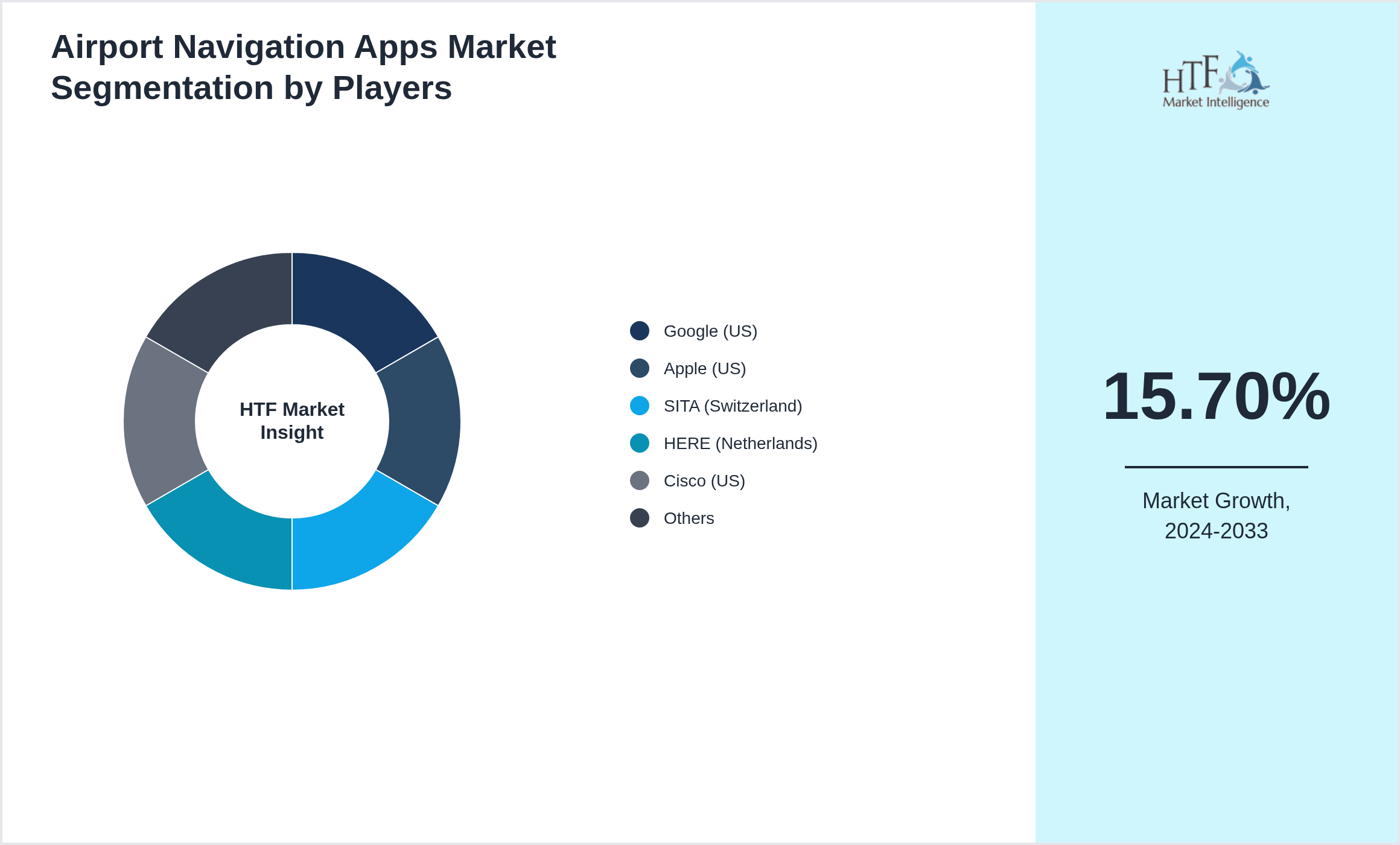
The key players in the Airport Navigation Apps are intensifying their focus on research and development (R&D) activities to innovate and stay competitive. Major companies, such as Google (US), Apple (US), SITA (Switzerland), HERE (Netherlands), Cisco (US), Huawei (China), Siemens (Germany), Indra (Spain), NEC (Japan), IBM (US), Accenture (Ireland), Samsung (Korea), LG (Korea), Amadeus (Spain), Thales (France), are heavily investing in R&D to develop new products and improve existing ones. This strategic emphasis on innovation drives significant advancements in product formulation and the introduction of sustainable and eco-friendly products.
Moreover, these established industry leaders are actively pursuing acquisitions of smaller companies to expand their regional presence and enhance their market share. These acquisitions not only help in diversifying their product portfolios but also provide access to new technologies and markets. This consolidation trend is a critical factor in the growth of the consumer goods industry, as it enables larger companies to streamline operations, reduce costs, and increase their competitive edge.
The companies highlighted in this profile were selected based on insights from primary experts and an evaluation of their market penetration, product offerings, and geographical reach:
- • Google (US)
- • Apple (US)
- • SITA (Switzerland)
- • HERE (Netherlands)
- • Cisco (US)
- • Huawei (China)
- • Siemens (Germany)
- • Indra (Spain)
- • NEC (Japan)
- • IBM (US)
- • Accenture (Ireland)
- • Samsung (Korea)
- • LG (Korea)
- • Amadeus (Spain)
- • Thales (France)
Key Highlights
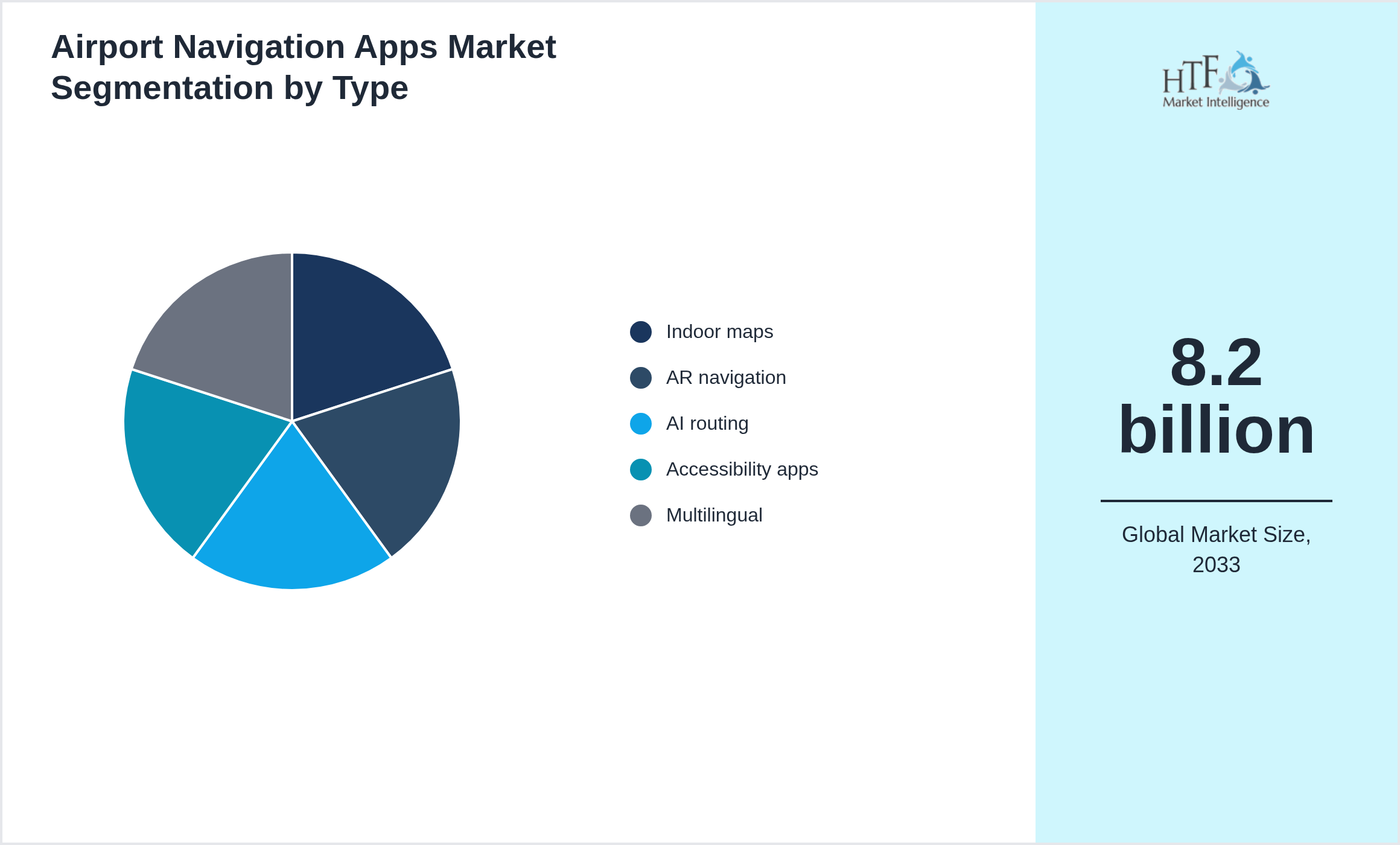
Segmentation by Type
- • Indoor maps
- • AR navigation
- • AI routing
- • Accessibility apps
- • Multilingual
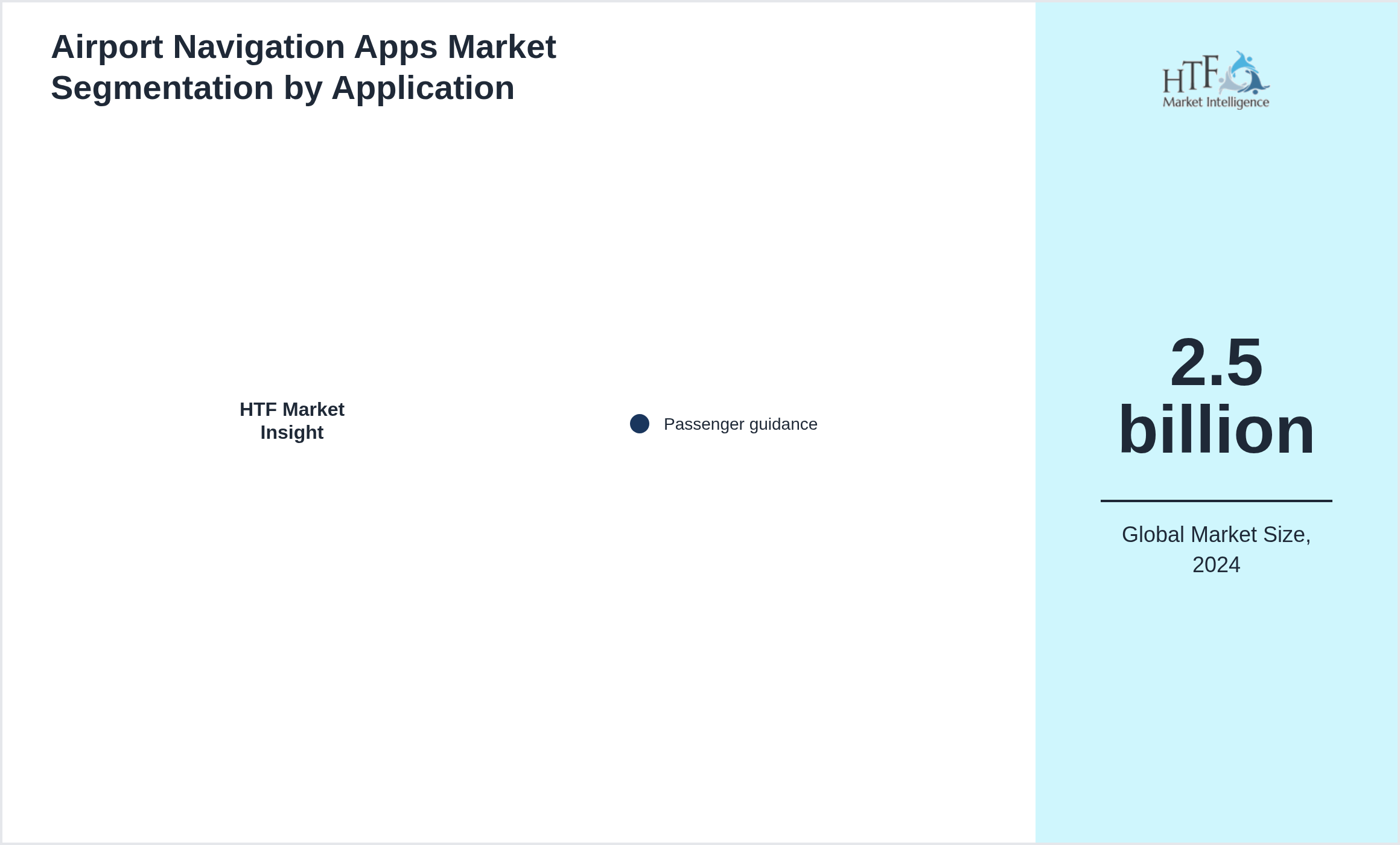
Segmentation by Application
- • Passenger guidance
Market Entropy
- • Q7 2025: AI-based indoor navigation and location tracking improved passenger routing efficiency by 30% and reduced missed flights
- • Q6 2025: Investment in real-time push notifications enhanced commercial revenue through personalized retail offers
- • Q5 2025: Production modernization of app features improved multi-terminal coverage and app responsiveness by 22%
- • Q4 2025: Regulatory compliance with data privacy and geolocation standards increased adoption confidence
- • Q3 2025: Operational optimization with dynamic routing and queue prediction improved passenger flow and satisfaction
- • Q2 2025: Sustainability initiatives included paperless navigation guides and reduced terminal signage dependency
- • Q1 2025: Industry-wide operational shifts toward mobile-first solutions increased engagement enhanced passenger experience and enabled digital transformation of airport services
Merger & Acquisition
- • Jan 2026 – A travel mobility software company acquired an indoor mapping technology provider specializing in airport navigation applications to strengthen its digital passenger assistance portfolio. The acquisition included AI-powered wayfinding engines augmented reality terminal guidance systems and personalized route optimization tools for travelers. The combined entity announced plans to integrate real-time crowd analytics and multilingual digital assistance features into major airport applications. In Apr 2026 a strategic partnership was established between an airport authority consortium and a location intelligence platform developer to deploy next-generation navigation applications across international aviation hubs. The collaboration focused on improving accessibility guidance gate change notifications and retail engagement opportunities through smart mobile ecosystems. Regional app developers also pursued acquisitions of data analytics startups to strengthen passenger behavior insights and improve personalized airport experiences. Industry analysts indicated that rising smartphone penetration and demand for seamless traveler assistance were fueling investment and consolidation activity across the market. These mergers and partnerships are expected to enhance airport digital connectivity improve traveler navigation efficiency and increase commercial engagement opportunities for airport operators
Regulatory Landscape
- • Airport Navigation Apps are regulated through consumer data privacy laws digital accessibility requirements cybersecurity standards and location-tracking compliance frameworks. Airports deploying indoor navigation technologies must ensure secure management of passenger location data and compliance with accessibility mandates for disabled travelers. Sustainability initiatives promoting optimized passenger flow and reduced congestion are encouraging investment in smart mobility applications. Dependence on high-speed wireless infrastructure beacon technology and cloud-based analytics creates operational vulnerability to network outages and cybersecurity risks. Trade restrictions on mobile hardware components and location-tracking technologies can influence deployment costs and scalability. Continuous software updates multilingual integration requirements and compatibility with airline systems increase operational expenditures but improve long-term user engagement and commercial monetization opportunities. Profitability is supported by integration with airport retail analytics targeted advertising and premium passenger services strengthening long-term digital infrastructure investment
Patent Analysis
- • Airport Navigation Apps market participants actively pursue trademark protection for indoor mapping platforms smart traveler guidance systems multilingual airport assistant applications and AI-powered passenger navigation services to enhance brand visibility in digital aviation ecosystems. Patent filings are increasingly concentrated around real-time indoor positioning systems augmented reality navigation overlays Bluetooth beacon integration predictive route optimization engines crowd-density tracking technologies and AI-based traveler assistance algorithms that improve terminal mobility and operational efficiency. Copyright activities heavily involve digital airport maps user interface designs real-time flight visualization systems voice-guided navigation software and personalized traveler recommendation engines integrated within mobile applications. Companies also protect proprietary data integration frameworks connecting retail locations boarding gates transportation hubs and airport security checkpoints into unified passenger mobility platforms. The growth of smart airports has further increased software-related patents for location-aware advertising systems accessibility-focused navigation tools and contextual travel notification technologies. Industry players continuously monitor unauthorized replication of mobile interface designs mapping assets and software architectures as competition intensifies within connected airport ecosystems
Investment and Funding Scenario
- • Investment activity in the Airport Navigation Apps market has expanded significantly as airports accelerate digital transformation initiatives aimed at improving passenger mobility
Competitive Innovation Radar
- • The Google ranking booster market is evolving from keyword-centric optimization toward AI-powered search visibility intelligence platforms integrating predictive ranking algorithms
The Top-Down and Bottom-Up Approaches
The top-down approach begins with a broad theory or hypothesis and breaks it down into specific components for testing. This structured, deductive process involves developing a theory, creating hypotheses, collecting and analyzing data, and drawing conclusions. It is particularly useful when there is substantial theoretical knowledge, but it can be rigid and may overlook new phenomena.
Conversely, the bottom-up approach starts with specific data or observations, from which broader generalizations and theories are developed. This inductive process involves collecting detailed data, analyzing it for patterns, developing hypotheses, formulating theories, and validating them with additional data. While this approach is flexible and encourages the discovery of new phenomena, it can be time-consuming and less structured.
Swot and Pestel Analysis
SWOT Analysis
A SWOT analysis evaluates a company’s internal strengths and weaknesses, as well as external opportunities and threats. This Airport Navigation Apps analysis helps businesses identify their competitive advantages, address internal challenges, and seize external opportunities while mitigating potential risks. It is performed to gain a comprehensive understanding of the organization's position in the market, align strategies with its strengths, and effectively navigate competitive landscapes.
PESTEL Analysis
Political, economic, social, technological, environmental, and legal factors impacting the business environment. This analysis helps organizations anticipate external changes, adapt strategies to macroeconomic trends, and ensure compliance with regulatory requirements. It is crucial for understanding the external forces that could influence business operations and for planning long-term strategies that align with evolving market conditions.
Report Infographics:
| Report Features | Details |
| Base Year | 2024 |
| Based Year Market Size 2024 | 2.5 billion |
| Historical Period | 2020 |
| CAGR (2024 to 2033) | 15.70% |
| Forecast Period | 2033 |
| Forecasted Period Market Size (2033) | 8.2 billion |
| Scope of the Report | By Type, By Application, By Sales Channel, By Region |
| Quantitative Units |
Revenue in USD million/billion, volume in kilotons, and CAGR from 2024 to 2033 |
| Companies Covered | Google (US), Apple (US), SITA (Switzerland), HERE (Netherlands), Cisco (US), Huawei (China), Siemens (Germany), Indra (Spain), NEC (Japan), IBM (US), Accenture (Ireland), Samsung (Korea), LG (Korea), Amadeus (Spain), Thales (France) |
| Customization Scope | 15% Free Customization (For example)
Want to Buy Specific Sections of This Report?
|
| Delivery Format | PDF and Excel through Email |