
Professional Swim School Software Market - Global Share, Size & Changing Dynamics 2020-2033
Global Professional Swim School Software Market is segmented by Application (Swim Schools, Private Coaching, Competitive Training, Aquatic Centers, Community Programs), Type (Class Scheduling, Progress Tracking, Attendance Management, Payment Management, Reporting & Analytics), and Geography (North America, LATAM, West Europe, Central & Eastern Europe, Northern Europe, Southern Europe, East Asia, Southeast Asia, South Asia, Central Asia, Oceania, MEA)
Pricing
Report Overview
Key Aspects of the Market Report
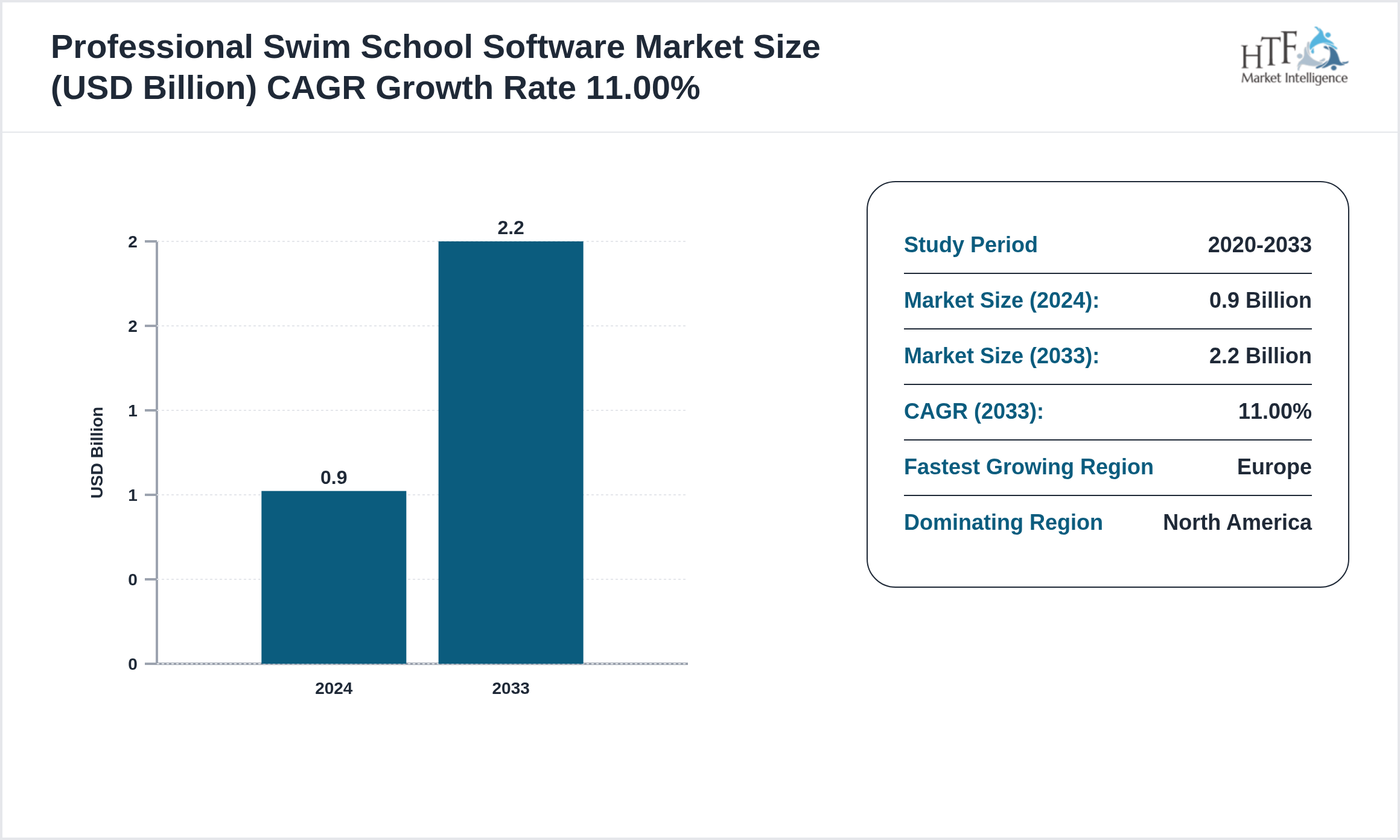
The Professional Swim School Software is growing at 11.00% and is expected to reach 2.2 billion by 2033. Below are some of the dynamics shaping the Professional Swim School Software.
Professional Swim School Software refers to specialized digital management platforms developed for swimming academies, aquatic training institutions, sports coaching centers, and recreational swimming facilities to automate operational workflows, scheduling, student enrollment, instructor management, attendance tracking, billing systems, performance analytics, and customer engagement processes. These platforms integrate cloud computing, AI-assisted scheduling, CRM functionalities, online booking systems, payment gateways, digital progress tracking, communication dashboards, and mobile application support to streamline administrative efficiency and improve customer experience. The market includes standalone software applications, SaaS-based swim management platforms, enterprise aquatic facility management solutions, analytics tools, and integrated sports training ecosystems used by commercial swim schools, fitness clubs, educational institutions, and municipal aquatic centers. Increasing digital transformation across sports education infrastructure, rising demand for automated operational management, expansion of online training ecosystems, and growing focus on personalized student performance tracking are driving market growth. Advanced technologies including predictive attendance analytics, AI-enabled learning assessments, wearable integration, automated notifications, and cloud-based multi-location management capabilities are enhancing scalability, operational optimization, and long-term business profitability for swim education service providers
Source: HTF Market Intelligence (HTF MI)
A Professional Swim School Software market research report effectively communicates vital insights through several key aspects. It begins with an executive summary that concisely outlines the findings, conclusions, and actionable recommendations, allowing stakeholders to quickly grasp essential information. Clearly stating the research objectives ensures the purpose and specific questions being addressed are understood. The methodology section describes the research methods employed, such as surveys or focus groups, and provides a rationale for their selection to establish credibility. A market overview presents the industry landscape, including market size, growth trends, and key drivers.
Additionally, the segmentation analysis examines distinct market segments to identify varied customer needs. The competitive analysis offers insights into major competitors, highlighting their strengths and weaknesses. Finally, the report concludes with key findings and insights, followed by conclusions and recommendations that provide actionable strategies to guide future business decisions.
Geographic Analysis of Professional Swim School Software
The Professional Swim School Software market exhibits significant regional variation, shaped by different economic conditions and consumer behaviors.
Currently, North America dominates the market due to high consumption, population growth, and sustained economic progress. Meanwhile, Europe is experiencing the fastest growth, driven by large-scale infrastructure investments, industrial development, and rising consumer demand.
- North America
- LATAM
- West Europe
- Central & Eastern Europe
- Northern Europe
- Southern Europe
- East Asia
- Southeast Asia
- South Asia
- Central Asia
- Oceania
- MEA
Professional Swim School Software Market Dynamics
Influencing Trend:
- • Cloud-based management platforms AI-powered scheduling systems and mobile-first customer engagement tools are major trends shaping the professional swim school software market. Software providers increasingly integrate automated billing digital waivers instructor management and real-time analytics into unified platforms. Contactless registration systems online learning modules and wearable performance tracking integration gain significant traction among modern swim schools. Subscription-based SaaS models and customizable dashboards improve accessibility for small and medium-sized aquatic training centers. Data-driven student progress analysis and predictive attendance management systems continue enhancing operational optimization and personalized learning experiences
Market Growth Drivers:
- • Increasing enrollment in swimming programs rising focus on water safety education and growing digitization of sports management operations strongly drive demand for professional swim school software. Swim schools increasingly adopt automated scheduling payment processing and student performance tracking systems to improve operational efficiency and customer engagement. Expansion of private aquatic training centers and competitive swimming academies further supports software adoption. Parents increasingly prefer digital communication platforms offering attendance monitoring progress reports and online class management. Growth in mobile-based administration tools and cloud-enabled educational systems continues accelerating market demand globally
Challenges:
- • High software implementation costs resistance to digital transformation and limited technical expertise among small swim schools create significant adoption challenges. Data privacy concerns and cybersecurity risks associated with customer information management increase regulatory complexity. Intense competition from generic sports management software providers pressures pricing strategies. Dependence on stable internet connectivity and ongoing software maintenance complicate usability in developing regions. Customization demands integration challenges with legacy systems and rising customer expectations for mobile functionality further increase operational and development costs
Opportunities:
- • Rapid expansion of organized aquatic education and increasing investment in sports training infrastructure create substantial growth opportunities for professional swim school software providers. Emerging markets with rising middle-class populations and growing emphasis on child safety education offer strong untapped demand potential. Product innovation in AI-assisted coaching analytics multilingual communication systems and virtual lesson management enables service differentiation. Partnerships with fitness clubs schools and municipal aquatic facilities further strengthen enterprise adoption opportunities. Integration with wearable fitness devices and online certification systems creates additional recurring revenue streams for software vendors
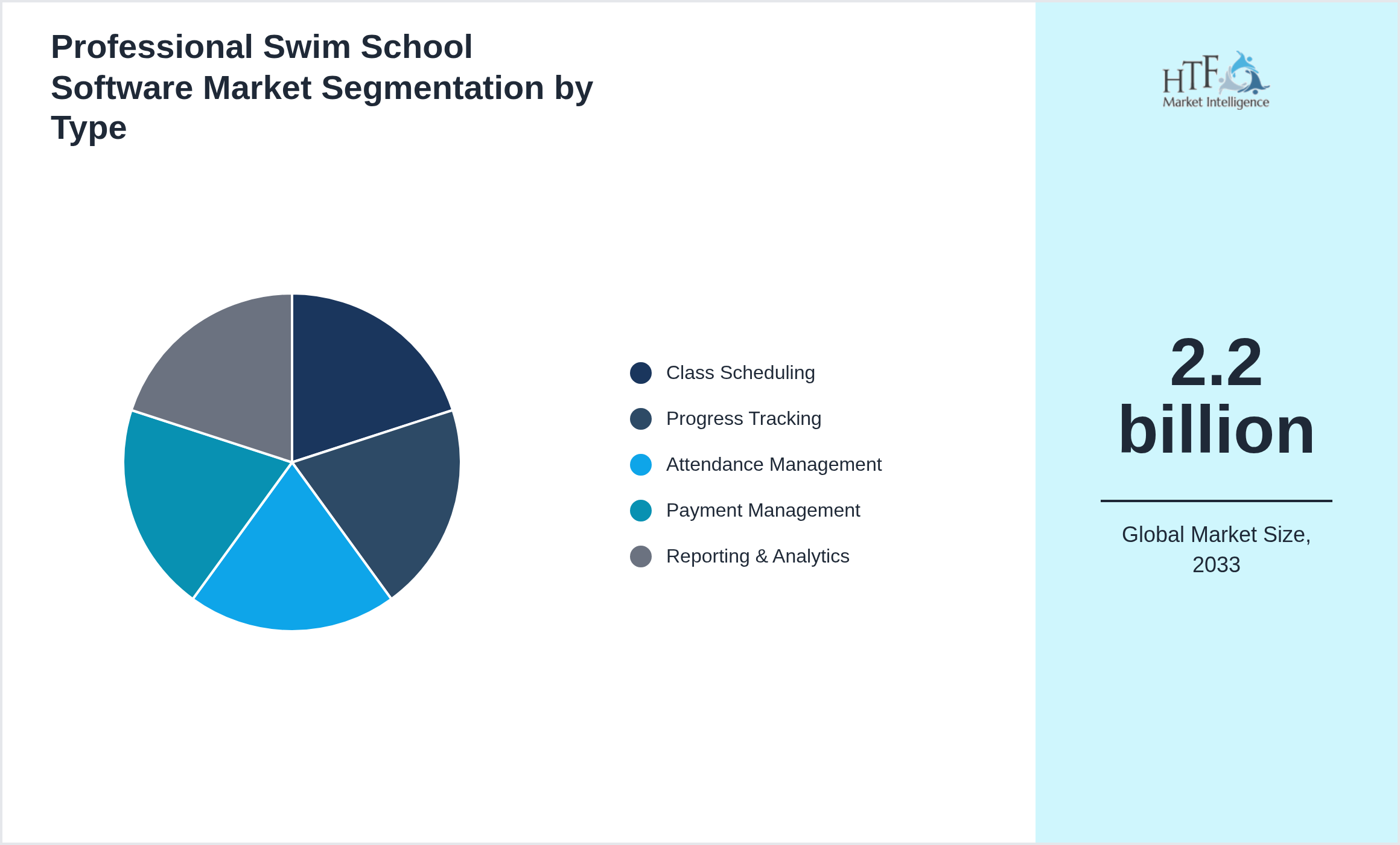
Segmentation by Type
- • Class Scheduling
- • Progress Tracking
- • Attendance Management
- • Payment Management
- • Reporting & Analytics
Segmentation by Application
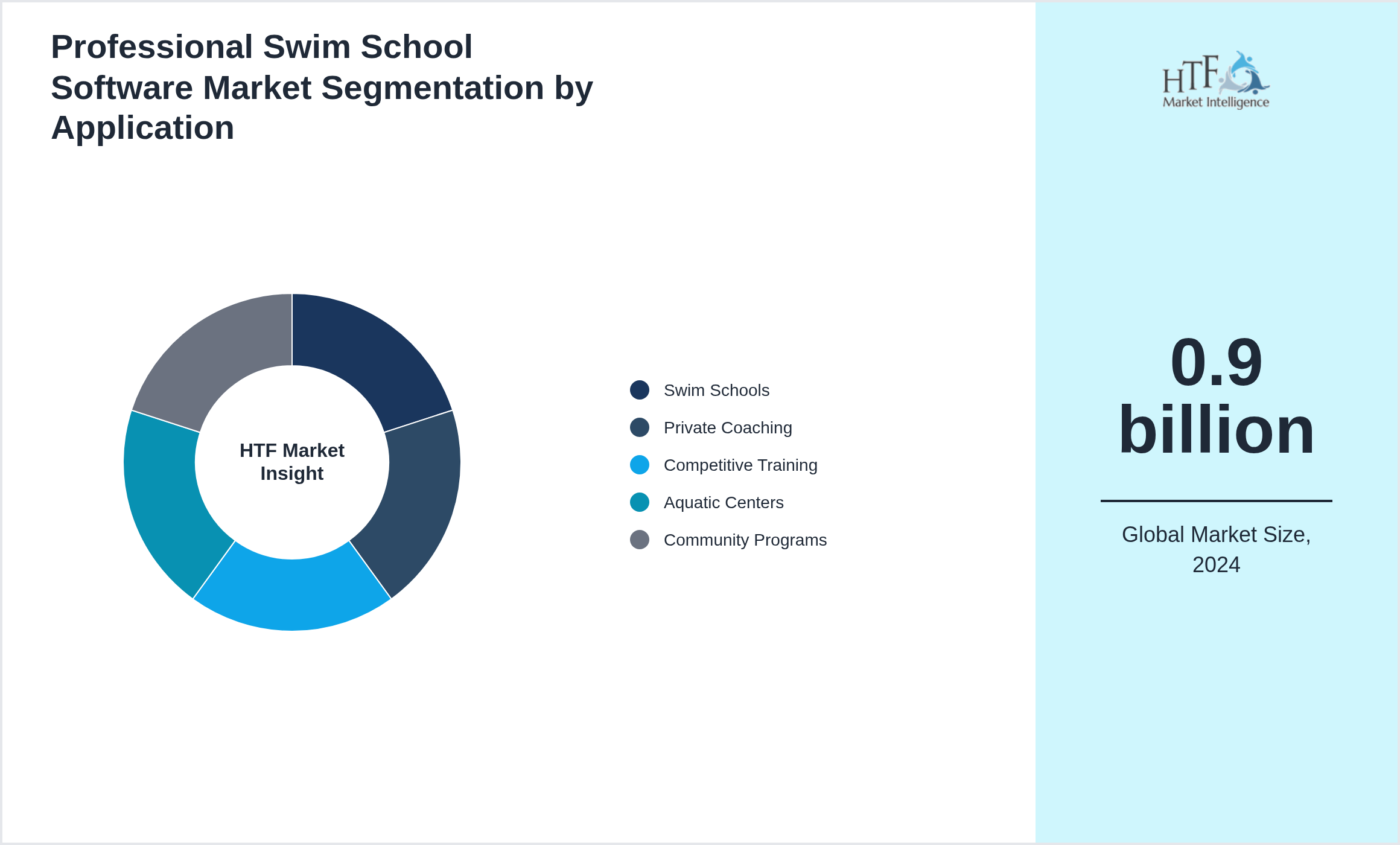
- • Swim Schools
- • Private Coaching
- • Competitive Training
- • Aquatic Centers
- • Community Programs
Key Players
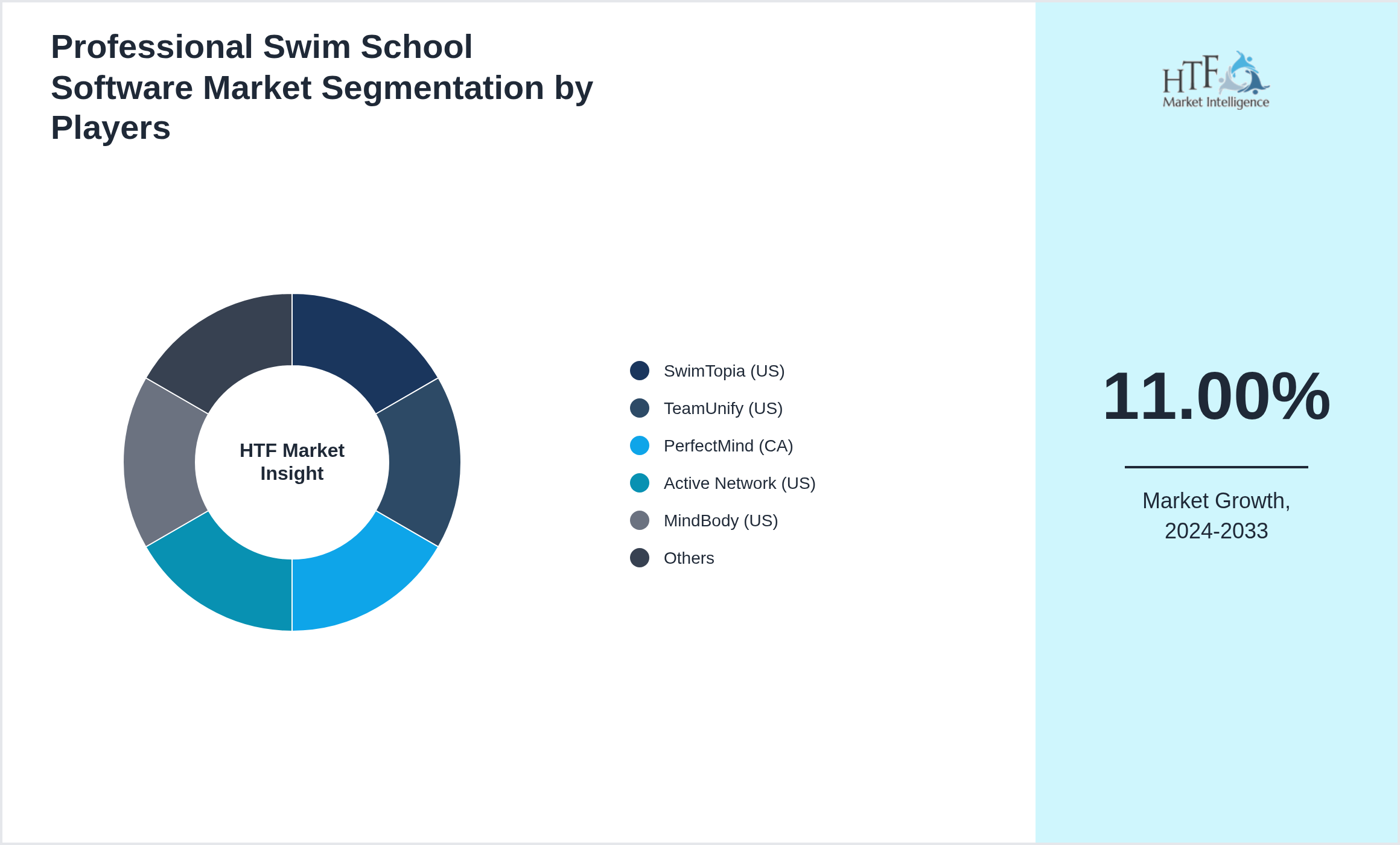
The companies highlighted in this profile were selected based on insights from primary experts and an evaluation of their market penetration, product offerings, and geographical reach:
- • SwimTopia (US)
- • TeamUnify (US)
- • PerfectMind (CA)
- • Active Network (US)
- • MindBody (US)
- • Jackrabbit Swim (US)
- • ClubAutomation (US)
- • iClassPro (US)
- • Amilia (CA)
- • SportsEngine (US)
- • Pooltrackr (US)
- • BlueUmbrella (UK)
- • SwimSoft (AU)
- • SwimOffice (IE)
- • SwimBiz (US)
Regional Outlook
The Europe is the fastest-growing region due to its rapidly increasing population and expanding economic activities across various industries. This growth is further fueled by rising urbanization, improving infrastructure, and government initiatives aimed at fostering industrial development. Additionally, the region's young and dynamic workforce, along with an increase in consumer spending, contributes significantly to its accelerated growth rate. The North America is the dominating region and is going to maintain its dominance during the forecasted period.
- North America
- LATAM
- West Europe
- Central & Eastern Europe
- Northern Europe
- Southern Europe
- East Asia
- Southeast Asia
- South Asia
- Central Asia
- Oceania
- MEA
Among the major investors, Johnson & Johnson is a prominent player. The company consistently allocates significant resources to expand its research capabilities, develop new medical technologies, and enhance its pharmaceutical portfolio. Johnson & Johnson's investments in R&D, coupled with strategic acquisitions and partnerships, reinforce its position as a major contributor to advancements in healthcare. This focus on innovation and market expansion underscores the critical importance of the North American region in the global healthcare landscape.
Source: HTF Market Intelligence (HTF MI)
For the complete company list, please ask for sample pages.
Competitive Landscape
The competitive landscape of the market provides a comprehensive analysis of the key players and their market positioning. It identifies the leading companies, including both established firms and emerging competitors, outlining their strengths such as innovation, strong brand presence, and extensive customer base, as well as weaknesses like limited product range or geographic reach. This section also delves into how these competitors position themselves in the market, whether they target premium, mid-tier, or budget segments, and how they differentiate from others through pricing, product innovation, or customer service.
Additionally, it highlights significant strategic moves, such as mergers, acquisitions, or product launches, that have impacted their competitive standing. The role of technology and innovation is another key factor, with companies investing in research and development to stay ahead. By understanding this competitive landscape, businesses can better identify market opportunities, anticipate competitor strategies, and adjust their approaches to gain a stronger foothold.
Research Methodology & Data Triangulation
Data triangulation is a robust research method that enhances the credibility and validity of findings by combining multiple data sources, methodologies, or perspectives. This approach involves three primary types: data source triangulation, where information is gathered from different sources such as surveys, interviews, and secondary data; methodological triangulation, which integrates various research methods, such as qualitative and quantitative techniques, to enrich the analysis; and investigator triangulation, where multiple researchers collaborate to interpret data, minimizing individual bias.
By employing data triangulation, businesses can gain a more comprehensive understanding of market dynamics and consumer behavior. This method helps validate findings by cross-referencing information, ensuring that conclusions are not based on a single data point. Consequently, triangulation enhances decision-making processes, as organizations can rely on more accurate and reliable insights. Ultimately, this approach fosters confidence in strategic planning and contributes to more effective risk management and resource allocation.
Key Development Activities
Market Entropy
- • Q7 2025: AI-driven swimmer performance analytics improved lesson efficiency by 28% and increased program retention rates
- • Q6 2025: Production modernization included cloud-based scheduling and automated lesson management improving operational efficiency by 25%
- • Q5 2025: Investment in gamification and interactive learning modules increased commercial scalability across multi-location swim schools
- • Q4 2025: Regulatory compliance features enabled adherence to safety and certification standards in aquatic programs
- • Q3 2025: Digital transformation initiatives included integration with wearable swim trackers and IoT sensors for performance feedback
- • Q2 2025: Supply-chain improvements for device compatibility and sensor integration reduced onboarding delays
- • Q1 2025: Sustainability milestones included cloud-hosted systems reducing on-premise IT infrastructure energy consumption
- • Mar 2026 – A sports management software provider acquired a swim school operations platform specializing in scheduling student performance tracking and digital payment management systems. The acquisition focused on expanding cloud-based administrative tools and AI-enabled progress monitoring features for professional swim training centers. The acquiring company announced plans to integrate predictive attendance analytics and personalized coaching insights into future software releases. In Jun 2026 a strategic collaboration was signed between a wearable fitness tracking company and a swim school software developer to integrate biometric performance monitoring into aquatic training management platforms. Several regional sports education software vendors also consolidated operations to improve mobile application capabilities and strengthen subscription-based service models. Market participants highlighted that increasing digitization within sports coaching and recreational education industries was driving consolidation across the market. These developments are expected to improve operational efficiency for swim schools enhance athlete performance tracking and strengthen competition among specialized sports software providers
- • Professional Swim School Software providers are expanding patent activity around AI-driven swimmer performance analytics automated scheduling systems digital coaching platforms biometric monitoring integrations and cloud-based class management technologies. Trademark registrations focus on aquatic education platforms digital swim academy ecosystems training analytics dashboards and subscription-based coaching management software. Copyright protection plays a major role in safeguarding instructional content swimmer performance databases mobile learning applications gamified progress-tracking systems and virtual swim training modules integrated with digital learning platforms. Industry participants are also protecting predictive attendance analytics customer retention software IoT-enabled pool monitoring integrations and AI-generated personalized coaching systems. Growing adoption of digital sports education and remote athlete management continues driving software-focused intellectual property expansion within the aquatic training technology sector
- • The Professional Swim School Software market is attracting increasing investments from edtech companies
Market Estimation Process
Report Details
| Report Features | Details |
| Base Year | 2024 |
| Based Year Market Size (2024) | 0.9 billion |
| Historical Period | 2020 to 2024 |
| CAGR (2024 to 2033) | 11.00% |
| Forecast Period | 2026 to 2033 |
| Forecasted Period Market Size (2033) | 2.2 billion |
| Scope of the Report | Class Scheduling, Progress Tracking, Attendance Management, Payment Management, Reporting & Analytics, Swim Schools, Private Coaching, Competitive Training, Aquatic Centers, Community Programs |
| Regions Covered | North America, LATAM, West Europe, Central & Eastern Europe, Northern Europe, Southern Europe, East Asia, Southeast Asia, South Asia, Central Asia, Oceania, MEA |
| Companies Covered | SwimTopia (US), TeamUnify (US), PerfectMind (CA), Active Network (US), MindBody (US), Jackrabbit Swim (US), ClubAutomation (US), iClassPro (US), Amilia (CA), SportsEngine (US), Pooltrackr (US), BlueUmbrella (UK), SwimSoft (AU), SwimOffice (IE), SwimBiz (US) |
| Customization Scope | 15% Free Customization |
| Delivery Format | PDF and Excel through Email |
Limitation & Assumptions
Limitations and assumptions in a market research report are critical for framing the context and reliability of the findings. Limitations refer to potential weaknesses or constraints that may impact the research outcomes. These can include a limited sample size, which may not represent the broader population, or reliance on self-reported data, which can introduce bias. Other limitations may involve geographical constraints, where findings may not be applicable outside the studied regions, or temporal factors, such as rapidly changing market conditions, that can render results less relevant over time.
Assumptions are foundational beliefs taken for granted in the research process. For instance, it may be assumed that respondents provided honest and accurate information or that market conditions remained stable during the research period. Acknowledging these limitations and assumptions helps stakeholders critically evaluate the validity of the report's conclusions and guides strategic decisions based on the inherent uncertainties of the research.