
Passenger Car Intercooler Market - Global Growth Opportunities 2020-2033
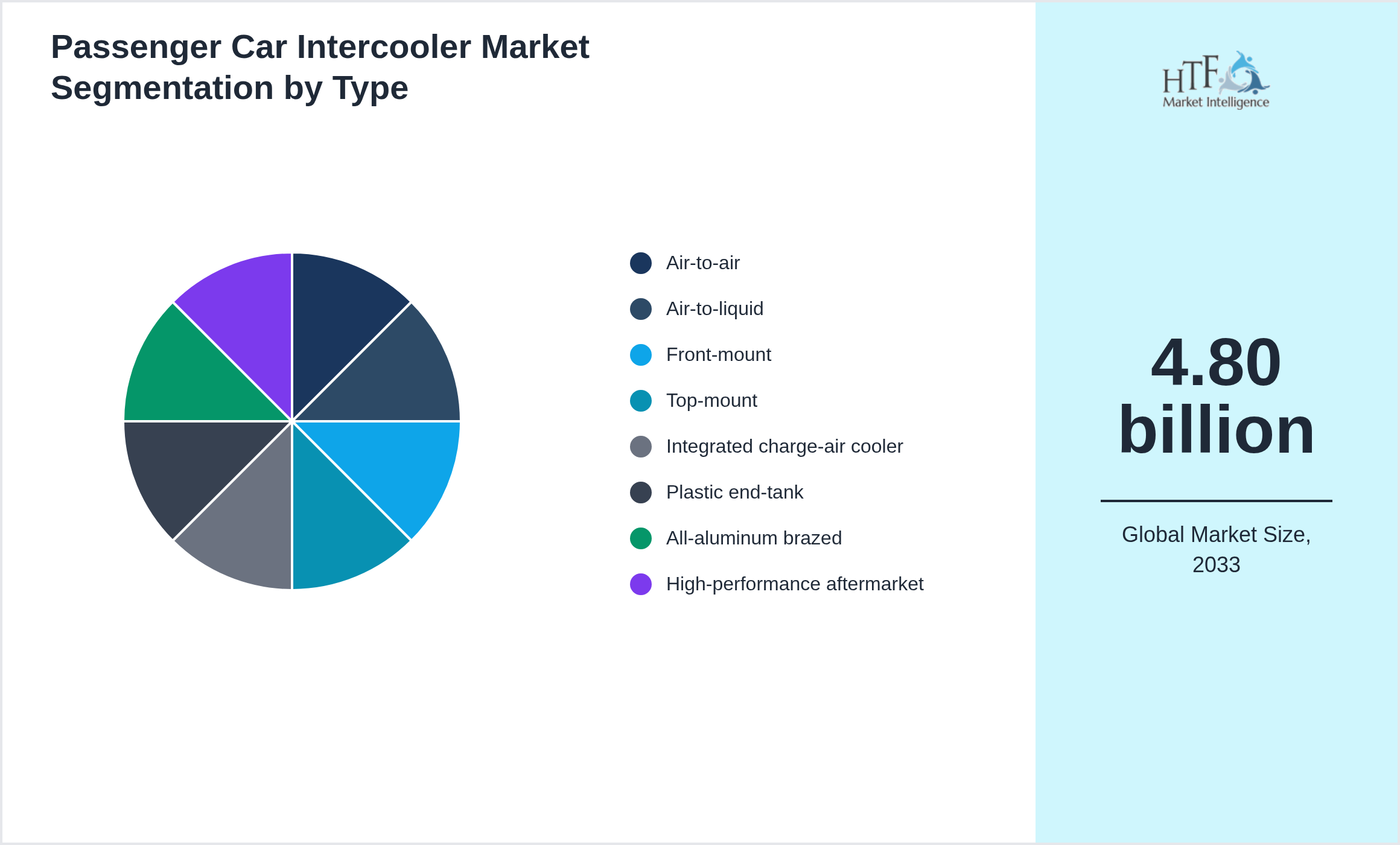
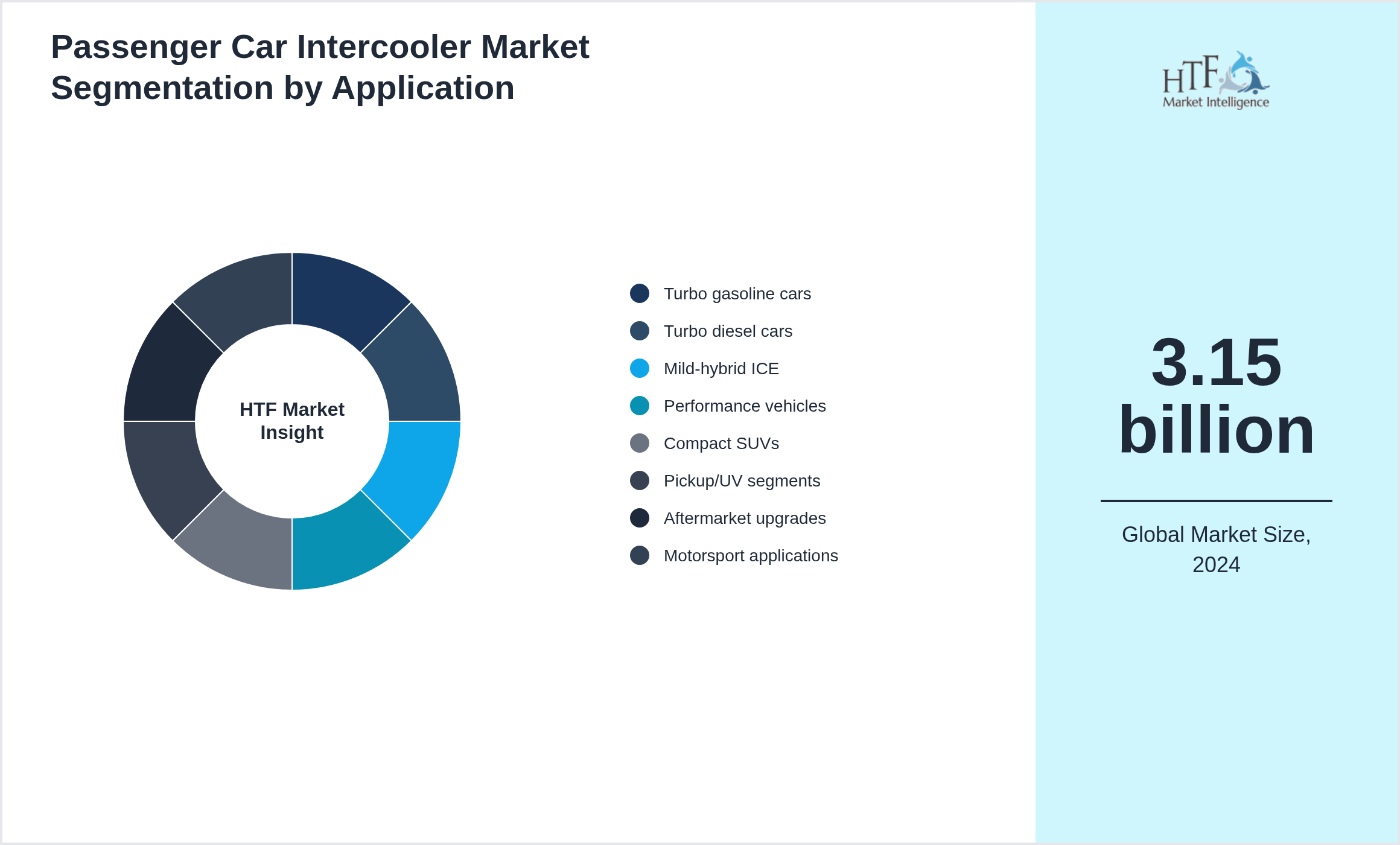
Global Passenger Car Intercooler Market is segmented by Application (Turbo gasoline cars, Turbo diesel cars, Mild-hybrid ICE, Performance vehicles, Compact SUVs, Pickup/UV segments, Aftermarket upgrades, Motorsport applications), Type (Air-to-air, Air-to-liquid, Front-mount, Top-mount, Integrated charge-air cooler, Plastic end-tank, All-aluminum brazed, High-performance aftermarket), and Geography (North America, LATAM, West Europe, Central & Eastern Europe, Northern Europe, Southern Europe, East Asia, Southeast Asia, South Asia, Central Asia, Oceania, MEA)
Pricing
Report Overview
Industry Overview
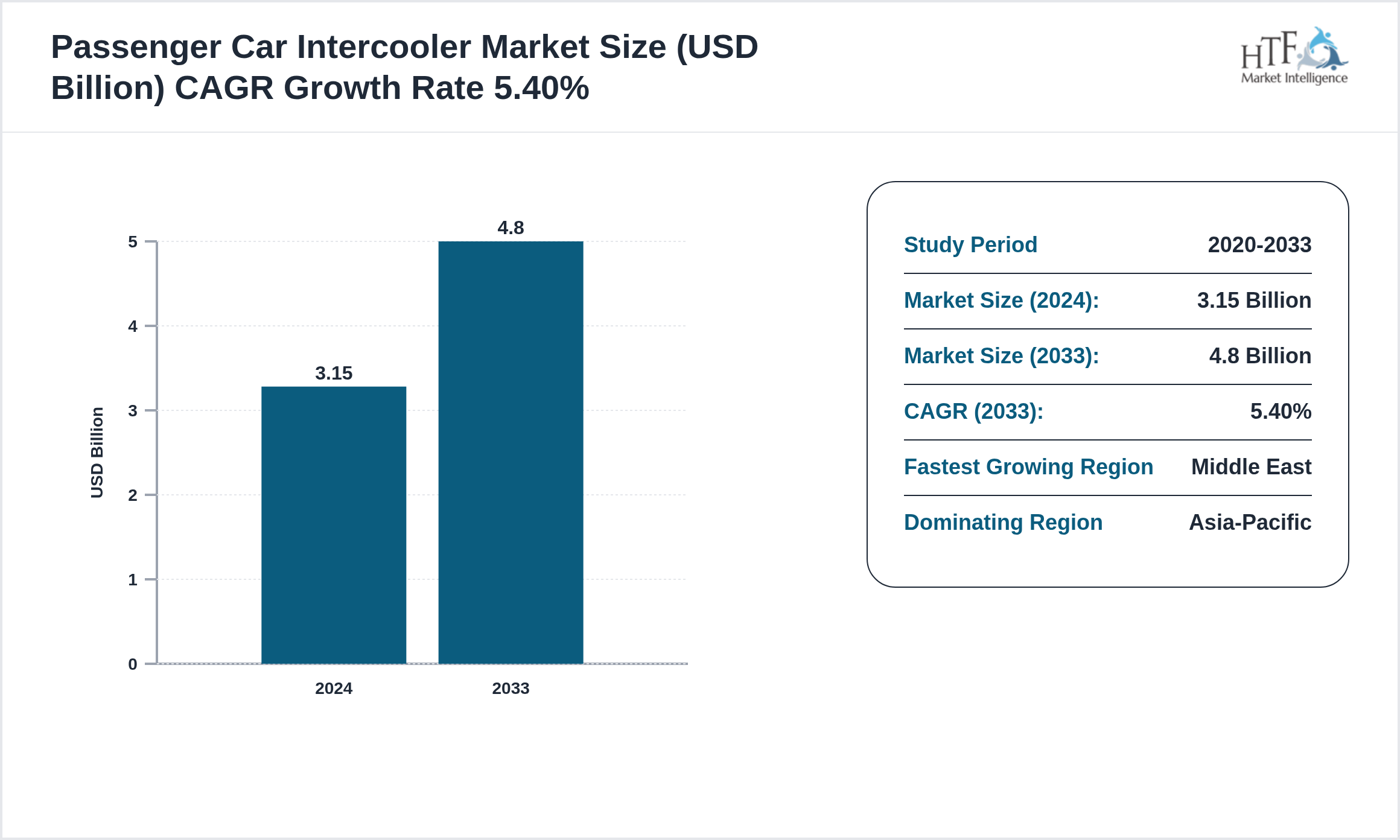
The Passenger Car Intercooler market is expected to reach 4.80 billion by 2033 and is growing at a CAGR of5.40% between 2024 and 2033.
A passenger car intercooler is a heat exchanger that cools compressed intake air from a turbocharger or supercharger before it enters the engine. Cooling increases air density reduces knock risk improves power and fuel efficiency and helps meet emissions targets. Intercoolers are designed for low pressure drop durability and packaging within the vehicle front end or engine bay.
Source: HTF Market Intelligence (HTF MI)
Market Size & Forecast
Market Segmentation
Selecting segmentation criteria in Mahle (Germany), Valeo (France), Denso (Japan), Hanon Systems (Korea), Modine (USA), T.RAD (Japan), Sanden (Japan), Calsonic Kansei/Marelli (Japan/Italy), Dana (USA), Tenneco (USA), BorgWarner (USA), Garrett Motion (Switzerland), Bosch (Germany), Continental (Germany), ZF (Germany), Rheinmetall (Germany), Behr (Germany), Keihin (Japan), Aisin (Japan), Toyota Industries (Japan), Hyundai Mobis (Korea), Mando (Korea), Weichai (China), SAIC Parts (China), BYD Components (China), Subros (India) involves several key steps. Researchers begin by defining their objectives, such as understanding consumer behavior or identifying market opportunities. They then gather relevant data on demographics, psychographics, and buying behavior. Next, they identify segmentation variables like age, location, lifestyle, and purchase patterns. Using analytical tools, they analyze the data to find distinct market segments and evaluate their attractiveness based on size, growth potential, and alignment with business goals. Detailed profiles are created for each segment, and the most promising ones are selected for targeting. Finally, tailored marketing strategies are developed, and the performance of these strategies is monitored and adjusted as needed. This process ensures that segmentation effectively identifies valuable market opportunities and aligns with strategic goals.
Segmentation by Type
- • Air-to-air
- • Air-to-liquid
- • Front-mount
- • Top-mount
- • Integrated charge-air cooler
- • Plastic end-tank
- • All-aluminum brazed
- • High-performance aftermarket
Segmentation by Application
- • Turbo gasoline cars
- • Turbo diesel cars
- • Mild-hybrid ICE
- • Performance vehicles
- • Compact SUVs
- • Pickup/UV segments
- • Aftermarket upgrades
- • Motorsport applications
Passenger Car Intercooler Market Dynamics
ThePassenger Car Intercooler is driven by factors such as increasing demand in end-use industries, technological advancements, research and development (R&D), economic growth, and increasing global trade.
Influencing Trend:
- • Integration into intake manifolds lighter plastic/aluminum hybrids improved fin designs for low pressure drop more air-to-liquid for packaging durability for higher boost thermal modeling + CFD-driven design increased aftermarket personalization.
- • Turbocharging penetration in downsized engines increases intercooler demand. Emissions and efficiency standards require cooler charge air for knock control and better combustion. Growth in SUVs and performance trims supports higher capacity units and premium materials.
- • ICE slowdown in some regions intense OEM cost pressure packaging constraints corrosion and fatigue failures quality variability in brazing performance trade-offs (cooling vs pressure drop) raw material price swings (aluminum).
- • Growth in turbo gasoline in emerging markets replacement demand premium CAC for hot climates supply to hybrid ICE platforms opportunities in low-cost modular designs for high-volume compact SUVs and localized manufacturing for OEMs.
Regional Insight
The Asia-Pacificregion holds a dominant market share, primarily driven by growing consumption patterns, a rising population, and robust economic activity that fuels market demand. Meanwhile, the Middle East Region is experiencing the fastest growth, propelled by increasing infrastructure developments, expanding industrial activities, and a surge in consumer demand, positioning it as a key driver for future market expansion.
- North America
- LATAM
- West Europe
- Central & Eastern Europe
- Northern Europe
- Southern Europe
- East Asia
- Southeast Asia
- South Asia
- Central Asia
- Oceania
- MEA
- • Demand global with higher growth in Asia (turbo downsizing) and Europe (performance + efficiency). North America steady EV shift moderates long-term but hybrids maintain demand. Aftermarket demand notable in NA and MEA.
Key Players
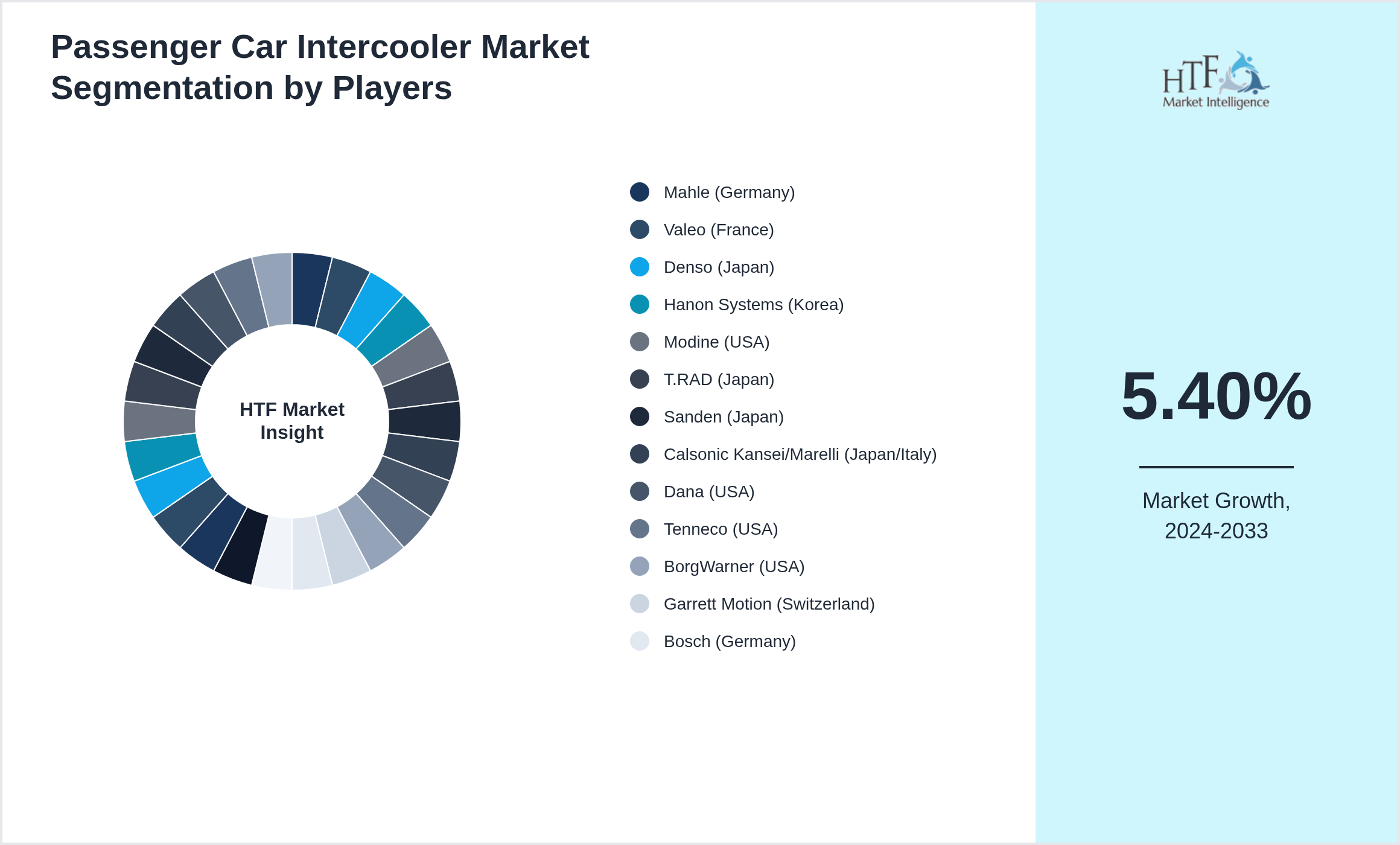
The companies highlighted in this profile were selected based on insights from primary experts and an evaluation of their market penetration, product offerings, and geographical reach:
- • Mahle (Germany)
- • Valeo (France)
- • Denso (Japan)
- • Hanon Systems (Korea)
- • Modine (USA)
- • T.RAD (Japan)
- • Sanden (Japan)
- • Calsonic Kansei/Marelli (Japan/Italy)
- • Dana (USA)
- • Tenneco (USA)
- • BorgWarner (USA)
- • Garrett Motion (Switzerland)
- • Bosch (Germany)
- • Continental (Germany)
- • ZF (Germany)
- • Rheinmetall (Germany)
- • Behr (Germany)
- • Keihin (Japan)
- • Aisin (Japan)
- • Toyota Industries (Japan)
- • Hyundai Mobis (Korea)
- • Mando (Korea)
- • Weichai (China)
- • SAIC Parts (China)
- • BYD Components (China)
- • Subros (India)
Regulatory Framework
The regulatory framework for the Passenger Car Intercooler ensures product safety, fair competition, and consumer protection. It encompasses setting standards for product quality and safety, enforcing truthful advertising and labeling, and implementing environmental sustainability practices. Regulations include robust procedures for product recalls, data protection, and anti-competitive practices, while also overseeing import/export controls and intellectual property rights. Regulatory bodies enforce these rules through inspections and penalties, and consumer education programs help individuals make informed decisions. This framework aims to protect consumers, promote fair market conditions, and encourage ethical business practices.
- • Must comply with automotive durability emissions-related performance validation and material restrictions. OEM qualification requires corrosion pressure pulse and thermal cycling tests. Supply chain standards mandate traceability and quality systems. Increasing scrutiny on recyclability and low-leak brazing processes.
Competitive Insights
The key players in the Passenger Car Intercooler are intensifying their focus on research and development (R&D) activities to innovate and stay competitive. Major companies, such as Mahle (Germany), Valeo (France), Denso (Japan), Hanon Systems (Korea), Modine (USA), T.RAD (Japan), Sanden (Japan), Calsonic Kansei/Marelli (Japan/Italy), Dana (USA), Tenneco (USA), BorgWarner (USA), Garrett Motion (Switzerland), Bosch (Germany), Continental (Germany), ZF (Germany), Rheinmetall (Germany), Behr (Germany), Keihin (Japan), Aisin (Japan), Toyota Industries (Japan), Hyundai Mobis (Korea), Mando (Korea), Weichai (China), SAIC Parts (China), BYD Components (China), Subros (India), are heavily investing in R&D to develop new products and improve existing ones. This strategic emphasis on innovation is driving significant advancements in product formulation and the introduction of sustainable and eco-friendly products.
In addition to R&D and acquisitions, there is a notable shift towards green investments among key players in the consumer goods industry. Companies are increasingly committing resources to sustainable practices and the development of environmentally friendly products. This green investment is in response to growing consumer demand for sustainable solutions and stringent environmental regulations. By prioritizing sustainability, these companies are not only contributing to environmental protection but also positioning themselves as leaders in the green movement, thereby fueling market growth.
Merger Acquisition
- • In November 2023 an automotive thermal systems supplier acquired an intercooler manufacturer to strengthen turbocharged powertrain and hybrid cooling portfolios. The transaction improved brazing capacity lightweight designs and OE program coverage while expanding aftermarket channels.
Patent Analysis
- • Patents cover fin/tube geometries low-pressure-drop designs integrated charge-air coolers lightweight materials and advanced brazing or bonding. Differentiation via compact packaging improved heat transfer and robustness against vibration/stone impacts.
Investment and Funding Scenario
- • Funding driven by Tier-1 platform awards and hybrid powertrain programs. Capex goes into brazing lines leak testing and simulation tools. Investors favor suppliers with multi-platform coverage lightweight innovations and cost-down manufacturing plus regional plants near OEM hubs.
Market Entropy
- • Nov 2024 – Intercoolers improved thermal efficiency for turbo engines and hybrids emphasizing lightweight construction and packaging optimization.
Report Infographics:
| Report Features | Details |
| Base Year | 2024 |
| Based Year Market Size 2024 | 3.15 billion |
| Historical Period Market Size 2020 | USD Million ZZ |
| CAGR (2024 to 2033) | 5.40% |
| Forecast Period | 2024 to2033 |
| Forecasted Period Market Size 2033 | 4.80 billion |
| Scope of the Report | Air-to-air, Air-to-liquid, Front-mount, Top-mount, Integrated charge-air cooler, Plastic end-tank, All-aluminum brazed, High-performance aftermarket, Turbo gasoline cars, Turbo diesel cars, Mild-hybrid ICE, Performance vehicles, Compact SUVs, Pickup/UV segments, Aftermarket upgrades, Motorsport applications |
| Regions Covered | North America, LATAM, West Europe, Central & Eastern Europe, Northern Europe, Southern Europe, East Asia, Southeast Asia, South Asia, Central Asia, Oceania, MEA |
| Year-on-Year Growth | 4.20% |
| Companies Covered | Mahle (Germany), Valeo (France), Denso (Japan), Hanon Systems (Korea), Modine (USA), T.RAD (Japan), Sanden (Japan), Calsonic Kansei/Marelli (Japan/Italy), Dana (USA), Tenneco (USA), BorgWarner (USA), Garrett Motion (Switzerland), Bosch (Germany), Continental (Germany), ZF (Germany), Rheinmetall (Germany), Behr (Germany), Keihin (Japan), Aisin (Japan), Toyota Industries (Japan), Hyundai Mobis (Korea), Mando (Korea), Weichai (China), SAIC Parts (China), BYD Components (China), Subros (India) |
| Customization Scope | 15% Free Customization (For EG) |
| Delivery Format | PDF and Excel through Email
Want to Buy Specific Sections of This Report?
|
Research Methodology
The research methodology for the consumer goods industry involves several key steps to ensure comprehensive and actionable insights. First, the research objectives are clearly defined, focusing on aspects like consumer behavior, market opportunities, competitive dynamics, or regulatory impacts. A thorough literature review follows, drawing from academic journals, industry reports, government publications, and market analyses to establish a knowledge base and identify research gaps. Data collection encompasses both primary methods, such as surveys, interviews, and focus groups with consumers and industry experts, and secondary methods, including analysis of market reports, government data, and industry publications. Quantitative data is analyzed using statistical tools to identify patterns and market segments, while qualitative data from interviews and focus groups is examined to extract key themes and insights.
The market is then segmented based on demographics, psychographics, geography, and purchasing behavior, and competitive analysis is conducted to evaluate key players' strategies and strengths. Trend analysis identifies current and emerging industry trends. Findings are compiled into a detailed report with data visualizations and strategic recommendations. The research is validated and refined through cross-checking and expert feedback, and a framework for continuous monitoring is established to keep the research current and relevant.
Multidisciplinary researcher with 10+ years of experience uncovering insights across diverse domains focused on uncovering insights that drive informed decisions.