
Asia Low-VOC Formulations Market Size, Growth & Revenue 2024-2034
Asia Low-VOC Formulations Market is segmented by Product Type (Water-Based Low-VOC Formulations, Solvent-Based Low-VOC Formulations, Powder Coatings Low-VOC Formulations, UV-Curable Low-VOC Formulations, Others (Epoxy, Silicone-based)), Application (Architectural Coatings, Automotive Coatings, Industrial Coatings, Wood Coatings, Marine Coatings), End-Use Industry (Construction, Automotive, Marine, Industrial Manufacturing), Distribution Channel (Direct Sales, Distributors/Wholesalers, Online Retail/E-Commerce), and Geography (China, Japan, India, South Korea, Southeast Asia, Rest of Asia)
Pricing
Report Overview
Executive Summary
- •The Asia Low-VOC Formulations Market represents a critical segment within the coatings industry, focusing on reducing the environmental and health impacts caused by volatile organic compounds. These formulations consist primarily of water-based, solvent-based, powder, and UV-curable coatings applied across architectural, automotive, industrial, wood, and marine sectors. The market scope includes raw material suppliers, chemical formulators, coating manufacturers, and end-users committed to sustainability and regulatory compliance. Rapid urbanization, stringent environmental regulations, and growing consumer preference for eco-friendly products are critical factors shaping the market landscape. The increasing adoption of green building standards and automotive emission norms in Asia further propel demand. Key applications such as architectural and automotive coatings dominate due to their large-scale usage, while technological advancements in UV-curable coatings offer significant growth potential. This market is poised for substantial expansion from 2024 to 2034, driven by innovations in formulation technology and rising environmental consciousness among industries and consumers alike.
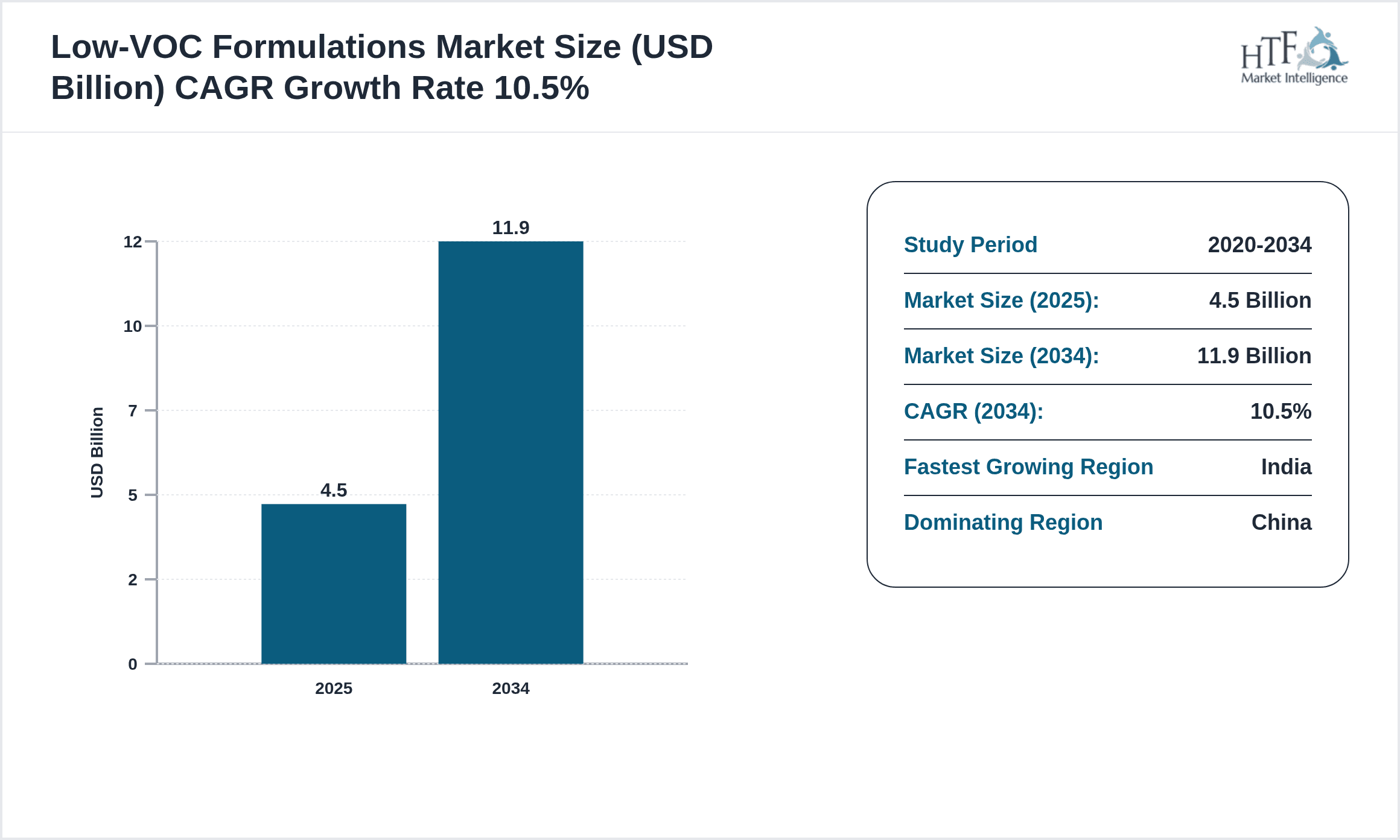
- •The Asia Low-VOC Formulations Market is expected to grow from USD 4.5 Billion in 2024 to USD 11.9 Billion by 2034, reflecting a CAGR of approximately 10.5%. China currently dominates the regional market, accounting for the largest share due to its extensive industrial base and regulatory enforcement, whereas India is the fastest-growing market driven by expanding automotive and construction sectors. Water-based coatings maintain the leading product type due to their low toxicity and versatility, while UV-curable formulations register the highest growth rate supported by technological advances and demand for rapid curing solutions. Architectural coatings continue to lead applications, followed closely by automotive coatings. Year-on-year growth averages near 10%, highlighting strong momentum. The market benefits from government incentives, growing environmental awareness, and increased adoption of sustainable construction practices across Asia.
- •This market offers valuable opportunities for chemical manufacturers, coating formulators, and industrial players aiming to capitalize on Asia's rapid industrialization and sustainability mandates. Strategic importance lies in aligning product innovation with evolving regulations and environmental standards. Stakeholders benefit from diversifying portfolios with low-VOC technologies to meet customer demands and regulatory frameworks. Investments in R&D for advanced coating solutions, collaboration with regulatory bodies, and expanding distribution networks in emerging Asian economies provide competitive advantages. The Asia Low-VOC Formulations Market serves diverse industries including automotive, construction, and marine sectors, underlining its broad impact. Overall, this market is crucial for advancing eco-friendly coatings adoption, reducing carbon footprints, and supporting Asia’s transition towards greener industrial practices.
Competitive Landscape
The competitive landscape of the Asia Low-VOC Formulations Market is characterized by intense rivalry among established multinational corporations and regional players focusing on innovation, sustainability, and market expansion. Leading companies invest heavily in R&D to develop advanced low-VOC technologies that comply with stringent environmental regulations across Asia, gaining competitive advantage through differentiated product portfolios. Strategic partnerships, joint ventures, and acquisitions are prevalent tactics to enhance market presence and access emerging markets. Pricing strategies vary with product type and application, balancing cost efficiency with eco-friendly benefits. Distribution channels are diversified, including direct sales, distributors, and e-commerce platforms to reach a wide customer base. Regional competitors leverage local market knowledge and regulatory compliance to challenge global players. Future competitive dynamics will be shaped by the ability to innovate rapidly, adapt to changing regulations, and develop sustainable supply chains, creating barriers to entry and consolidating market positions for early movers.
Leading Companies in Low-VOC Formulations Market
- •PPG Industries (United States)
- •Sherwin-Williams Company (United States)
- •Akzo Nobel N.V. (Netherlands)
- •Nippon Paint Holdings Co., Ltd. (Japan)
- •Asian Paints Limited (India)
- •Axalta Coating Systems (United States)
- •BASF SE (Germany)
- •RPM International Inc. (United States)
- •Kansai Paint Co., Ltd. (Japan)
- •Jotun Group (Norway)
- •The Valspar Corporation (United States)
- •Hempel A/S (Denmark)
- •Sherwin-Williams India Pvt. Ltd. (India)
- •Axalta Coating Systems India Pvt. Ltd. (India)
- •DuluxGroup Limited (Australia)
- •Valspar Paints (China)
- •BASF India Limited (India)
- •Jotun Coatings (China) Ltd. (China)
- •Nippon Paint (India) Private Limited (India)
- •Kansai Nerolac Paints Ltd. (India)
- •Beijing New Building Materials Public Limited Company (China)
- •Sherwin-Williams Korea Co., Ltd. (South Korea)
- •Asian Paints Australia Pty Ltd (Australia)
- •Chugoku Marine Paints, Ltd. (Japan)
- •Nippon Paint Marine Coatings (Japan)

Market Breakdown
- •By Product Type
- ◦Water-Based Low-VOC Formulations
- ◦Solvent-Based Low-VOC Formulations
- ◦Powder Coatings Low-VOC Formulations
- ◦UV-Curable Low-VOC Formulations
- ◦Others (Epoxy, Silicone-based)
- •By Application
- ◦Architectural Coatings
- ◦Automotive Coatings
- ◦Industrial Coatings
- ◦Wood Coatings
- ◦Marine Coatings
- •By End-Use Industry
- ◦Construction
- ◦Automotive
- ◦Marine
- ◦Industrial Manufacturing
- •By Distribution Channel
- ◦Direct Sales
- ◦Distributors/Wholesalers
- ◦Online Retail/E-Commerce
Growth Dynamics
The Asia Low-VOC Formulations Market experiences dynamic growth driven by increasing environmental regulations aimed at reducing volatile organic compound emissions, particularly in China and India. Governments enforce stringent air quality standards, compelling manufacturers to adopt eco-friendly coatings. Rapid urbanization and infrastructure development fuel demand for architectural coatings with low VOC content, while the expanding automotive sector necessitates environmentally compliant automotive coatings. Technological innovation, including advancements in water-based and UV-curable formulations, provides enhanced performance and faster curing times, appealing to manufacturers seeking sustainable solutions. Additionally, rising consumer awareness regarding indoor air quality and health concerns drives preference for low-VOC products in residential and commercial construction. Investments in R&D and government incentives further accelerate market expansion, making the Asia region a hotspot for sustainable coating technologies.

Market Trends
Asia’s Low-VOC Formulations Market is witnessing a significant trend toward the integration of bio-based and renewable raw materials to further reduce environmental impact. Companies are increasingly adopting green chemistry principles to formulate coatings that not only meet VOC limits but also improve biodegradability. The rise of digitalization in manufacturing processes, including advanced mixing and application technologies, ensures precision and consistency in low-VOC coatings. Furthermore, the growing demand for powder and UV-curable coatings is reshaping product portfolios, driven by their superior durability and fast curing capabilities. Strategic collaborations between chemical producers and end-users are becoming prevalent, enabling tailored solutions that address specific regional regulatory requirements and performance expectations. This trend aligns with the broader sustainability movement permeating Asia’s industrial sectors.

Market Opportunities
The Asia Low-VOC Formulations Market offers abundant opportunities, particularly in emerging economies such as India, Southeast Asia, and South Korea, where industrialization and urbanization accelerate demand for sustainable coatings. Expansion into underpenetrated sectors like marine and wood coatings presents growth potential due to increasing regulatory focus on VOC emissions in these industries. Technological innovation in UV-curable and powder coating formulations offers avenues for differentiation and market penetration. Additionally, government incentives and subsidies aimed at promoting green building certifications create favorable conditions for product adoption. Strategic partnerships and localized manufacturing in key regional markets can reduce costs and improve supply chain efficiency. The growing consumer preference for eco-friendly products further enhances market acceptance, positioning manufacturers for long-term growth within Asia’s evolving sustainability landscape.
Market Challenges
Despite promising growth, the Asia Low-VOC Formulations Market faces challenges such as higher production costs associated with water-based and UV-curable technologies compared to traditional solvent-based coatings. Technical limitations in achieving desired performance characteristics, especially in demanding industrial applications, hinder widespread adoption. Variability in regulatory enforcement across Asian countries creates uncertainty for manufacturers and complicates compliance strategies. Market fragmentation and presence of numerous small-scale local players increase competition and price pressure. Additionally, supply chain disruptions, including raw material shortages and fluctuating costs, pose operational risks. Educating end-users about the benefits and proper application of low-VOC coatings remains an ongoing challenge. Addressing these issues requires continued innovation, robust quality assurance, and collaborative efforts among industry stakeholders and regulatory bodies.
Regulatory Framework
Between 2019 and 2024, several key regulations have shaped the Low-VOC Formulations Market in Asia. China implemented the 'Air Pollution Prevention and Control Action Plan' mandating strict VOC emission limits in coatings, significantly driving reformulation efforts. India introduced the 'Environment Protection Act' amendments focusing on VOC reduction in industrial products, prompting manufacturers to adopt greener technologies. Japan updated its 'Chemical Substances Control Law' to include VOC restrictions specific to paints and coatings. Southeast Asian countries like South Korea and Malaysia issued guidelines for VOC content in architectural and automotive coatings aligned with international standards. These regulatory frameworks impose compliance requirements involving product testing, certification, and reporting, fostering market transformation toward sustainable coatings. Enforcement mechanisms and government incentives support adoption, making regulation a critical factor influencing market growth and innovation.
Market Intelligence
In March 2024, Asian Paints Limited launched a new line of ultra-low VOC water-based architectural coatings targeting the rapidly expanding green building sector in India. The product features enhanced durability and quick drying times, designed to meet stringent Indian environmental standards and consumer demand for healthier indoor air quality. This launch exemplifies the company’s commitment to sustainability and innovation, reinforcing its leadership in eco-friendly coatings. In January 2025, Nippon Paint Holdings Co., Ltd. introduced a breakthrough UV-curable low-VOC coating technology in Japan, enabling faster curing times with reduced environmental footprint. This innovation addresses the automotive and industrial segments’ demand for efficient, compliant coatings, positioning the company competitively in Asia’s evolving market landscape. Both developments highlight the region’s focus on sustainable solutions and technological advancement.
Mergers and Acquisitions in Low-VOC Formulations Market
- •In July 2023, Sherwin-Williams Company acquired a significant stake in a leading Indian specialty coatings manufacturer, enhancing its portfolio with advanced low-VOC formulations tailored for the Asia-Pacific region. This strategic move aims to strengthen Sherwin-Williams’ market presence in India and Southeast Asia, leveraging local expertise and expanding its sustainable product offerings. The acquisition facilitates technology transfer and accelerated innovation, positioning the company to meet increasing environmental regulations and consumer demand for eco-friendly coatings. By integrating regional capabilities with global resources, Sherwin-Williams aims to capitalize on Asia's growing low-VOC formulations market and reinforce its competitive advantage.
- •In November 2024, Akzo Nobel N.V. completed the acquisition of a Japan-based specialty chemical firm specializing in waterborne and UV-curable low-VOC coating technologies. This acquisition broadens Akzo Nobel’s technological capabilities and product portfolio within Asia, especially in the automotive and industrial sectors. The deal enables Akzo Nobel to accelerate the development of sustainable coatings aligned with tightening regional regulations. Additionally, it strengthens the company's innovation pipeline and regional R&D initiatives, supporting its commitment to carbon neutrality and sustainable growth in the Asia Low-VOC Formulations Market.
Recent Industry News
- •In February 2024, BASF SE partnered with a leading Chinese construction firm to develop customized low-VOC coatings for large-scale infrastructure projects across China. This collaboration focuses on creating high-performance, environmentally friendly formulations that comply with new government regulations on VOC emissions. The joint initiative aims to reduce the carbon footprint of construction activities while enhancing coating durability and aesthetics. This partnership is expected to accelerate the adoption of sustainable coatings in China's booming urban development sector, supporting both companies’ strategic growth objectives in Asia. Source: BASF Official Press Release
- •In September 2023, Kansai Paint Co., Ltd. expanded its manufacturing facility in South Korea to increase production capacity for its water-based low-VOC coatings, responding to rising demand from the automotive and industrial markets. The expansion includes state-of-the-art technology integration to improve efficiency and reduce environmental impact. Kansai Paint’s investment underscores its commitment to sustainability and market leadership in Asia’s low-VOC formulations segment. The enhanced capacity is expected to support the company’s growth and meet increasing regional regulatory standards. Source: Kansai Paint Corporate Announcement
- •In May 2025, Asian Paints Limited unveiled an advanced powder coating product with ultra-low VOC emissions, targeting the industrial manufacturing sector in India and Southeast Asia. The new product offers superior corrosion resistance and environmental benefits, aligning with customer preferences for sustainable solutions. This launch positions Asian Paints to capture increasing market share in industrial coatings while addressing tightening environmental regulations. The introduction reflects ongoing innovation and responsiveness to evolving market needs within the Asia Low-VOC Formulations Market. Source: Asian Paints Press Statement
- •In December 2024, PPG Industries inaugurated a new R&D center in Japan focused on developing next-generation low-VOC formulations, including bio-based and UV-curable coatings. The facility aims to accelerate innovation cycles and adapt products to Asia-specific regulatory requirements and performance expectations. This move strengthens PPG’s commitment to sustainability and technological leadership in the Asian coatings industry. The center is expected to foster collaborations with local universities and industry partners, enhancing the company’s competitive positioning. Source: PPG Industries News Release
Market Statistics
- •CAGR by 2034: 10.5%
- •Market Size by 2034: USD 11.9 Billion
- •Market Size in 2025: USD 5.0 Billion
- •Dominating Type: Water-Based
- •Next-Following Type: UV-Curable
- •Dominating Application: Architectural Coatings
- •Next-Following Application: Automotive Coatings
- •Dominating Region: China
- •Second-Leading Region: Japan
- •Region with Highest Growth Rate: India
- •Dominating Country: China
Market Share Table
- •Market Share (%) Comparison
- ◦Water-Based: 45%
- ◦UV-Curable: 20%
- ◦Architectural Coatings: 40%
- ◦Automotive Coatings: 25%
- •Growth Rate (%) Comparison
- ◦Water-Based: 8.5%
- ◦UV-Curable: 15.0%
- ◦Architectural Coatings: 9.0%
- ◦Automotive Coatings: 11.0%
Top 5 Global Players
- •PPG Industries (United States)
- •Sherwin-Williams Company (United States)
- •Akzo Nobel N.V. (Netherlands)
- •Nippon Paint Holdings Co., Ltd. (Japan)
- •Asian Paints Limited (India)
Regional Outlook
The China currently holds a significant share of the market, primarily due to several key factors: increasing consumption rates, a burgeoning population, and robust economic momentum. These elements collectively drive demand, positioning this region as a leader in the market. On the other hand, India is rapidly emerging as the fastest-growing area within the industry. This remarkable growth can be attributed to swift infrastructure development, the expansion of various industrial sectors, and a marked increase in consumer demand. These dynamics make this region a crucial player in shaping future market growth.
In our report, we cover a comprehensive analysis of the following regions and countries:
- China
- Japan
- India
- South Korea
- Southeast Asia
- Rest of Asia
| Feature | Details |
|---|---|
| Base Year Market Size | USD 4.5 Billion |
| Forecast Year Market Size | USD 11.9 Billion |
| CAGR | 10.5% |
| Forecast Period | 2026 to 2033 |
| YoY Growth | 10% |
| Scope of Report | Market is segmented by Product Type (Water-Based Low-VOC Formulations, Solvent-Based Low-VOC Formulations, Powder Coatings Low-VOC Formulations, UV-Curable Low-VOC Formulations, Others (Epoxy, Silicone-based)), Application (Architectural Coatings, Automotive Coatings, Industrial Coatings, Wood Coatings, Marine Coatings), End-Use Industry (Construction, Automotive, Marine, Industrial Manufacturing), Distribution Channel (Direct Sales, Distributors/Wholesalers, Online Retail/E-Commerce) |
| Regions Covered | China, Japan, India, South Korea, Southeast Asia, Rest of Asia |
| Key Companies | PPG Industries (United States), Sherwin-Williams Company (United States), Akzo Nobel N.V. (Netherlands), Nippon Paint Holdings Co., Ltd. (Japan), Asian Paints Limited (India) |
Asia Low-VOC Formulations Market Size, Growth & Revenue 2024-2034 - Table of Contents
Frequently Asked Questions (FAQ):
The Compact Track Loaders market is projected to grow at a CAGR of 6.8% from 2025 to 2030, driven by increasing demand in construction and agricultural sectors.
North America currently leads the market with approximately 45% market share, followed by Europe at 28% and Asia-Pacific at 22%. The remaining regions account for 5% of the global market.
Key growth drivers include increasing construction activities, rising demand for versatile equipment in agriculture, technological advancements in track loader design, and growing preference for compact equipment in urban construction projects.