
Global Organic Stearic Acid Market Size, Growth & Revenue 2024-2033
Global Organic Stearic Acid Market is segmented by Application (Soaps/detergents, Rubber, Cosmetics, Candles, Plastics, Textiles, Pharmaceuticals, Coatings), Type (Food grade, Cosmetic, Industrial, Pharma, High purity, Animal feed, Surfactants, Derivative), and Geography (North America, LATAM, West Europe, Central & Eastern Europe, Northern Europe, Southern Europe, East Asia, Southeast Asia, South Asia, Central Asia, Oceania, MEA)
Pricing
Report Overview
Industry Overview
The Organic Stearic Acid market is witnessing significant growth and is expected to expand at a CAGR of 8.70% during the forecast period from 2024 to 2033. The market growth is driven by increasing demand across various industries, rapid technological advancements, and rising investments in research and development activities. Companies are focusing on innovation, strategic partnerships, and product enhancements to strengthen their market presence and meet evolving consumer needs.
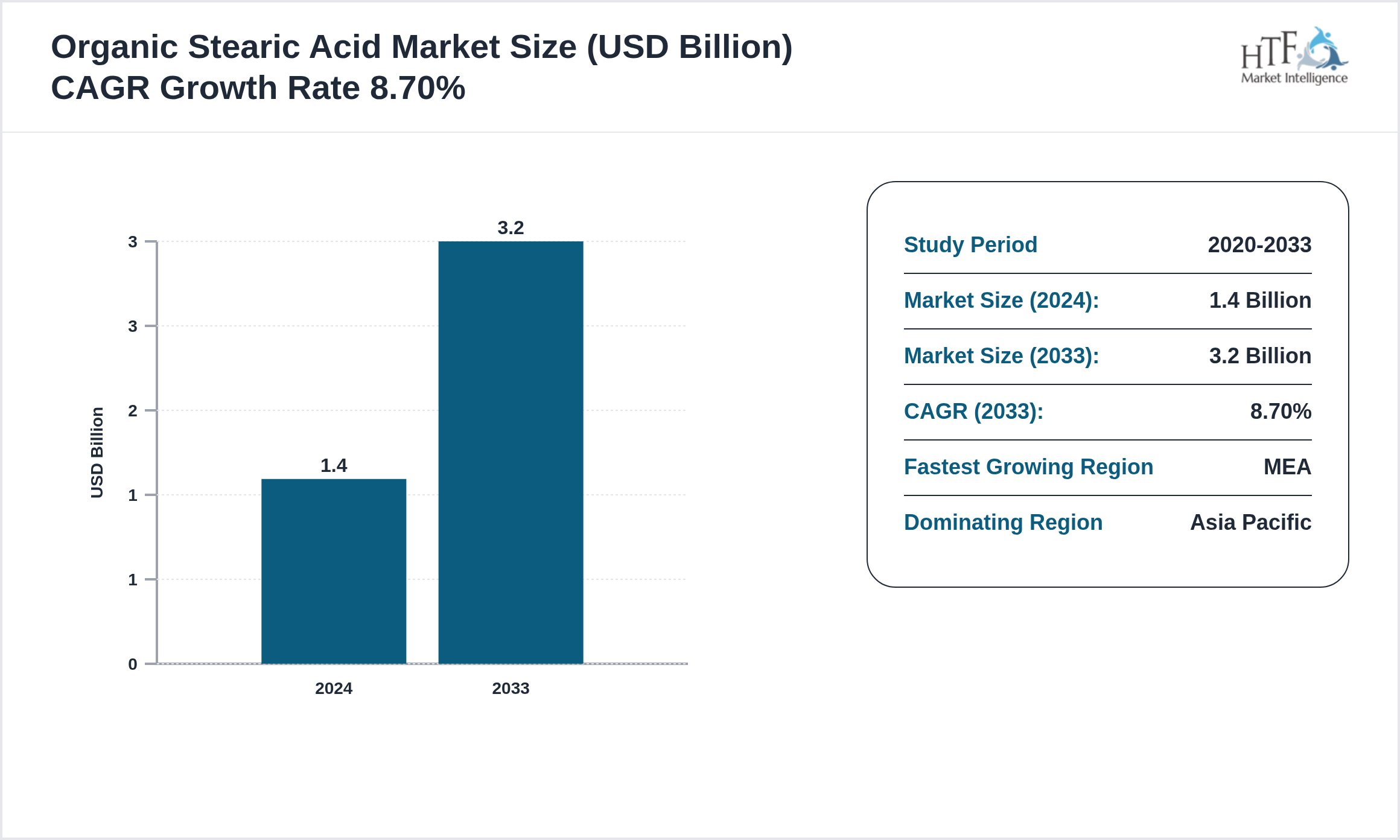
Source: HTF Market Intelligence (HTF MI)
Organic Stearic Acid is a saturated fatty acid extracted from plant sources used in cosmetics detergents pharmaceuticals and candle production. The market emphasizes natural sourcing sustainability and incorporation into personal care products lubricants and industrial applications. Its versatile properties as a surfactant emulsifier and thickener enhance its industrial relevance while meeting rising demand for eco-friendly alternatives.
A key component of the global economy, the chemical industry spurs innovation in industries including agriculture and healthcare. It includes the manufacturing of base materials that are essential to almost every process and product, such as chemicals, polymers, and specialized compounds. Businesses in this industry are key participants in supply chains, guaranteeing raw supplies for consumer goods, construction, and manufacturing. In an effort to lessen its influence on the environment, the sector is spending more on green chemistry and circular economy projects.
Key Player Analysis
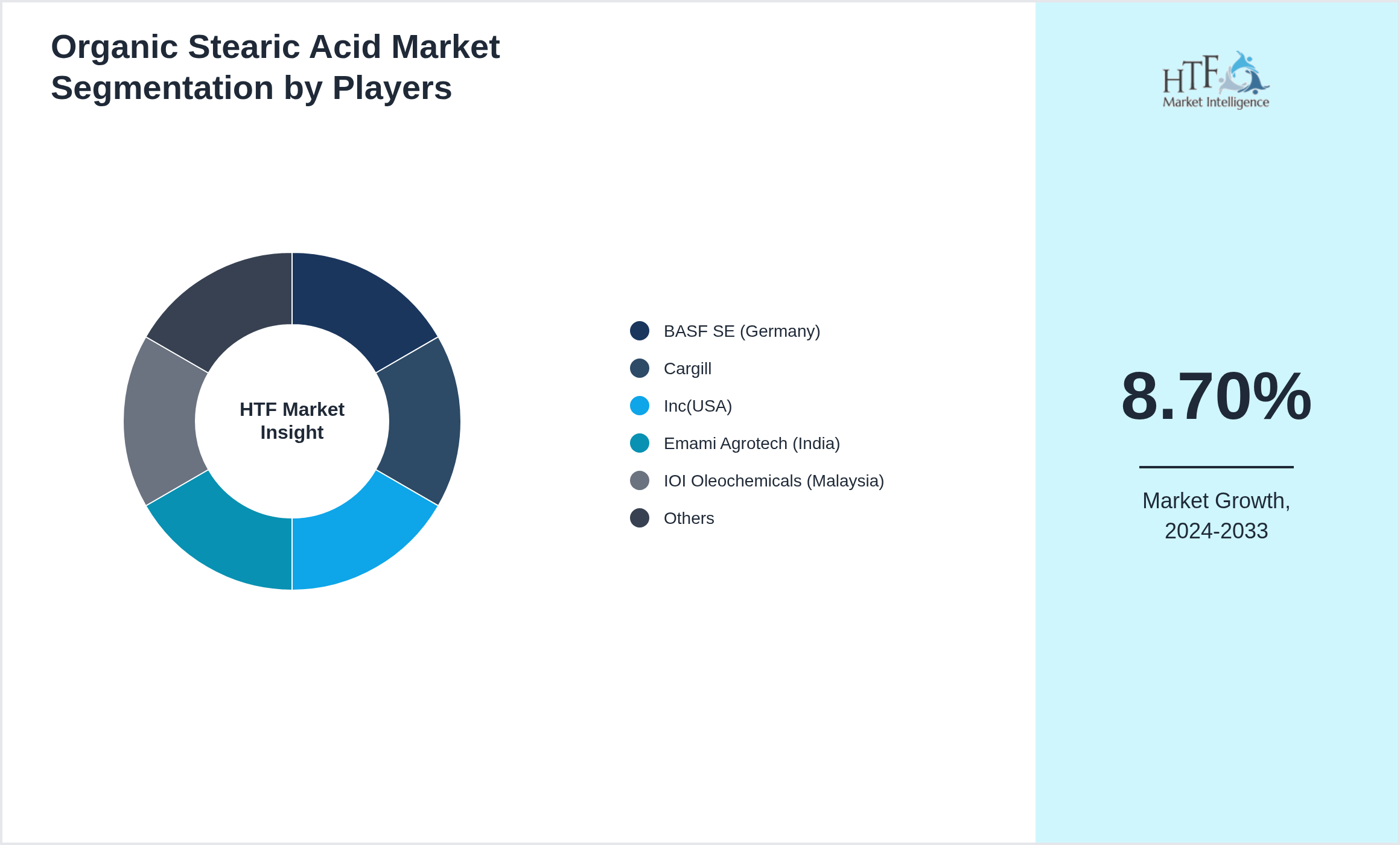
The key players in the { keyword } are intensifying their focus on research and development (R&D) activities to innovate and stay competitive. Major companies, such as BASF SE (Germany), Cargill, Inc(USA), Emami Agrotech (India), IOI Oleochemicals (Malaysia), VVF Limited (India), Malaysian Palm Oil Board (Malaysia), Musim Mas Holdings (Singapore), KLK OLEO (Malaysia), Godrej Industries Ltd(India), Wilmar International (Singapore), are heavily investing in R&D to develop new products and improve existing ones. This strategic emphasis on innovation is driving significant advancements in product formulation and the introduction of sustainable and eco-friendly products.
The companies highlighted in this profile were selected based on insights from primary experts and an evaluation of their market penetration, product offerings, and geographical reach. We also include recent years' innovation and strategies followed by companies that are growing in the market:
- • BASF SE (Germany)
- • Cargill
- • Inc(USA)
- • Emami Agrotech (India)
- • IOI Oleochemicals (Malaysia)
- • VVF Limited (India)
- • Malaysian Palm Oil Board (Malaysia)
- • Musim Mas Holdings (Singapore)
- • KLK OLEO (Malaysia)
- • Godrej Industries Ltd(India)
- • Wilmar International (Singapore)
Regional Insights
The chemical industry exhibits significant regional variation, driven by factors such as resource availability, regulatory environments, and economic conditions. In North America, the industry is maintained by abundant natural resources, particularly shale gas, which provides a competitive advantage in petrochemical production. The U.S. remains a key player, with ongoing investments in advanced manufacturing technologies and sustainable practices positioning the region as a leader in innovation.
Regional dynamics in the chemical industry are shaped by local market conditions, regulatory landscapes, and the global push for sustainability, leading to diverse growth opportunities across different markets.
- North America
- LATAM
- West Europe
- Central & Eastern Europe
- Northern Europe
- Southern Europe
- East Asia
- Southeast Asia
- South Asia
- Central Asia
- Oceania
- MEA
- • Widely used in cosmetics detergents & pharmaceuticals; highest adoption in North America & Europe.
Market Entropy
- • In Sep 2024 organic stearic acid became a key ingredient in the production of personal care products soaps and detergents. The market saw growth due to rising demand for sustainable plant-based fatty acids in various end-use industries.
Merger & Acquisition
- • Jan 2024: A leading chemical manufacturer acquired an organic stearic acid producer to strengthen its portfolio of plant-based fatty acids catering to the cosmetics food and rubber industries with sustainable sourcing and production.
Regulatory Landscape
- • Regulated under ingredient safety laws; thresholds for inclusion in certain products specified.
Patent Analysis
- • Patents on tailored blends improved crystallinity & eco‑friendly processing.
Investment and Funding Scenario
- • Funding from personal care & industrial chemical producers for sustainable production.
Market Segmentation
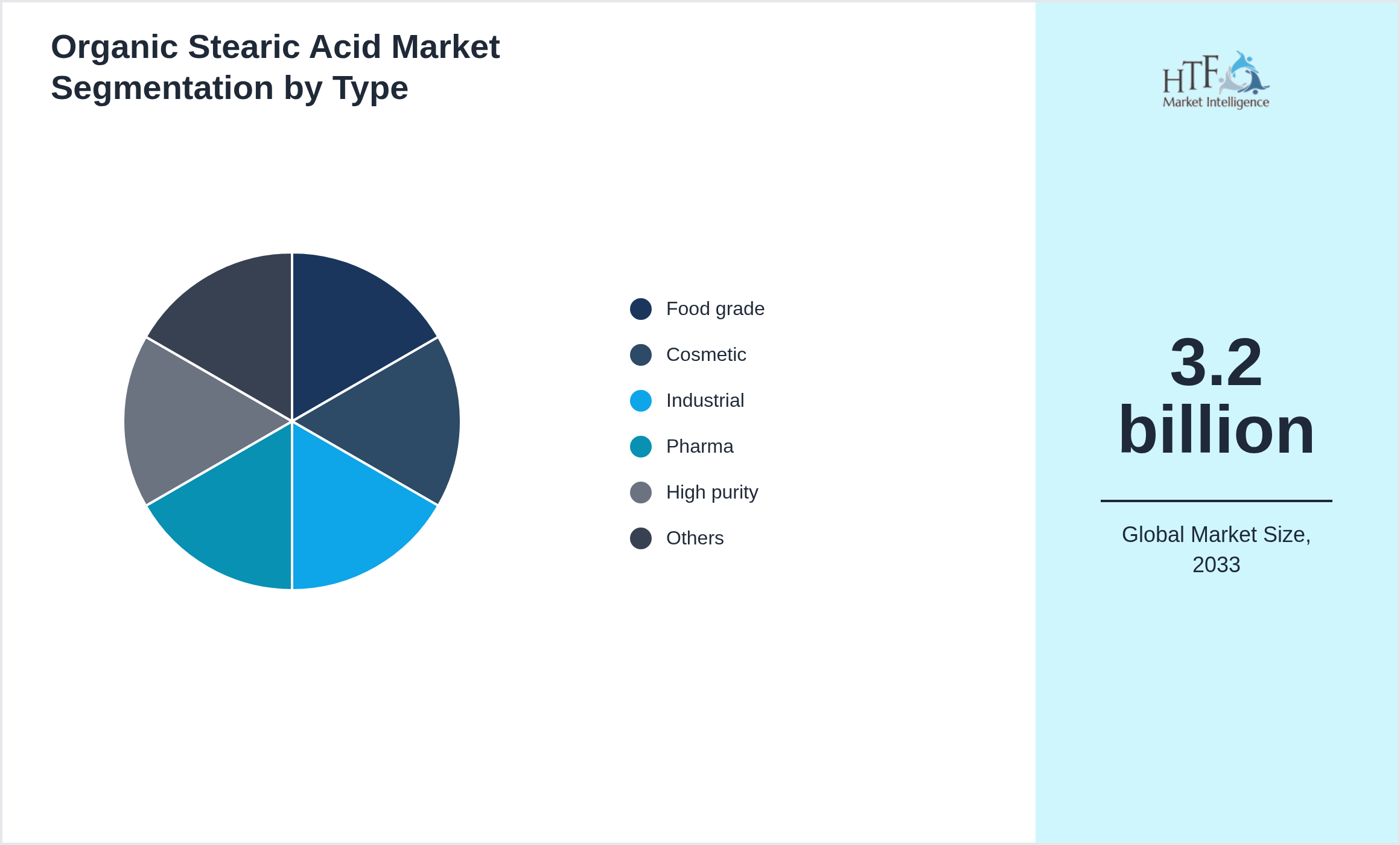
Segmentation by Type
- • Food grade
- • Cosmetic
- • Industrial
- • Pharma
- • High purity
- • Animal feed
- • Surfactants
- • Derivative
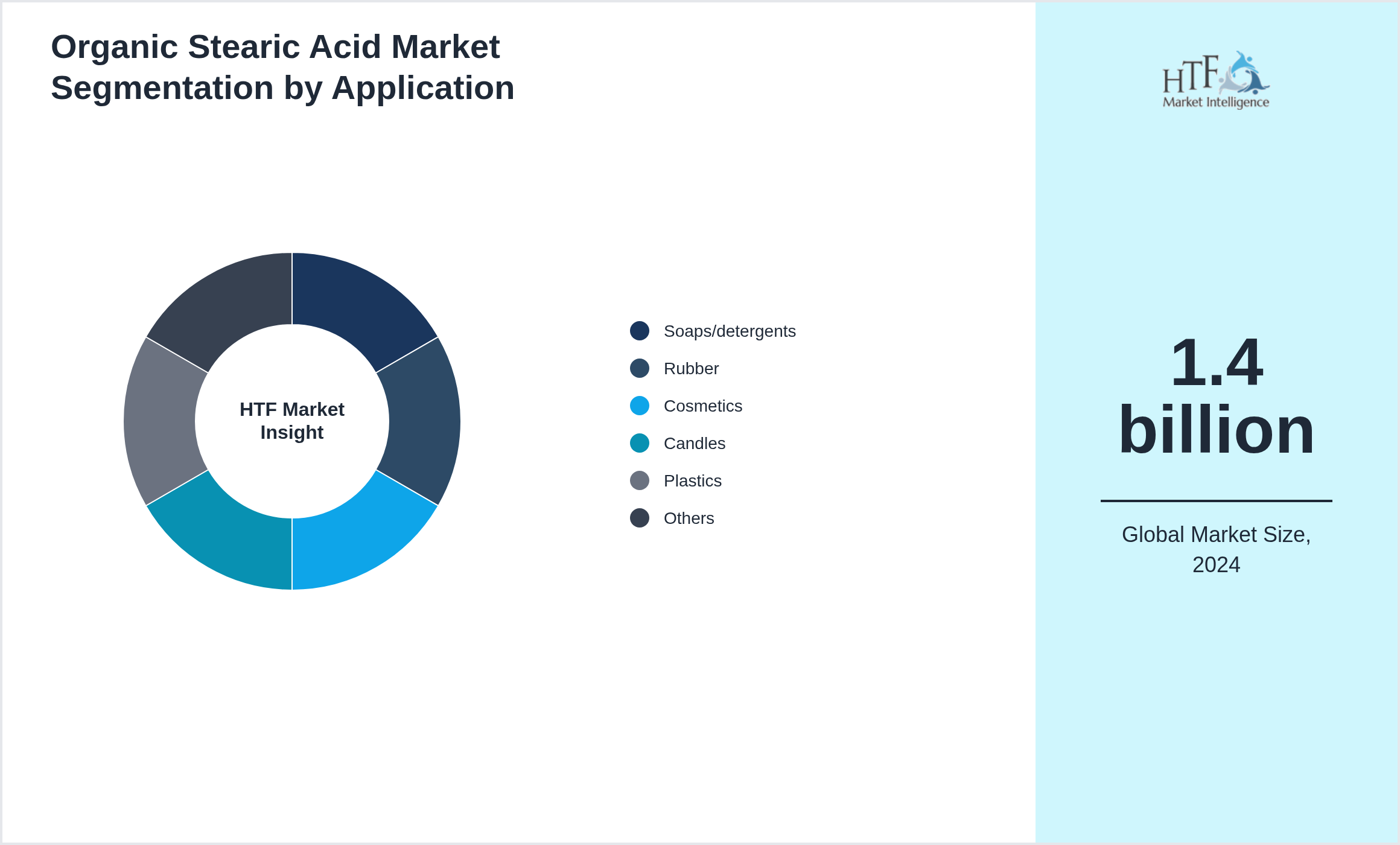
Segmentation by Application
- • Soaps/detergents
- • Rubber
- • Cosmetics
- • Candles
- • Plastics
- • Textiles
- • Pharmaceuticals
- • Coatings
Key Market Dynamics and Impact Analysis
Market Growth Drivers:
The Organic Stearic Acid market is experiencing significant growth due to various factors.
- • Growth in personal care and cosmetic industries increasing use in bio-based lubricants and detergents and rising preference for natural fatty acids drive market demand.
Influencing Trend:
The Organic Stearic Acid market is growing rapidly due to various factors.
- • Market trends include clean-label formulations multifunctional product integration and sustainable production practices.
Opportunities:
The Organic Stearic Acid has several opportunities, particularly in developing countries where industrialization is growing.
- • Opportunities exist in vegan cosmetics biodegradable industrial formulations and pharmaceutical excipients using organic stearic acid.
Challenges:
The market for fluid power systems faces several obstacles despite its promising growth possibilities.
- • Challenges include competition with cheaper synthetic stearic acid dependency on plant-based feedstock and price volatility.
Report Infographics:
| Report Features | Details |
| Base Year | 2024 |
| Base-Year Market Size | 1.4 billion |
| Historical Period | 2020 |
| CAGR (2024 to 2033) | 8.70% |
| Forecast Period | 2033 |
| Forecasted Period Market Size (2033) | 3.2 billion |
| Scope of the Report |
By Type: Food grade, Cosmetic, Industrial, Pharma, High purity, Animal feed, Surfactants, Derivative, By Application: Soaps/detergents, Rubber, Cosmetics, Candles, Plastics, Textiles, Pharmaceuticals, Coatings |
| Regions Covered | North America, LATAM, West Europe, Central & Eastern Europe, Northern Europe, Southern Europe, East Asia, Southeast Asia, South Asia, Central Asia, Oceania, MEA |
| Companies Covered | BASF SE (Germany), Cargill, Inc(USA), Emami Agrotech (India), IOI Oleochemicals (Malaysia), VVF Limited (India), Malaysian Palm Oil Board (Malaysia), Musim Mas Holdings (Singapore), KLK OLEO (Malaysia), Godrej Industries Ltd(India), Wilmar International (Singapore) |
| Customization Scope | 15% Free Customization (For example) |
| Delivery Format | PDF and Excel through Email |
Report Coverage
The study on the Organic Stearic Acid market provides a thorough examination of the sector. Important company profiles, new product releases, significant mergers, acquisitions, and collaborations, as well as the incidence of osteoarthritis in important nations, are also highlighted in the research.