
Global Grain Dryer Market Size, Growth & Revenue 2025-2034
Global Grain Dryer Market is segmented by Product Type (Batch Dryers, Continuous Flow Dryers, Recirculating Dryers, Mobile Dryers, Solar Dryers), Application (On-Farm Drying, Commercial Drying, Industrial Drying, Post-Harvest Processing, Storage Drying), End-Use Industry (Agriculture, Feed Production, Food Processing, Biofuel Industry), Distribution Channel (Direct Sales, Dealerships, Online Platforms), and Geography (North America, LATAM, West Europe, Central & Eastern Europe, Northern Europe, Southern Europe, East Asia, Southeast Asia, South Asia, Central Asia, Oceania, MEA)
Pricing
Report Overview
Executive Summary
- •The global grain dryer market comprises a broad portfolio of drying equipment tailored to reduce moisture content in grains, enhancing their storability and quality. This market serves diverse applications including on-farm drying, commercial and industrial drying, post-harvest processing, and storage drying, addressing the needs of farmers, agribusinesses, feed manufacturers, and food processing companies worldwide. The grain drying process is vital to prevent microbial growth, insect infestation, and quality deterioration, thereby safeguarding food supplies and enhancing economic returns. Key product types include batch dryers, continuous flow dryers, recirculating dryers, mobile dryers, and solar dryers, each suited to different volume requirements and operational contexts. The market's value chain spans raw material suppliers for components, equipment manufacturers, distributors, and service providers, culminating in end users who rely on efficient drying technology to maintain grain integrity. Technological advancements focusing on energy efficiency, automation, and environmentally sustainable solutions are reshaping the competitive landscape. The market growth is propelled by increasing agricultural production, rising demand for processed grains, and heightened awareness of post-harvest loss reduction strategies globally. Moreover, regulatory emphasis on food safety and storage standards further underpins market expansion. The multifaceted nature of the grain dryer market, encompassing various technologies and applications, positions it as a critical enabler of global food security and agricultural sustainability. The strategic importance of this sector is underscored by its role in enhancing supply chain efficiency, reducing waste, and supporting economic development across multiple regions.
- •Key market highlights include a base market size of USD 2.8 Billion in 2025, with projections indicating growth to USD 5.9 Billion by 2034 at a CAGR of 8.1%. North America currently dominates due to advanced agricultural infrastructure and high adoption of mechanized drying solutions. Asia-Pacific is identified as the fastest-growing region fueled by expanding agricultural output, increasing mechanization, and supportive government policies. Continuous flow dryers lead the product segment, favored for their efficiency in large-scale operations, while solar dryers represent the fastest-growing segment owing to sustainability trends and off-grid applicability. These dynamics highlight a market that balances traditional practices with modern technology adoption, poised for robust expansion.
- •The value proposition of grain dryers spans improved grain quality, reduced post-harvest losses, and operational cost savings, making them indispensable to agricultural stakeholders. Their strategic importance extends to enhancing food security by maintaining grain viability during storage and transport, supporting global supply chains, and meeting stringent regulatory requirements. For manufacturers, innovation in energy-efficient and automated dryers offers competitive advantages. For end users, these solutions contribute to profitability by minimizing spoilage and ensuring consistent product quality. The grain dryer market thus represents a critical intersection of agricultural productivity, technological advancement, and sustainable resource management.

Competitive Landscape
The global grain dryer market is characterized by intense competition among established manufacturers and emerging players, driving innovation and technological advancements. Market dynamics are influenced by the continuous development of energy-efficient and automated drying solutions, which address cost and sustainability concerns. Companies are leveraging strategic partnerships, mergers, and acquisitions to expand their product portfolios and geographic reach, enhancing their competitive positioning. Pricing strategies vary across regions, reflecting differences in agricultural practices and economic conditions. Distribution channels include direct sales, dealers, and online platforms, facilitating broad market access. The adoption of advanced materials and IoT-enabled monitoring systems distinguishes market leaders, enabling real-time process control and predictive maintenance. Barriers to entry include high capital investment and technological expertise requirements. Regional competition is prominent, with North America and Europe featuring mature markets with sophisticated demand, while Asia-Pacific presents rapid growth opportunities driven by mechanization and modernization of agriculture. Future competitive trends point towards integration of renewable energy sources, hybrid drying technologies, and digitalization to improve efficiency and traceability. Overall, the competitive landscape is dynamic, with innovation and regional adaptation as key success factors.
Leading Companies in Grain Dryer Market
- •AGI – Ag Growth International Inc. (Canada)
- •Bühler Group (Switzerland)
- •GSI Group, LLC (United States)
- •Alvan Blanch Development Company Ltd. (United Kingdom)
- •Chief Industries, Inc. (United States)
- •Yantai Shuangpai Machinery Manufacturing Co., Ltd. (China)
- •Cimbria A/S (Denmark)
- •Marel hf. (Iceland)
- •Sukup Manufacturing Co. (United States)
- •Nordfab Industrial Ducting (United States)
- •Westrup A/S (Denmark)
- •Kongskilde Industries A/S (Denmark)
- •AGCO Corporation (United States)
- •Berggren AB (Sweden)
- •CTB, Inc. (United States)
- •Dupps Company (United States)
- •Andritz AG (Austria)
- •Praj Industries Ltd. (India)
- •Zhengzhou Taida Drying Equipment Co., Ltd. (China)
- •FEECO International, Inc. (United States)
- •Huaian Zhongtai Grain Drying Equipment Co., Ltd. (China)
- •Lindsay Corporation (United States)
- •Jiangsu Guoxin Agriculture Machinery Co., Ltd. (China)
- •Osttiroler Getreidetrocknungsanlagen GmbH (Austria)
- •Toscotec S.p.A (Italy)

Market Breakdown
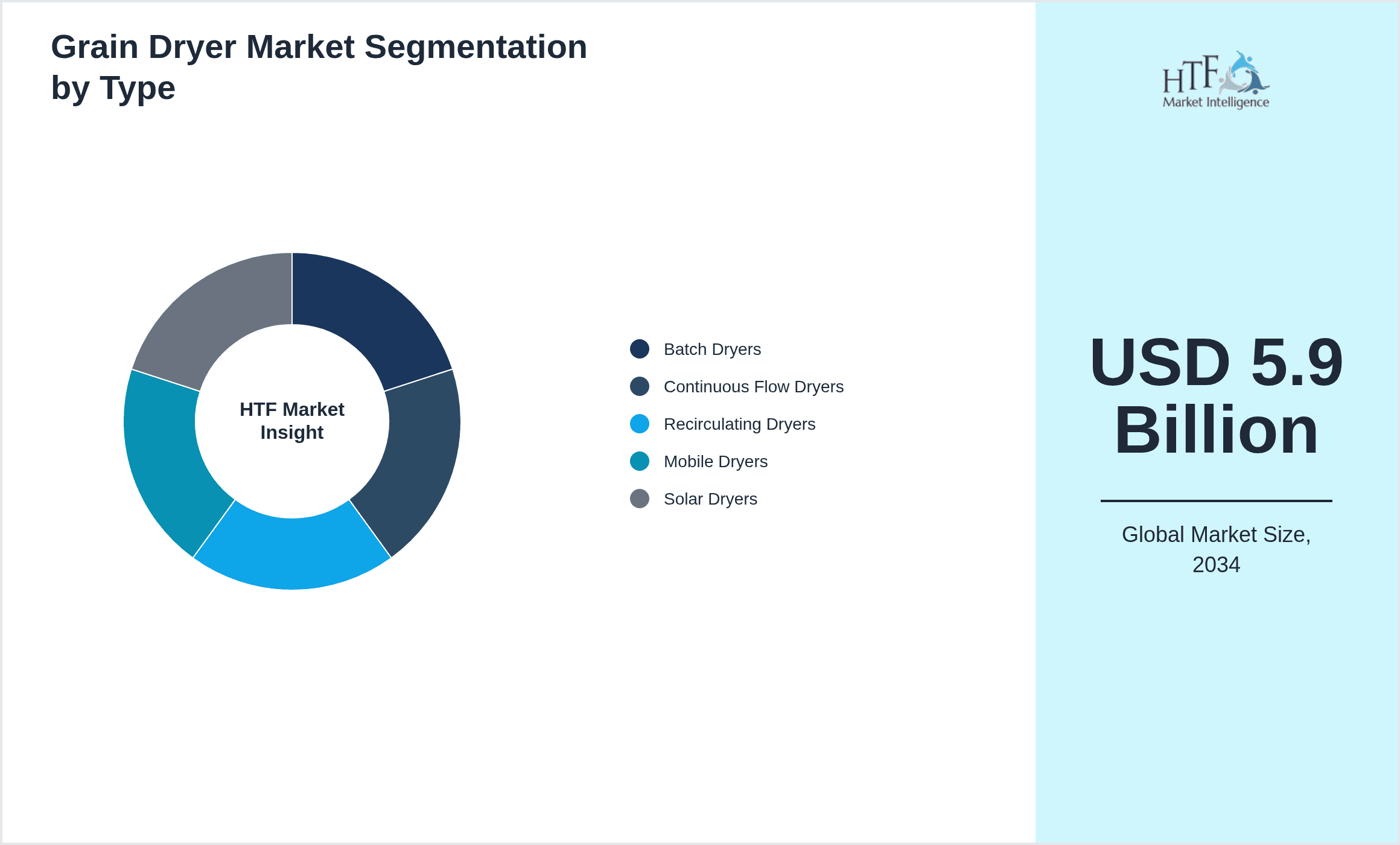
- •By Product Type
- ◦Batch Dryers
- ◦Continuous Flow Dryers
- ◦Recirculating Dryers
- ◦Mobile Dryers
- ◦Solar Dryers
- •By Application
- ◦On-Farm Drying
- ◦Commercial Drying
- ◦Industrial Drying
- ◦Post-Harvest Processing
- ◦Storage Drying
- •By End-Use Industry
- ◦Agriculture
- ◦Feed Production
- ◦Food Processing
- ◦Biofuel Industry
- •By Distribution Channel
- ◦Direct Sales
- ◦Dealerships
- ◦Online Platforms
Growth Dynamics
- •Increasing global agricultural production is a primary growth driver for grain dryers, as higher yields necessitate efficient moisture control to prevent post-harvest losses and maintain grain quality. For example, the expanding cultivation of corn and wheat in Asia-Pacific and Latin America is stimulating demand for advanced drying solutions.
- •Rising mechanization and modernization in agriculture, particularly in developing regions, are accelerating grain dryer adoption. Government subsidies and policies promoting agricultural infrastructure investments further facilitate this trend, enhancing operational efficiency and reducing labor dependency.
- •Technological advancements in energy-efficient and environmentally friendly drying equipment, such as solar-powered dryers and IoT-enabled monitoring systems, are driving market growth. These innovations reduce operational costs, improve drying precision, and appeal to sustainability-conscious stakeholders.
- •The increasing emphasis on food safety and storage standards worldwide compels stakeholders to adopt reliable grain drying technologies. Compliance with regulatory frameworks and quality certifications strengthens market demand, especially in export-oriented agriculture sectors.
- •Rising consumer awareness about reducing food wastage and ensuring grain quality is encouraging investments in effective drying solutions. This behavioral shift supports increased uptake across both smallholder and commercial farming operations.
- •Expanding applications of dried grains in biofuel production and feed industries are creating new market avenues, fueling demand for specialized drying technologies tailored to these sectors.
- •Investment trends indicate growing capital inflows into research and development for innovative drying technologies, driven by increasing global focus on sustainable agriculture and resource optimization.
Market Trends
- •The market is witnessing a significant shift towards automation and digitalization, with the integration of IoT sensors and remote monitoring enabling real-time control of drying parameters, enhancing efficiency and reducing operational downtime.
- •Sustainability is a dominant trend, with manufacturers developing solar and hybrid drying systems to reduce energy consumption and carbon footprint, aligning with global environmental goals and energy cost reduction efforts.
- •Customization of grain drying solutions to meet specific crop types and regional climatic conditions is gaining traction, allowing users to optimize drying processes and improve grain quality outcomes.
- •Collaborations and partnerships between equipment manufacturers and agricultural technology firms are emerging to innovate integrated drying and grain management solutions, enhancing value chain efficiency.
- •Increasing demand for compact and mobile grain dryers supports small and medium-sized farms, facilitating convenient on-site drying and reducing logistical challenges.
- •The rising adoption of renewable energy sources within grain drying operations reflects a broader trend towards decarbonization and sustainable agricultural practices.
- •Expansion of online sales channels and digital marketing strategies is reshaping distribution dynamics, improving accessibility and after-sales support for grain drying equipment globally.

Market Opportunities
- •There is significant growth potential in emerging markets where agricultural mechanization is nascent, representing untapped demand for cost-effective and scalable grain drying technologies tailored to smallholder farmers.
- •Integration of renewable energy with traditional drying systems offers opportunities to develop hybrid solutions that reduce operational costs and environmental impact, appealing to sustainability-driven customers.
- •Advancements in smart drying technologies leveraging AI and machine learning can optimize drying cycles, reduce energy consumption, and improve grain quality, presenting innovation avenues for market players.
- •Expanding the application scope towards biofuel feedstock drying and specialty grains opens new market niches, supporting product diversification and revenue growth.
- •Strategic collaborations with agricultural cooperatives and government programs can facilitate market penetration, especially in regions with fragmented farming communities.
- •Customization and modular designs enabling easy retrofit and scalability present opportunities to capture diverse customer segments, from small farms to large agribusinesses.
- •Enhanced after-sales service offerings and digital support platforms can improve customer retention and build brand loyalty in competitive markets.
Market Challenges
- •High initial capital investment and operational costs of advanced grain drying equipment hinder adoption among small-scale farmers, especially in developing regions with limited financial resources.
- •Variability in climatic conditions and diverse grain types require adaptable drying solutions, complicating standardization and increasing product development complexity for manufacturers.
- •Lack of awareness and technical expertise among end users regarding optimal drying practices and equipment maintenance limits market penetration in certain regions.
- •Supply chain disruptions and raw material price volatility impact manufacturing costs and equipment availability, challenging market stability and growth forecasts.
- •Regulatory compliance and certification requirements vary across regions, creating barriers for manufacturers to uniformly market their products internationally.
- •Competition from traditional sun drying and low-cost alternatives remains intense in some markets, inhibiting rapid transition to mechanized drying solutions.
- •Energy dependency and associated costs for electrically powered dryers pose operational challenges, particularly in regions with unstable power supply or high energy prices.
Regulatory Framework
- •The Food Safety Modernization Act (FSMA) implemented in the United States between 2016 and 2025 mandates stringent controls on moisture levels during grain storage to prevent contamination, compelling operators to adopt effective drying technologies.
- •European Union regulations on food hygiene and storage, including directives on moisture and pest control enacted throughout 2018-2025, require compliance with specific grain drying standards, influencing market demand in Europe.
- •Environmental protection regulations in regions such as North America and Europe have introduced emissions standards for drying equipment, encouraging manufacturers to develop energy-efficient and low-emission dryers.
- •The Indian Ministry of Agriculture's initiatives from 2019 to 2025 include subsidies and quality standards promoting mechanized grain drying to reduce post-harvest losses, supporting domestic market growth.
- •International standards like ISO 9001 for quality management systems and ISO 22000 for food safety management impact grain dryer manufacturers by establishing compliance benchmarks and enhancing market credibility.
Market Intelligence
- •15th February 2025, Bühler Group launched its next-generation continuous flow grain dryer featuring integrated IoT-enabled sensors for real-time moisture monitoring and automated control. This innovation targets large-scale commercial farms seeking to optimize drying efficiency while reducing energy consumption. The product's modular design allows for scalable installation, addressing diverse operational needs across global markets. Strategic objectives include strengthening Bühler's position in the Asia-Pacific and North America regions by offering sustainable and technologically advanced solutions. The launch aligns with increasing demand for digitalized agricultural equipment and environmental compliance.
- •10th April 2025, AGI – Ag Growth International Inc. introduced a solar-powered mobile grain dryer designed for off-grid applications in developing countries. Utilizing renewable energy, the dryer reduces reliance on fossil fuels and lowers operating costs, making it attractive for smallholder farmers. The company positioned this product to capture emerging market segments in Africa and Latin America, where access to electricity is limited. Expected impacts include enhancing food security through improved post-harvest grain preservation and supporting sustainable agriculture initiatives.
- •22nd July 2025, GSI Group, LLC announced a strategic partnership with a leading IoT solutions provider to integrate advanced data analytics and predictive maintenance capabilities into their grain drying equipment. This collaboration aims to improve operational uptime, reduce maintenance costs, and enable precision drying tailored to specific grain types. The initiative is expected to accelerate adoption of smart drying systems in North America and Europe, enhancing competitive differentiation and customer value.
- •5th September 2025, Alvan Blanch Development Company Ltd. completed the acquisition of a regional grain dryer manufacturer in Southeast Asia to expand its footprint and product portfolio in the rapidly growing Asia-Pacific market. This acquisition enables the company to offer localized solutions and strengthen distribution networks. Synergies include leveraging combined R&D capabilities to innovate energy-efficient dryers adapted to tropical climates. The move consolidates market presence and aligns with growth strategies focused on emerging economies.
- •Source: Official company press releases, industry publications, and verified market news portals
Regional Outlook
The North America currently holds a significant share of the market, primarily due to several key factors: increasing consumption rates, a burgeoning population, and robust economic momentum. These elements collectively drive demand, positioning this region as a leader in the market. On the other hand, Asia-Pacific is rapidly emerging as the fastest-growing area within the industry. This remarkable growth can be attributed to swift infrastructure development, the expansion of various industrial sectors, and a marked increase in consumer demand. These dynamics make this region a crucial player in shaping future market growth.
In our report, we cover a comprehensive analysis of the following regions and countries:
- North America
- LATAM
- West Europe
- Central & Eastern Europe
- Northern Europe
- Southern Europe
- East Asia
- Southeast Asia
- South Asia
- Central Asia
- Oceania
- MEA
| Feature | Details |
|---|---|
| Base Year Market Size | USD 2.8 Billion |
| Forecast Year Market Size | USD 5.9 Billion |
| CAGR | 8.1% |
| Forecast Period | 2026 to 2033 |
| YoY Growth | 7.8% |
| Scope of Report | Market is segmented by Product Type (Batch Dryers, Continuous Flow Dryers, Recirculating Dryers, Mobile Dryers, Solar Dryers), Application (On-Farm Drying, Commercial Drying, Industrial Drying, Post-Harvest Processing, Storage Drying), End-Use Industry (Agriculture, Feed Production, Food Processing, Biofuel Industry), Distribution Channel (Direct Sales, Dealerships, Online Platforms) |
| Regions Covered | North America, LATAM, West Europe, Central & Eastern Europe, Northern Europe, Southern Europe, East Asia, Southeast Asia, South Asia, Central Asia, Oceania, MEA |
| Key Companies | AGI – Ag Growth International Inc. (Canada), Bühler Group (Switzerland), GSI Group, LLC (United States), Alvan Blanch Development Company Ltd. (United Kingdom), Chief Industries, Inc. (United States), Yantai Shuangpai Machinery Manufacturing Co., Ltd. (China), Cimbria A/S (Denmark), Marel hf. (Iceland), Sukup Manufacturing Co. (United States), Nordfab Industrial Ducting (United States), Westrup A/S (Denmark), Kongskilde Industries A/S (Denmark), AGCO Corporation (United States), Berggren AB (Sweden), CTB, Inc. (United States), Dupps Company (United States), Andritz AG (Austria), Praj Industries Ltd. (India), Zhengzhou Taida Drying Equipment Co., Ltd. (China), FEECO International, Inc. (United States), Huaian Zhongtai Grain Drying Equipment Co., Ltd. (China), Lindsay Corporation (United States), Jiangsu Guoxin Agriculture Machinery Co., Ltd. (China), Osttiroler Getreidetrocknungsanlagen GmbH (Austria), Toscotec S.p.A (Italy) |
Global Grain Dryer Market Size, Growth & Revenue 2025-2034 - Table of Contents
Frequently Asked Questions (FAQ):
The Compact Track Loaders market is expected to see value worth 5.3 Billion in 2025.
North America currently leads the market with approximately 45% market share, followed by Europe at 28% and Asia-Pacific at 22%. The remaining regions account for 5% of the global market.
Key growth drivers include increasing construction activities, rising demand for versatile equipment in agriculture, technological advancements in track loader design, and growing preference for compact equipment in urban construction projects.