
Global LED Driving Power Supply Market Size, Growth & Revenue 2025-2034
Global LED Driving Power Supply Market is segmented by Type (Constant Current LED Drivers, Constant Voltage LED Drivers, AC-DC LED Drivers, DC-DC LED Drivers, Dimmable LED Drivers), Application (Residential Lighting, Commercial Lighting, Automotive Lighting, Street Lighting, Industrial Lighting), End-Use Industry (Construction, Automotive, Retail, Manufacturing), Distribution Channel (Direct Sales, Distributors, E-commerce), and Geography (North America, LATAM, West Europe, Central & Eastern Europe, Northern Europe, Southern Europe, East Asia, Southeast Asia, South Asia, Central Asia, Oceania, MEA)
Pricing
Report Overview
Executive Summary
- •The Global LED Driving Power Supply market comprises specialized electronic components that ensure the proper operation and efficiency of LED lighting systems across diverse sectors such as residential, commercial, automotive, street, and industrial applications. These power supplies regulate and convert electrical inputs to match the precise requirements of LEDs, offering constant current or constant voltage outputs to maintain brightness, color consistency, and safety. The product range includes constant current drivers, constant voltage drivers, AC-DC and DC-DC converters, and dimmable drivers that support advanced lighting controls. The market's importance is underscored by the worldwide shift toward energy-efficient lighting solutions that reduce carbon footprints and operational costs. Increasing urban infrastructure development, smart city initiatives, and stringent energy regulations globally fuel demand for advanced LED driving power supplies, positioning this market as a critical enabler in the evolution of sustainable lighting technologies.
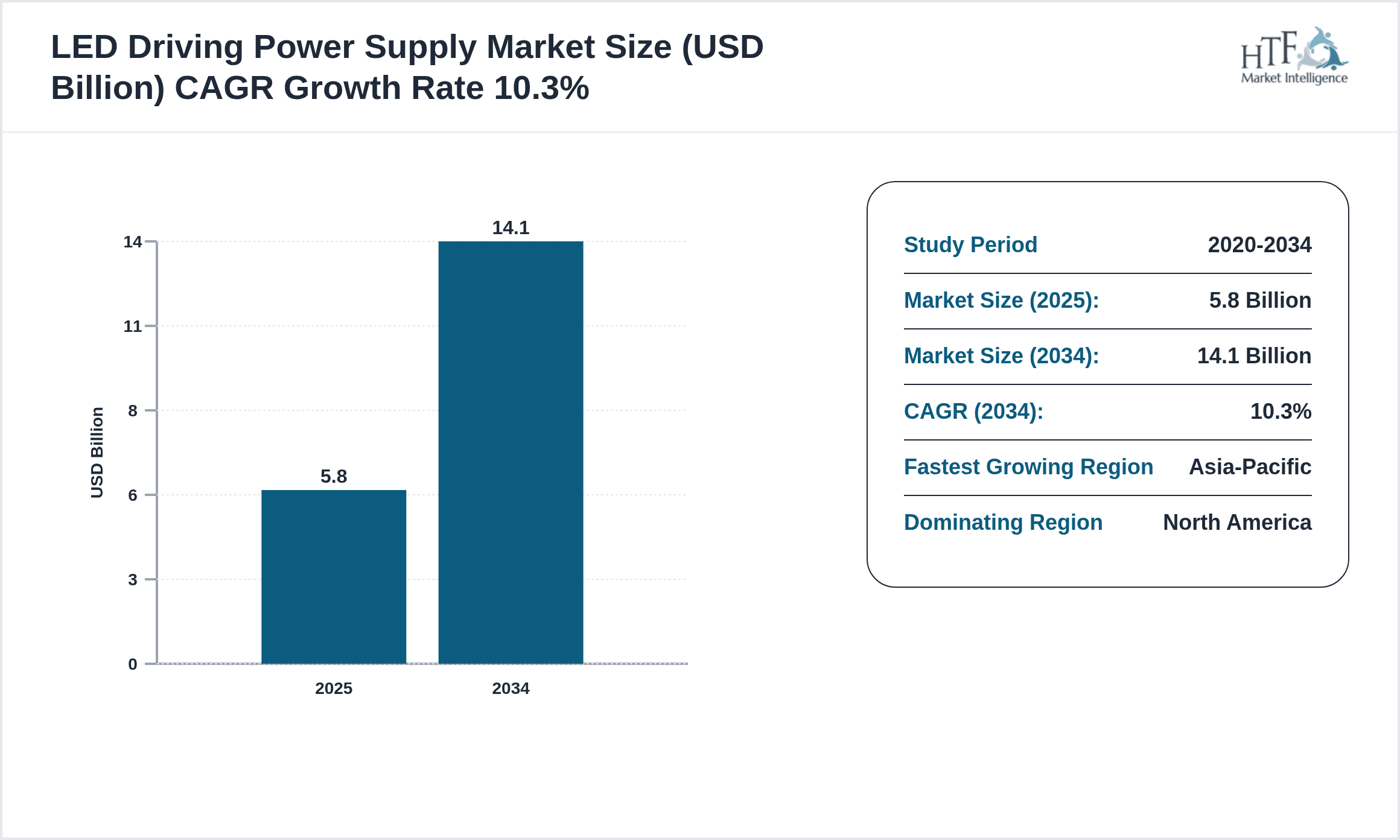
- •The market is projected to grow from USD 5.8 Billion in 2025 to USD 14.1 Billion by 2034, registering a robust CAGR of 10.3% during the forecast period. North America leads the market in terms of revenue share, while Asia-Pacific exhibits the highest growth rate driven by rapid industrialization and infrastructure expansion. Constant current LED drivers dominate the product segment with widespread adoption in commercial and industrial lighting. The rise of dimmable LED drivers, fueled by demand for energy-efficient and customizable lighting, reflects the fastest-growing product category. Market dynamics are shaped by innovations in driver technologies, increasing LED penetration in automotive and street lighting, and regulatory mandates promoting energy conservation.
- •This market offers strategic value to manufacturers, urban planners, and technology providers by enabling enhanced lighting performance, operational cost savings, and compliance with environmental standards. The ongoing transition to smart lighting ecosystems integrates LED drivers with IoT and automation, further elevating the significance of this market. Stakeholders benefit from the expanding application scope, technological advancements, and evolving consumer preferences toward sustainable and intelligent lighting solutions worldwide.
Competitive Landscape
The competitive landscape of the Global LED Driving Power Supply market is characterized by aggressive innovation, strategic partnerships, and geographic expansion to capture emerging markets. Leading companies emphasize research and development to improve efficiency, reliability, and integration capabilities of LED drivers, often collaborating with smart lighting and IoT solution providers to develop intelligent and adaptive power supplies. The adoption of advanced technologies such as dimmable and programmable drivers enhances product differentiation. Companies invest in expanding manufacturing bases in Asia-Pacific to leverage cost advantages and meet growing regional demand. Mergers and acquisitions facilitate consolidation, enabling firms to expand product portfolios and technological expertise. Pricing strategies are balanced with quality and customization offerings, catering to diverse end-use industries. Distribution channel optimization, including e-commerce platforms and direct B2B sales, strengthens market reach. Overall, competitive strategies focus on innovation-led growth, sustainability compliance, and customer-centric solutions to secure and enhance market positions globally.
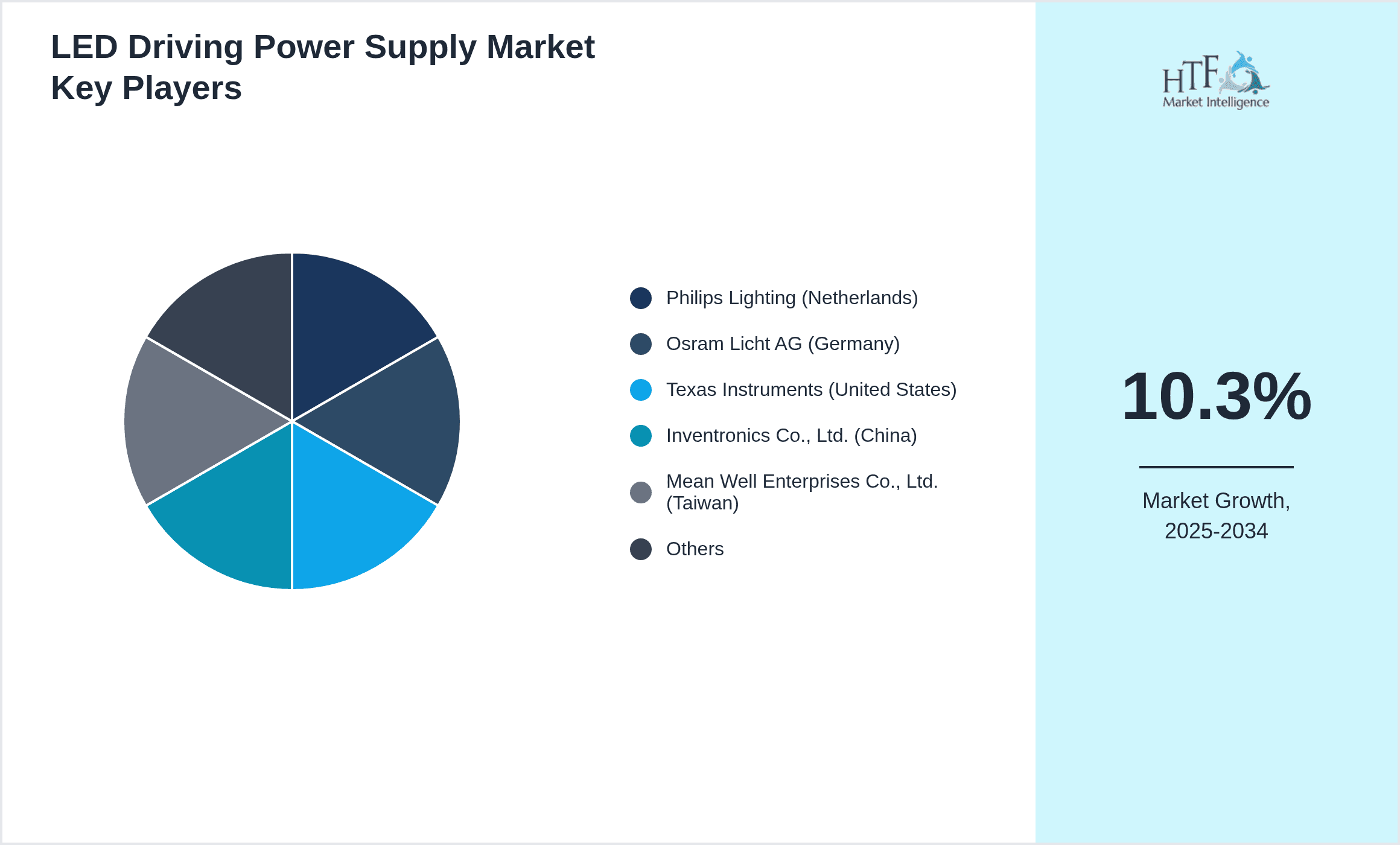
Leading Companies in LED Driving Power Supply Market
- •Philips Lighting (Netherlands)
- •Osram Licht AG (Germany)
- •Texas Instruments (United States)
- •Inventronics Co., Ltd. (China)
- •Mean Well Enterprises Co., Ltd. (Taiwan)
- •GE Lighting (United States)
- •Lite-On Technology Corporation (Taiwan)
- •Tridonic GmbH & Co KG (Austria)
- •Vossloh-Schwabe Deutschland GmbH (Germany)
- •Delta Electronics, Inc. (Taiwan)
- •Shanghai Fuda Power Technology Co., Ltd. (China)
- •LIFUD Technology Co., Ltd. (China)
- •Eaton Corporation (Ireland)
- •Samsung Electronics (South Korea)
- •Lutron Electronics Co., Inc. (United States)
- •Fulham Co., Inc. (United States)
- •Inventronics (China)
- •Mornsun Guangzhou Science & Technology Co., Ltd. (China)
- •Helvar Ltd. (Finland)
- •Cree, Inc. (United States)
Market Breakdown
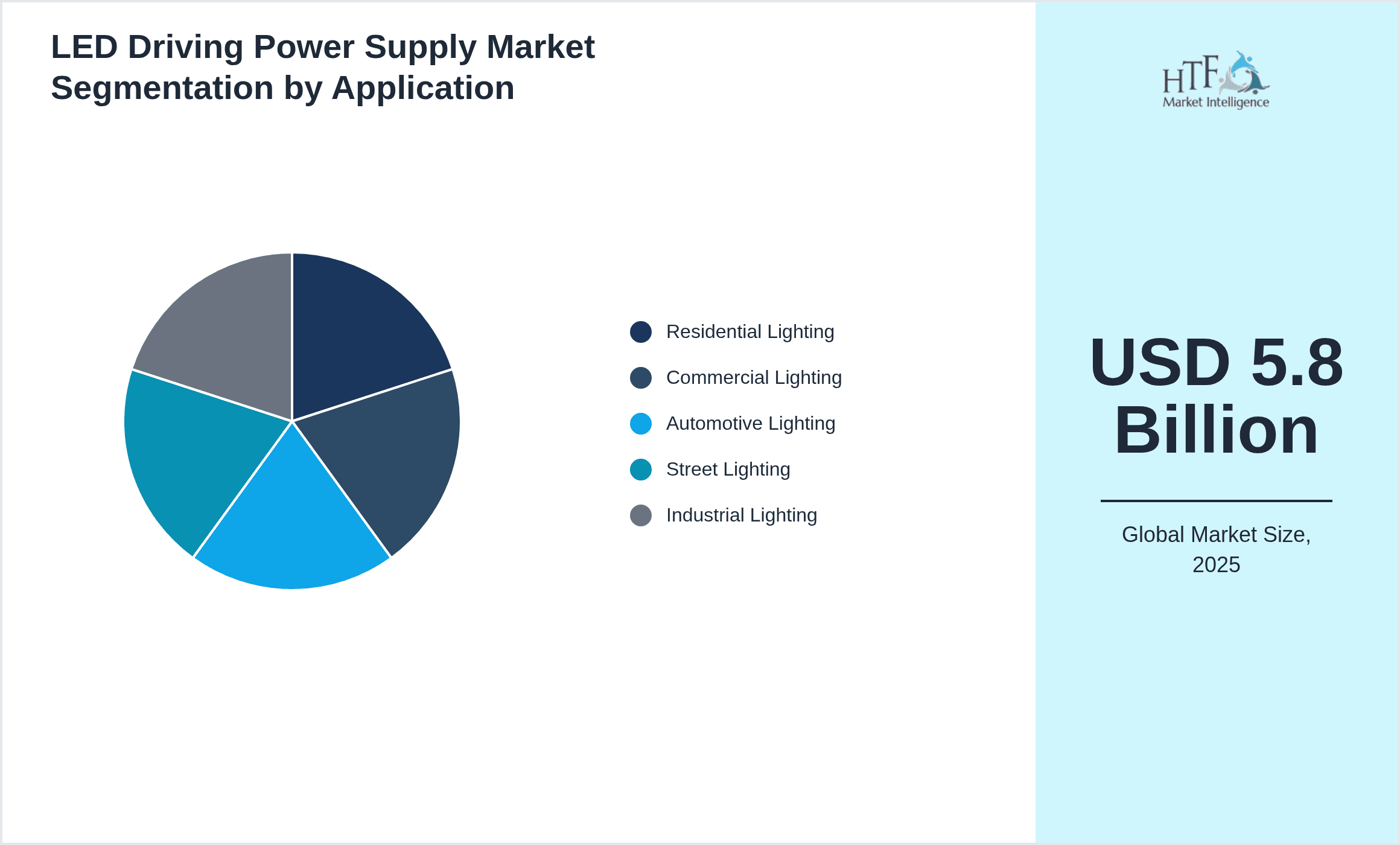
- •By Type
- ◦Constant Current LED Drivers
- ◦Constant Voltage LED Drivers
- ◦AC-DC LED Drivers
- ◦DC-DC LED Drivers
- ◦Dimmable LED Drivers
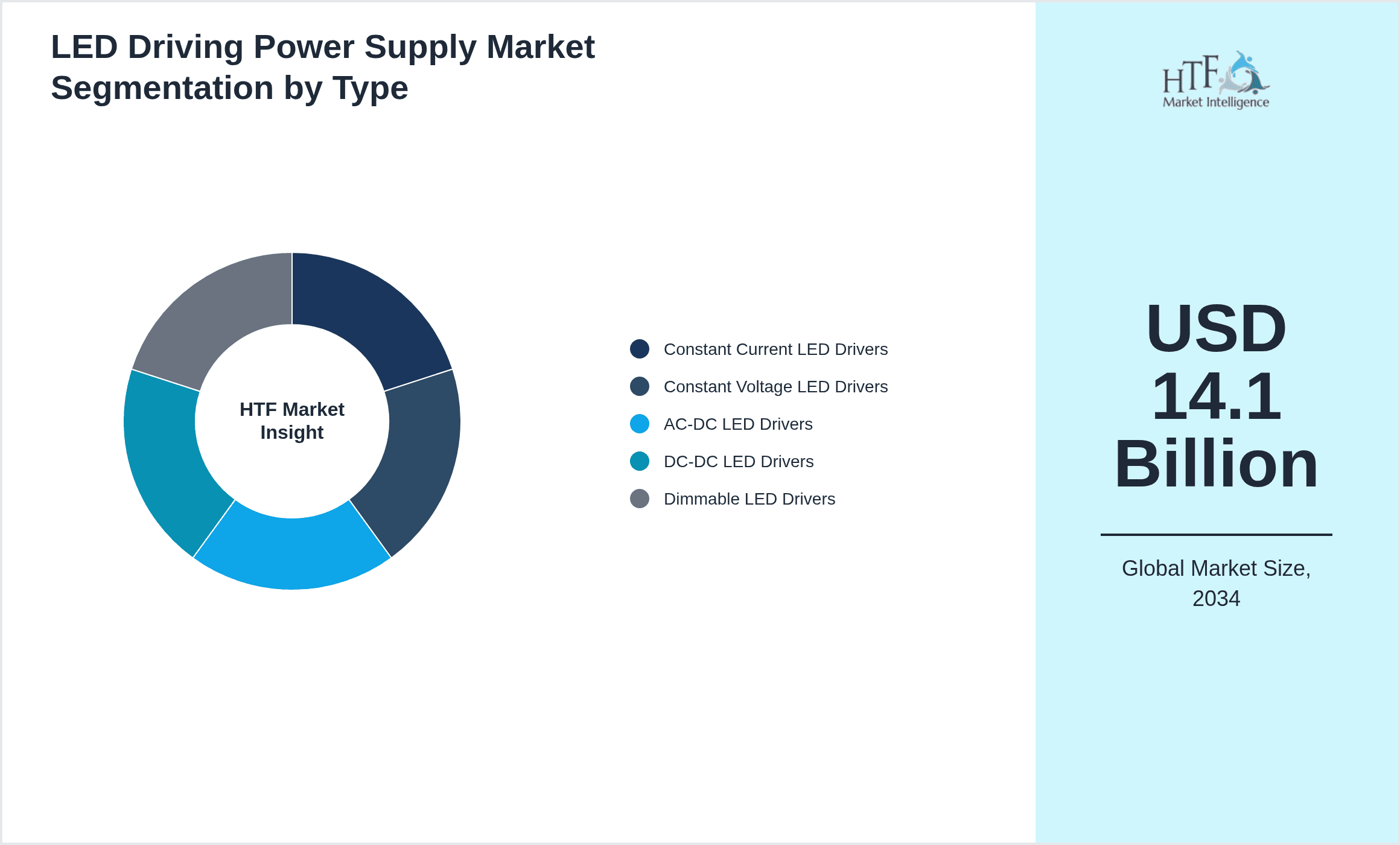
- •By Application
- ◦Residential Lighting
- ◦Commercial Lighting
- ◦Automotive Lighting
- ◦Street Lighting
- ◦Industrial Lighting
- •By End-Use Industry
- ◦Construction
- ◦Automotive
- ◦Retail
- ◦Manufacturing
- •By Distribution Channel
- ◦Direct Sales
- ◦Distributors
- ◦E-commerce
Growth Dynamics
Rising global demand for energy-efficient lighting solutions drives the LED Driving Power Supply market. Urbanization and infrastructure development in emerging economies accelerate adoption in commercial and street lighting applications. Technological advancements such as dimmable and programmable drivers enable enhanced user control and energy savings. Increasing government regulations promoting energy conservation and carbon emission reduction incentivize market expansion. The integration of LED drivers with smart lighting and IoT ecosystems fosters product innovation and new business models. Leading companies invest heavily in R&D to improve power supply efficiency and reliability, responding to evolving customer requirements. Recent initiatives targeting smart city projects in Asia-Pacific exemplify the market's growth potential. Furthermore, the shift from traditional lighting to LED-based systems in automotive lighting boosts demand, as LEDs offer longer lifespan and superior performance. These factors collectively propel market growth with substantial opportunities for stakeholders.
Market Trends
Emerging trends in the LED Driving Power Supply market include the rapid adoption of dimmable drivers that support dynamic lighting control, enhancing energy efficiency and user experience. The integration of LED drivers with IoT platforms allows remote management and predictive maintenance, transforming traditional lighting systems into smart networks. Increasing use of wireless communication protocols further facilitates seamless connectivity. The shift towards miniaturized and compact driver designs meets the demand for sleek lighting fixtures in modern architectural applications. Environmental sustainability drives development of lead-free and RoHS-compliant components. Market leaders increasingly focus on modular and scalable driver solutions adaptable to various configurations. Recent product launches featuring advanced thermal management and surge protection demonstrate innovation momentum. These trends position the market to capitalize on digital transformation and growing consumer preference for customizable, eco-friendly lighting solutions globally.
Market Opportunities
The LED Driving Power Supply market reveals significant opportunities in expanding smart city initiatives, where intelligent lighting systems require advanced driver technologies for integration and energy optimization. Growth in electric and autonomous vehicles presents new prospects for automotive LED drivers with specialized specifications. Emerging economies exhibit untapped potential due to increasing infrastructure investments and rising LED adoption rates. Innovation in dimmable and programmable drivers enables penetration into premium residential and commercial segments seeking customizable lighting experiences. Collaborations between LED manufacturers and IoT solution providers create avenues for integrated product offerings. Energy efficiency regulations across regions stimulate retrofit projects, driving demand for high-performance LED drivers. Additionally, the surge in demand for outdoor and street lighting in developing markets opens channels for durable and weather-resistant power supplies. These opportunities underscore the market's potential for innovation-led growth and geographic expansion.
Market Challenges
The LED Driving Power Supply market faces challenges including high initial costs associated with advanced driver technologies which can limit adoption in price-sensitive segments. Technical complexities in designing drivers compatible with diverse LED configurations and dimming standards pose development hurdles. Supply chain disruptions, particularly for semiconductor components, impact production timelines and pricing. Intense competition leads to pricing pressures, affecting profit margins for manufacturers. Regulatory compliance varies across regions, complicating product standardization and market entry strategies. Recent instances of component shortages highlight vulnerabilities in sourcing critical materials. Furthermore, achieving optimal thermal management and ensuring driver reliability under harsh environmental conditions remain engineering challenges. These factors collectively create barriers for new entrants and necessitate continuous innovation and strategic resource management by market players.
Regulatory Framework
Key regulations shaping the LED Driving Power Supply market over the past five years include energy efficiency standards such as the U.S. Department of Energy’s updated regulations for external power supplies, which mandate minimum efficiency levels reducing energy waste. The European Union’s Ecodesign Directive enforces strict environmental and performance requirements, compelling manufacturers to adhere to sustainability and safety norms. China’s Energy Labeling Program promotes energy-saving products with clear labeling for consumer awareness. Additionally, RoHS and REACH regulations globally restrict hazardous substances in electronic components, influencing material selection and manufacturing processes. Compliance with these regulations ensures market access, fosters innovation in eco-friendly designs, and aligns with global efforts to reduce carbon footprints in lighting solutions.
Market Intelligence
- •
- •
- •
- •
- •
Regional Outlook
The North America currently holds a significant share of the market, primarily due to several key factors: increasing consumption rates, a burgeoning population, and robust economic momentum. These elements collectively drive demand, positioning this region as a leader in the market. On the other hand, Asia-Pacific is rapidly emerging as the fastest-growing area within the industry. This remarkable growth can be attributed to swift infrastructure development, the expansion of various industrial sectors, and a marked increase in consumer demand. These dynamics make this region a crucial player in shaping future market growth.
In our report, we cover a comprehensive analysis of the following regions and countries:
- North America
- LATAM
- West Europe
- Central & Eastern Europe
- Northern Europe
- Southern Europe
- East Asia
- Southeast Asia
- South Asia
- Central Asia
- Oceania
- MEA
| Feature | Details |
|---|---|
| Base Year Market Size | USD 5.8 Billion |
| Forecast Year Market Size | USD 14.1 Billion |
| CAGR | 10.3% |
| Forecast Period | 2026 to 2033 |
| YoY Growth | 10.2% |
| Scope of Report | Market is segmented by Type (Constant Current LED Drivers, Constant Voltage LED Drivers, AC-DC LED Drivers, DC-DC LED Drivers, Dimmable LED Drivers), Application (Residential Lighting, Commercial Lighting, Automotive Lighting, Street Lighting, Industrial Lighting), End-Use Industry (Construction, Automotive, Retail, Manufacturing), Distribution Channel (Direct Sales, Distributors, E-commerce) |
| Regions Covered | North America, LATAM, West Europe, Central & Eastern Europe, Northern Europe, Southern Europe, East Asia, Southeast Asia, South Asia, Central Asia, Oceania, MEA |
| Key Companies | Philips Lighting (Netherlands), Osram Licht AG (Germany), Texas Instruments (United States), Inventronics Co., Ltd. (China), Mean Well Enterprises Co., Ltd. (Taiwan), GE Lighting (United States), Lite-On Technology Corporation (Taiwan), Tridonic GmbH & Co KG (Austria), Vossloh-Schwabe Deutschland GmbH (Germany), Delta Electronics, Inc. (Taiwan), Shanghai Fuda Power Technology Co., Ltd. (China), LIFUD Technology Co., Ltd. (China), Eaton Corporation (Ireland), Samsung Electronics (South Korea), Lutron Electronics Co., Inc. (United States), Fulham Co., Inc. (United States), Inventronics (China), Mornsun Guangzhou Science & Technology Co., Ltd. (China), Helvar Ltd. (Finland), Cree, Inc. (United States) |
Global LED Driving Power Supply Market Size, Growth & Revenue 2025-2034 - Table of Contents
Frequently Asked Questions (FAQ):
The Compact Track Loaders market is projected to grow at a CAGR of 6.8% from 2025 to 2030, driven by increasing demand in construction and agricultural sectors.
North America currently leads the market with approximately 45% market share, followed by Europe at 28% and Asia-Pacific at 22%. The remaining regions account for 5% of the global market.
Key growth drivers include increasing construction activities, rising demand for versatile equipment in agriculture, technological advancements in track loader design, and growing preference for compact equipment in urban construction projects.