
Global Marine Airbag Market Size, Growth & Revenue 2024-2034
Global Marine Airbag Market is segmented by Product Type (Rubber Marine Airbags, Reinforced Marine Airbags, Synthetic Marine Airbags, Steel Cord Marine Airbags, Hybrid Marine Airbags), Application (Ship Launching, Ship Lifting, Heavy Cargo Transportation, Salvage Operations, Offshore Construction), End-Use Industry (Shipbuilding, Offshore Oil and Gas, Port and Harbor Operations, Marine Salvage Services), Distribution Channel (Direct Sales, Distributors, Online Sales), and Geography (North America, LATAM, West Europe, Central & Eastern Europe, Northern Europe, Southern Europe, East Asia, Southeast Asia, South Asia, Central Asia, Oceania, MEA)
Pricing
Report Overview
Executive Summary
- •The global Marine Airbag market is a critical segment within maritime and offshore industries, focusing on innovative airbag technologies used for ship launching, heavy cargo transportation, salvage operations, and offshore construction. These airbags, made from materials such as rubber, reinforced synthetic fabrics, and steel cord composites, provide essential buoyancy and cushioning to vessels and cargo, enabling safer, efficient operations across global ports and shipyards. The market scope covers a wide range of applications and integrates advances in material science and engineering to improve load capacity and durability. Its significance is heightened by increasing global maritime trade, the need for cost-effective shipbuilding methods, and stringent safety regulations. The industry comprises manufacturers, distributors, and service providers who cater to diverse geographic regions including North America, Europe, Asia-Pacific, Latin America, and the Middle East & Africa. Market growth is supported by technological innovation, expanding shipbuilding activities, and rising demand for eco-friendly and reliable marine launching solutions worldwide.
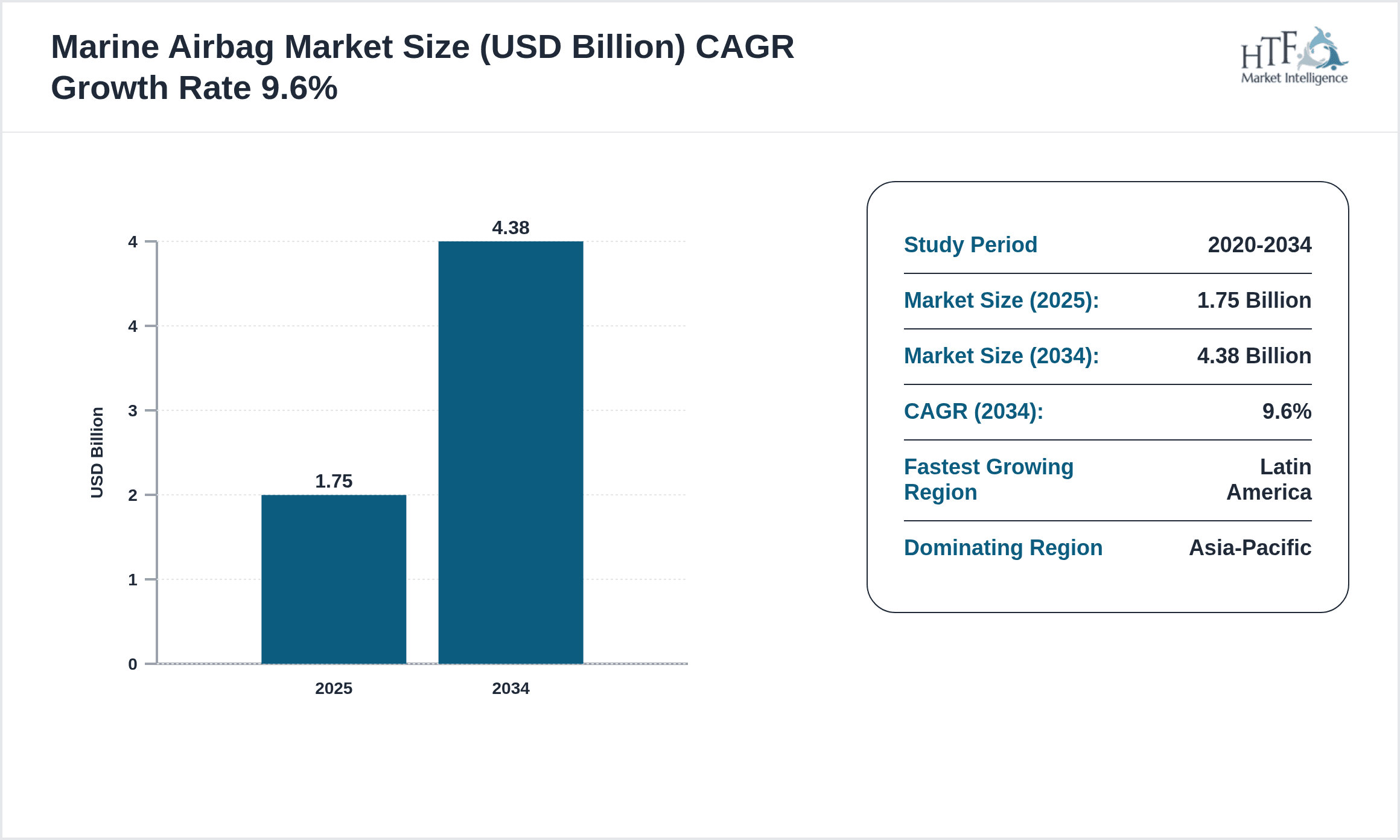
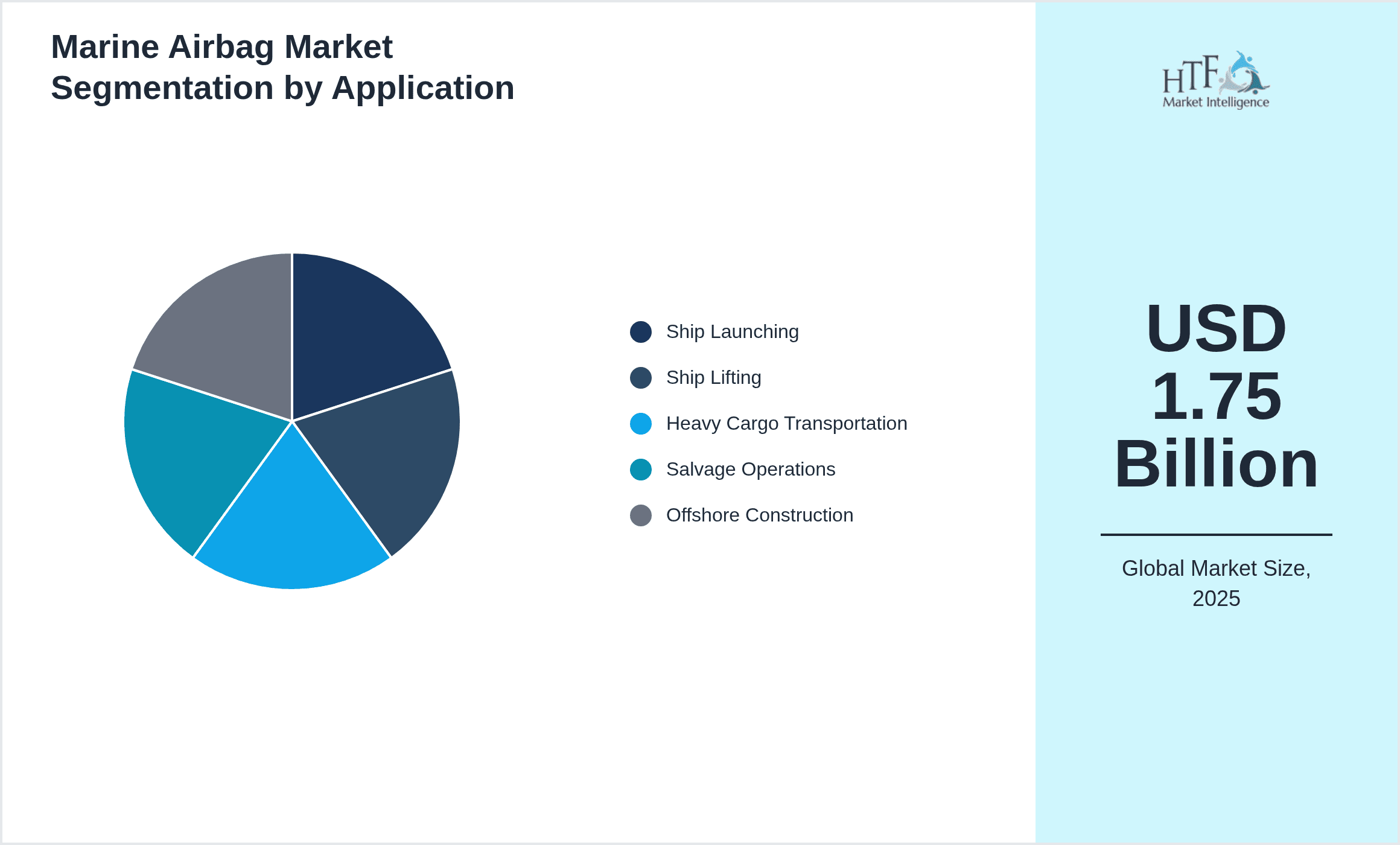
- •Key highlights include a base market size of USD 1.75 Billion in 2024, projected to reach USD 4.38 Billion by 2034, reflecting a CAGR of 9.6%. The Asia-Pacific region dominates the market with the highest share, driven by extensive shipbuilding and maritime infrastructure development, while Latin America exhibits the fastest growth rate due to increasing offshore operations and port expansions. Rubber Marine Airbags remain the leading product type due to their proven durability and cost efficiency, whereas Hybrid Marine Airbags are the fastest growing segment, benefiting from technological advancements that combine materials for enhanced performance. Ship Launching remains the primary application, followed closely by Heavy Cargo Transportation, underscoring the critical role of airbags in maritime logistics and vessel deployment. These factors collectively underscore robust industry growth and diversification.
- •The Marine Airbag market offers strategic value to maritime construction firms, shipbuilders, offshore service providers, and logistics companies by reducing operational costs and improving safety standards. Its advanced technologies enable scalable solutions that align with global sustainability goals by minimizing environmental impact compared to traditional launching methods. Stakeholders benefit from emerging opportunities in developing regions and innovations in airbag materials and design. As global trade volumes increase and maritime infrastructure evolves, the Marine Airbag market remains a pivotal enabler of efficient marine operations, fostering competitive advantage and long-term industry resilience.
Competitive Landscape
The global Marine Airbag market is characterized by a highly competitive environment with numerous players focusing on innovation, quality differentiation, and strategic partnerships to secure market share. Leading companies invest heavily in R&D to develop airbags with improved load-bearing capacity, enhanced durability, and environmental resistance to withstand harsh marine conditions. The market sees intense rivalry driven by regional capabilities, product customization, and price competitiveness. Market players adopt diverse strategies including product portfolio expansion, mergers and acquisitions, and alliances with shipyards and offshore contractors to strengthen their presence. The competitive landscape also features emerging players leveraging advanced synthetic materials and hybrid designs to disrupt traditional offerings. Additionally, adherence to stringent maritime safety regulations and certification standards is a key factor influencing market positioning. Distribution networks and after-sales service quality further define competitive differentiation. Future trends indicate consolidation through M&A, increasing automation in manufacturing, and a focus on sustainable product innovations to meet evolving customer demands globally.
Leading Companies in Marine Airbag Market
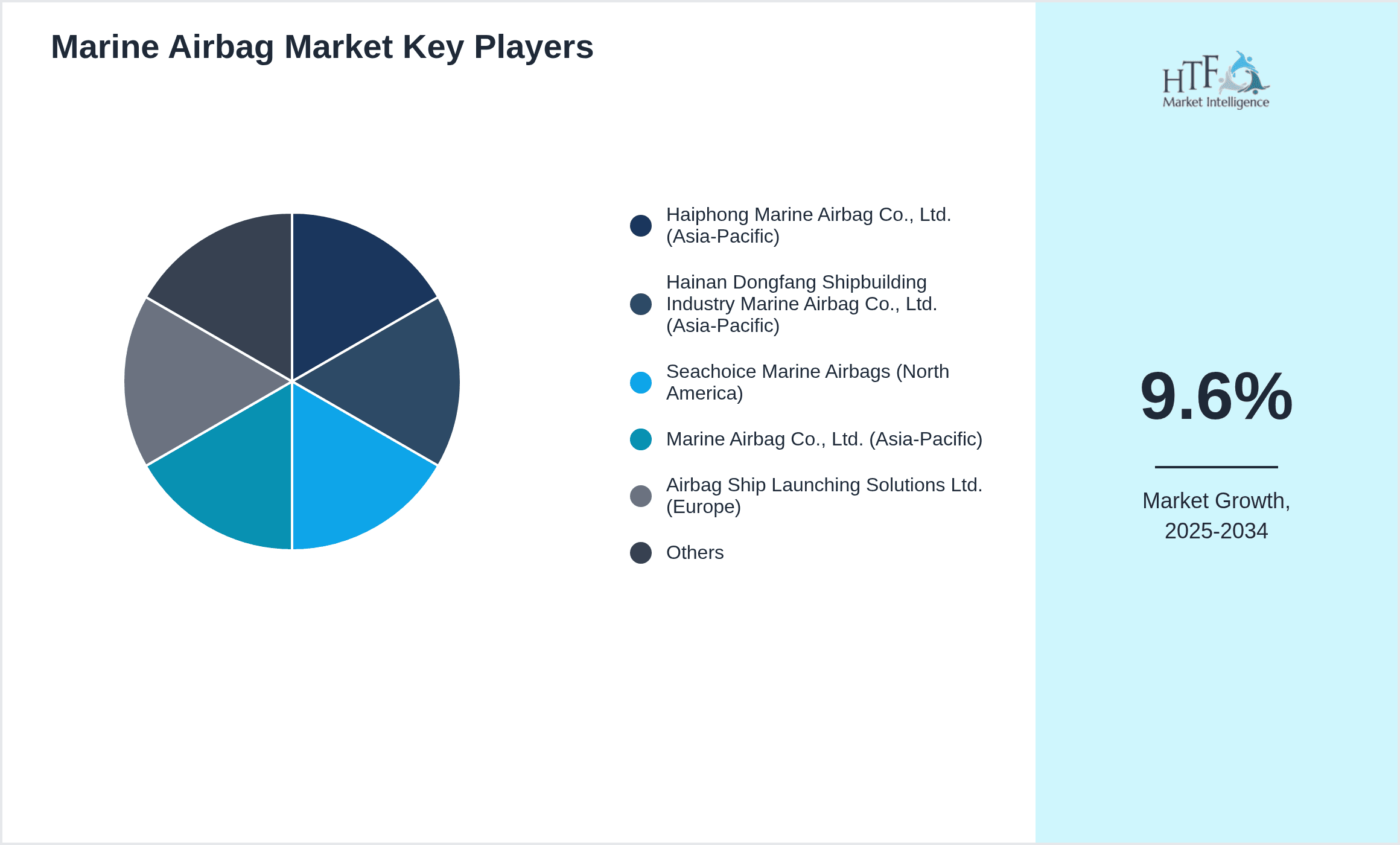
- •Haiphong Marine Airbag Co., Ltd. (Asia-Pacific)
- •Hainan Dongfang Shipbuilding Industry Marine Airbag Co., Ltd. (Asia-Pacific)
- •Seachoice Marine Airbags (North America)
- •Marine Airbag Co., Ltd. (Asia-Pacific)
- •Airbag Ship Launching Solutions Ltd. (Europe)
- •Shanghai Dongfeng Marine Airbag Co., Ltd. (Asia-Pacific)
- •Jiangsu Ocean Marine Airbag Manufacturing (Asia-Pacific)
- •ZH Marine Equipment Co., Ltd. (Asia-Pacific)
- •Yantai Haixin Marine Technology Co., Ltd. (Asia-Pacific)
- •Marine Tech Airbags Inc. (North America)
- •Suzhou Sea King Marine Airbag Systems (Asia-Pacific)
- •Ningbo Ocean Marine Airbag Corporation (Asia-Pacific)
- •Korea Marine Airbag Co., Ltd. (Asia-Pacific)
- •Oceanic Airbag Systems Ltd. (Europe)
- •Shenzhen Marine Safety Equipment Co., Ltd. (Asia-Pacific)
- •Marine Airbag Enterprises Ltd. (Middle East & Africa)
- •Global Marine Airbag Solutions (Europe)
- •Asia Marine Innovations Co., Ltd. (Asia-Pacific)
- •Ocean Marine Systems Inc. (North America)
- •Wuxi Marine Airbag Technology Co., Ltd. (Asia-Pacific)
- •PT Marine Airbag Indonesia (Asia-Pacific)
- •Marine Airbag Solutions GmbH (Europe)
- •Seawave Marine Airbag Co., Ltd. (Asia-Pacific)
- •Oceanic Marine Equipment Ltd. (Europe)
- •Yantai Ocean Marine Airbag Manufacturing (Asia-Pacific)
Market Breakdown
- •By Product Type
- ◦Rubber Marine Airbags
- ◦Reinforced Marine Airbags
- ◦Synthetic Marine Airbags
- ◦Steel Cord Marine Airbags
- ◦Hybrid Marine Airbags
- •By Application
- ◦Ship Launching
- ◦Ship Lifting
- ◦Heavy Cargo Transportation
- ◦Salvage Operations
- ◦Offshore Construction
- •By End-Use Industry
- ◦Shipbuilding
- ◦Offshore Oil and Gas
- ◦Port and Harbor Operations
- ◦Marine Salvage Services
- •By Distribution Channel
- ◦Direct Sales
- ◦Distributors
- ◦Online Sales
Growth Dynamics
- •Rising global maritime trade and shipbuilding activities are primary growth drivers, stimulating demand for efficient marine launching solutions that reduce operational costs and improve safety. Increasing investments in port infrastructure across Asia-Pacific and Latin America further amplify market expansion.
- •Technological advancements in materials such as hybrid composites enable airbags with enhanced durability and load capacity, allowing wider application in heavy cargo transport and offshore construction projects, thereby fueling market growth.
- •Growing environmental regulations encourage the adoption of eco-friendly marine airbag solutions that minimize underwater noise and pollution compared to conventional launching methods, attracting stakeholders focused on sustainability.
- •Expanding offshore oil and gas exploration necessitates reliable salvage and lifting operations, increasing demand for specialized airbags designed for harsh marine environments, particularly in emerging markets.
- •Strategic collaborations between marine airbag manufacturers and shipyards enable customization and integration of airbags in new vessel designs, enhancing operational efficiency and market penetration.

Market Trends
- •The shift towards hybrid marine airbags combining rubber and synthetic fibers reflects a growing trend to optimize strength-to-weight ratios, providing enhanced performance and longer service life in marine applications.
- •Digitalization of manufacturing processes, including IoT-enabled monitoring of airbag condition and performance, is gaining traction to improve maintenance scheduling and operational safety.
- •An increasing number of companies are adopting sustainable sourcing and production practices, aligning with global maritime environmental standards and customer expectations.
- •Collaborations between marine airbag providers and offshore engineering firms are becoming prevalent to develop integrated solutions for complex lifting and salvage operations.
- •Market consolidation through mergers and acquisitions is intensifying as companies seek to expand geographic reach and technological capabilities, enhancing competitive positioning.
Market Opportunities
- •Emerging markets in Latin America and the Middle East offer significant growth potential due to expanding offshore infrastructure and increasing maritime trade volumes requiring advanced marine airbag solutions.
- •Innovation in biodegradable and eco-friendly airbag materials presents a lucrative opportunity for companies focused on sustainable product development and compliance with stringent environmental regulations.
- •Development of customized airbags for niche applications such as Arctic marine operations and deep-sea salvage can open new revenue streams and competitive differentiation.
- •Expansion of online distribution channels and digital sales platforms can enhance market accessibility and customer engagement globally, particularly in underserved regions.
- •Strategic alliances with shipbuilding and offshore service companies can facilitate integrated solutions, increasing adoption rates and market footprint.
Market Challenges
- •High initial costs associated with advanced marine airbags and installation can limit adoption, especially among small to medium shipyards with constrained capital expenditure budgets.
- •Stringent regulatory compliance and certification requirements across different regions pose challenges for manufacturers, increasing time-to-market and operational costs.
- •Material degradation due to prolonged exposure to harsh marine environments, including UV radiation and saltwater corrosion, affects airbag lifespan and increases maintenance demands.
- •Fragmented market with numerous small players leads to price competition and challenges in establishing strong brand recognition and customer loyalty.
- •Supply chain disruptions and raw material price volatility can impact production schedules and profitability, especially for airbags relying on specialized composites.
Regulatory Framework
- •Between 2019 and 2024, international maritime organizations introduced updated safety standards mandating rigorous testing and certification for marine airbags used in ship launching and salvage operations to ensure operator safety and environmental protection.
- •New regulations in Europe and North America require manufacturers to comply with environmental norms limiting emissions and waste during airbag production and disposal, fostering adoption of sustainable materials.
- •Regional mandates in Asia-Pacific emphasize compliance with national maritime safety agencies, requiring periodic inspections and maintenance documentation for marine airbags deployed in commercial ports.
- •Government incentives in key shipbuilding nations promote the use of innovative marine airbag technologies that reduce carbon footprint and enhance operational efficiency, accelerating industry modernization.
- •Global policy frameworks encourage harmonization of safety and environmental standards to facilitate international trade and cross-border marine operations involving airbags, reducing regulatory complexity for manufacturers.
Market Intelligence
- •On 15th January 2025, Haiphong Marine Airbag Co., Ltd. launched a new line of hybrid marine airbags that combine rubber and advanced synthetic fibers, offering enhanced durability and load capacity tailored for offshore construction projects. This innovation aims to address the growing demand for resilient airbags capable of withstanding extreme marine environments, positioning the company as a technology leader. The product features integrated IoT sensors for real-time monitoring, enhancing safety and reducing maintenance costs. This launch is expected to capture significant market share in Asia-Pacific and Latin America, aligning with increasing maritime infrastructure investments. Source: Official company press release.
- •In March 2025, Marine Tech Airbags Inc. announced the expansion of its manufacturing facility in North America to increase production capacity of reinforced marine airbags. The expansion includes state-of-the-art automation technologies aimed at improving product consistency and reducing lead times. This strategic move supports growing demand from the offshore oil and gas and shipbuilding sectors, enabling faster delivery schedules and enhanced customer service. It also reflects the company’s commitment to sustainability through energy-efficient processes and waste reduction initiatives. The facility upgrade is projected to boost annual revenues substantially. Source: Corporate news bulletin.
- •On 10th May 2025, Airbag Ship Launching Solutions Ltd. entered into a strategic partnership with a leading European shipyard to co-develop customized marine airbag systems for next-generation vessel launching. This collaboration leverages advanced material science and engineering expertise to produce airbags optimized for heavier ship classes and complex launching scenarios. The partnership is expected to drive innovation and strengthen market presence in Europe and Asia-Pacific, addressing evolving customer requirements. It also highlights the trend of integrated solutions combining product development with operational consulting. Source: Industry publication.
- •In June 2025, Shanghai Dongfeng Marine Airbag Co., Ltd. introduced an eco-friendly marine airbag line featuring biodegradable coatings and recyclable materials designed to minimize environmental impact in port operations. The new product complies with stringent global maritime environmental standards and targets eco-conscious shipbuilders and offshore operators. This launch represents a significant step towards sustainability in the marine airbag market, with potential to influence regulatory frameworks and customer preferences worldwide. Initial market response has been positive, with pre-orders from major clients in Asia-Pacific. Source: Company website announcement.
Regional Outlook
The Asia-Pacific currently holds a significant share of the market, primarily due to several key factors: increasing consumption rates, a burgeoning population, and robust economic momentum. These elements collectively drive demand, positioning this region as a leader in the market. On the other hand, Latin America is rapidly emerging as the fastest-growing area within the industry. This remarkable growth can be attributed to swift infrastructure development, the expansion of various industrial sectors, and a marked increase in consumer demand. These dynamics make this region a crucial player in shaping future market growth.
In our report, we cover a comprehensive analysis of the following regions and countries:
- North America
- LATAM
- West Europe
- Central & Eastern Europe
- Northern Europe
- Southern Europe
- East Asia
- Southeast Asia
- South Asia
- Central Asia
- Oceania
- MEA
| Feature | Details |
|---|---|
| Base Year Market Size | USD 1.75 Billion |
| Forecast Year Market Size | USD 4.38 Billion |
| CAGR | 9.6% |
| Forecast Period | 2026 to 2033 |
| YoY Growth | 9.2% |
| Scope of Report | Market is segmented by Product Type (Rubber Marine Airbags, Reinforced Marine Airbags, Synthetic Marine Airbags, Steel Cord Marine Airbags, Hybrid Marine Airbags), Application (Ship Launching, Ship Lifting, Heavy Cargo Transportation, Salvage Operations, Offshore Construction), End-Use Industry (Shipbuilding, Offshore Oil and Gas, Port and Harbor Operations, Marine Salvage Services), Distribution Channel (Direct Sales, Distributors, Online Sales) |
| Regions Covered | North America, LATAM, West Europe, Central & Eastern Europe, Northern Europe, Southern Europe, East Asia, Southeast Asia, South Asia, Central Asia, Oceania, MEA |
| Key Companies | Haiphong Marine Airbag Co., Ltd. (Asia-Pacific), Hainan Dongfang Shipbuilding Industry Marine Airbag Co., Ltd. (Asia-Pacific), Seachoice Marine Airbags (North America), Marine Airbag Co., Ltd. (Asia-Pacific), Airbag Ship Launching Solutions Ltd. (Europe), Shanghai Dongfeng Marine Airbag Co., Ltd. (Asia-Pacific), Jiangsu Ocean Marine Airbag Manufacturing (Asia-Pacific), ZH Marine Equipment Co., Ltd. (Asia-Pacific), Yantai Haixin Marine Technology Co., Ltd. (Asia-Pacific), Marine Tech Airbags Inc. (North America), Suzhou Sea King Marine Airbag Systems (Asia-Pacific), Ningbo Ocean Marine Airbag Corporation (Asia-Pacific), Korea Marine Airbag Co., Ltd. (Asia-Pacific), Oceanic Airbag Systems Ltd. (Europe), Shenzhen Marine Safety Equipment Co., Ltd. (Asia-Pacific), Marine Airbag Enterprises Ltd. (Middle East & Africa), Global Marine Airbag Solutions (Europe), Asia Marine Innovations Co., Ltd. (Asia-Pacific), Ocean Marine Systems Inc. (North America), Wuxi Marine Airbag Technology Co., Ltd. (Asia-Pacific), PT Marine Airbag Indonesia (Asia-Pacific), Marine Airbag Solutions GmbH (Europe), Seawave Marine Airbag Co., Ltd. (Asia-Pacific), Oceanic Marine Equipment Ltd. (Europe), Yantai Ocean Marine Airbag Manufacturing (Asia-Pacific) |
Global Marine Airbag Market Size, Growth & Revenue 2024-2034 - Table of Contents
Frequently Asked Questions (FAQ):
The Compact Track Loaders market is expected to see value worth 5.3 Billion in 2025.
North America currently leads the market with approximately 45% market share, followed by Europe at 28% and Asia-Pacific at 22%. The remaining regions account for 5% of the global market.
Key growth drivers include increasing construction activities, rising demand for versatile equipment in agriculture, technological advancements in track loader design, and growing preference for compact equipment in urban construction projects.