
Global Cabin for Construction Machinery Market Size, Growth & Revenue 2024-2034
Global Cabin for Construction Machinery Market is segmented by Product Type (Standard Cabin, Comfort Cabin, Safety Cabin, Luxury Cabin, Custom Cabin), Application (Excavators, Loaders, Bulldozers, Cranes, Others), End-Use Industry (Construction, Mining, Agriculture, Infrastructure Development), Distribution Channel (OEM Direct Sales, Aftermarket Dealers, Online Platforms), and Geography (North America, LATAM, West Europe, Central & Eastern Europe, Northern Europe, Southern Europe, East Asia, Southeast Asia, South Asia, Central Asia, Oceania, MEA)
Pricing
Report Overview
Executive Summary
- •The global Cabin for Construction Machinery market covers the manufacturing and application of specialized cabins designed for operators of heavy construction equipment, including excavators, loaders, bulldozers, cranes, and other machinery. These cabins are engineered to enhance operator safety, comfort, and productivity by integrating ergonomic design, climate control systems, noise reduction technologies, and safety features such as reinforced structures and advanced visibility options. The market includes various cabin types such as standard, comfort, safety-enhanced, luxury, and custom cabins, each adapted to specific operational demands and regulatory requirements. The scope extends to aftermarket retrofits and technological innovations that improve operator experience and compliance with evolving safety standards. This market is critical to the construction machinery industry, serving infrastructure development, mining, and industrial applications worldwide. Demand drivers include increased infrastructure investments, stringent safety regulations, and rising emphasis on operator well-being, positioning this market as a key segment in construction equipment manufacturing and service ecosystems.
- •Key market highlights include a robust CAGR of 8.6% projected from 2024 to 2034, with the market size expected to grow from USD 6.8 Billion in 2024 to USD 15.9 Billion by 2034. The comfort cabin segment stands as the leading product type, driven by operator demand for enhanced ergonomics, while the luxury cabin segment is anticipated to record the fastest growth owing to rising premiumization trends. Excavators dominate the application segment, reflecting their extensive use in construction and mining sectors. Geographically, North America holds the dominant market share due to advanced construction infrastructure and stringent safety norms, while Asia-Pacific exhibits the highest growth rate propelled by rapid urbanization and industrialization. Year-on-year growth rates remain strong at approximately 8.3%, indicating sustained market momentum and expanding opportunities across global regions.
- •The Cabin for Construction Machinery market offers significant value propositions to diverse stakeholders, including manufacturers, construction firms, and machinery operators. By enhancing operator safety and comfort, cabins improve operational efficiency, reduce downtime, and contribute to workplace safety compliance. Strategic importance is underscored by ongoing technological advancements, such as smart cabins equipped with IoT sensors and automation capabilities, which facilitate real-time monitoring and predictive maintenance. The market also supports aftermarket service providers through retrofitting and customization, creating additional revenue streams. Overall, the market's growth aligns with global infrastructure expansion, regulatory frameworks emphasizing operator protection, and growing demand for advanced construction machinery solutions, making it a critical segment within the global construction equipment ecosystem.

Competitive Landscape
The global Cabin for Construction Machinery market is characterized by intense competition among established manufacturers and emerging players focusing on innovation, product differentiation, and strategic partnerships. Market leaders invest heavily in R&D to develop cabins with enhanced ergonomic features, integrated digital controls, and compliance with evolving safety standards. Competitive strategies include expanding product portfolios to cover diverse cabin types such as comfort and luxury models, catering to varying customer segments. Companies leverage global distribution networks and aftermarket services to strengthen market presence and customer loyalty. Mergers and acquisitions are common to consolidate technological expertise and geographic reach. Pricing strategies balance cost-efficiency with premium offerings to address different market tiers. Regional competition varies, with North America and Europe dominated by technologically advanced cabins, while Asia-Pacific markets witness rapid growth fueled by infrastructure investments and demand for affordable yet sophisticated cabin solutions. Future trends point to increased adoption of smart cabin technologies and sustainable materials, raising competition levels further.
Prominent Players in Cabin for Construction Machinery Market
- •CNH Industrial N.V. (Netherlands)
- •Caterpillar Inc. (United States)
- •Volvo Construction Equipment (Sweden)
- •Komatsu Ltd. (Japan)
- •Hitachi Construction Machinery Co., Ltd. (Japan)
- •JCB (United Kingdom)
- •Liebherr Group (Switzerland)
- •Doosan Infracore (South Korea)
- •Terex Corporation (United States)
- •XCMG Group (China)
- •SANY Group Co., Ltd. (China)
- •Wirtgen Group (Germany)
- •Manitou Group (France)
- •Bobcat Company (United States)
- •Atlas Copco AB (Sweden)
- •Kobelco Construction Machinery Co., Ltd. (Japan)
- •Shantui Construction Machinery Co., Ltd. (China)
- •Hyundai Construction Equipment (South Korea)
- •Zoomlion Heavy Industry Science & Technology Co., Ltd. (China)
- •Doosan Bobcat Inc. (South Korea)
- •Ammann Group (Switzerland)
- •Takeuchi Mfg. Co., Ltd. (Japan)
- •Kawasaki Heavy Industries, Ltd. (Japan)
- •Furukawa Co., Ltd. (Japan)
- •LiuGong Machinery Corporation (China)
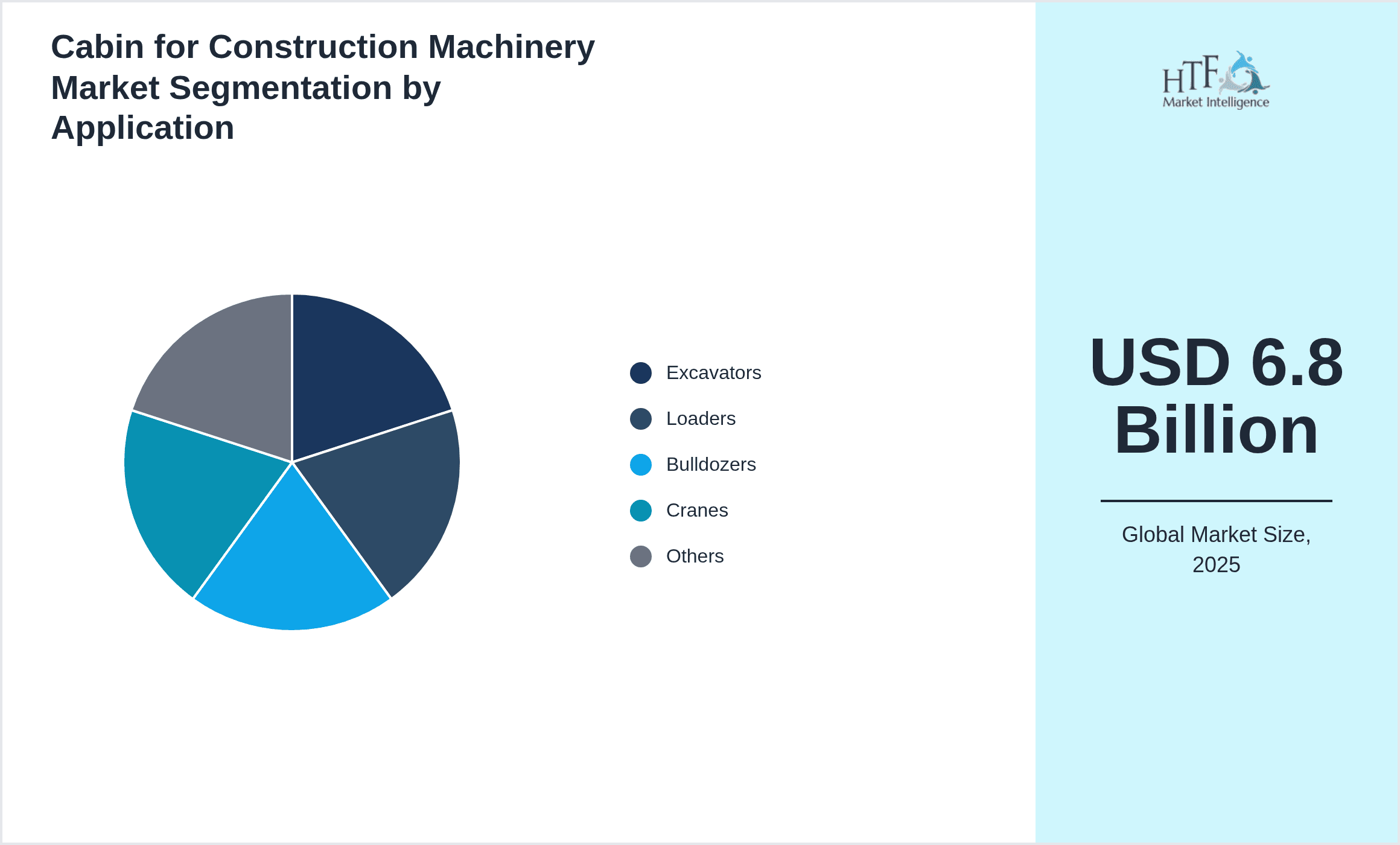
Market Breakdown
- •By Product Type
- ◦Standard Cabin
- ◦Comfort Cabin
- ◦Safety Cabin
- ◦Luxury Cabin
- ◦Custom Cabin
- •By Application
- ◦Excavators
- ◦Loaders
- ◦Bulldozers
- ◦Cranes
- ◦Others
- •By End-Use Industry
- ◦Construction
- ◦Mining
- ◦Agriculture
- ◦Infrastructure Development
- •By Distribution Channel
- ◦OEM Direct Sales
- ◦Aftermarket Dealers
- ◦Online Platforms
Growth Dynamics
- •Increasing infrastructure development worldwide is driving demand for advanced cabins that enhance operator safety and comfort, contributing to higher productivity and compliance with safety regulations.
- •Rising adoption of automation and smart cabin technologies, including IoT integration and real-time monitoring, is transforming cabin functionality and attracting significant investment from market players.
- •Growing emphasis on operator ergonomics, noise reduction, and climate control in cabins is creating demand for comfort and luxury cabin segments, especially in developed markets with stringent workplace safety standards.
- •Expansion in emerging economies, particularly in Asia-Pacific, is fueling market growth due to increased construction activities and modernization of heavy machinery fleets with upgraded cabins.
- •Government regulations mandating enhanced safety standards for construction equipment operators are compelling manufacturers to innovate and integrate advanced safety cabins.
- •Investment in aftermarket services and retrofitting solutions offers additional growth avenues by extending the lifecycle and functionality of existing machinery cabins.
- •Sustainability trends are encouraging the use of eco-friendly materials and energy-efficient cabin designs, appealing to environmentally conscious stakeholders in the construction industry.

Market Trends
- •Integration of advanced digital displays and control systems in cabins is enhancing operator-machine interaction, leading to improved operational efficiency and safety.
- •Modular cabin designs allowing easy customization and rapid replacement are gaining traction, enabling equipment owners to tailor cabins to specific jobsite requirements.
- •Emerging use of augmented reality (AR) and heads-up displays within cabins is setting new benchmarks for operator assistance and situational awareness.
- •Sustainability is influencing cabin manufacturing through the adoption of recyclable materials and energy-saving climate control technologies to reduce environmental impact.
- •Collaborations between cabin manufacturers and construction equipment OEMs are intensifying to co-develop integrated solutions that streamline production and after-sales support.
- •Market segmentation is becoming more nuanced with offerings that cater specifically to different machinery types, enhancing compatibility and operator experience across applications.
- •The proliferation of remote monitoring and telematics integration in cabins supports predictive maintenance and fleet management, driving adoption in fleet-intensive construction operations.

Market Opportunities
- •There is significant growth potential in emerging markets where rapid urbanization and infrastructure projects are increasing demand for modern construction machinery cabins.
- •Developing smart cabins equipped with AI-driven safety features and automation capabilities presents an opportunity for differentiation and premium pricing.
- •Expanding aftermarket retrofit services for upgrading older machinery cabins can unlock new revenue streams and prolong equipment usability.
- •Geographical expansion into underpenetrated regions such as Latin America and the Middle East offers untapped market prospects driven by growing construction activities.
- •Innovations in sustainable cabin materials and energy-efficient systems align with global environmental goals, appealing to eco-conscious customers and regulators.
- •Strategic partnerships between cabin manufacturers and technology providers can accelerate development of next-generation cabins with enhanced connectivity features.
- •Customization and modular cabin solutions tailored to niche applications provide opportunities to capture specialized market segments with unique requirements.
Market Challenges
- •High costs associated with advanced cabin technologies and premium materials may deter adoption among price-sensitive customers, particularly in developing regions.
- •Stringent and varying safety regulations across countries complicate product standardization and increase compliance costs for manufacturers operating globally.
- •Supply chain disruptions and raw material price volatility impact production timelines and profitability, posing a significant operational challenge.
- •Competition from low-cost cabin manufacturers can lead to price erosion and pressure on margins, especially in price-competitive markets.
- •Technological complexity of integrating smart features requires continuous R&D investment and skilled workforce, posing resource challenges for smaller players.
- •Limited awareness and adoption of advanced cabin solutions in certain emerging economies restrict market penetration and growth potential.
- •Retrofitting older machinery with new cabins can be technically challenging due to compatibility issues, limiting aftermarket growth opportunities.
Regulatory Framework
- •Between 2020 and 2024, multiple regions implemented stricter operator safety norms mandating enhanced cabin structural integrity and crash protection features, increasing compliance requirements across the market.
- •The European Union enforced updated machinery directive standards with specific cabin noise and vibration limits, compelling manufacturers to integrate advanced noise reduction technologies.
- •In North America, OSHA regulations introduced new guidelines for operator seat design and visibility standards within cabins, influencing product design and testing protocols.
- •Asia-Pacific countries, including China and India, have progressively adopted international safety standards, harmonizing regulations and creating export opportunities for compliant cabin products.
- •Government incentives promoting sustainable construction equipment have encouraged adoption of eco-friendly cabin materials and energy-efficient climate control systems.
Market Intelligence
- •15th January 2025, Caterpillar Inc. launched its latest Comfort Cabin model featuring state-of-the-art ergonomic seating, integrated climate control, and advanced noise insulation technology aimed at enhancing operator productivity and safety. This new cabin is designed to meet stringent North American and European safety standards and includes IoT-enabled sensors for real-time monitoring of cabin conditions. Caterpillar’s innovation underscores their commitment to operator well-being and sets a new benchmark in construction machinery cabins, expected to drive significant market demand across global regions.
- •20th March 2025, Volvo Construction Equipment introduced a smart Safety Cabin equipped with augmented reality heads-up display and AI-based hazard detection systems. This cabin leverages cutting-edge technology to provide operators with enhanced situational awareness and automated safety alerts, reducing accident risks on construction sites. The product launch aligns with Volvo's strategic focus on digital transformation and sustainable construction solutions, positioning it as a leader in next-generation cabin technology adoption worldwide.
- •10th June 2024, CNH Industrial N.V. announced a strategic partnership with a leading IoT technology provider to integrate predictive maintenance capabilities into their cabin systems. This collaboration aims to reduce equipment downtime by enabling real-time diagnostics and proactive servicing alerts directly from the operator cabin interface. The initiative is expected to enhance operational efficiency for construction firms and strengthen CNH's competitive advantage in the cabin market globally.
- •5th September 2024, Komatsu Ltd. completed the acquisition of a European cabin manufacturer specializing in luxury cabins with advanced ergonomic features. This acquisition expands Komatsu’s product portfolio and manufacturing footprint, enabling it to cater to premium segments in Europe and North America. The deal reflects Komatsu’s strategic intent to consolidate its position in the global cabin market through innovation and geographic diversification.
- •Source: Official press releases from Caterpillar Inc., Volvo Construction Equipment, CNH Industrial N.V., Komatsu Ltd.
Regional Outlook
The North America currently holds a significant share of the market, primarily due to several key factors: increasing consumption rates, a burgeoning population, and robust economic momentum. These elements collectively drive demand, positioning this region as a leader in the market. On the other hand, Asia-Pacific is rapidly emerging as the fastest-growing area within the industry. This remarkable growth can be attributed to swift infrastructure development, the expansion of various industrial sectors, and a marked increase in consumer demand. These dynamics make this region a crucial player in shaping future market growth.
In our report, we cover a comprehensive analysis of the following regions and countries:
- North America
- LATAM
- West Europe
- Central & Eastern Europe
- Northern Europe
- Southern Europe
- East Asia
- Southeast Asia
- South Asia
- Central Asia
- Oceania
- MEA
| Feature | Details |
|---|---|
| Base Year Market Size | USD 6.8 Billion |
| Forecast Year Market Size | USD 15.9 Billion |
| CAGR | 8.6% |
| Forecast Period | 2026 to 2033 |
| YoY Growth | 8.3% |
| Scope of Report | Market is segmented by Product Type (Standard Cabin, Comfort Cabin, Safety Cabin, Luxury Cabin, Custom Cabin), Application (Excavators, Loaders, Bulldozers, Cranes, Others), End-Use Industry (Construction, Mining, Agriculture, Infrastructure Development), Distribution Channel (OEM Direct Sales, Aftermarket Dealers, Online Platforms) |
| Regions Covered | North America, LATAM, West Europe, Central & Eastern Europe, Northern Europe, Southern Europe, East Asia, Southeast Asia, South Asia, Central Asia, Oceania, MEA |
| Key Companies | CNH Industrial N.V. (Netherlands), Caterpillar Inc. (United States), Volvo Construction Equipment (Sweden), Komatsu Ltd. (Japan), Hitachi Construction Machinery Co., Ltd. (Japan), JCB (United Kingdom), Liebherr Group (Switzerland), Doosan Infracore (South Korea), Terex Corporation (United States), XCMG Group (China), SANY Group Co., Ltd. (China), Wirtgen Group (Germany), Manitou Group (France), Bobcat Company (United States), Atlas Copco AB (Sweden), Kobelco Construction Machinery Co., Ltd. (Japan), Shantui Construction Machinery Co., Ltd. (China), Hyundai Construction Equipment (South Korea), Zoomlion Heavy Industry Science & Technology Co., Ltd. (China), Doosan Bobcat Inc. (South Korea), Ammann Group (Switzerland), Takeuchi Mfg. Co., Ltd. (Japan), Kawasaki Heavy Industries, Ltd. (Japan), Furukawa Co., Ltd. (Japan), LiuGong Machinery Corporation (China) |
Global Cabin for Construction Machinery Market Size, Growth & Revenue 2024-2034 - Table of Contents
Frequently Asked Questions (FAQ):
The Compact Track Loaders market is projected to grow at a CAGR of 6.8% from 2025 to 2030, driven by increasing demand in construction and agricultural sectors.
North America currently leads the market with approximately 45% market share, followed by Europe at 28% and Asia-Pacific at 22%. The remaining regions account for 5% of the global market.
Key growth drivers include increasing construction activities, rising demand for versatile equipment in agriculture, technological advancements in track loader design, and growing preference for compact equipment in urban construction projects.