
Global Confectionery Depositors Market Size, Growth & Revenue 2024-2034
Global Confectionery Depositors Market is segmented by Product Type (Hydraulic Depositors, Pneumatic Depositors, Servo-driven Depositors, Electric Depositors, Manual Depositors), Application (Chocolate, Pastry, Candy, Bakery, Ice Cream), End-Use Industry (Confectionery Manufacturers, Bakery Industry, Ice Cream Producers, Pastry & Dessert Makers), Distribution Channel (Direct Sales, Distributors, Online Platforms), and Geography (North America, LATAM, West Europe, Central & Eastern Europe, Northern Europe, Southern Europe, East Asia, Southeast Asia, South Asia, Central Asia, Oceania, MEA)
Pricing
Report Overview
Executive Summary
- •The Global Confectionery Depositors Market represents a critical segment within the food processing machinery industry, focusing on specialized equipment designed to deposit precise quantities of confectionery materials including chocolate, candy, pastries, bakery goods, and ice cream. This market's scope includes a broad range of depositor types such as hydraulic, pneumatic, servo-driven, electric, and manual machines, each offering unique capabilities suited to different production scales and product specifications. The core purpose of these depositors is to enhance manufacturing efficiency by automating product shaping and filling processes, thereby ensuring uniformity and elevating product quality. The market is expansive, serving manufacturers from small artisanal producers to large-scale industrial confectioners across global regions. With increasing consumer demand for premium and customized confectionery products, manufacturers are investing in technologically advanced depositors that offer precision, speed, and flexibility. The industry also integrates associated services including installation, maintenance, and upgrades, emphasizing holistic solutions to optimize operational workflows. The market's growth is further driven by trends in automation, sustainability, and regulatory compliance that influence product design and manufacturing strategies, positioning confectionery depositors as indispensable tools in modern confectionery production.
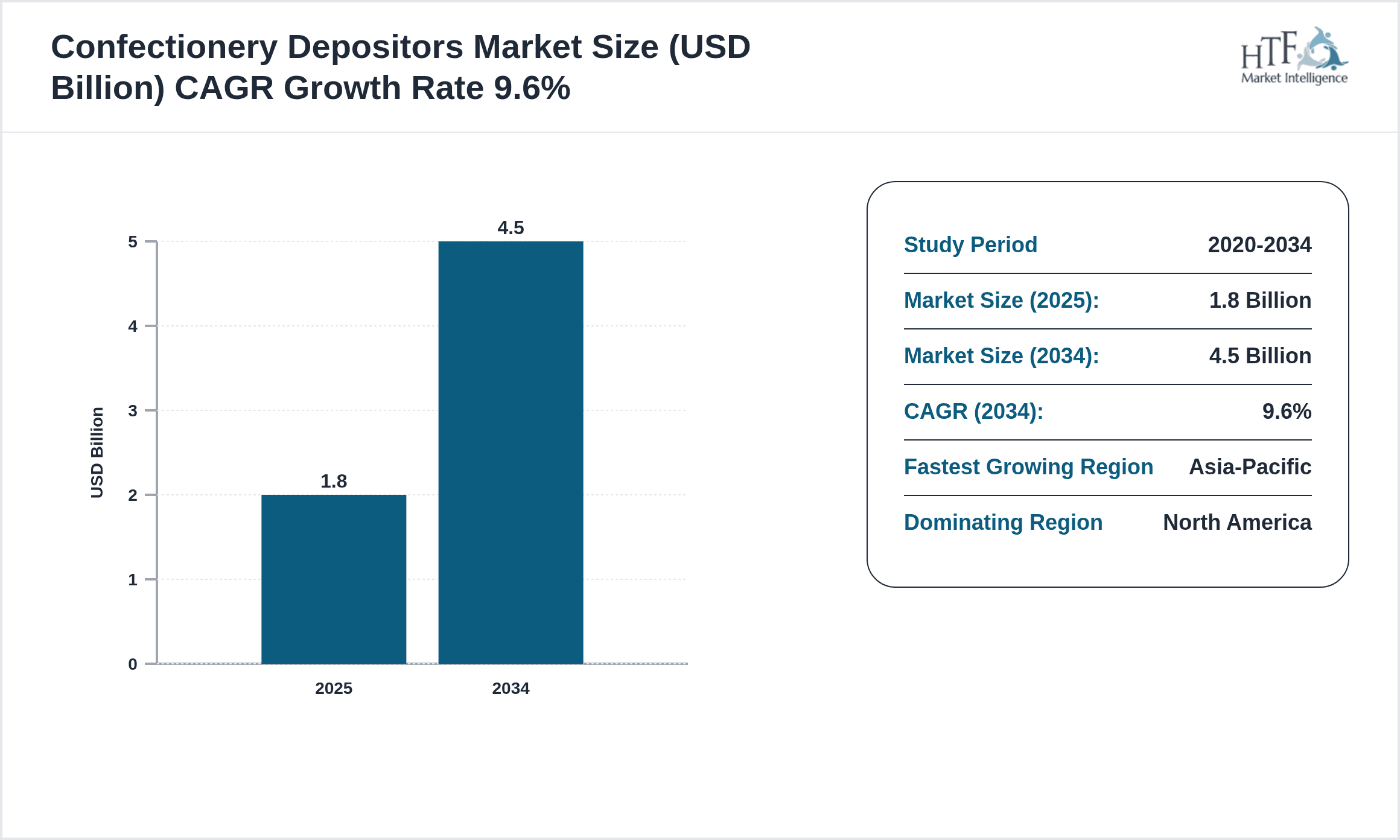
- •The market has demonstrated robust growth with a current valuation of USD 1.8 Billion in 2024, projected to escalate to USD 4.5 Billion by 2034, reflecting a compound annual growth rate (CAGR) of approximately 9.6%. Key highlights include the dominance of hydraulic depositors, which hold the largest market share due to their reliability and precision. The Asia-Pacific region is identified as the fastest-growing market, propelled by rapid industrialization, expanding confectionery industries, and increasing adoption of automation technologies. Growth is supported by rising disposable incomes and changing consumer preferences favoring premium and artisanal confectionery products. The market's strategic importance is underscored by its role in enhancing production efficiency, reducing labor dependency, and enabling product innovation, which are critical for manufacturers aiming to stay competitive in a dynamic global environment.
- •The value proposition of the Global Confectionery Depositors Market lies in its ability to drive productivity and product differentiation for confectionery manufacturers. By facilitating consistent product deposition with minimal waste, these machines contribute to cost efficiency and higher output quality. The strategic importance extends to various stakeholders including equipment manufacturers, confectionery producers, and investors seeking to capitalize on automation trends. Additionally, the market supports sustainability goals by enabling precise ingredient use and reducing energy consumption through advanced depositor technologies. Overall, the sector represents a vital nexus of innovation and operational excellence within the global confectionery industry.
Competitive Landscape
The competitive environment within the Global Confectionery Depositors Market is characterized by intense rivalry among established machinery manufacturers and emerging innovators. Key players focus on technological advancements to differentiate their products, emphasizing precision control, speed, and energy efficiency. Companies adopt diverse competitive strategies including strategic partnerships, product customization, and after-sales service excellence to capture market share. Innovation plays a pivotal role, with an increasing emphasis on servo-driven and electric depositor systems that provide enhanced flexibility and integration with Industry 4.0 technologies. Market positioning is often determined by geographical presence, product portfolio breadth, and the ability to meet stringent regulatory standards. Mergers and acquisitions have contributed to market consolidation, enabling firms to expand their technological capabilities and global footprint. Distribution strategies leveraging direct sales, distributors, and digital platforms ensure broad market penetration. The competitive landscape also reflects the growing importance of regional players in Asia-Pacific and Latin America, who are capitalizing on local demand and cost advantages. Future trends indicate a shift towards smarter, connected depositor systems that align with evolving confectionery production requirements.
Leading Companies in Confectionery Depositors Market
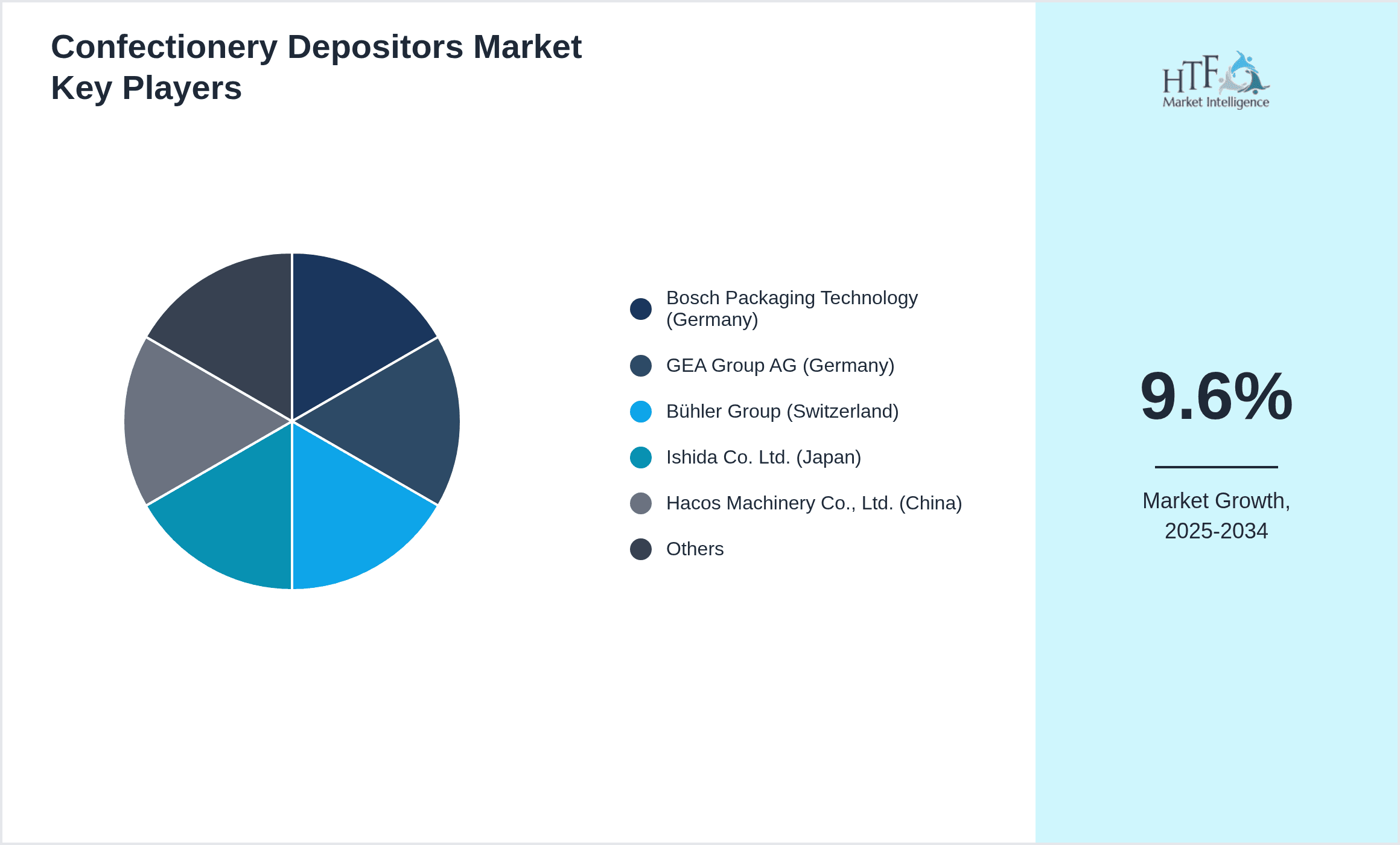
- •Bosch Packaging Technology (Germany)
- •GEA Group AG (Germany)
- •Bühler Group (Switzerland)
- •Ishida Co. Ltd. (Japan)
- •Hacos Machinery Co., Ltd. (China)
- •Chocotech Equipment Ltd. (United Kingdom)
- •IMPAQ Group (United States)
- •Baker Perkins (United Kingdom)
- •Vemag Maschinenbau GmbH (Germany)
- •Key Technology Inc. (United States)
- •Selmi Group (Italy)
- •Kreyer GmbH (Germany)
- •Winkler + Dünnebier GmbH (Germany)
- •A.M.P-Rose (United States)
- •Tanis Confectionery (Netherlands)
- •Schreder Group (Belgium)
- •Hacos Maschinen GmbH (Germany)
- •F.B. Leopold Co., Ltd. (Japan)
- •Cama Group (Italy)
- •Sormac B.V. (Netherlands)
- •Wenger Manufacturing, Inc. (United States)
- •Turatti S.p.A. (Italy)
- •JBT Corporation (United States)
- •Mecatherm Group (France)
- •Unifiller Systems, Inc. (United States)
Market Breakdown
- •By Product Type
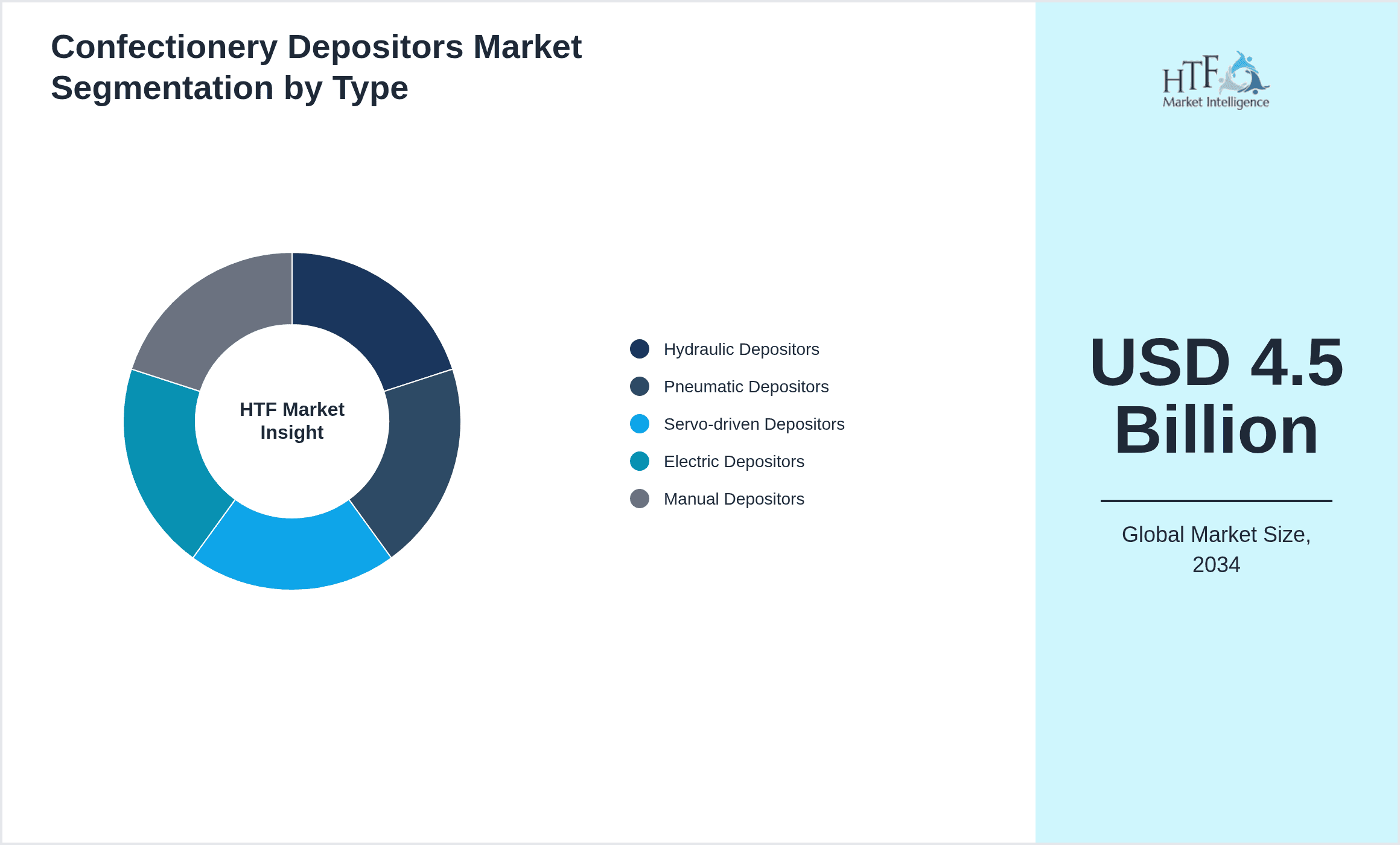
- ◦Hydraulic Depositors
- ◦Pneumatic Depositors
- ◦Servo-driven Depositors
- ◦Electric Depositors
- ◦Manual Depositors
- •By Application
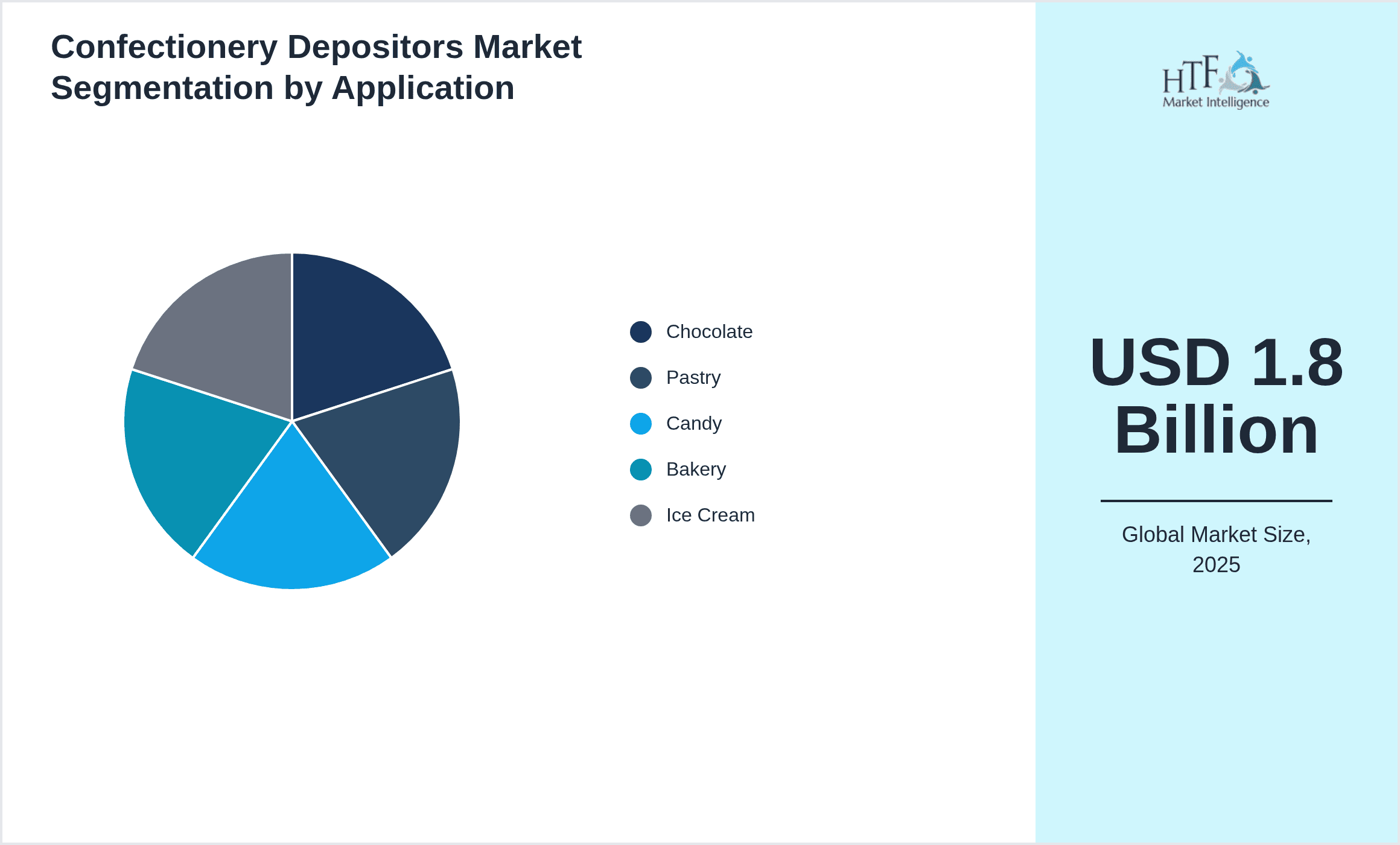
- ◦Chocolate
- ◦Pastry
- ◦Candy
- ◦Bakery
- ◦Ice Cream
- •By End-Use Industry
- ◦Confectionery Manufacturers
- ◦Bakery Industry
- ◦Ice Cream Producers
- ◦Pastry & Dessert Makers
- •By Distribution Channel
- ◦Direct Sales
- ◦Distributors
- ◦Online Platforms
Growth Dynamics
- •The Global Confectionery Depositors Market is experiencing strong growth driven by increasing automation in confectionery production, which enhances precision and reduces labor costs. The rising demand for premium and customized confectionery products propels manufacturers to adopt advanced depositor technologies that support diverse product shapes and fillings. Expansion of the confectionery sector in emerging regions, particularly Asia-Pacific, fuels market growth due to rising disposable incomes and urbanization. Technological innovations such as servo-driven depositors provide enhanced control, speed, and flexibility, meeting the evolving needs of manufacturers. Additionally, stringent food safety regulations increase the demand for hygienic and reliable depositor equipment, further stimulating market expansion.
- •Trends shaping the market include the integration of Industry 4.0 technologies like IoT and automation, enabling real-time monitoring and predictive maintenance of depositor machines. Sustainable manufacturing practices encourage the development of energy-efficient and resource-saving equipment. There is a notable shift towards modular and scalable depositor systems that allow manufacturers to adjust production capacities swiftly. Additionally, customization capabilities are gaining prominence, with depositors designed to handle a wide variety of confectionery formulations and packaging styles. The growing preference for artisanal and gourmet confectionery products requires flexible depositor solutions that can accommodate complex designs and textures.
- •Despite robust growth, the market faces restraints including high capital investment in advanced depositor systems, which can be a barrier for small and medium-sized manufacturers. Complexity in machine operation and maintenance requires skilled labor, limiting adoption in regions with labor shortages. Supply chain disruptions affecting raw materials and components for manufacturing depositors also pose challenges. Additionally, stringent regulatory standards across different regions necessitate continuous compliance efforts, increasing operational costs. Market volatility due to fluctuating raw material prices and economic uncertainties may affect capital expenditures in the confectionery manufacturing sector.
- •Opportunities abound in expanding into emerging markets where confectionery consumption is on the rise, offering significant growth potential for depositor manufacturers. Innovations in depositor technology that incorporate AI and machine learning for smarter operations can create competitive advantages. There is a growing scope for developing compact, multi-functional depositor units catering to artisanal and small-scale manufacturers. Strategic collaborations with confectionery companies to co-develop tailored solutions can enhance market penetration. Furthermore, increasing demand for sugar-free and health-oriented confectionery products opens avenues for specialized depositor applications.
- •Challenges include navigating complex international regulatory landscapes that vary significantly across regions, complicating product standardization. Intense competition from low-cost manufacturers in Asia poses pricing pressures on established companies. Technological obsolescence due to rapid innovation cycles requires continuous investment in R&D. Adoption barriers persist in traditional markets resistant to automation. Additionally, global supply chain constraints and logistical challenges impact timely delivery and installation of depositor equipment, affecting customer satisfaction and market growth.
Market Trends
- •The market is witnessing accelerated adoption of servo-driven depositors, which offer superior precision and adaptability compared to traditional hydraulic and pneumatic systems. This trend is driven by increasing demand for customized confectionery products with intricate designs and fillings. Industry 4.0 integration, including IoT connectivity and data analytics, is enabling manufacturers to optimize depositor performance and maintenance schedules, thereby reducing downtime and operational costs. Sustainable manufacturing practices are prompting the introduction of energy-efficient depositor models which align with corporate social responsibility goals. The surge in e-commerce for confectionery products is also influencing depositor design to accommodate packaging innovations and faster production cycles.
- •Innovations in depositor technology focus on enhancing user interface simplicity and automation capabilities, reducing the need for highly skilled operators. Modular depositor systems that can be easily upgraded or reconfigured according to production needs are gaining popularity, particularly among mid-sized confectionery manufacturers. The trend towards health-conscious confectionery products is encouraging the development of depositors capable of handling alternative ingredients such as sugar substitutes and plant-based formulations. Additionally, collaborative efforts between equipment manufacturers and confectionery producers foster product-specific depositor solutions that improve efficiency and product quality.
- •Strategic partnerships and acquisitions among key players are reshaping the competitive landscape, facilitating access to new technologies and geographic markets. For example, recent collaborations have enabled integration of advanced robotics with depositor systems, enhancing automation levels. Market players are also focusing on expanding their after-sales services and digital support platforms, improving customer retention and satisfaction. The rise of artisanal confectionery brands is influencing market trends towards smaller, flexible depositor units suitable for boutique production. Additionally, regulatory emphasis on food safety and hygiene is driving innovation in sanitary design features of depositor equipment.
- •Digital transformation is a significant trend, with manufacturers adopting cloud-based monitoring and control systems that facilitate remote diagnostics and predictive maintenance. This reduces machine downtime and extends equipment lifespan. The growing focus on sustainability encourages the use of recyclable materials and energy-efficient designs in depositor manufacturing. Moreover, shifting consumer preferences towards personalized confectionery products stimulate demand for depositors capable of multi-product handling and rapid changeovers. The market also observes increased integration of AI-driven quality control systems within depositor lines to ensure consistent product standards.
- •Collaboration between equipment suppliers and confectionery manufacturers is fostering ecosystem development, enabling co-innovation and faster time-to-market for new products. This trend enhances customization and flexibility in depositor offerings. Consumer demand segmentation and preference analysis are driving value chain evolution, leading to specialized depositor solutions tailored to distinct market niches. Investment in R&D for disruptive depositor technologies, such as 3D food printing and robotic integration, points to future paradigm shifts. These innovations promise to redefine confectionery manufacturing processes, offering novel product formats and enhanced efficiency.
Market Opportunities
- •The expanding middle-class population and increasing urbanization in emerging economies present significant growth opportunities for confectionery depositor manufacturers to penetrate new markets with tailored solutions addressing local production needs and cost sensitivities.
- •Technological advancements in AI and machine learning open avenues for developing smart depositor systems capable of self-optimization and predictive maintenance, enhancing operational efficiency and reducing downtime.
- •Rising demand for health-oriented confectionery products including sugar-free and organic options creates opportunities to innovate depositors that can handle diverse and sensitive ingredient formulations without compromising product quality.
- •Partnerships with artisanal and boutique confectionery manufacturers to develop compact, multi-functional depositors can open niche market segments and drive diversification beyond large-scale industrial customers.
- •Geographical expansion into underpenetrated regions such as Latin America and Middle East & Africa offers potential for volume growth, driven by increasing confectionery consumption and rising automation adoption.
- •The shift towards sustainable manufacturing practices invites innovation in energy-efficient and environmentally friendly depositor designs, aligning with global sustainability goals and regulatory frameworks.
- •Enhanced digital services including remote machine monitoring, software upgrades, and virtual training provide avenues for value-added offerings, strengthening customer relationships and creating recurring revenue streams.
Market Challenges
- •High initial investment costs for advanced depositor machinery limit accessibility for small and medium-sized confectionery producers, constraining market penetration in price-sensitive segments.
- •Operational complexity and requirement for skilled personnel to manage and maintain sophisticated depositor systems pose challenges, especially in regions with labor shortages or limited technical training infrastructure.
- •Fragmented regulatory environments across different countries create compliance challenges, necessitating costly modifications and certifications for depositor equipment to meet diverse safety and hygiene standards.
- •Volatility in raw material prices and supply chain disruptions impact manufacturing costs and delivery timelines for depositor equipment, affecting market stability and customer satisfaction.
- •Competition from low-cost manufacturers in Asia exerts pricing pressure on established players, potentially eroding profit margins and challenging brand positioning.
- •Rapid technological advancements require continuous R&D investments to avoid obsolescence, posing financial and strategic challenges for equipment manufacturers.
- •Resistance to automation adoption in traditional confectionery markets slows growth potential, as some manufacturers prefer manual or semi-automated processes due to cultural or operational preferences.
Regulatory Framework
- •Between 2019 and 2024, international food safety standards such as ISO 22000 and HACCP have been increasingly mandated for confectionery equipment manufacturers, requiring depositors to comply with rigorous hygiene and contamination control protocols. This has led to design innovations focusing on easy-to-clean materials and sealed operating mechanisms to prevent microbial ingress.
- •The European Union implemented the Machinery Directive 2006/42/EC with updated amendments enforced up to 2024, compelling manufacturers to enhance safety features on confectionery depositors, including emergency stops, protective enclosures, and operator training requirements, thus elevating market entry standards.
- •Environmental regulations targeting energy consumption and emissions have influenced depositor manufacturers to develop more energy-efficient systems, with some regions introducing incentives for adopting green manufacturing technologies between 2020 and 2024.
- •In North America, FDA regulations on food contact materials have tightened, necessitating the use of approved, non-toxic substances in depositor components that come into contact with confectionery products, impacting material selection and production processes.
- •Government initiatives across Asia-Pacific countries promoting industrial automation and food safety have provided subsidies and technical support to confectionery equipment manufacturers, accelerating depositor adoption and compliance with updated regulatory frameworks during the base period.
Market Intelligence
- •15th February 2025, Bosch Packaging Technology launched its latest servo-driven confectionery depositor equipped with IoT-enabled features allowing real-time monitoring and predictive maintenance. This innovation targets large-scale confectionery manufacturers seeking to optimize production efficiency and reduce downtime. The depositor supports multi-product handling with quick changeovers, enhancing manufacturing flexibility. Bosch aims to strengthen its market position by addressing the growing demand for digitalized and automated depositor systems globally. Source: Bosch Official Press Release
- •30th January 2025, GEA Group AG introduced an energy-efficient hydraulic depositor designed specifically for premium chocolate applications. The new model incorporates advanced servo controls to ensure precise filling and decorative capabilities. This launch aligns with increasing industry trends towards sustainability and high-quality confectionery production. GEA anticipates expanded adoption in Europe and North America due to rising premium confectionery consumption. Source: GEA Group Website
- •10th March 2025, Bühler Group announced a strategic partnership with a leading Asian confectionery manufacturer to co-develop modular depositor systems tailored for the growing artisanal market segment. This collaboration focuses on integrating AI-based quality control and flexible production modules. The initiative aims to capture the rapidly expanding Asia-Pacific confectionery equipment market and foster innovation in depositor technology. Source: Bühler Group Corporate News
- •5th April 2025, Chocotech Equipment Ltd. completed the acquisition of a smaller European depositor manufacturer to broaden its product portfolio and geographic reach. The acquisition strengthens Chocotech’s presence in the premium confectionery depositor segment and accelerates technology integration efforts. This move reflects ongoing consolidation trends in the market to enhance competitiveness and innovation capacity. Source: Industry Publication
Regional Outlook
The North America currently holds a significant share of the market, primarily due to several key factors: increasing consumption rates, a burgeoning population, and robust economic momentum. These elements collectively drive demand, positioning this region as a leader in the market. On the other hand, Asia-Pacific is rapidly emerging as the fastest-growing area within the industry. This remarkable growth can be attributed to swift infrastructure development, the expansion of various industrial sectors, and a marked increase in consumer demand. These dynamics make this region a crucial player in shaping future market growth.
In our report, we cover a comprehensive analysis of the following regions and countries:
- North America
- LATAM
- West Europe
- Central & Eastern Europe
- Northern Europe
- Southern Europe
- East Asia
- Southeast Asia
- South Asia
- Central Asia
- Oceania
- MEA
| Feature | Details |
|---|---|
| Base Year Market Size | USD 1.8 Billion |
| Forecast Year Market Size | USD 4.5 Billion |
| CAGR | 9.6% |
| Forecast Period | 2026 to 2033 |
| YoY Growth | 9.2% |
| Scope of Report | Market is segmented by Product Type (Hydraulic Depositors, Pneumatic Depositors, Servo-driven Depositors, Electric Depositors, Manual Depositors), Application (Chocolate, Pastry, Candy, Bakery, Ice Cream), End-Use Industry (Confectionery Manufacturers, Bakery Industry, Ice Cream Producers, Pastry & Dessert Makers), Distribution Channel (Direct Sales, Distributors, Online Platforms) |
| Regions Covered | North America, LATAM, West Europe, Central & Eastern Europe, Northern Europe, Southern Europe, East Asia, Southeast Asia, South Asia, Central Asia, Oceania, MEA |
| Key Companies | Bosch Packaging Technology (Germany), GEA Group AG (Germany), Bühler Group (Switzerland), Ishida Co. Ltd. (Japan), Hacos Machinery Co., Ltd. (China) |
Global Confectionery Depositors Market Size, Growth & Revenue 2024-2034 - Table of Contents
Frequently Asked Questions (FAQ):
The Compact Track Loaders market is projected to grow at a CAGR of 6.8% from 2025 to 2030, driven by increasing demand in construction and agricultural sectors.
North America currently leads the market with approximately 45% market share, followed by Europe at 28% and Asia-Pacific at 22%. The remaining regions account for 5% of the global market.
Key growth drivers include increasing construction activities, rising demand for versatile equipment in agriculture, technological advancements in track loader design, and growing preference for compact equipment in urban construction projects.