
Global Case Packing Robot Market Size, Growth & Revenue 2024-2034
Global Case Packing Robot Market is segmented by Product Type (Delta Robots, SCARA Robots, Articulated Robots, Cartesian Robots, Cylindrical Robots), Application (Food & Beverage, Pharmaceuticals, Consumer Goods, Electronics, Automotive), End-Use Industry (Manufacturing, Logistics & Warehousing, Healthcare, Retail), Distribution Channel (Direct Sales, Channel Partners, OEM Partnerships), and Geography (North America, LATAM, West Europe, Central & Eastern Europe, Northern Europe, Southern Europe, East Asia, Southeast Asia, South Asia, Central Asia, Oceania, MEA)
Pricing
Report Overview
Executive Summary
- •The Global Case Packing Robot Market represents a pivotal segment within industrial automation, focusing on robotic solutions that streamline product packaging into containers. This market covers a diverse range of robot types such as delta, SCARA, articulated, cartesian, and cylindrical robots, each tailored to specific packaging applications across industries like food & beverage, pharmaceuticals, consumer goods, electronics, and automotive. The adoption of these robotic systems addresses critical operational challenges including labor shortages, demand for higher throughput, and quality consistency. These robots integrate advanced technologies like AI, machine vision, and IoT to enhance operational precision, flexibility, and efficiency. The market's scope extends to hardware, software, and comprehensive automation solutions enabling manufacturers globally to optimize packaging processes, reduce costs, and ensure compliance with stringent regulatory requirements. With rising global industrialization and increasing emphasis on automation, the case packing robot market is witnessing robust growth driven by innovation and expanding end-user demand, positioning it as a strategic enabler of modern manufacturing ecosystems.
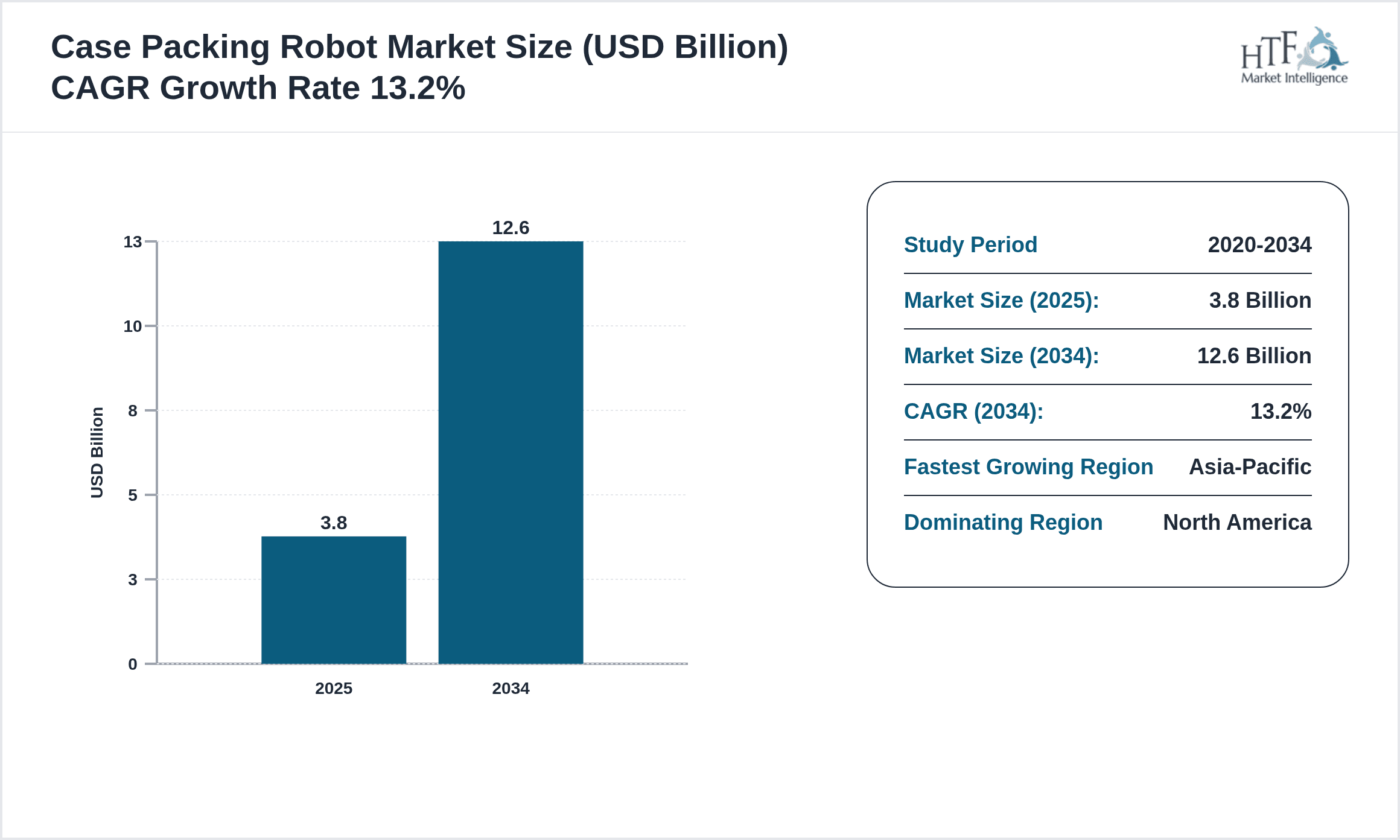
- •Key market highlights include a base market size of USD 3.8 Billion in 2025, with a projected growth to USD 12.6 Billion by 2034, representing a robust CAGR of 13.2%. The market is dominated by North America, accounting for the largest share due to early adoption and technological maturity, while Asia-Pacific is the fastest-growing region fueled by expanding manufacturing sectors and increasing automation investments. Delta robots lead the product type segment owing to their high-speed capabilities and precision, whereas SCARA robots exhibit the fastest growth attributed to their adaptability in diverse packaging applications. The food & beverage sector remains the dominant application area, closely followed by pharmaceuticals, reflecting growing consumer demand and stringent hygiene standards driving automation adoption. These growth indicators underscore the increasing strategic investment in robotic packaging to enhance productivity and supply chain resilience globally.
- •The value proposition of the case packing robot market lies in its ability to deliver significant operational efficiencies, reduce human error, and enhance workplace safety across manufacturing and packaging floors. For stakeholders including manufacturers, technology providers, and end-users, these robotic systems offer scalable and customizable solutions that align with Industry 4.0 principles. Strategic importance is highlighted by the market’s role in supporting sustainable manufacturing through energy-efficient operations and waste reduction. The integration of advanced robotics not only accelerates packaging throughput but also enables real-time data analytics for predictive maintenance and process optimization. Consequently, this market serves as a critical driver for competitiveness in global supply chains, ensuring manufacturers remain agile amid evolving consumer expectations and regulatory landscapes.
Competitive Landscape
The competitive environment in the Global Case Packing Robot Market is marked by intense rivalry among established multinational corporations and emerging specialized technology providers. Market leaders emphasize innovation through continuous R&D investment, focusing on enhancing robot dexterity, speed, and integration capabilities with smart factory systems. Strategic partnerships and collaborations with software firms and automation integrators are common to develop comprehensive end-to-end packaging solutions. Companies leverage product differentiation strategies by introducing robots tailored to specific industry needs, such as hygienic designs for pharmaceuticals and high-speed models for food packaging. Pricing strategies balance cost-effectiveness with technological superiority to capture diverse customer segments. Distribution channels are expanding globally, supported by localized service networks to ensure rapid deployment and maintenance. Barriers to entry include high capital requirements and the need for advanced technical expertise. Future competitive trends point toward greater adoption of AI-powered robotics, cloud connectivity, and modular robotic platforms to enhance flexibility and scalability in packaging operations.
Prominent Players in Case Packing Robot Market
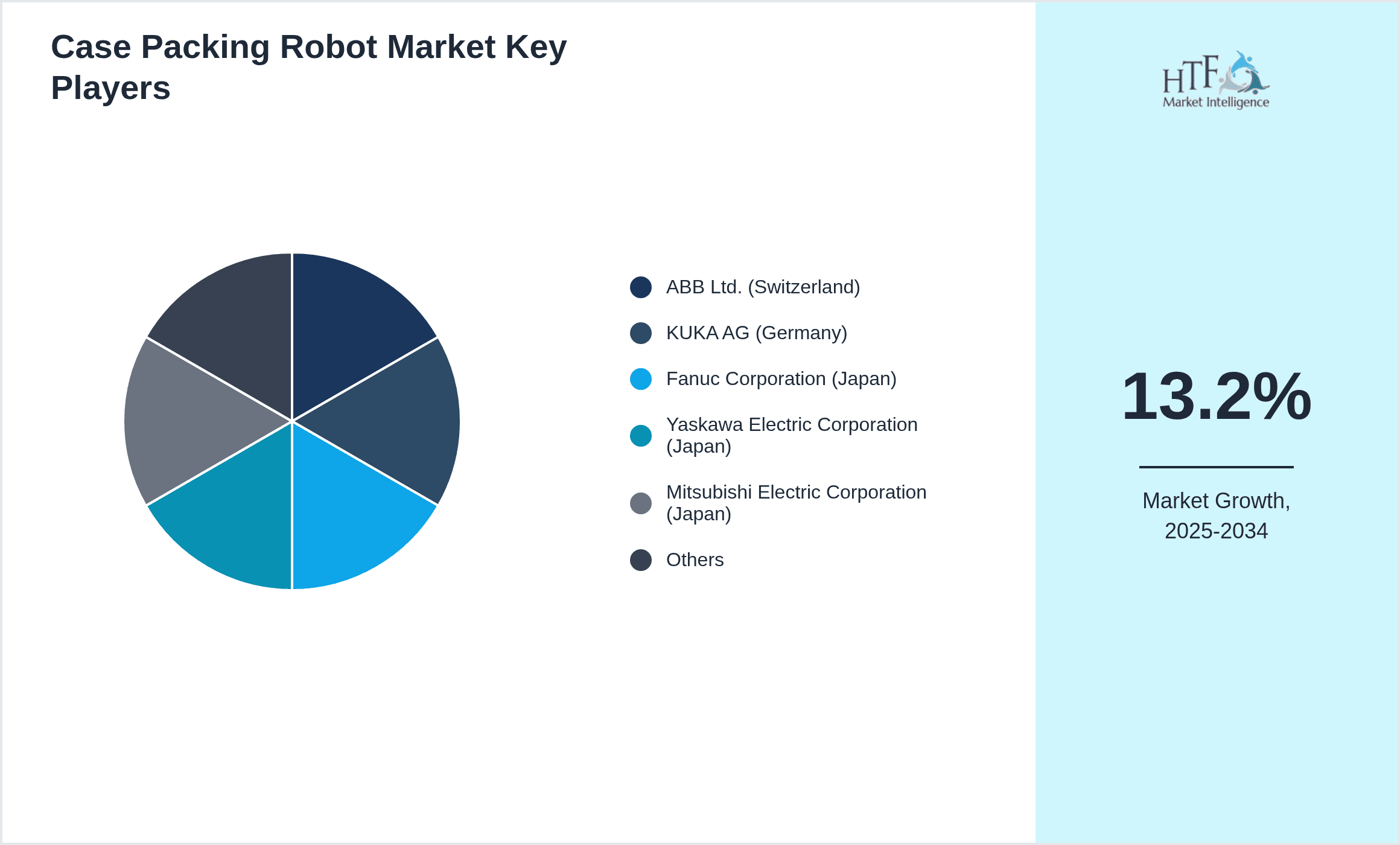
- •ABB Ltd. (Switzerland)
- •KUKA AG (Germany)
- •Fanuc Corporation (Japan)
- •Yaskawa Electric Corporation (Japan)
- •Mitsubishi Electric Corporation (Japan)
- •Universal Robots A/S (Denmark)
- •Epson Robots (Japan)
- •Omron Corporation (Japan)
- •Denso Wave Incorporated (Japan)
- •Staubli International AG (Switzerland)
- •Comau S.p.A. (Italy)
- •Schneider Electric SE (France)
- •Bosch Rexroth AG (Germany)
- •Nachi-Fujikoshi Corp. (Japan)
- •Adept Technology, Inc. (United States)
- •Kawasaki Heavy Industries, Ltd. (Japan)
- •Universal Logic, Inc. (United States)
- •Fanuc America Corporation (United States)
- •Rockwell Automation, Inc. (United States)
- •Intelligrated (United States)
- •Yamaha Motor Co., Ltd. (Japan)
- •igus GmbH (Germany)
- •Staubli Robotics (Switzerland)
- •Sepro Group (France)
- •Omron Adept Technologies (United States)
Market Breakdown
- •By Product Type
- ◦Delta Robots
- ◦SCARA Robots
- ◦Articulated Robots
- ◦Cartesian Robots
- ◦Cylindrical Robots
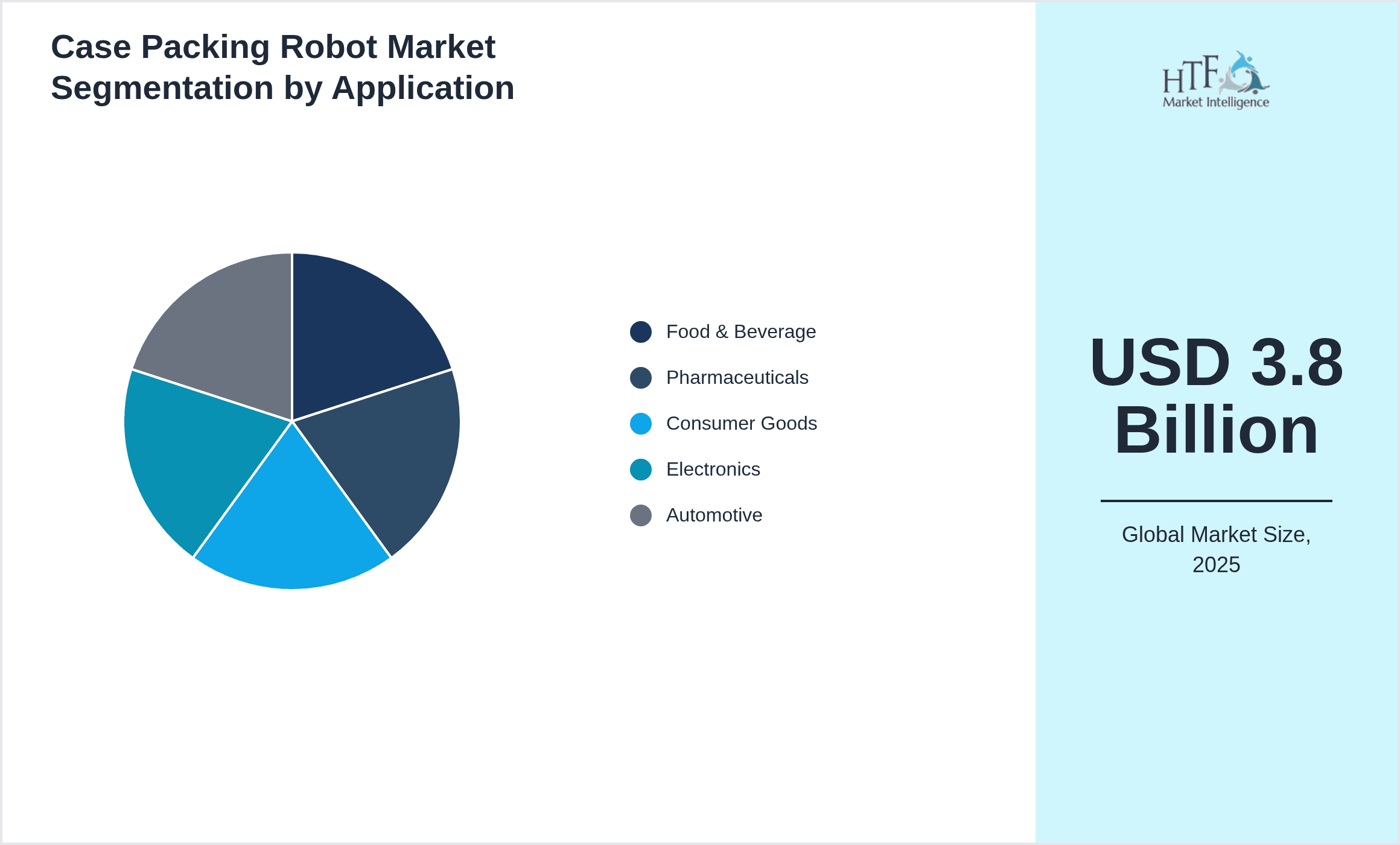
- •By Application
- ◦Food & Beverage
- ◦Pharmaceuticals
- ◦Consumer Goods
- ◦Electronics
- ◦Automotive
- •By End-Use Industry
- ◦Manufacturing
- ◦Logistics & Warehousing
- ◦Healthcare
- ◦Retail
- •By Distribution Channel
- ◦Direct Sales
- ◦Channel Partners
- ◦OEM Partnerships
Growth Dynamics
The Global Case Packing Robot Market is propelled by increasing labor cost pressures and workforce shortages, which incentivize manufacturers to adopt automation solutions that enhance productivity and reduce reliance on manual labor. Advanced robotics offer precision and speed that significantly improve packaging throughput while minimizing errors, directly impacting operational efficiency. Additionally, growing demand for packaged goods driven by e-commerce growth necessitates scalable packaging systems, further accelerating robot adoption. Technological innovations such as AI integration and machine vision enable robots to handle complex packaging tasks and adapt to diverse product formats, broadening their applicability. Government initiatives promoting Industry 4.0 and automation investments also spur market expansion, particularly in developing regions. These growth drivers collectively underpin strong market momentum and encourage continuous product development to meet evolving industrial needs.

Market Trends
The market is witnessing a significant shift towards collaborative robots (cobots) that operate safely alongside human workers, enabling flexible packaging processes and reducing the need for costly safety infrastructure. Integration of IoT and cloud-based analytics platforms allows real-time monitoring and predictive maintenance, improving uptime and reducing operational costs. There is a growing preference for modular and easily programmable robotic systems that can be rapidly redeployed across different packaging lines, enhancing manufacturing agility. Sustainability trends are influencing robot designs to be energy efficient and compatible with recyclable packaging materials. Furthermore, increasing adoption of vision-guided robotics facilitates handling of irregularly shaped products, expanding the scope of automation in complex packaging environments.
Market Opportunities
Emerging markets in Asia-Pacific and Latin America offer substantial growth opportunities due to rapid industrialization and increasing automation awareness among manufacturers. The growing demand for customized packaging solutions presents opportunities for product innovation and differentiation. Integration of AI and machine learning to enable adaptive packaging robots capable of self-optimization creates new value propositions. Expansion into underserved sectors such as pharmaceuticals and healthcare, which require high precision and hygiene standards, represents a lucrative opportunity. Strategic collaborations between robotics manufacturers and packaging solution providers can unlock bundled offerings that appeal to diverse customer needs, facilitating market penetration and revenue growth.
Market Challenges
High initial capital investment and complex integration processes limit adoption among small and medium enterprises, constraining market reach. Variability in product sizes, shapes, and packaging materials poses challenges for robot programming and operational flexibility. Lack of skilled workforce to operate and maintain advanced robotic systems further hampers deployment. Regulatory compliance related to safety, hygiene, and environmental standards requires continuous adaptation, increasing operational complexity. Additionally, concerns over workforce displacement and resistance to automation adoption impact market growth. These challenges necessitate focused efforts on cost-effective solutions, user-friendly interfaces, and training programs to accelerate market acceptance.
Regulatory Framework
Between 2019 and 2025, regulatory developments have increasingly emphasized safety standards for robotic systems in packaging environments, mandating compliance with ISO 10218 and ANSI/RIA R15.06 standards to ensure safe human-robot collaboration. Environmental regulations targeting energy consumption and waste reduction have prompted manufacturers to design energy-efficient robots and promote sustainable packaging practices. Regional directives in Europe, North America, and Asia-Pacific require adherence to product-specific hygiene and contamination control guidelines, particularly in food and pharmaceutical applications. Governments have also introduced incentives and subsidies to encourage automation adoption, aligning with Industry 4.0 strategies. These regulatory updates influence product design, deployment strategies, and market entry decisions, shaping the competitive landscape and operational frameworks.
Market Intelligence
- •15th January 2025, ABB Ltd. launched its latest generation delta robot equipped with enhanced AI-powered vision systems aimed at improving packaging flexibility and speed in the food & beverage sector. This innovative robot offers real-time adaptive capabilities, allowing it to handle diverse product shapes and sizes with minimal downtime, targeting manufacturers seeking to optimize throughput and reduce operational costs. ABB’s strategic objective includes expanding its footprint in emerging markets by providing scalable solutions that integrate seamlessly with existing production lines. This launch reinforces ABB’s commitment to leading automation innovation in the case packing segment. Source: ABB Official Press Release
- •10th March 2025, KUKA AG introduced its new SCARA robotic platform designed specifically for pharmaceutical packaging applications, featuring advanced sterile operation capabilities and modular design for easy customization. The platform supports high-precision handling of delicate products in compliance with stringent hygiene regulations, addressing growing demand for automation in healthcare. KUKA’s innovation focuses on reducing changeover times and enhancing operational safety, positioning the company to capture expanding market share in pharmaceutical packaging automation. This development underlines KUKA’s strategic focus on specialized solutions that meet evolving industry standards and customer expectations. Source: KUKA Corporate Announcement
- •22nd June 2025, Fanuc Corporation announced a strategic partnership with a leading packaging system integrator to co-develop intelligent case packing solutions leveraging Fanuc’s articulated robot technology combined with advanced machine learning algorithms. This collaboration aims to deliver turnkey automation solutions that increase packaging line efficiency and adaptability, targeting large-scale food and consumer goods manufacturers. The initiative reflects Fanuc’s strategy to enhance product offerings through synergistic partnerships, accelerating innovation and market penetration globally. Expected outcomes include reduced deployment times and improved operational intelligence for end-users. Source: Fanuc Press Release
- •30th August 2025, Yaskawa Electric Corporation completed acquisition of a robotics software startup specializing in AI-driven packaging optimization tools. This acquisition enables Yaskawa to integrate cutting-edge AI algorithms into its case packing robots, enhancing autonomous decision-making and adaptive capabilities. The strategic move strengthens Yaskawa’s technological portfolio and competitive position by offering customers advanced solutions that improve packaging accuracy and reduce waste. This transaction aligns with Yaskawa’s long-term vision to lead innovation in intelligent robotics and expand its market presence across diverse industries. Source: Yaskawa Corporate News
Regional Outlook
The North America currently holds a significant share of the market, primarily due to several key factors: increasing consumption rates, a burgeoning population, and robust economic momentum. These elements collectively drive demand, positioning this region as a leader in the market. On the other hand, Asia-Pacific is rapidly emerging as the fastest-growing area within the industry. This remarkable growth can be attributed to swift infrastructure development, the expansion of various industrial sectors, and a marked increase in consumer demand. These dynamics make this region a crucial player in shaping future market growth.
In our report, we cover a comprehensive analysis of the following regions and countries:
- North America
- LATAM
- West Europe
- Central & Eastern Europe
- Northern Europe
- Southern Europe
- East Asia
- Southeast Asia
- South Asia
- Central Asia
- Oceania
- MEA
| Feature | Details |
|---|---|
| Base Year Market Size | USD 3.8 Billion |
| Forecast Year Market Size | USD 12.6 Billion |
| CAGR | 13.2% |
| Forecast Period | 2026 to 2033 |
| YoY Growth | 12.4% |
| Scope of Report | Market is segmented by Product Type (Delta Robots, SCARA Robots, Articulated Robots, Cartesian Robots, Cylindrical Robots), Application (Food & Beverage, Pharmaceuticals, Consumer Goods, Electronics, Automotive), End-Use Industry (Manufacturing, Logistics & Warehousing, Healthcare, Retail), Distribution Channel (Direct Sales, Channel Partners, OEM Partnerships) |
| Regions Covered | North America, LATAM, West Europe, Central & Eastern Europe, Northern Europe, Southern Europe, East Asia, Southeast Asia, South Asia, Central Asia, Oceania, MEA |
| Key Companies | ABB Ltd. (Switzerland), KUKA AG (Germany), Fanuc Corporation (Japan), Yaskawa Electric Corporation (Japan), Mitsubishi Electric Corporation (Japan), Universal Robots A/S (Denmark), Epson Robots (Japan), Omron Corporation (Japan), Denso Wave Incorporated (Japan), Staubli International AG (Switzerland), Comau S.p.A. (Italy), Schneider Electric SE (France), Bosch Rexroth AG (Germany), Nachi-Fujikoshi Corp. (Japan), Adept Technology, Inc. (United States), Kawasaki Heavy Industries, Ltd. (Japan), Universal Logic, Inc. (United States), Fanuc America Corporation (United States), Rockwell Automation, Inc. (United States), Intelligrated (United States), Yamaha Motor Co., Ltd. (Japan), igus GmbH (Germany), Staubli Robotics (Switzerland), Sepro Group (France), Omron Adept Technologies (United States) |
Global Case Packing Robot Market Size, Growth & Revenue 2024-2034 - Table of Contents
Frequently Asked Questions (FAQ):
The Compact Track Loaders market is expected to see value worth 5.3 Billion in 2025.
North America currently leads the market with approximately 45% market share, followed by Europe at 28% and Asia-Pacific at 22%. The remaining regions account for 5% of the global market.
Key growth drivers include increasing construction activities, rising demand for versatile equipment in agriculture, technological advancements in track loader design, and growing preference for compact equipment in urban construction projects.