
Global Fludioxonil Market Size, Growth & Revenue 2024-2034
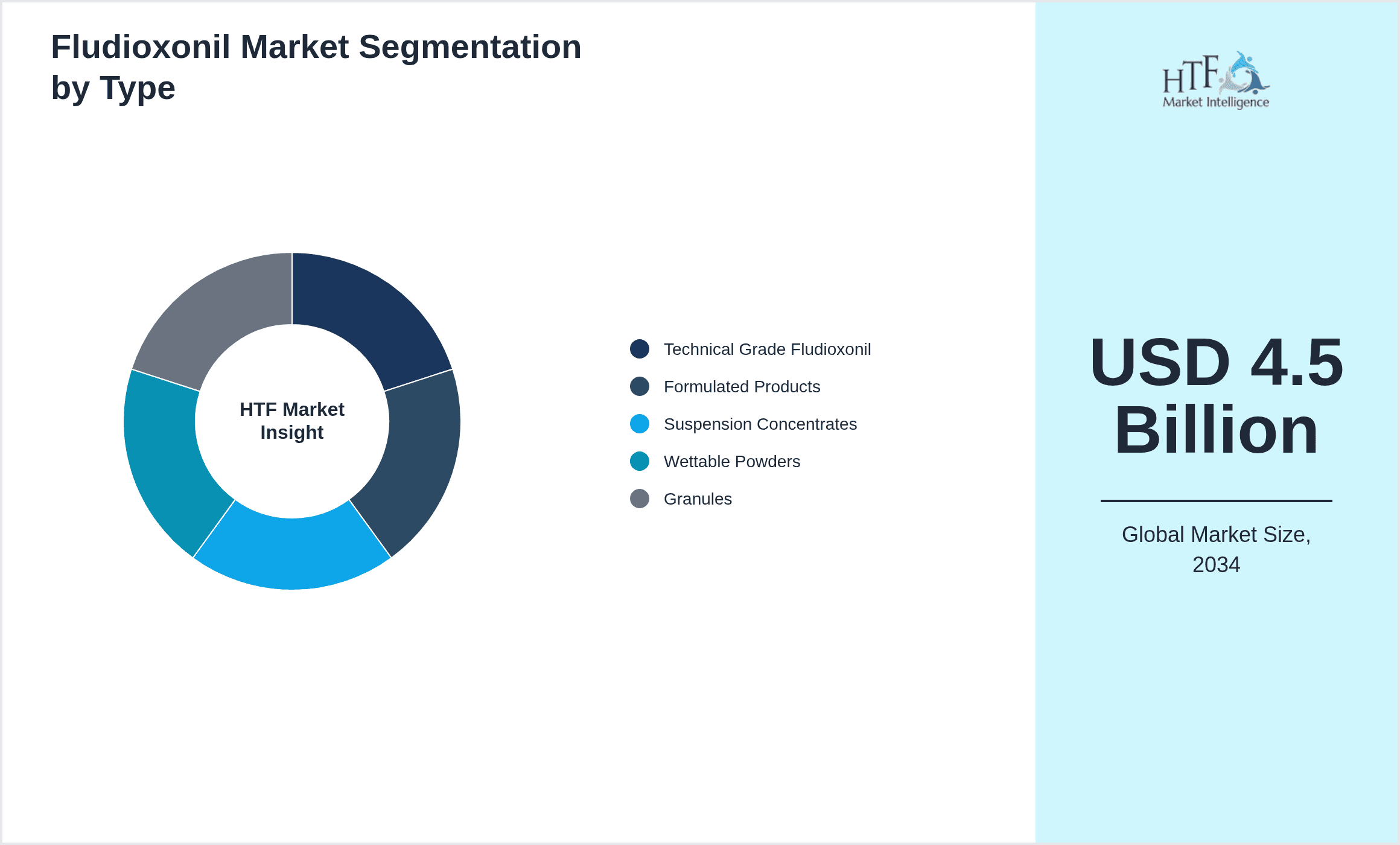
Global Fludioxonil Market is segmented by Product Type (Technical Grade Fludioxonil, Formulated Products, Suspension Concentrates, Wettable Powders, Granules), Application (Seed Treatment, Post-Harvest Treatment, Foliar Spray, Soil Treatment, Others), End-Use Industry (Cereals & Grains, Fruits & Vegetables, Ornamental Plants, Commercial Agriculture), Distribution Channel (Direct Sales, Distributors & Dealers, E-commerce Platforms), and Geography (North America, LATAM, West Europe, Central & Eastern Europe, Northern Europe, Southern Europe, East Asia, Southeast Asia, South Asia, Central Asia, Oceania, MEA)
Pricing
Report Overview
Executive Summary
- •The global Fludioxonil market is an essential segment within the agricultural fungicides industry, focusing on the use of Fludioxonil to protect a range of crops from fungal infections that cause significant yield losses. This market includes various product types such as technical grade active ingredients and formulated products including suspension concentrates, wettable powders, granules, and liquid formulations. Applications span seed treatment, post-harvest protection, foliar sprays, and soil treatment, addressing diverse crop protection needs globally. Fludioxonil’s effectiveness against a broad spectrum of fungal pathogens makes it a preferred choice in cereals, fruits, and vegetables, supported by increasing regulatory approvals and a rising demand for sustainable agricultural inputs. The market is characterized by innovation in formulation technologies, growing adoption in emerging agricultural regions, and dynamic competitive strategies from leading agrochemical companies. These factors collectively propel the global Fludioxonil market’s steady growth trajectory through 2034.
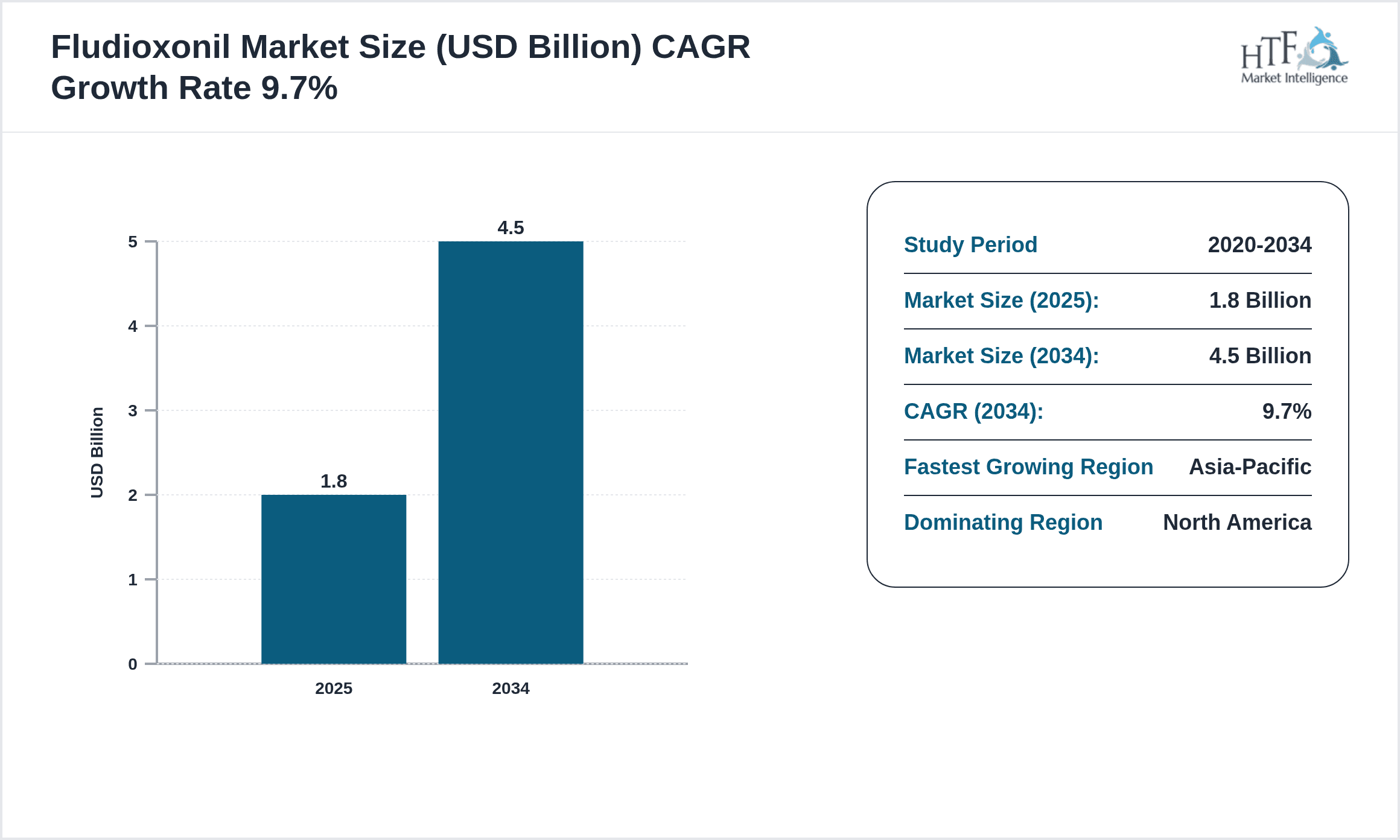
- •Key highlights include a base market size of USD 1.8 billion in 2024, projected to reach USD 4.5 billion by 2034, reflecting a compound annual growth rate (CAGR) of approximately 9.7%. North America currently dominates the market due to extensive agricultural activities and technological advancements, while Asia-Pacific is identified as the fastest-growing region, driven by expanding farming practices and increasing demand for crop protection products. Formulated products lead the product type category, with suspension concentrates emerging as the fastest-growing segment owing to their enhanced efficacy and ease of application. Seed treatment remains the dominant application, with post-harvest treatment growing rapidly due to heightened focus on reducing crop losses during storage and transportation. These data points underscore the robust growth potential and strategic importance of the Fludioxonil market globally.
- •The Fludioxonil market offers significant value propositions for stakeholders including agrochemical manufacturers, distributors, and farmers by improving crop resilience, yield quality, and sustainability. Innovations in product formulations and integrated pest management approaches enhance its relevance in modern agriculture. Strategic importance is further heightened by regulatory support for sustainable fungicides and growing awareness among farmers about crop protection benefits. These factors collectively make the Fludioxonil market a critical component of the global agrochemical landscape, offering long-term growth opportunities and contributing to food security and agricultural sustainability worldwide.
Competitive Landscape
The global Fludioxonil market exhibits a highly competitive environment characterized by the presence of multinational agrochemical corporations and regional players striving to expand their market share through innovation, strategic partnerships, and geographic expansion. Companies adopt differentiation strategies focusing on advanced formulation technologies, including suspension concentrates and enhanced wettable powders, to improve product performance and usability. Rivalry is intensified by the need to comply with stringent regulatory frameworks while addressing the growing demand for environmentally friendly fungicides. Market players invest heavily in research and development to introduce sustainable and effective Fludioxonil-based solutions that align with integrated pest management practices. Mergers and acquisitions serve as a critical strategy to consolidate product portfolios and enhance global reach. Distribution channels are optimized to improve market penetration, especially in emerging regions with rising agricultural investments. The competitive landscape is poised to evolve with continuous innovation and strategic collaborations shaping future market dynamics.
Key Participants in Fludioxonil Market
- •Syngenta AG (Switzerland)
- •BASF SE (Germany)
- •FMC Corporation (United States)
- •ADAMA Agricultural Solutions Ltd. (Israel)
- •UPL Limited (India)
- •Nufarm Limited (Australia)
- •Sumitomo Chemical Company, Limited (Japan)
- •Bayer CropScience AG (Germany)
- •Isagro S.p.A. (Italy)
- •Arysta LifeScience Corporation (Japan)
- •Corteva Agriscience (United States)
- •Nissan Chemical Corporation (Japan)
- •Sharda Cropchem Ltd. (India)
- •Valent U.S.A. LLC (United States)
- •Sumitomo Chemical Agro Europe (Belgium)
- •Jiangsu Yangnong Chemical Group Co., Ltd. (China)
- •Tessenderlo Group (Belgium)
- •Cheminova A/S (Denmark)
- •Helena Chemical Company (United States)
- •BASF Agricultural Solutions (Brazil)
- •InVivo NSA (France)
- •Nufarm Americas Inc. (United States)
- •Sipcam-Oxon S.p.A. (Italy)
- •Wilbur-Ellis Company (United States)
- •Koch Agronomic Services LLC (United States)

Market Breakdown
- •By Product Type
- ◦Technical Grade Fludioxonil
- ◦Formulated Products
- ◦Suspension Concentrates
- ◦Wettable Powders
- ◦Granules
- •By Application
- ◦Seed Treatment
- ◦Post-Harvest Treatment
- ◦Foliar Spray
- ◦Soil Treatment
- ◦Others
- •By End-Use Industry
- ◦Cereals & Grains
- ◦Fruits & Vegetables
- ◦Ornamental Plants
- ◦Commercial Agriculture
- •By Distribution Channel
- ◦Direct Sales
- ◦Distributors & Dealers
- ◦E-commerce Platforms
Growth Dynamics
- •Rising global demand for sustainable and effective crop protection solutions is fueling the growth of the Fludioxonil market. Its broad-spectrum fungicidal properties help farmers mitigate fungal diseases across diverse crops, enhancing yield and quality, which directly contributes to market expansion.
- •Technological advancements in formulation, especially the development of suspension concentrates and wettable powders, improve the efficacy and ease of application of Fludioxonil, attracting wider adoption among commercial growers and seed treatment companies.
- •Increasing regulatory approvals and supportive policies for safer fungicides in major agricultural regions encourage manufacturers to invest in Fludioxonil-based products, thereby driving market penetration and acceptance.
- •The expansion of commercial agriculture, particularly in emerging economies within Asia-Pacific and Latin America, provides significant opportunities for Fludioxonil fungicides as farmers seek reliable disease management solutions to boost productivity.
- •Growing awareness among farmers regarding the benefits of integrated pest management and the advantages of post-harvest treatments to reduce crop losses is supporting increased demand for Fludioxonil fungicides globally.
Market Trends
- •An increasing trend toward eco-friendly and bio-based fungicide formulations is evident, with manufacturers integrating Fludioxonil into combination products to reduce chemical load and environmental impact while maintaining efficacy.
- •Digital agriculture and precision farming technologies are being leveraged to optimize the use of Fludioxonil fungicides, ensuring targeted application and minimizing wastage, which enhances overall operational efficiency.
- •Strategic collaborations between agrochemical companies and seed producers are growing, enabling co-development of Fludioxonil-treated seeds that offer enhanced disease resistance and crop protection.
- •Increasing adoption of post-harvest treatment solutions using Fludioxonil is driven by the need to extend shelf life and reduce spoilage in fruits and vegetables during transportation and storage.
- •Emerging markets in Asia-Pacific and Latin America are witnessing rapid growth in Fludioxonil usage due to rising investments in agriculture infrastructure and increasing governmental support for crop protection products.
Market Opportunities
- •There is considerable opportunity to expand Fludioxonil applications into organic and sustainable farming through development of compliant formulations that meet organic certification standards, opening new market segments.
- •Emerging markets in Asia-Pacific and Latin America present untapped growth potential due to expanding agricultural acreage and increasing adoption of modern fungicides to improve crop yields and reduce losses.
- •Innovation in nano-formulations and controlled-release technologies for Fludioxonil can enhance product performance, reduce environmental impact, and offer competitive advantages in the fungicide market.
- •Digital agriculture platforms and data analytics offer new channels for marketing and distribution of Fludioxonil products, enabling precision application and improved customer engagement.
- •Collaborations with seed companies to develop Fludioxonil-treated seeds can create high-value product offerings that drive adoption and loyalty among commercial farmers.
Market Challenges
- •Stringent regulatory frameworks and frequent changes in pesticide approval processes pose significant challenges for manufacturers, increasing compliance costs and time to market for Fludioxonil products.
- •Rising concerns about environmental safety and human health impact demand continuous innovation in safer formulations, which requires substantial R&D investment and may limit market growth.
- •Competition from alternative fungicides and biofungicides with overlapping efficacy profiles creates pricing pressure and market share challenges for Fludioxonil producers.
- •Supply chain disruptions and raw material price volatility adversely affect production costs and product availability, impacting market stability and growth.
- •Resistance development in fungal pathogens against Fludioxonil necessitates integrated pest management approaches and rotating fungicides, which may constrain standalone product demand.
Regulatory Framework
- •Between 2019 and 2024, several key regulations were implemented worldwide to enhance the safety and efficacy standards for fungicides including Fludioxonil. The European Union updated its pesticide approval guidelines in 2021, requiring stricter residue limits and environmental impact assessments, influencing product registrations and market access.
- •In North America, the Environmental Protection Agency (EPA) introduced revised compliance requirements for fungicide labeling and application in 2022, aimed at protecting pollinators and reducing off-target effects, impacting Fludioxonil usage patterns.
- •Several countries in Asia-Pacific adopted new safety protocols and maximum residue limits (MRLs) between 2020 and 2023 to harmonize with international standards, facilitating export opportunities but requiring product reformulations.
- •Regulatory frameworks for sustainable agriculture continue to evolve, with incentives for integrated pest management adoption and restrictions on high-toxicity fungicides, encouraging manufacturers to innovate safer Fludioxonil formulations.
- •Government initiatives supporting organic and low-impact crop protection products have led to increased scrutiny of synthetic fungicides, influencing market dynamics and pushing for balanced regulatory policies to maintain crop protection efficacy.
Market Intelligence
- •15th February 2025, Syngenta AG announced the launch of an advanced Fludioxonil suspension concentrate formulation designed to enhance seed treatment efficacy while reducing environmental residues. This new product targets major cereal crops and offers improved compatibility with other agrochemicals, aiding integrated pest management strategies. The launch reflects Syngenta’s commitment to innovation and sustainable agriculture, aiming to capture growing demand in North America and Asia-Pacific. Source: Syngenta Official Press Release
- •10th April 2025, BASF SE unveiled a next-generation Fludioxonil-based fungicide combining bio-enhancers to boost crop protection performance in fruits and vegetables. The product features reduced application rates and improved rainfastness, catering to regulatory trends favoring lower chemical inputs. BASF’s strategic focus on sustainable crop protection solutions strengthens its portfolio and market position globally. Source: BASF Corporate Announcement
- •20th January 2025, UPL Limited announced a strategic partnership with a seed technology firm to co-develop Fludioxonil-treated seeds aimed at enhancing disease resistance in key staple crops cultivated in Asia-Pacific and Latin America. This collaboration leverages UPL’s formulation expertise and the partner’s seed genetics, targeting improved farmer adoption and market penetration. The initiative underlines the growing trend of integrated crop protection solutions. Source: UPL Investor Relations
- •5th March 2025, FMC Corporation completed the acquisition of a regional agrochemical distributor to expand its Fludioxonil product reach in Latin America. This move enhances FMC’s supply chain capabilities and strengthens its market presence in high-growth agricultural regions. The acquisition aligns with FMC’s strategy to increase its foothold in emerging markets with tailored crop protection offerings. Source: FMC Press Release
Regional Outlook
The North America currently holds a significant share of the market, primarily due to several key factors: increasing consumption rates, a burgeoning population, and robust economic momentum. These elements collectively drive demand, positioning this region as a leader in the market. On the other hand, Asia-Pacific is rapidly emerging as the fastest-growing area within the industry. This remarkable growth can be attributed to swift infrastructure development, the expansion of various industrial sectors, and a marked increase in consumer demand. These dynamics make this region a crucial player in shaping future market growth.
In our report, we cover a comprehensive analysis of the following regions and countries:
- North America
- LATAM
- West Europe
- Central & Eastern Europe
- Northern Europe
- Southern Europe
- East Asia
- Southeast Asia
- South Asia
- Central Asia
- Oceania
- MEA
| Feature | Details |
|---|---|
| Base Year Market Size | USD 1.8 Billion |
| Forecast Year Market Size | USD 4.5 Billion |
| CAGR | 9.7% |
| Forecast Period | 2026 to 2033 |
| YoY Growth | 9.3% |
| Scope of Report | Market is segmented by Product Type (Technical Grade Fludioxonil, Formulated Products, Suspension Concentrates, Wettable Powders, Granules), Application (Seed Treatment, Post-Harvest Treatment, Foliar Spray, Soil Treatment, Others), End-Use Industry (Cereals & Grains, Fruits & Vegetables, Ornamental Plants, Commercial Agriculture), Distribution Channel (Direct Sales, Distributors & Dealers, E-commerce Platforms) |
| Regions Covered | North America, LATAM, West Europe, Central & Eastern Europe, Northern Europe, Southern Europe, East Asia, Southeast Asia, South Asia, Central Asia, Oceania, MEA |
| Key Companies | There is considerable opportunity to expand Fludioxonil applications into organic and sustainable farming through development of compliant formulations that meet organic certification standards, opening new market segments., Emerging markets in Asia-Pacific and Latin America present untapped growth potential due to expanding agricultural acreage and increasing adoption of modern fungicides to improve crop yields and reduce losses., Innovation in nano-formulations and controlled-release technologies for Fludioxonil can enhance product performance, reduce environmental impact, and offer competitive advantages in the fungicide market., Digital agriculture platforms and data analytics offer new channels for marketing and distribution of Fludioxonil products, enabling precision application and improved customer engagement., Collaborations with seed companies to develop Fludioxonil-treated seeds can create high-value product offerings that drive adoption and loyalty among commercial farmers. |
Global Fludioxonil Market Size, Growth & Revenue 2024-2034 - Table of Contents
Frequently Asked Questions (FAQ):
The Compact Track Loaders market is projected to grow at a CAGR of 6.8% from 2025 to 2030, driven by increasing demand in construction and agricultural sectors.
North America currently leads the market with approximately 45% market share, followed by Europe at 28% and Asia-Pacific at 22%. The remaining regions account for 5% of the global market.
Key growth drivers include increasing construction activities, rising demand for versatile equipment in agriculture, technological advancements in track loader design, and growing preference for compact equipment in urban construction projects.