
Global Android TV Set Top Box Market Size, Growth & Revenue 2024-2034
Global Android TV Set Top Box Market is segmented by Product Type (Standard Android TV Box, 4K Android TV Box, Gaming Android TV Box, Portable Android TV Box, Hybrid Android TV Box), Application (Home Entertainment, Gaming, Streaming Services, Educational Content, Smart Home Integration), End-Use Industry (Residential, Commercial, Educational Institutions, Hospitality), Distribution Channel (Online Retail, Specialty Electronics Stores, Mass Merchandisers), and Geography (North America, LATAM, West Europe, Central & Eastern Europe, Northern Europe, Southern Europe, East Asia, Southeast Asia, South Asia, Central Asia, Oceania, MEA)
Pricing
Report Overview
Executive Summary
- •The global Android TV Set Top Box market is defined by devices that transform conventional televisions into smart, connected platforms using the Android operating system. These set top boxes enable streaming of multimedia content, gaming, educational applications, and smart home device integration. The market encompasses various product types, including standard, 4K, gaming, portable, and hybrid Android TV boxes. Key applications span home entertainment, gaming, streaming services, educational content, and smart home integration, serving a diverse global consumer base. The industry involves hardware manufacturers, software developers, content providers, and platform operators working synergistically to innovate and expand the smart TV ecosystem. Rapid advancements in internet infrastructure and the rising adoption of over-the-top (OTT) platforms drive market expansion. Increasing consumer preference for personalized content and interactive features further intensifies demand. The scope also includes regional variations in consumer behavior, technology adoption rates, and regulatory environments influencing market dynamics across North America, Europe, Asia-Pacific, Latin America, and Middle East & Africa.
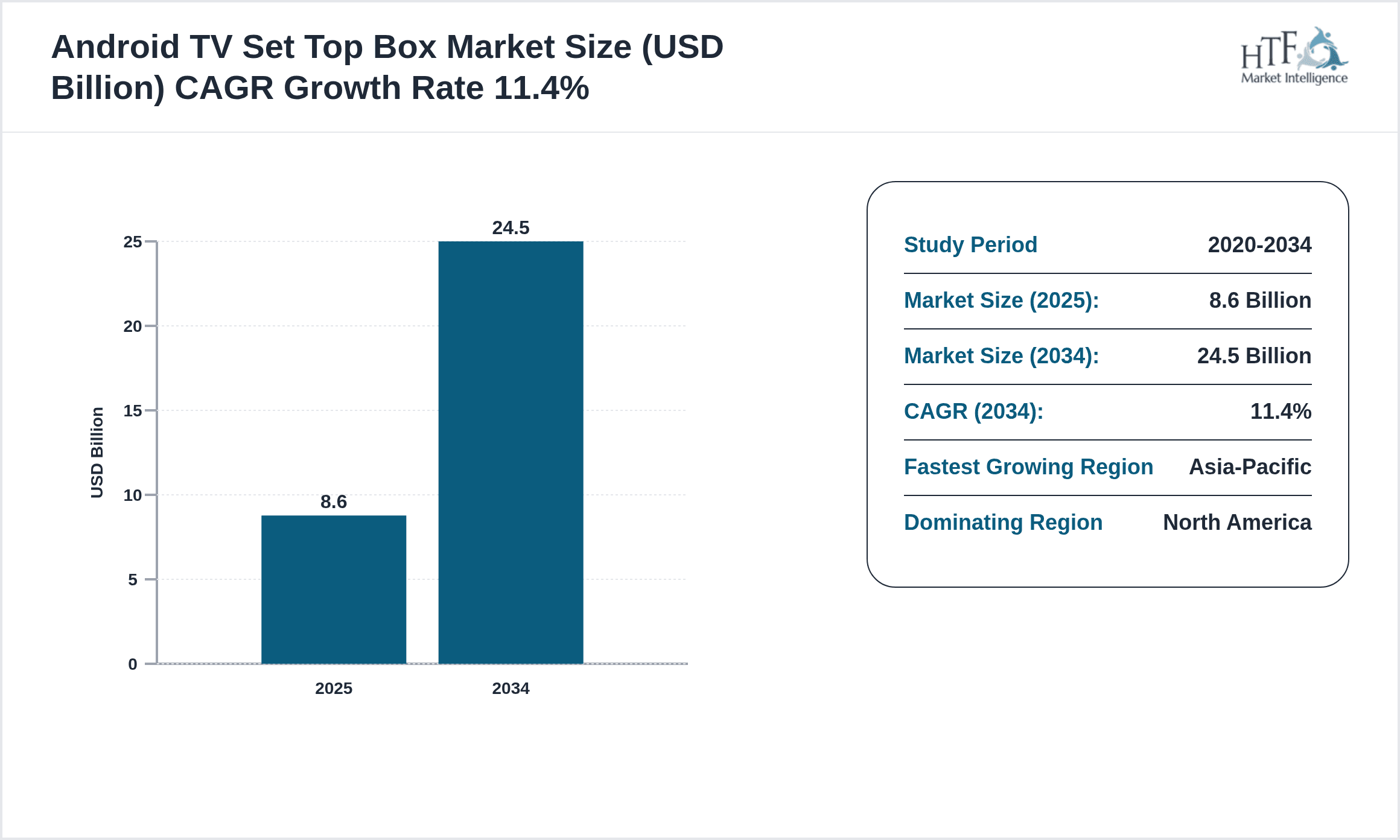
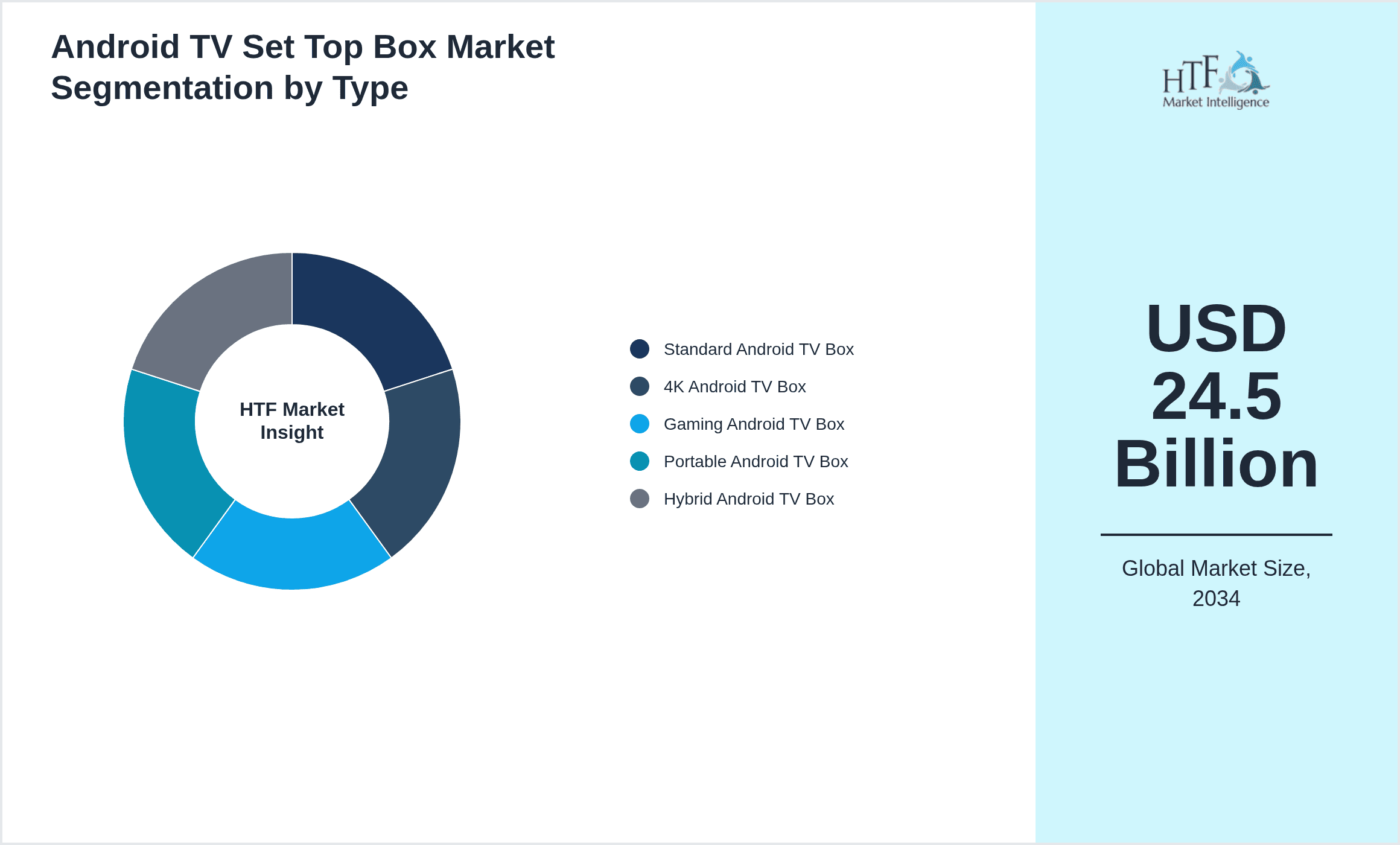
- •Key market highlights underscore an estimated base market size of USD 8.6 Billion in 2024, projected to reach USD 24.5 Billion by 2034, reflecting a robust compound annual growth rate (CAGR) of 11.4%. The dominance of North America is attributed to high technology adoption and mature OTT ecosystems, while Asia-Pacific is the fastest-growing region due to rising internet penetration and expanding middle-class consumers. The 4K Android TV Box segment leads the market in value, supported by growing consumer demand for high-definition content, whereas gaming Android TV boxes exhibit the fastest growth fueled by increasing popularity of cloud and mobile gaming. Streaming services remain the primary application, driven by global content consumption trends, with home entertainment and smart home integration following closely. Market dynamics are shaped by continuous innovation, strategic partnerships, and evolving consumer preferences, positioning this market as a key player in the digital entertainment industry.
- •This market offers significant value propositions for device manufacturers, content providers, and service operators by enabling expanded revenue streams through device sales, subscription services, and platform monetization. The strategic importance lies in its role as a conduit for digital content delivery, smart home interconnectivity, and interactive gaming experiences. For stakeholders, understanding regional variations and technological advancements is critical to capitalizing on emerging opportunities. The market’s growth supports broader trends in digital transformation and consumer electronics innovation, highlighting its relevance in shaping future entertainment and communication ecosystems worldwide.
Competitive Landscape
The global Android TV Set Top Box market exhibits intense competition characterized by rapid innovation, strategic collaborations, and aggressive pricing strategies. Market leaders focus on continuous product enhancements such as integrating 4K and gaming capabilities, expanding content partnerships, and improving user interface experiences to differentiate their offerings. Rivalry is further intensified by emerging players introducing niche devices targeting specific applications like portable streaming and hybrid functionalities. Companies embrace diverse distribution channels, including online platforms and retail partnerships, to maximize reach. Technological advancements such as voice control, AI-driven recommendations, and smart home compatibility are key competitive factors. Market entry barriers include the need for strong software ecosystems and compliance with regional regulations. The competitive landscape is dynamic, with ongoing mergers, acquisitions, and alliances shaping market consolidation and expansion. Future trends point to increased convergence of entertainment and smart home technologies, driving further market evolution.
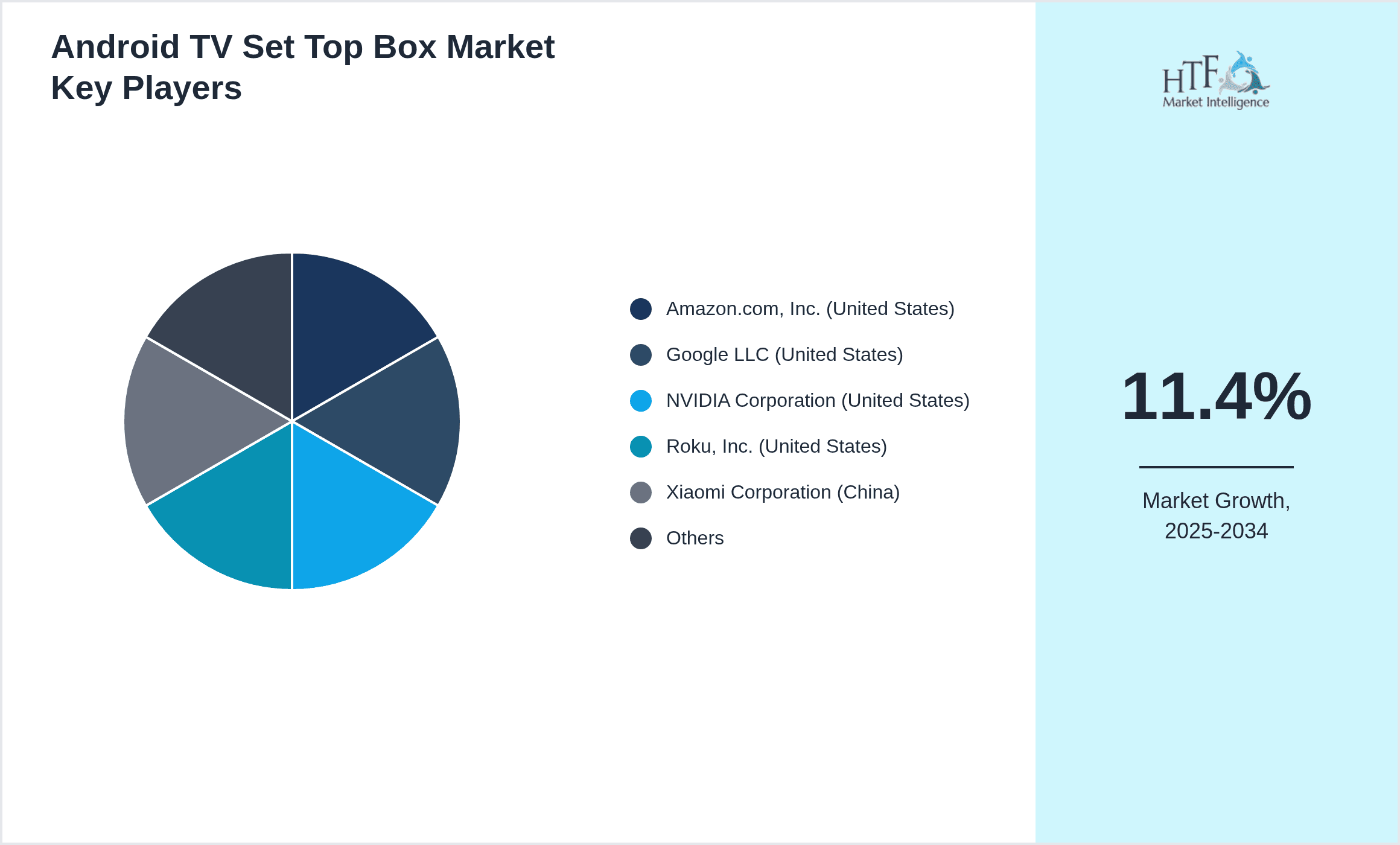
Leading Companies in Android TV Set Top Box Market
- •Amazon.com, Inc. (United States)
- •Google LLC (United States)
- •NVIDIA Corporation (United States)
- •Roku, Inc. (United States)
- •Xiaomi Corporation (China)
- •Samsung Electronics Co., Ltd. (South Korea)
- •Sony Corporation (Japan)
- •Amlogic Inc. (United States)
- •Harman International (United States)
- •TCL Technology (China)
- •Huawei Technologies Co., Ltd. (China)
- •Skyworth Group Co., Ltd. (China)
- •Hisense Group (China)
- •Lenovo Group Limited (China)
- •Funai Electric Co., Ltd. (Japan)
- •Broadcom Inc. (United States)
- •MediaTek Inc. (Taiwan)
- •Arris International Limited (United States)
- •EchoStar Corporation (United States)
- •Vizio Inc. (United States)
- •ZTE Corporation (China)
- •Panasonic Corporation (Japan)
- •Cisco Systems, Inc. (United States)
- •Netgear, Inc. (United States)
- •Philips (Netherlands)

Market Breakdown
- •By Product Type
- ◦Standard Android TV Box
- ◦4K Android TV Box
- ◦Gaming Android TV Box
- ◦Portable Android TV Box
- ◦Hybrid Android TV Box
- •By Application
- ◦Home Entertainment
- ◦Gaming
- ◦Streaming Services
- ◦Educational Content
- ◦Smart Home Integration
- •By End-Use Industry
- ◦Residential
- ◦Commercial
- ◦Educational Institutions
- ◦Hospitality
- •By Distribution Channel
- ◦Online Retail
- ◦Specialty Electronics Stores
- ◦Mass Merchandisers
Growth Dynamics
- •Rising consumer demand for high-definition and interactive content fuels growth in the Android TV Set Top Box market, with 4K devices gaining substantial traction globally due to enhanced viewing experiences.
- •Expansion of OTT platforms and increasing internet penetration worldwide drive adoption, enabling users to access a wide range of streaming services and digital content through Android TV boxes.
- •Integration of gaming capabilities into Android TV boxes attracts younger demographics, creating new revenue streams and fostering ecosystem expansion for content providers and device manufacturers.
- •Technological advancements in AI and voice recognition enhance user interaction and personalization, improving customer satisfaction and encouraging market growth.
- •Growing smart home adoption worldwide positions Android TV Set Top Boxes as central control hubs, integrating multiple IoT devices and expanding application opportunities beyond traditional media consumption.
- •Increasing investments and strategic partnerships among key players accelerate innovation and market penetration, strengthening competitive positioning and global reach.
- •Emerging markets in Asia-Pacific and Latin America exhibit significant growth potential driven by expanding middle-class populations and improved digital infrastructure.
Market Trends
- •The shift toward 4K and HDR-enabled Android TV Set Top Boxes underscores consumer preference for superior visual quality, with manufacturers responding through enhanced hardware capabilities.
- •Cloud gaming integration is an emerging trend, with Android TV boxes increasingly supporting high-performance gaming experiences via streaming, reducing the need for dedicated consoles.
- •Subscription-based content bundles and partnerships between device makers and OTT providers are reshaping market dynamics, offering consumers seamless access to diverse entertainment options.
- •Sustainability initiatives are influencing product design, with companies adopting energy-efficient components and recyclable materials to meet regulatory and consumer expectations.
- •Advances in AI-powered content recommendation engines improve user engagement and drive longer platform usage times across Android TV ecosystems.
- •Increasing adoption of voice assistants integrated with Android TV boxes enhances accessibility and user convenience, fostering wider market acceptance.
- •Collaborations between telecom operators and Android TV device manufacturers facilitate bundled offerings, expanding market reach and consumer base.
Market Opportunities
- •Expanding untapped markets in Latin America and Middle East & Africa present significant growth opportunities due to rising internet accessibility and increasing consumer spending on digital entertainment.
- •Development of hybrid Android TV Set Top Boxes combining streaming, gaming, and smart home control capabilities caters to evolving consumer preferences and differentiates product offerings.
- •Strategic partnerships between content providers and device manufacturers can unlock new monetization avenues through exclusive content and bundled services.
- •Integration with emerging technologies such as augmented reality (AR) and virtual reality (VR) presents potential for innovative applications and enhanced user experiences within Android TV platforms.
- •Growth in educational content delivery via Android TV boxes opens avenues for collaborations with educational institutions and content creators targeting remote learning needs.
- •The rising adoption of smart home ecosystems globally offers opportunities to position Android TV Set Top Boxes as central smart home controllers, expanding functionality beyond entertainment.
- •Emerging distribution channels such as direct-to-consumer online platforms enable cost-effective market penetration and personalized customer engagement strategies.
Market Challenges
- •High competition with frequent product launches leads to price erosion, impacting profit margins for Android TV Set Top Box manufacturers across the globe.
- •Fragmentation in Android OS versions and software customization complicates product development and maintenance, increasing operational costs for device makers.
- •Regulatory complexities related to digital content distribution and data privacy across different regions pose compliance challenges for manufacturers and service providers.
- •Supply chain disruptions and semiconductor shortages have intermittently impacted production schedules and increased component costs in recent years.
- •Consumer concerns over data security and privacy in smart devices may hinder adoption rates, requiring transparent policies and robust security implementations.
- •Limited digital literacy in certain emerging markets restricts the penetration of advanced Android TV Set Top Box features and services.
- •Rapid technological obsolescence demands continuous innovation, imposing significant R&D investments and time-to-market pressures on companies.
Regulatory Framework
- •Between 2019 and 2024, data privacy regulations such as GDPR in Europe and CCPA in North America established stringent compliance requirements for Android TV Set Top Box manufacturers and service providers, impacting data handling and user consent protocols.
- •New regulations mandating energy efficiency standards for consumer electronics were implemented globally, requiring manufacturers to optimize power consumption in Android TV devices to reduce environmental impact.
- •Safety certification requirements, including electromagnetic compatibility (EMC) and radio frequency (RF) emissions standards, have become mandatory for all Android TV Set Top Boxes sold in key markets, ensuring device safety and interoperability.
- •Regional mandates on content accessibility and censorship, particularly in Asia-Pacific and Middle East & Africa, require adaptation of streaming capabilities and content filters in Android TV platforms to comply with local laws.
- •Government initiatives promoting digital inclusion have subsidized smart device adoption in emerging economies, indirectly supporting Android TV Set Top Box market growth through increased consumer affordability.
Market Intelligence
- •15th January 2025, Google LLC launched its latest 4K Android TV Box featuring enhanced AI-driven voice control and integrated gaming capabilities aimed at expanding its user base in North America and Europe. This product includes upgraded hardware specifications supporting smoother streaming and gaming experiences, targeting premium home entertainment consumers. The launch is aligned with Google's strategic focus on smart home ecosystem integration, leveraging partnerships with leading OTT providers to offer bundled content packages. This innovation is expected to strengthen Google's competitive position and accelerate market share growth globally. Source: Official Google Press Release
- •10th March 2025, NVIDIA Corporation introduced the Shield Pro Gaming Android TV Box with cloud gaming optimization and support for emerging VR applications. Designed to cater to the growing gaming segment within the Android TV ecosystem, the device offers advanced GPU performance and seamless integration with popular game streaming services. NVIDIA aims to capitalize on the rapid expansion of cloud gaming in the Asia-Pacific and North America regions by providing hardware that enhances user experience. The launch reflects the company’s commitment to innovation in the intersection of gaming and smart home entertainment. Source: NVIDIA Official Website
- •20th February 2025, Amazon.com, Inc. announced a strategic partnership with leading OTT platforms to launch bundled subscription services with its Fire TV Android Set Top Boxes. This initiative focuses on the Latin American and Middle East & Africa markets to increase user engagement and drive device sales through value-added content offerings. Amazon’s move aims to leverage regional growth dynamics and consumer demand for affordable, all-in-one entertainment solutions. The partnership is expected to enhance Amazon’s ecosystem and fortify its market presence globally. Source: Amazon Corporate Announcement
- •5th April 2025, Xiaomi Corporation expanded its Android TV Set Top Box portfolio with a new portable hybrid model targeting emerging markets. The device features multi-functionality including streaming, gaming, and smart home control capabilities. Xiaomi’s strategy focuses on providing affordable, versatile devices to capture the rapidly growing middle-class segment in Asia-Pacific and Latin America. This launch demonstrates Xiaomi’s commitment to innovation and market expansion in the global Android TV ecosystem. Source: Xiaomi Press Release
Regional Outlook
The North America currently holds a significant share of the market, primarily due to several key factors: increasing consumption rates, a burgeoning population, and robust economic momentum. These elements collectively drive demand, positioning this region as a leader in the market. On the other hand, Asia-Pacific is rapidly emerging as the fastest-growing area within the industry. This remarkable growth can be attributed to swift infrastructure development, the expansion of various industrial sectors, and a marked increase in consumer demand. These dynamics make this region a crucial player in shaping future market growth.
In our report, we cover a comprehensive analysis of the following regions and countries:
- North America
- LATAM
- West Europe
- Central & Eastern Europe
- Northern Europe
- Southern Europe
- East Asia
- Southeast Asia
- South Asia
- Central Asia
- Oceania
- MEA
| Feature | Details |
|---|---|
| Base Year Market Size | USD 8.6 Billion |
| Forecast Year Market Size | USD 24.5 Billion |
| CAGR | 11.4% |
| Forecast Period | 2026 to 2033 |
| YoY Growth | 11.4% |
| Scope of Report | Market is segmented by Product Type (Standard Android TV Box, 4K Android TV Box, Gaming Android TV Box, Portable Android TV Box, Hybrid Android TV Box), Application (Home Entertainment, Gaming, Streaming Services, Educational Content, Smart Home Integration), End-Use Industry (Residential, Commercial, Educational Institutions, Hospitality), Distribution Channel (Online Retail, Specialty Electronics Stores, Mass Merchandisers) |
| Regions Covered | North America, LATAM, West Europe, Central & Eastern Europe, Northern Europe, Southern Europe, East Asia, Southeast Asia, South Asia, Central Asia, Oceania, MEA |
| Key Companies | Amazon.com, Inc. (United States), Google LLC (United States), NVIDIA Corporation (United States), Roku, Inc. (United States), Xiaomi Corporation (China), Samsung Electronics Co., Ltd. (South Korea), Sony Corporation (Japan), Amlogic Inc. (United States), Harman International (United States), TCL Technology (China), Huawei Technologies Co., Ltd. (China), Skyworth Group Co., Ltd. (China), Hisense Group (China), Lenovo Group Limited (China), Funai Electric Co., Ltd. (Japan), Broadcom Inc. (United States), MediaTek Inc. (Taiwan), Arris International Limited (United States), EchoStar Corporation (United States), Vizio Inc. (United States), ZTE Corporation (China), Panasonic Corporation (Japan), Cisco Systems, Inc. (United States), Netgear, Inc. (United States), Philips (Netherlands) |
Global Android TV Set Top Box Market Size, Growth & Revenue 2024-2034 - Table of Contents
Multidisciplinary researcher with 10+ years of experience uncovering insights across diverse domains focused on uncovering insights that drive informed decisions.
Frequently Asked Questions (FAQ):
The Market market is projected to grow at a steady CAGR from 2025 to 2030, driven by increasing demand and expansion in various applications.
North America currently leads the market, followed by Europe and Asia-Pacific.
Key growth drivers include increasing activities, rising demand for innovative solutions, technological advancements, and growing preference for efficient products.