
Global Garlic Equipment Market Size, Growth & Revenue 2024-2034
Global Garlic Equipment Market is segmented by Product Type (Mechanical Equipment, Automatic Equipment, Semi-Automatic Equipment, Pneumatic Equipment, Others), Application (Garlic Processing, Garlic Packaging, Garlic Sorting, Garlic Peeling, Garlic Harvesting), End-Use Industry (Food Processing, Pharmaceuticals, Cosmetics, Agriculture), Distribution Channel (Direct Sales, Distributors & Dealers, Online Sales), and Geography (North America, LATAM, West Europe, Central & Eastern Europe, Northern Europe, Southern Europe, East Asia, Southeast Asia, South Asia, Central Asia, Oceania, MEA)
Pricing
Report Overview
Executive Summary
- •The global Garlic Equipment Market encompasses a diverse range of machinery designed to optimize garlic-related agricultural and industrial processes. This market includes equipment for garlic harvesting, peeling, sorting, processing, and packaging, integrating advanced technologies such as automation and pneumatic systems to enhance operational efficiency. Its scope spans from small-scale farmers to large commercial enterprises, addressing the increasing global demand for garlic products in food, pharmaceutical, and cosmetic industries. The market is characterized by rapid technological innovation aimed at reducing manual labor and improving product quality through precise sorting and hygienic packaging solutions. Furthermore, the expansion of garlic cultivation in Asia-Pacific and Latin America, coupled with rising consumer awareness of garlic’s health benefits, fuels demand for modern equipment. Key applications include garlic harvesting machines that reduce crop loss, peeling machines that improve yield, and packaging systems that extend shelf life, collectively contributing to the growth of the garlic processing industry worldwide.
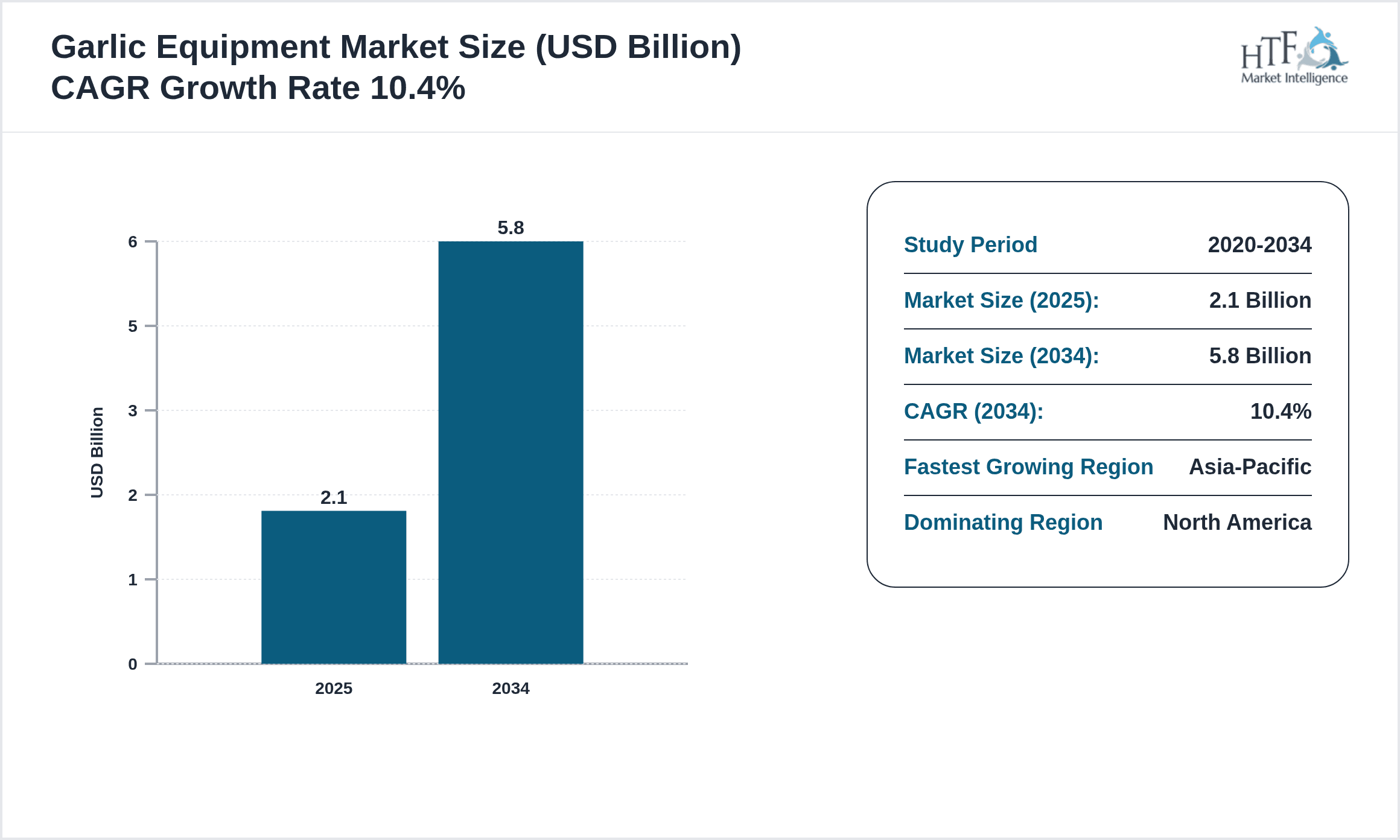
- •Market highlights reveal a robust CAGR of 10.4% projected from 2024 to 2034, with the market size expected to grow from USD 2.1 Billion in 2024 to USD 5.8 Billion by 2034. North America currently dominates the market due to advanced agricultural mechanization and high-value garlic exports. Asia-Pacific is identified as the fastest-growing region, driven by increasing garlic cultivation and industrialization in China and India. Automatic garlic processing equipment leads the product type segment, favored for its efficiency and precision, while mechanical equipment is the fastest-growing type owing to its cost-effectiveness and adaptability. Application-wise, garlic processing and packaging hold the largest shares, reflecting the growing demand for processed and ready-to-use garlic products in global food supply chains.
- •The global garlic equipment market offers significant value propositions to manufacturers, agricultural stakeholders, and food processors by enabling enhanced productivity, cost savings, and improved product quality. Strategic importance lies in the market’s ability to support sustainable agriculture, reduce post-harvest losses, and meet stringent food safety standards. For investors and technology developers, this market represents a fertile ground for innovation in automation, IoT-enabled equipment, and energy-efficient machinery. Moreover, expanding consumer preferences for convenience foods and organic garlic products create avenues for customized equipment solutions. Stakeholders benefit from integrated supply chain advancements, reinforcing the market’s role as a critical enabler of global garlic industry growth and competitiveness.
Competitive Landscape
The competitive environment within the global garlic equipment market is marked by a blend of established multinational corporations and emerging regional manufacturers, fostering a highly dynamic and innovation-driven landscape. Market players focus on differentiating their offerings through advanced automation, precision engineering, and sustainable design to address diverse customer needs across geographies. Strategic partnerships, product portfolio expansions, and technology acquisitions are common tactics to enhance market positioning and capture emerging opportunities. The rivalry is intensified by the entry of cost-effective manufacturers from Asia, compelling incumbents to continuously innovate and improve operational efficiencies. Companies leverage distribution networks and after-sales services to build brand loyalty, while investments in R&D facilitate development of smart and IoT-enabled garlic equipment. Additionally, regional competition varies with North America and Europe emphasizing high-tech solutions, whereas Asia-Pacific focuses on scalable and affordable machinery. Future trends indicate increasing consolidation and strategic collaborations to strengthen global market footprints and technological capabilities.
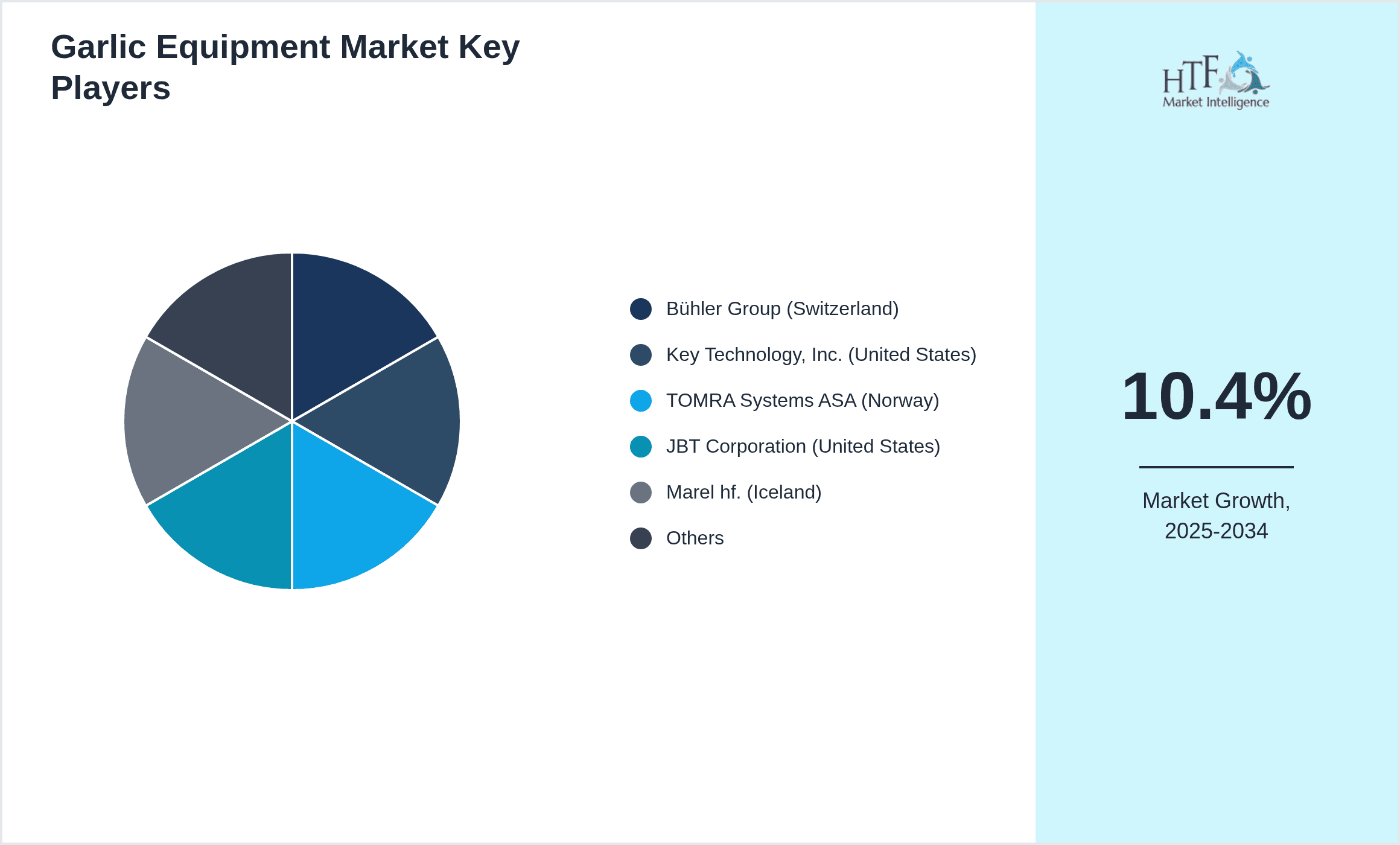
Leading Companies in Garlic Equipment Market
- •Bühler Group (Switzerland)
- •Key Technology, Inc. (United States)
- •TOMRA Systems ASA (Norway)
- •JBT Corporation (United States)
- •Marel hf. (Iceland)
- •Grote Company (United States)
- •Sormac B.V. (Netherlands)
- •Sormec Group (Italy)
- •Newtec Group (Belgium)
- •Hochland Maschinenbau GmbH (Germany)
- •Fritzmeier Umwelttechnik GmbH (Germany)
- •Satake Corporation (Japan)
- •Meyer Maschinenfabrik GmbH & Co. KG (Germany)
- •Grimme Landmaschinenfabrik GmbH & Co. KG (Germany)
- •Alvan Blanch Development Company Ltd. (United Kingdom)
- •Sormac USA Inc. (United States)
- •Koch Equipment (United States)
- •Sormac Asia Pacific (Singapore)
- •Hoffman Manufacturing (United States)
- •Perten Instruments AB (Sweden)
- •Tomra Food (Norway)
- •Moba B.V. (Netherlands)
- •GEA Group AG (Germany)
- •Key Technology Europe GmbH (Germany)
- •Buhler Sortex (United Kingdom)
Market Breakdown
- •By Product Type
- ◦Mechanical Equipment
- ◦Automatic Equipment
- ◦Semi-Automatic Equipment
- ◦Pneumatic Equipment
- ◦Others
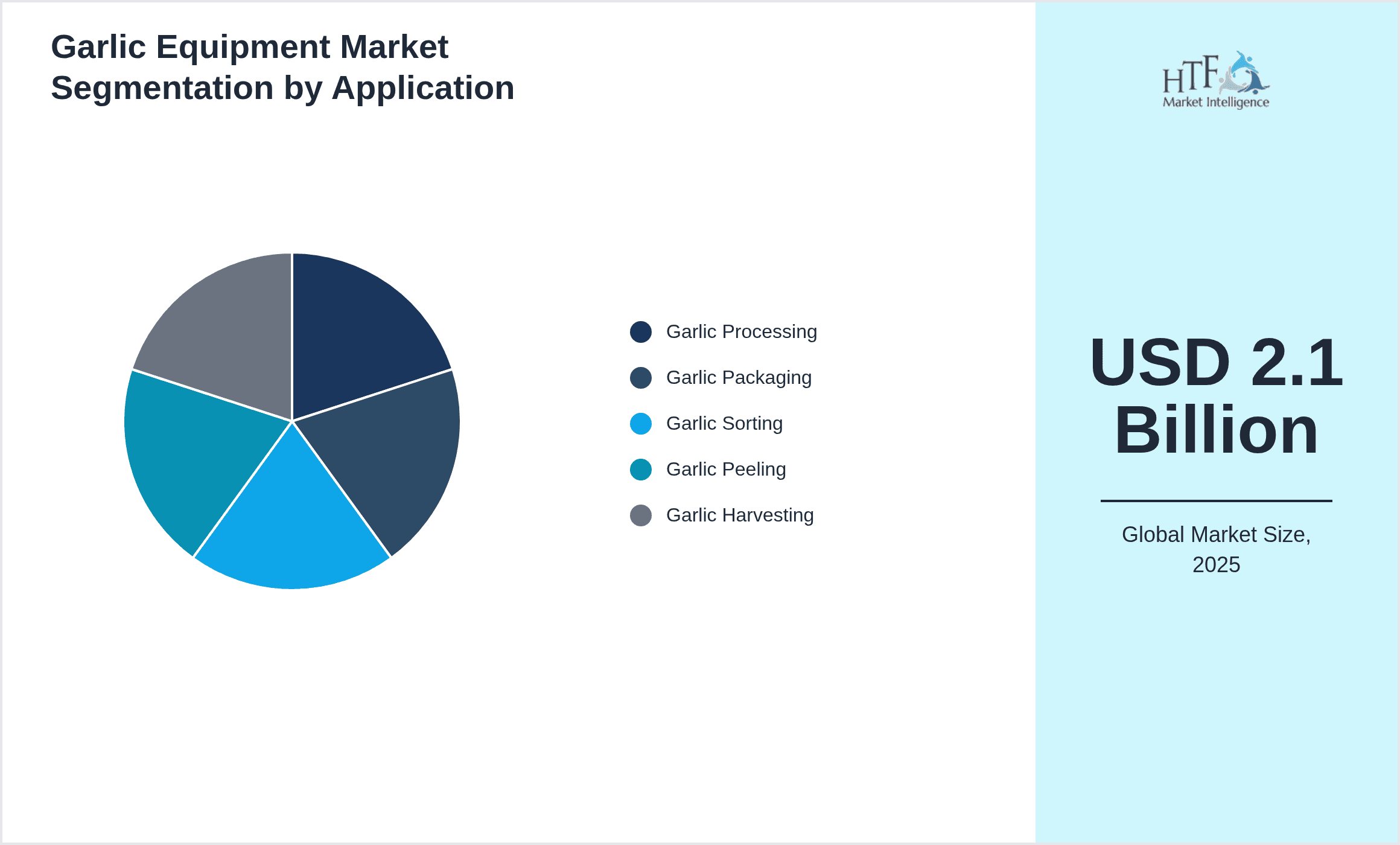
- •By Application
- ◦Garlic Processing
- ◦Garlic Packaging
- ◦Garlic Sorting
- ◦Garlic Peeling
- ◦Garlic Harvesting
- •By End-Use Industry
- ◦Food Processing
- ◦Pharmaceuticals
- ◦Cosmetics
- ◦Agriculture
- •By Distribution Channel
- ◦Direct Sales
- ◦Distributors & Dealers
- ◦Online Sales
Growth Dynamics
- •The increasing global demand for processed garlic products is a primary growth driver, propelled by rising health consciousness and culinary trends emphasizing garlic’s medicinal properties. This surge directly boosts adoption of advanced garlic equipment that enhances processing efficiency and quality control.
- •Technological advancements such as automation, IoT integration, and AI-powered sorting systems are revolutionizing equipment capabilities, enabling higher throughput and precision. These innovations attract investment and expand market penetration across both developed and emerging regions.
- •Government initiatives promoting agricultural mechanization and food safety standards in key garlic-producing regions encourage modernization of equipment fleets, improving productivity and compliance, thereby stimulating market growth.
- •Expansion of garlic cultivation in Asia-Pacific, driven by favorable climatic conditions and increased export activities, creates significant demand for scalable and cost-effective garlic equipment tailored to local needs.
- •Rising labor costs and scarcity of skilled manpower in developed markets incentivize adoption of automated and semi-automatic garlic processing machines, enhancing operational efficiency and reducing production costs.
- •Increasing consumer preference for packaged and ready-to-use garlic products in retail and foodservice sectors drives demand for innovative packaging equipment with enhanced shelf-life and hygiene features.
- •Investment trends focus on sustainable and energy-efficient garlic equipment, aligning with global environmental regulations and corporate responsibility goals, further propelling market expansion.

Market Trends
- •The rise of smart garlic equipment integrated with sensors and data analytics is enabling real-time monitoring and predictive maintenance, reducing downtime and improving process automation across production facilities worldwide.
- •Emerging trend of modular garlic machinery designs allows customization and scalability, catering to diverse farm sizes and processing capacities, which is gaining traction especially in developing regions.
- •Sustainability is gaining importance with manufacturers adopting eco-friendly materials and energy-saving technologies in garlic equipment manufacturing, responding to regulatory pressures and consumer awareness.
- •Collaborations between equipment manufacturers and technology firms are accelerating innovation cycles, producing next-generation garlic processing solutions that integrate AI and machine learning for enhanced efficiency.
- •Increasing demand for multifunctional garlic equipment capable of performing peeling, sorting, and packaging in a single line optimizes space and reduces capital expenditure, influencing procurement decisions.
- •Digitalization of supply chains coupled with online sales platforms is transforming distribution channels, enabling faster delivery and customized service offerings for garlic equipment buyers globally.
- •Future market direction points towards fully automated, robotics-enabled garlic processing plants, poised to disrupt traditional manufacturing and set new productivity benchmarks.
Market Opportunities
- •Expanding organic garlic farming globally presents a lucrative opportunity for specialized equipment that supports non-chemical peeling and processing aligned with organic certification standards.
- •Untapped markets in Latin America and Middle East & Africa offer high growth potential due to increasing garlic consumption and gradual mechanization of agriculture, inviting targeted market entry strategies.
- •Investment in R&D to develop cost-effective, compact garlic equipment for smallholder farmers can unlock significant market segments, particularly in emerging economies where mechanization is nascent.
- •Integration of IoT-enabled tracking systems to ensure traceability and quality assurance throughout the garlic supply chain aligns with regulatory requirements and consumer demand, opening new business avenues.
- •Collaborative ventures between garlic equipment manufacturers and food processing companies can foster innovation in customized solutions that optimize processing workflows and reduce waste.
- •Geographical expansion by establishing manufacturing units and sales offices in Asia-Pacific and Latin America can enhance local presence and responsiveness to region-specific equipment needs.
- •Development of energy-efficient and sustainable equipment solutions is increasingly favored by governments and customers, representing a critical opportunity for market differentiation and long-term growth.
Market Challenges
- •High initial capital investment and maintenance costs for advanced garlic equipment deter small and medium-scale farmers, limiting market penetration in developing regions.
- •Technical complexities and lack of skilled labor to operate and maintain sophisticated machinery pose operational challenges, particularly in rural areas with limited training resources.
- •Fluctuations in raw material prices and supply chain disruptions impact manufacturing costs and equipment availability, affecting market stability and growth trajectories.
- •Regulatory compliance across multiple regions with varying standards requires manufacturers to adapt equipment designs, increasing development costs and time to market.
- •Intense competition from low-cost manufacturers in Asia challenges established players, pressuring profit margins and necessitating continuous innovation to maintain market share.
- •Limited awareness among small-scale farmers regarding benefits of mechanization restricts adoption rates and slows overall market expansion in certain regions.
- •Environmental concerns related to energy consumption and waste disposal in garlic processing equipment require compliance with stringent regulations, adding to operational burdens.
Regulatory Framework
- •Between 2019 and 2024, the implementation of the EU Machinery Directive has mandated stringent safety and environmental compliance for garlic processing equipment sold within Europe, necessitating design modifications and certifications.
- •The U.S. Food and Drug Administration (FDA) updated its equipment hygiene guidelines in 2021, impacting the manufacturing standards for garlic processing machinery to ensure food safety and reduce contamination risks.
- •China's Ministry of Agriculture introduced mechanization subsidies in 2022, promoting adoption of certified garlic harvesting and processing equipment, which significantly boosted local manufacturing and sales.
- •New environmental regulations in India, effective from 2023, require manufacturers to integrate energy-efficient technologies and reduce emissions in agricultural machinery production, influencing garlic equipment design and costs.
- •International standards such as ISO 22000 for food safety management have been increasingly adopted globally from 2019 onwards, driving demand for compliant garlic processing and packaging equipment across multiple regions.
Market Intelligence
- •15th January 2025, Bühler Group launched an advanced automatic garlic peeling machine featuring AI-driven vision systems for enhanced sorting accuracy and minimal waste. This innovation targets large-scale processors aiming to increase throughput while reducing labor costs. The machine's modular design allows for easy integration into existing production lines, offering scalability and improved hygiene standards. Bühler's strategic push into smart garlic processing equipment reflects growing industry demand for automation and quality assurance, positioning the company as a market leader in technological advancements.
- •20th March 2025, Key Technology, Inc. introduced a next-generation garlic sorting system combining pneumatic and optical technologies to optimize sorting precision and reduce product damage. Designed for mid-sized facilities, the system enhances operational efficiency with reduced energy consumption and user-friendly interfaces. This launch addresses the increasing need for customized solutions in emerging garlic production regions, strengthening Key Technology's competitive position and supporting global mechanization trends.
- •10th June 2024, TOMRA Systems ASA announced a strategic partnership with agricultural cooperative groups in Asia-Pacific to deploy IoT-enabled garlic sorting and grading equipment. This initiative aims to improve supply chain transparency and product quality, aligning with regional government goals to modernize agricultural practices. The collaboration is expected to accelerate adoption of smart technologies and expand TOMRA's footprint in high-growth markets.
- •5th November 2024, JBT Corporation completed acquisition of a regional garlic equipment manufacturer specializing in pneumatic peeling systems. This move enhances JBT's product portfolio and market reach in Latin America, enabling delivery of integrated processing solutions. The acquisition aligns with JBT's strategic focus on expanding presence in emerging markets and driving innovation in garlic equipment technology.
- •Source: Official company press releases and industry publications
Regional Outlook
The North America currently holds a significant share of the market, primarily due to several key factors: increasing consumption rates, a burgeoning population, and robust economic momentum. These elements collectively drive demand, positioning this region as a leader in the market. On the other hand, Asia-Pacific is rapidly emerging as the fastest-growing area within the industry. This remarkable growth can be attributed to swift infrastructure development, the expansion of various industrial sectors, and a marked increase in consumer demand. These dynamics make this region a crucial player in shaping future market growth.
In our report, we cover a comprehensive analysis of the following regions and countries:
- North America
- LATAM
- West Europe
- Central & Eastern Europe
- Northern Europe
- Southern Europe
- East Asia
- Southeast Asia
- South Asia
- Central Asia
- Oceania
- MEA
| Feature | Details |
|---|---|
| Base Year Market Size | USD 2.1 Billion |
| Forecast Year Market Size | USD 5.8 Billion |
| CAGR | 10.4% |
| Forecast Period | 2026 to 2033 |
| YoY Growth | 10% |
| Scope of Report | Market is segmented by Product Type (Mechanical Equipment, Automatic Equipment, Semi-Automatic Equipment, Pneumatic Equipment, Others), Application (Garlic Processing, Garlic Packaging, Garlic Sorting, Garlic Peeling, Garlic Harvesting), End-Use Industry (Food Processing, Pharmaceuticals, Cosmetics, Agriculture), Distribution Channel (Direct Sales, Distributors & Dealers, Online Sales) |
| Regions Covered | North America, LATAM, West Europe, Central & Eastern Europe, Northern Europe, Southern Europe, East Asia, Southeast Asia, South Asia, Central Asia, Oceania, MEA |
| Key Companies | Bühler Group (Switzerland), Key Technology, Inc. (United States), TOMRA Systems ASA (Norway), JBT Corporation (United States), Marel hf. (Iceland) |
Global Garlic Equipment Market Size, Growth & Revenue 2024-2034 - Table of Contents
Research enthusiast focused on transforming data uncovering into actionable insights through data-driven decision-making.
Frequently Asked Questions (FAQ):
The Market market is expected to see significant growth and value in 2025.
North America currently leads the market, followed by Europe and Asia-Pacific.
Key growth drivers include increasing activities, rising demand for innovative solutions, technological advancements, and growing preference for efficient products.