
Global Automatic Juice Vending Machine Market Size, Growth & Revenue 2024-2034
Global Automatic Juice Vending Machine Market is segmented by Product Type (Fresh Juice Dispensers, Concentrate Juice Dispensers, Pre-packaged Juice Dispensers, Mixed Juice Dispensers, Customizable Juice Machines), Application (Retail Outlets, Office Buildings, Airports, Hospitals, Educational Institutions), End-Use Industry (Food and Beverage, Healthcare, Education, Transportation), Distribution Channel (Direct Sales, Online Sales, Third-party Distributors), and Geography (North America, LATAM, West Europe, Central & Eastern Europe, Northern Europe, Southern Europe, East Asia, Southeast Asia, South Asia, Central Asia, Oceania, MEA)
Pricing
Report Overview
Executive Summary
- •The global Automatic Juice Vending Machine market is an evolving sector that delivers automated solutions for dispensing various juice types including fresh, concentrate, pre-packaged, and customizable juice blends. This market spans numerous applications such as retail outlets, office buildings, airports, hospitals, and educational institutions, serving the growing consumer demand for convenient and healthy beverage options. The machines leverage advanced technologies including refrigeration, touch interfaces, and hygienic dispensing mechanisms to enhance user experience and operational efficiency. Increasing urbanization, rising health consciousness, and the need for on-the-go nutrition are primary factors driving market expansion. Moreover, the industry is influenced by innovations in automation, IoT integration, and eco-friendly designs, broadening its scope to include sustainable and energy-efficient systems. The competitive landscape is marked by continuous product development and strategic collaborations aimed at capturing diverse regional markets globally. With a forecast CAGR of over 12% through 2034, this sector represents significant growth potential, driven by technological advancements and changing consumer lifestyles seeking fresh juice availability anytime and anywhere.
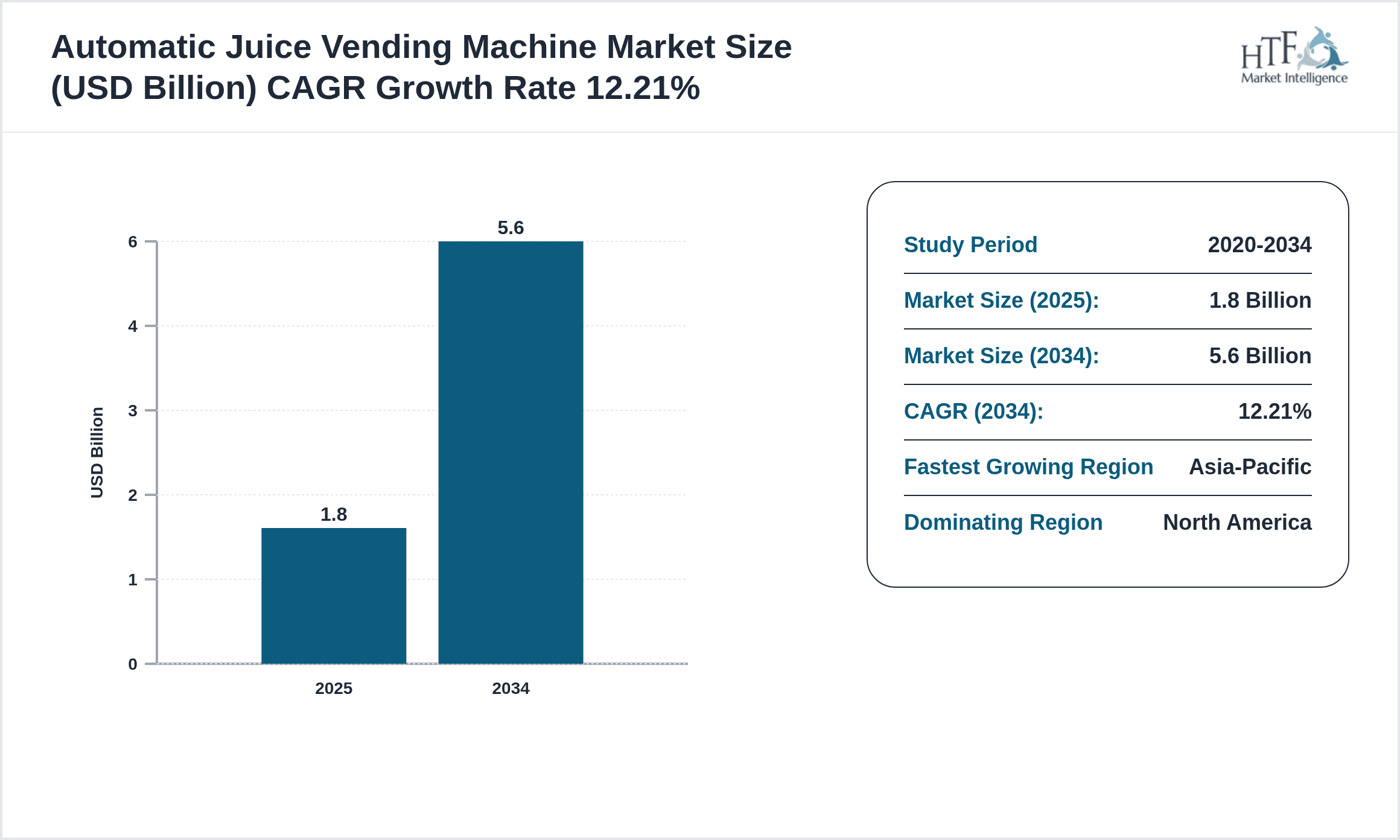
- •Key market highlights include a base market size of USD 1.8 Billion in 2025 with projections reaching USD 5.6 Billion by 2034, reflecting a robust CAGR of 12.21%. North America currently dominates the market due to high consumer awareness and established retail infrastructure, whereas Asia-Pacific is identified as the fastest-growing region driven by urbanization and increasing disposable incomes. Fresh Juice Dispensers are the leading product type owing to their ability to provide freshly prepared beverages, while Customizable Juice Machines showcase the highest growth potential due to consumer preference for personalized options. Applications such as retail outlets and office buildings remain significant contributors, supported by technological integration and convenience factors. Market dynamics indicate a positive outlook underpinned by expanding applications and innovations in vending technology.
- •The automatic juice vending machine market offers substantial value propositions to stakeholders including manufacturers, distributors, and end-users by enabling efficient, hygienic, and cost-effective juice delivery. For industries, it presents opportunities to enhance customer engagement and operational throughput by automating beverage dispensing in high-traffic locations. Investors benefit from the rapid growth fueled by health trends and technological innovation, while consumers gain access to fresh and customizable juice options without the need for traditional retail interaction. This strategic importance is reinforced by evolving consumer lifestyles favoring quick-service healthy alternatives, making the market a critical segment within the beverage and vending sectors worldwide.
Competitive Landscape
The competitive environment of the global Automatic Juice Vending Machine market is characterized by intense rivalry among established multinational corporations and emerging regional players. Market participants focus heavily on innovation to differentiate their product offerings through enhanced automation, user-friendly interfaces, and integration of IoT and AI technologies. Strategic partnerships and collaborations are commonplace, allowing companies to expand distribution networks and improve market penetration across various regions. Pricing strategies vary widely, with premium models offering advanced customization and hygienic features competing against cost-effective standard machines aimed at mass markets. Mergers and acquisitions have played a pivotal role in consolidating market share and fostering technological advancements, addressing both competitive pressures and consumer demand for variety and convenience. Additionally, companies emphasize sustainability and energy efficiency to align with regulatory frameworks and growing environmental awareness. Barriers to entry include high R&D costs, compliance with food safety standards, and the need for robust after-sales service infrastructure, which together shape the competitive dynamics and future growth trajectories.
Key Players in Automatic Juice Vending Machine Market
- •Keurig Dr Pepper Inc. (United States)
- •Fuji Electric Co., Ltd. (Japan)
- •Selecta Group S.A. (Switzerland)
- •Crane Merchandising Systems (United States)
- •Bianchi Industry S.p.A. (Italy)
- •N&W Global Vending SpA (Italy)
- •Royal Vendors, Inc. (United States)
- •Automated Merchandising Systems Inc. (United States)
- •SandenVendo America Inc. (United States)
- •Sanden International Holdings Co., Ltd. (Japan)
- •Azkoyen Group (Spain)
- •FAS International (Italy)
- •Jofemar Corporation (Spain)
- •Sielaff GmbH & Co. KG (Germany)
- •Vendo Company (United States)
- •Jofemar Corporation (Spain)
- •Vendo Company (United States)
- •Sielaff GmbH & Co. KG (Germany)
- •FAS International (Italy)
- •Selecta Group S.A. (Switzerland)
- •Crane Merchandising Systems (United States)
- •Bianchi Industry S.p.A. (Italy)
- •N&W Global Vending SpA (Italy)
- •Royal Vendors, Inc. (United States)
- •Automated Merchandising Systems Inc. (United States)

Market Breakdown
- •By Product Type
- ◦Fresh Juice Dispensers
- ◦Concentrate Juice Dispensers
- ◦Pre-packaged Juice Dispensers
- ◦Mixed Juice Dispensers
- ◦Customizable Juice Machines
- •By Application
- ◦Retail Outlets
- ◦Office Buildings
- ◦Airports
- ◦Hospitals
- ◦Educational Institutions
- •By End-Use Industry
- ◦Food and Beverage
- ◦Healthcare
- ◦Education
- ◦Transportation
- •By Distribution Channel
- ◦Direct Sales
- ◦Online Sales
- ◦Third-party Distributors
Growth Dynamics
- •The global Automatic Juice Vending Machine market is propelled by increasing consumer health awareness and demand for convenient access to fresh, nutritious beverages. Urbanization and rising disposable incomes in emerging economies contribute to the rapid adoption of automated juice vending solutions. Technological innovations such as touchless operation, IoT integration for real-time monitoring, and customizable juice options enhance consumer engagement, expanding market reach. Additionally, the growing presence of retail chains, corporate offices, and public venues investing in automated vending infrastructure supports sustained growth. Market players benefit from strategic product development focused on hygiene, energy efficiency, and user experience, further fueling adoption worldwide.
- •Consumer trends favoring healthy lifestyles and on-the-go consumption are reshaping the juice vending landscape. The integration of smart vending machines equipped with AI and cloud connectivity enables personalized beverage offerings and data-driven maintenance, improving operational efficiency. Sustainability concerns are prompting manufacturers to develop eco-friendly machines using recyclable materials and energy-saving technologies. The shift towards contactless transactions accelerated by the COVID-19 pandemic has increased acceptance of automated vending solutions. Furthermore, collaborations between vending machine manufacturers and juice suppliers are creating innovative product bundles and loyalty programs to attract end-users in diverse settings.
- •Despite promising growth, the market faces challenges including the high initial cost of advanced vending machines and the complexity of maintenance. Technical limitations related to juice freshness preservation and machine hygiene require continuous innovation. Regional disparities in infrastructure and consumer readiness affect market penetration, particularly in developing regions. Additionally, stringent food safety regulations and compliance requirements impose operational constraints on manufacturers and operators. The need for reliable after-sales service and supply chain robustness presents further hurdles. Addressing these challenges is critical for sustainable market expansion and customer retention.
- •Emerging opportunities lie in expanding applications such as healthcare facilities and educational institutions where demand for healthy beverage options is rising. The development of customizable machines catering to diverse dietary preferences and flavor profiles opens new market segments. Geographic expansion into untapped regions with growing urban populations offers significant growth potential. Integration with mobile payment platforms and digital marketing channels enhances consumer convenience and engagement. Investment in R&D focusing on machine miniaturization, energy efficiency, and smart diagnostics is expected to yield competitive advantages for early adopters. Strategic alliances with juice brands and technology firms can accelerate innovation and market penetration.
- •Market challenges include fluctuating raw material prices affecting juice concentrate and packaging costs, which impact overall profitability. Competition from traditional juice retail outlets and bottled juice products limits vending machine adoption in some markets. Regulatory variations across countries demand adaptable compliance strategies, increasing operational complexity. The risk of machine vandalism and theft in public spaces necessitates robust security features and insurance considerations. Additionally, consumer skepticism regarding juice quality and machine hygiene requires transparent communication and consistent product standards. Overcoming these challenges is essential to build market trust and expand consumer base globally.

Market Trends
- •The market is witnessing a surge in demand for customizable juice vending machines that allow consumers to select ingredients and adjust sweetness or nutritional content, driving personalized beverage trends. Integration of AI and IoT technologies enables predictive maintenance and inventory management, reducing downtime and operational costs. The adoption of cashless and contactless payment systems is becoming standard, enhancing user convenience and safety. Sustainable design innovations focusing on energy efficiency and recyclable materials align with global environmental goals and attract eco-conscious consumers. Furthermore, multi-functional vending machines capable of dispensing other healthy beverages alongside juice are gaining traction, broadening market scope and consumer appeal.
- •Emerging markets in Asia-Pacific and Latin America are adopting automated juice vending solutions rapidly due to urban lifestyle changes and growing health awareness, positioning these regions as high-growth hubs. Collaborations between vending machine manufacturers and popular juice brands facilitate co-branding and exclusive product offerings, enhancing market differentiation. The rise of smart cities and smart building initiatives incorporate automated vending as part of digital infrastructure upgrades, promoting seamless consumer experiences. Additionally, the integration of augmented reality and gamification in vending interfaces is innovating consumer engagement strategies, attracting younger demographics. These trends collectively contribute to shaping the future market landscape with a focus on technology and user-centricity.
- •Strategic trend adoption includes the expansion of subscription-based models providing regular maintenance and supply replenishment services, improving customer retention. Innovation in cold-pressed juice vending machines preserves nutrient integrity better, catering to premium market segments. Partnerships with health and wellness platforms are creating integrated offerings that combine vending services with lifestyle applications. The market is also moving towards modular vending solutions enabling easy upgrades and customization to meet specific consumer or location needs. These strategic moves enhance flexibility and scalability of vending operations, supporting sustainable growth and competitive advantage.
- •Digital transformation is accelerating with the deployment of data analytics to optimize location selection, product assortment, and pricing strategies, resulting in improved profitability. Sustainability initiatives are driving the adoption of biodegradable cups and packaging within vending systems, reducing environmental footprints. Operational efficiency is enhanced through remote monitoring and automated alerts for maintenance needs, minimizing downtime. The focus on hygiene, intensified by the global health crisis, is leading to the incorporation of antimicrobial surfaces and UV sterilization technologies within vending machines. These technological and operational trends are redefining market standards and consumer expectations.
- •Collaboration trends include joint ventures between technology startups and established vending machine manufacturers to accelerate innovation cycles. Ecosystem development involving beverage suppliers, payment solution providers, and maintenance service companies fosters comprehensive offerings to end-users. Consumer segmentation strategies leveraging behavioral data enable targeted marketing and personalized promotions, enhancing market penetration. Value chain evolution emphasizes integrated supply chain management to reduce lead times and ensure product freshness. The market is also exploring disruptive innovations such as blockchain for supply chain transparency and quality assurance, positioning stakeholders for future resilience and growth.
- •Consumer preferences are evolving towards organic and exotic juice varieties dispensed through automated machines, influencing product development pipelines. Market segmentation based on location demographics supports tailored vending solutions optimized for specific environments such as airports or hospitals. Value chain integration with localized sourcing and production reduces costs and enhances sustainability credentials. The emergence of hybrid vending models combining physical machines with digital ordering platforms is expanding convenience and accessibility. Future directions point to fully automated, AI-powered vending ecosystems capable of dynamic product customization and seamless user interaction, representing a paradigm shift in beverage retailing.
- •Disruptive innovations expected include the use of robotics for juice preparation and dispensing, enhancing precision and hygiene. Advances in sensor technologies will enable real-time quality monitoring and freshness validation, assuring consumers of product integrity. Blockchain integration may provide traceability from fruit sourcing to dispensing, building consumer trust. The adoption of 5G connectivity will facilitate faster data transmission for remote monitoring and customer interaction. These paradigm shifts will transform the automatic juice vending machine market into a technologically sophisticated and highly responsive sector, aligned with future consumer demands and sustainability goals.

Market Opportunities
- •Expanding into emerging markets with rising urbanization and disposable income presents significant growth potential for automatic juice vending machine manufacturers. Targeting underserved applications such as healthcare and educational institutions can unlock new revenue streams. Developing machines with multi-functional capabilities to offer a broader range of healthy beverages meets consumer demand for variety and convenience. Leveraging digital platforms for remote machine management and customer engagement enhances operational efficiency and user experience. These strategic opportunities allow companies to capitalize on both geographic and application-based market expansions.
- •Untapped segments like corporate wellness programs and fitness centers offer promising avenues for vending machine deployment, aligning with health-conscious consumer bases. Innovations in machine design focusing on compactness and portability enable penetration into smaller retail outlets and kiosks. Integration with mobile apps for pre-ordering and loyalty rewards can increase customer retention and sales frequency. Geographic expansion into Latin America and Middle East & Africa, where automation adoption is accelerating, provides long-term growth prospects. These opportunities encourage diversified product offerings and market presence.
- •Investment in R&D targeting energy-efficient and eco-friendly vending machines addresses growing regulatory and consumer expectations for sustainability. Collaborations with juice producers and technology partners enable co-development of innovative products and enhanced service models. Exploring subscription and pay-per-use business models creates flexible revenue mechanisms and strengthens customer relationships. Expansion of after-sales service networks improves machine uptime and customer satisfaction, supporting brand loyalty. These investment and partnership opportunities reinforce competitive positioning and market resilience.
- •Geographical expansion into regions with growing public infrastructure projects and smart city initiatives offers opportunities to embed automatic juice vending solutions within urban amenities. Developing customizable machines catering to diverse local tastes and dietary preferences increases market relevance. Enhancing value propositions with integrated health tracking and nutritional analytics can differentiate offerings in competitive markets. Strategic acquisitions of regional players facilitate rapid entry and local expertise acquisition. These opportunities foster innovation-driven and market-responsive growth strategies.
- •Product development focusing on hygienic, touchless dispensing technologies meets increasing consumer demand for safety and convenience. Enhancing machine connectivity for real-time data analytics supports dynamic inventory management and predictive maintenance. Forming strategic alliances for co-marketing and distribution expands market reach and brand visibility. Anticipating future regulatory changes and adapting product designs proactively ensures compliance and market continuity. These forward-looking opportunities empower companies to stay ahead in the competitive landscape while addressing evolving consumer and regulatory requirements.
- •Partnerships with payment solution providers enable seamless integration of diverse transaction methods, improving accessibility and customer satisfaction. Acquisition of technology startups can accelerate innovation and enable cutting-edge product features. Joint ventures with local distributors and service providers enhance market penetration and operational support. Collaborative marketing efforts with health and wellness brands amplify consumer awareness and demand. These alliance-driven opportunities strengthen market positioning and foster sustainable growth.
- •Anticipating societal trends toward healthier lifestyles and sustainability can guide product innovation and market positioning. Regulatory incentives for green technologies may open funding and subsidy opportunities. Expanding into adjacent markets such as automated smoothie or coffee vending leverages existing infrastructure and consumer bases. Developing standardized platforms for machine interoperability promotes scalability and reduced costs. These strategic considerations prepare market players for long-term value creation and industry leadership.
Market Challenges
- •High capital expenditure required for advanced automatic juice vending machines limits adoption, especially among small-scale operators and in price-sensitive markets. The complexity of maintaining freshness and hygiene poses operational challenges, necessitating specialized service expertise and regular upkeep. Variability in power supply and infrastructure in developing regions hampers reliable machine operation and expansion. These factors collectively constrain market growth and require innovative cost-effective and maintenance-friendly solutions.
- •Technical limitations related to juice quality preservation, such as oxidation and microbial contamination, challenge manufacturers to enhance machine design and processing technologies. Compliance with diverse food safety regulations across regions adds complexity to product certification and market entry. Limited consumer awareness and trust in automated juice vending, particularly in emerging markets, restrict demand. Addressing these technical and regulatory hurdles is critical for market acceptance and scalability.
- •Competition from traditional juice retail outlets and bottled beverages remains a significant barrier, as consumers may prefer established brands and formats. Market saturation in developed regions intensifies price competition and compresses profit margins. The risk of machine vandalism, theft, and misuse in public spaces increases operational costs and insurance requirements. These competitive and security challenges necessitate robust risk management and differentiation strategies.
- •Regulatory uncertainties and frequent changes in food safety and vending machine standards impose compliance burdens on manufacturers and operators. Navigating complex import/export regulations affects supply chain efficiency and cost structures. Price volatility in raw materials like fruit concentrates impacts production costs and pricing strategies. These regulatory and economic constraints require agile business models and proactive stakeholder engagement.
- •Talent shortages in skilled service and maintenance personnel restrict effective after-sales support, impacting machine uptime and customer satisfaction. Infrastructure gaps including internet connectivity and power reliability limit advanced machine functionalities in certain regions. Consumer resistance to adopting new vending technologies due to perceived complexity or hygiene concerns slows market penetration. Overcoming these challenges requires investment in training, infrastructure development, and consumer education.
- •Fluctuating economic conditions and geopolitical tensions can affect investment flows and market stability. Supply chain disruptions due to global events impact component availability and production timelines. Ensuring data security and privacy in connected vending machines is increasingly important amidst rising cyber threats. These external challenges necessitate resilient operational strategies and continuous risk assessment.
- •Addressing environmental concerns related to waste management, packaging disposal, and energy consumption requires ongoing innovation and compliance. Balancing machine affordability with advanced technological features remains a market challenge. Aligning product development with diverse regional preferences and cultural differences demands localized approaches. These multifaceted challenges underscore the complexity of sustaining growth in the global automatic juice vending machine market.
Regulatory Framework
- •Between 2019 and 2025, key regulations such as the Food Safety Modernization Act (FSMA) in the United States and the European Union’s Food Hygiene Package mandated stringent compliance for automated food dispensing equipment, including juice vending machines. These regulations require manufacturers to implement hazard analysis and critical control points (HACCP) systems ensuring product safety during preparation and dispensing. Compliance improved consumer confidence and prompted innovation in hygienic machine design.
- •Mandatory adherence to electrical safety standards like IEC 60335-2-75 and regional certifications (CE marking in Europe, UL certification in North America) has governed machine manufacturing from 2019 to 2025. These standards ensure operational safety, reducing risk of electrical hazards, and influencing product reliability and market acceptance.
- •Environmental regulations focusing on energy efficiency and waste reduction, including the EU Ecodesign Directive and ENERGY STAR certifications, have driven manufacturers to develop more sustainable juice vending solutions. These requirements support reduced environmental impact and align with global sustainability goals.
- •Country-specific mandates, such as China’s GB 31604 series on food contact materials and India’s Food Safety and Standards Authority (FSSAI) guidelines, have introduced localized compliance challenges and timelines, necessitating region-specific product adaptations and certifications.
- •Government initiatives promoting automation in retail and public utilities, including subsidies and tax incentives in regions like Europe and Asia-Pacific, have encouraged adoption of automatic juice vending machines. These policy frameworks foster innovation, market growth, and alignment with smart city development objectives.
Market Intelligence
- •15th March 2025, Keurig Dr Pepper Inc. launched an innovative customizable juice vending machine featuring AI-powered ingredient selection and touchless dispensing technology. Targeted at high-traffic retail outlets and corporate offices, this product offers real-time freshness monitoring and integrates with mobile payment platforms to enhance consumer convenience and hygiene. The launch aims to capture growing demand for personalized, healthy beverage options while addressing post-pandemic safety concerns. Strategic objectives include expanding presence in North America and Asia-Pacific with plans for continuous software updates and service enhancements. Source: Official Keurig Dr Pepper Press Release.
- •7th January 2025, Fuji Electric Co., Ltd. introduced a next-generation fresh juice dispenser equipped with refrigerated storage and UV sterilization features. Designed for airports and hospitals, the machine ensures extended freshness and superior hygiene standards. It supports IoT-enabled remote monitoring for predictive maintenance, reducing operational downtime. Fuji Electric’s innovation targets markets with strict regulatory environments and growing health awareness, aiming to strengthen its footprint in Europe and Asia-Pacific. The product launch is part of a broader strategy focusing on energy efficiency and sustainability. Source: Fuji Electric Corporate Announcement.
- •20th June 2024, Selecta Group S.A. announced a strategic partnership with a major juice concentrate supplier to co-develop exclusive vending solutions customized for the Latin American market. This collaboration includes joint marketing campaigns and bundled product-service offerings to increase customer engagement and loyalty. The initiative leverages Selecta’s extensive distribution network and supplier expertise to accelerate growth in emerging markets. Planned rollouts include innovative vending machines with enhanced customization and mobile app integration. The partnership is expected to boost regional market share and revenue streams significantly. Source: Selecta Group Official Release.
- •10th February 2025, Crane Merchandising Systems completed the acquisition of a smart vending technology startup specializing in AI-driven juice dispensing analytics. This acquisition enhances Crane’s product portfolio by integrating advanced data analytics and machine learning capabilities, enabling dynamic inventory optimization and personalized consumer experiences. The move strengthens Crane’s competitive position globally, particularly in North America and Europe, and aligns with its strategic focus on digital transformation and sustainability. Plans include rapid integration of the startup’s technology across existing product lines. Source: Crane Merchandising Systems Press Release.
Regional Outlook
The North America currently holds a significant share of the market, primarily due to several key factors: increasing consumption rates, a burgeoning population, and robust economic momentum. These elements collectively drive demand, positioning this region as a leader in the market. On the other hand, Asia-Pacific is rapidly emerging as the fastest-growing area within the industry. This remarkable growth can be attributed to swift infrastructure development, the expansion of various industrial sectors, and a marked increase in consumer demand. These dynamics make this region a crucial player in shaping future market growth.
In our report, we cover a comprehensive analysis of the following regions and countries:
- North America
- LATAM
- West Europe
- Central & Eastern Europe
- Northern Europe
- Southern Europe
- East Asia
- Southeast Asia
- South Asia
- Central Asia
- Oceania
- MEA
| Feature | Details |
|---|---|
| Base Year Market Size | USD 1.8 Billion |
| Forecast Year Market Size | USD 5.6 Billion |
| CAGR | 12.21% |
| Forecast Period | 2026 to 2033 |
| YoY Growth | 12.12% |
| Scope of Report | Market is segmented by Product Type (Fresh Juice Dispensers, Concentrate Juice Dispensers, Pre-packaged Juice Dispensers, Mixed Juice Dispensers, Customizable Juice Machines), Application (Retail Outlets, Office Buildings, Airports, Hospitals, Educational Institutions), End-Use Industry (Food and Beverage, Healthcare, Education, Transportation), Distribution Channel (Direct Sales, Online Sales, Third-party Distributors) |
| Regions Covered | North America, LATAM, West Europe, Central & Eastern Europe, Northern Europe, Southern Europe, East Asia, Southeast Asia, South Asia, Central Asia, Oceania, MEA |
| Key Companies | Keurig Dr Pepper Inc. (United States), Fuji Electric Co., Ltd. (Japan), Selecta Group S.A. (Switzerland), Crane Merchandising Systems (United States), Bianchi Industry S.p.A. (Italy) |
Global Automatic Juice Vending Machine Market Size, Growth & Revenue 2024-2034 - Table of Contents
Frequently Asked Questions (FAQ):
The Compact Track Loaders market is projected to grow at a CAGR of 6.8% from 2025 to 2030, driven by increasing demand in construction and agricultural sectors.
North America currently leads the market with approximately 45% market share, followed by Europe at 28% and Asia-Pacific at 22%. The remaining regions account for 5% of the global market.
Key growth drivers include increasing construction activities, rising demand for versatile equipment in agriculture, technological advancements in track loader design, and growing preference for compact equipment in urban construction projects.