
Global Palm Date Processing Equipment Market Size, Growth & Revenue 2025-2034
Global Palm Date Processing Equipment Market is segmented by Product Type (Automatic Palm Date Processing Equipment, Semi-Automatic Palm Date Processing Equipment, Manual Palm Date Processing Equipment, Conveyor Systems, Ancillary Equipment), Application (Sorting, Cleaning, Pitting, Drying, Packaging), End-Use Industry (Food Processing, Agricultural Processing, Retail Packaging, Export and Distribution), Distribution Channel (Direct Sales, Dealers and Distributors, Online Platforms), and Geography (North America, LATAM, West Europe, Central & Eastern Europe, Northern Europe, Southern Europe, East Asia, Southeast Asia, South Asia, Central Asia, Oceania, MEA)
Pricing
Report Overview
Executive Summary
- •The global palm date processing equipment market includes a broad array of machinery designed to support the efficient processing of palm dates from harvest through to packaging. It covers technologies for sorting, cleaning, pitting, drying, and packaging, with equipment types ranging from manual to fully automated systems. This market plays a vital role in optimizing production efficiency, ensuring product quality, and meeting stringent food safety regulations globally. Increasing demand for processed palm dates in food and beverage industries, coupled with the expansion of date cultivation regions, drives market growth. The market landscape is characterized by technological innovation focused on automation and energy efficiency, which helps stakeholders reduce labor costs and minimize product losses. Key applications include sorting to remove defective fruits, cleaning to ensure hygiene, pitting for value-added products, drying for preservation, and packaging to enhance shelf life and distribution. The market spans across major regions such as North America, Europe, Asia-Pacific, Latin America, and the Middle East & Africa, each contributing to market dynamics influenced by regional consumption patterns, technological adoption, and regulatory environments. The forecast period from 2025 to 2034 is expected to witness robust growth driven by modernization of processing lines and increasing investments in food processing infrastructure globally.
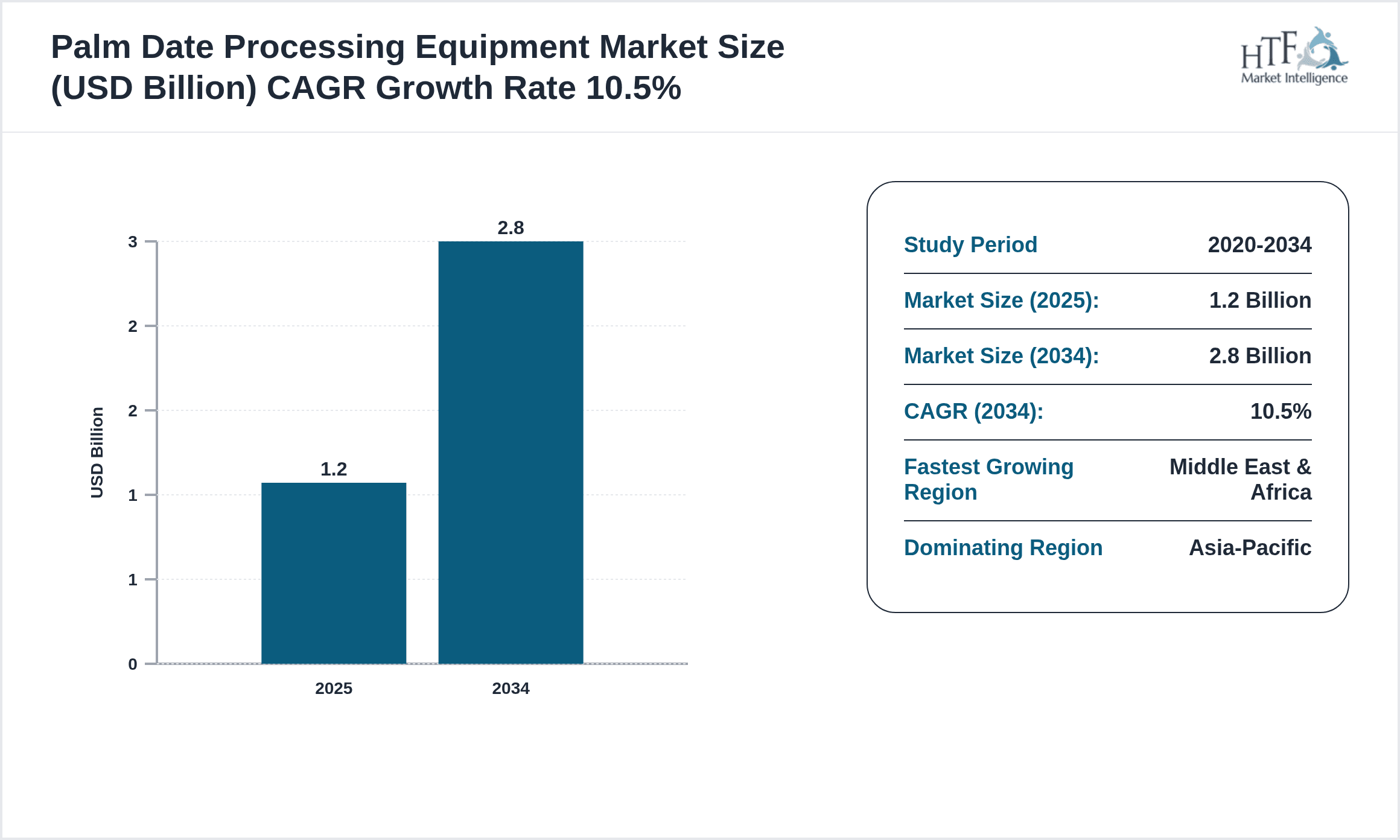
- •Key market highlights include a base market size of USD 1.2 Billion in 2025, projected to reach USD 2.8 Billion by 2034, reflecting a compound annual growth rate (CAGR) of 10.5%. The Asia-Pacific region dominates the market with 33% share, while the Middle East & Africa is the fastest-growing region due to expanding date production and processing modernization. Leading product types include automatic palm date processing equipment, which is gaining traction for its efficiency and scalability. Market drivers include rising demand for processed dates, technological advancements in sorting and packaging, and increased focus on reducing post-harvest losses. However, challenges such as high capital investment and maintenance costs persist. Opportunities exist in conveyor system innovations and in expanding applications to value-added date products. The market exhibits steady year-on-year growth of approximately 10%, indicating strong industry momentum and investor confidence.
- •The palm date processing equipment market offers significant value to stakeholders including equipment manufacturers, date producers, and food processors. The strategic importance lies in its ability to streamline processing workflows, improve product quality, and ensure compliance with global food safety standards. Increasing consumer preference for processed and packaged dates in snacks, confectionery, and health food segments stimulates equipment demand. Furthermore, adoption of automation enhances operational efficiencies and reduces dependency on manual labor, which is critical in regions with labor shortages. The market's growth potential also aligns with increasing investments in modern agricultural and food processing infrastructure worldwide. This market report provides actionable insights for investors, manufacturers, and policymakers seeking to capitalize on evolving market trends, regulatory changes, and technological advancements to drive sustained growth and competitive advantage.
Competitive Landscape
The competitive landscape of the global palm date processing equipment market is marked by intense rivalry among established manufacturers and emerging regional players, each striving to innovate and expand their market presence. Companies focus on developing advanced automation technologies, energy-efficient machines, and integrated processing lines to differentiate their product offerings. Strategic partnerships and collaborations are common to leverage complementary capabilities, enhance R&D efforts, and expand geographic reach. Mergers and acquisitions play a significant role in consolidating market share and accelerating innovation pipelines. Pricing strategies vary from premium offerings with advanced features to cost-effective solutions targeting small-scale producers. Distribution channels include direct sales, dealers, and online platforms, facilitating broad market access. Regional competition is influenced by local agricultural practices, regulatory environments, and customer preferences, necessitating customization of equipment. Future trends indicate heightened adoption of Internet of Things (IoT) enabled machinery, predictive maintenance, and sustainable processing solutions. Barriers to market entry include high capital requirements and stringent quality standards, which favor established players. Overall, the market is poised for consolidation alongside technological disruption, driving competitive advantages through innovation and operational excellence.
Prominent Players in Palm Date Processing Equipment Market
- •Bühler Group (Switzerland)
- •JBT Corporation (United States)
- •Key Technology, Inc. (United States)
- •Greefa BV (Netherlands)
- •TOMRA Systems ASA (Norway)
- •Marel hf. (Iceland)
- •Baader Group (Germany)
- •Aweta B.V. (Netherlands)
- •Scanvaegt Systems A/S (Denmark)
- •Fitzpatrick Engineering Co., Inc. (United States)
- •Moba Group (Netherlands)
- •Jash Engineering Pvt. Ltd. (India)
- •Al Dahra Agriculture (UAE)
- •Al Haramain Agro Industry (Saudi Arabia)
- •Durra Date Processing Equipment (Saudi Arabia)
- •DateTech (Morocco)
- •Sun Date Machines (Egypt)
- •NaanDanJain Irrigation Ltd. (Israel)
- •Hammonds Engineering (United Kingdom)
- •UltraSource (United States)
- •Fomaco (Denmark)
- •Al Amal Machinery (Turkey)
- •Date Packaging Solutions (France)
- •Sorma Group (Italy)
- •Andritz AG (Austria)

Market Breakdown
- •By Product Type
- ◦Automatic Palm Date Processing Equipment
- ◦Semi-Automatic Palm Date Processing Equipment
- ◦Manual Palm Date Processing Equipment
- ◦Conveyor Systems
- ◦Ancillary Equipment
- •By Application
- ◦Sorting
- ◦Cleaning
- ◦Pitting
- ◦Drying
- ◦Packaging
- •By End-Use Industry
- ◦Food Processing
- ◦Agricultural Processing
- ◦Retail Packaging
- ◦Export and Distribution
- •By Distribution Channel
- ◦Direct Sales
- ◦Dealers and Distributors
- ◦Online Platforms
Growth Dynamics
The global palm date processing equipment market is propelled by the increasing global demand for processed and packaged palm dates, driven by rising health consciousness and consumer preference for natural sweeteners. Technological innovations, including automation and smart conveyor systems, enhance processing efficiency and reduce manual labor dependence, further accelerating market growth. Expansion of date cultivation regions into non-traditional areas and government initiatives promoting agricultural modernization contribute to demand. Energy-efficient and environmentally friendly processing equipment adoption aligns with sustainability goals, attracting investments. Additionally, growing export opportunities in emerging markets create new growth avenues, supported by advancements in packaging technology that extend product shelf life and freshness. The integration of IoT and AI technologies for real-time monitoring and predictive maintenance enhances operational reliability, making these solutions attractive for large-scale producers. Collectively, these factors establish a robust growth trajectory for the market over the forecast period.

Market Trends
A notable trend in the palm date processing equipment market is the shift towards fully automated systems that integrate multiple processing stages, reducing human intervention and enhancing throughput. Equipment manufacturers are increasingly incorporating IoT-enabled sensors and AI analytics to enable real-time quality control and predictive maintenance, minimizing downtime and operational costs. Adoption of sustainable materials and energy-efficient designs is gaining momentum to meet regulatory requirements and consumer expectations for eco-friendly products. Another emerging trend is the customization of equipment to cater to different date varieties and processing scales, enabling tailored solutions for small to large enterprises. Digitalization of supply chain management and traceability systems also drive market innovation, ensuring compliance with food safety standards and enhancing consumer confidence. These trends collectively improve operational efficiency and product quality, positioning the market for sustained expansion.

Market Opportunities
Significant opportunities exist in expanding the application of conveyor systems and ancillary equipment that streamline processing workflows and enable scalable operations. Emerging markets in Middle East & Africa and Latin America present untapped potential due to increasing date production and modernization efforts. Innovations in packaging technologies that extend shelf life and enhance product appeal offer avenues for differentiation and value addition. Collaborations between equipment manufacturers and date producers to develop customized solutions tailored to regional varieties and processing needs represent growth opportunities. Additionally, integrating renewable energy sources into processing equipment to reduce operational costs aligns with global sustainability trends and can attract environmentally conscious investors. Expansion of e-commerce platforms for equipment sales and after-sales services also provides new channels for market penetration and customer engagement.
Market Challenges
High initial capital expenditure and maintenance costs pose significant challenges for small and medium-scale producers in adopting advanced palm date processing equipment. Variability in date varieties and processing requirements across regions complicates standardization and equipment customization, increasing complexity and costs. Limited technical expertise and skilled labor shortages in certain regions hinder optimal equipment utilization and slow adoption rates. Regulatory compliance related to food safety and machinery standards varies globally, creating barriers for equipment manufacturers and producers aiming for international market access. Supply chain disruptions and fluctuating raw material availability can impact manufacturing and timely delivery of equipment. Additionally, competition from low-cost manual processing methods in developing economies restricts market penetration of automated solutions. Addressing these challenges requires strategic investments in training, flexible equipment designs, and harmonization of regulatory frameworks.
Regulatory Framework
Between 2020 and 2025, significant regulatory developments have influenced the palm date processing equipment market across major regions. The European Union implemented updated machinery safety directives in 2021 requiring enhanced guarding and emergency stop mechanisms, compelling manufacturers to upgrade designs to ensure compliance and operator safety. In North America, the FDA introduced stricter food contact material standards in 2022, mandating the use of certified non-toxic materials in equipment components, impacting manufacturing processes and material sourcing. Asia-Pacific countries, including China and India, enhanced their food safety regulations between 2023 and 2025 to align with global standards, promoting adoption of hygienic and easy-to-clean processing equipment. The Middle East adopted mandatory certification schemes for date processing machinery in 2024 to ensure quality and safety in exports. Furthermore, environmental regulations focusing on energy efficiency and emissions reduction have been introduced globally, encouraging manufacturers to develop eco-friendly equipment. These regulatory changes have increased compliance costs but also driven innovation and quality improvements across the market.
Market Intelligence
- •15th January 2025, Bühler Group announced the launch of its latest fully automated palm date processing line featuring integrated sorting, cleaning, and packaging with advanced AI-based quality control. Designed for high throughput and minimal waste, the system targets large-scale producers aiming to improve efficiency and product consistency. Bühler’s new equipment incorporates IoT connectivity for predictive maintenance and remote monitoring, reducing downtime and operational costs. This innovation underscores the company’s commitment to digital transformation in food processing industries and is expected to strengthen its market leadership globally. Source: Bühler Official Press Release
- •28th March 2025, JBT Corporation introduced a semi-automatic palm date pitting machine optimized for small and medium-sized enterprises. The machine offers enhanced safety features, ease of operation, and modular design allowing customization based on processing capacity. JBT emphasized its competitive pricing and after-sales service network expansion to penetrate emerging markets in Latin America and Africa. The launch reflects growing demand for scalable solutions catering to diverse producer sizes and regional requirements. This initiative is anticipated to boost JBT’s footprint in the palm date processing segment significantly. Source: JBT Corporation Newsroom
- •10th June 2025, Key Technology, Inc. announced a strategic partnership with a leading date exporter in the Middle East to deploy conveyor system innovations incorporating smart sensors and AI analytics for real-time sorting and quality assurance. The collaboration aims to enhance processing speed and reduce labor dependency while improving product traceability. This partnership also includes joint R&D efforts to customize equipment for regional date varieties and export standards. The initiative highlights increasing industry focus on technological integration and market-specific solutions to drive competitive advantage. Source: Key Technology Corporate Announcement
- •30th August 2024, Marel hf. completed the acquisition of a niche date packaging equipment manufacturer to expand its product portfolio and strengthen presence in the Middle East and North Africa region. The acquisition enables Marel to offer end-to-end processing solutions including packaging automation tailored to palm date producers. This strategic move is expected to consolidate Marel’s market position and accelerate innovation through combined expertise and resource sharing. The deal reflects the ongoing trend of consolidation and diversification among key industry players aiming for comprehensive market coverage. Source: Marel Official Press Release
Regional Outlook
The Asia-Pacific currently holds a significant share of the market, primarily due to several key factors: increasing consumption rates, a burgeoning population, and robust economic momentum. These elements collectively drive demand, positioning this region as a leader in the market. On the other hand, Middle East & Africa is rapidly emerging as the fastest-growing area within the industry. This remarkable growth can be attributed to swift infrastructure development, the expansion of various industrial sectors, and a marked increase in consumer demand. These dynamics make this region a crucial player in shaping future market growth.
In our report, we cover a comprehensive analysis of the following regions and countries:
- North America
- LATAM
- West Europe
- Central & Eastern Europe
- Northern Europe
- Southern Europe
- East Asia
- Southeast Asia
- South Asia
- Central Asia
- Oceania
- MEA
| Feature | Details |
|---|---|
| Base Year Market Size | USD 1.2 Billion |
| Forecast Year Market Size | USD 2.8 Billion |
| CAGR | 10.5% |
| Forecast Period | 2026 to 2033 |
| YoY Growth | 10% |
| Scope of Report | Market is segmented by Product Type (Automatic Palm Date Processing Equipment, Semi-Automatic Palm Date Processing Equipment, Manual Palm Date Processing Equipment, Conveyor Systems, Ancillary Equipment), Application (Sorting, Cleaning, Pitting, Drying, Packaging), End-Use Industry (Food Processing, Agricultural Processing, Retail Packaging, Export and Distribution), Distribution Channel (Direct Sales, Dealers and Distributors, Online Platforms) |
| Regions Covered | North America, LATAM, West Europe, Central & Eastern Europe, Northern Europe, Southern Europe, East Asia, Southeast Asia, South Asia, Central Asia, Oceania, MEA |
| Key Companies | Bühler Group (Switzerland), JBT Corporation (United States), Key Technology, Inc. (United States), Greefa BV (Netherlands), TOMRA Systems ASA (Norway) |
Global Palm Date Processing Equipment Market Size, Growth & Revenue 2025-2034 - Table of Contents
Frequently Asked Questions (FAQ):
The Compact Track Loaders market is expected to see value worth 5.3 Billion in 2025.
North America currently leads the market with approximately 45% market share, followed by Europe at 28% and Asia-Pacific at 22%. The remaining regions account for 5% of the global market.
Key growth drivers include increasing construction activities, rising demand for versatile equipment in agriculture, technological advancements in track loader design, and growing preference for compact equipment in urban construction projects.