
Global Light Quadricycles Market Size, Growth & Revenue 2025-2034
Global Light Quadricycles Market is segmented by Product Type (Electric Light Quadricycles, Gasoline Light Quadricycles, Hybrid Light Quadricycles, Off-road Light Quadricycles, Utility Light Quadricycles), Application (Personal Mobility, Urban Transportation, Commercial Use, Recreational Use, Delivery Services), End-Use Industry (Logistics and Delivery, Tourism and Recreation, Public Transportation, Retail and E-commerce), Distribution Channel (Dealerships, Direct Sales, Online Sales Platforms), and Geography (North America, LATAM, West Europe, Central & Eastern Europe, Northern Europe, Southern Europe, East Asia, Southeast Asia, South Asia, Central Asia, Oceania, MEA)
Pricing
Report Overview
Executive Summary
- •The global Light Quadricycles market represents a rapidly expanding segment of the automotive industry, focusing on compact, lightweight four-wheeled vehicles designed for efficient urban and recreational mobility. These vehicles are distinguished by their low weight and diverse propulsion systems, including electric, gasoline, and hybrid models, tailored for personal, commercial, and recreational applications. The market’s growth is propelled by increasing demand for sustainable transportation, urban congestion mitigation, and regulatory incentives promoting low-emission vehicles. Technological advancements such as improved battery capacities, lightweight materials, and enhanced safety features are driving product innovation and consumer adoption worldwide. Key applications encompass personal mobility solutions, urban delivery services, and recreational uses, positioning light quadricycles as versatile and eco-friendly alternatives to traditional vehicles. Geographically, North America currently leads the market due to established infrastructure and consumer acceptance, while Asia-Pacific demonstrates the fastest growth fueled by rapid urbanization and government initiatives. The forecast period from 2025 to 2034 is expected to witness significant market expansion driven by increasing environmental awareness, technological progress, and evolving regulatory frameworks. Industry stakeholders, including manufacturers, suppliers, and policymakers, recognize the strategic importance of light quadricycles in addressing urban transportation challenges and advancing sustainable mobility goals globally.
- •Key market highlights include a base market size of USD 3.8 Billion in 2025, projected to reach USD 12.7 Billion by 2034, reflecting a robust CAGR of 14.2%. The year-on-year growth rate of approximately 13.5% underscores strong investor confidence and consumer demand. Electric light quadricycles dominate the product landscape, benefiting from government subsidies and growing environmental concerns, while hybrid variants are emerging as the fastest growing segment due to their balanced performance and lower emissions. North America holds the largest market share supported by high urban mobility demand and infrastructure readiness. Asia-Pacific’s rapid urbanization and favorable regulatory policies contribute to its position as the fastest growing region. The market is characterized by increasing innovation, strategic partnerships, and expanding distribution channels to cater to diverse applications from personal use to commercial logistics. These dynamics collectively shape a promising outlook for the light quadricycles market worldwide.
- •The value proposition of the global Light Quadricycles market lies in its ability to offer sustainable, cost-effective, and versatile transportation solutions that address urban congestion and environmental challenges. For industries, these vehicles provide an efficient last-mile delivery option and mobility alternatives that reduce operational costs and carbon footprints. Consumers benefit from affordable, easy-to-maneuver vehicles suitable for urban environments, promoting convenience and eco-consciousness. Policymakers leverage the market’s growth to advance clean energy targets and improve urban air quality. Additionally, technological innovation and expanding infrastructure further enhance market attractiveness. Consequently, the light quadricycles market holds strategic importance across automotive, logistics, urban planning, and environmental sectors, supporting global efforts toward sustainable mobility and smart city development.

Competitive Landscape
The global Light Quadricycles market features a competitive environment shaped by a mix of established automotive manufacturers, specialized electric vehicle producers, and emerging startups. Market dynamics are driven by continuous innovation in propulsion technologies, battery systems, and lightweight materials, enabling companies to differentiate products and capture niche segments. Competitive strategies include strategic partnerships, joint ventures, and acquisitions to expand technological capabilities and geographic presence. Companies invest heavily in R&D to improve vehicle range, safety, and cost-effectiveness while complying with evolving regulatory standards. Pricing strategies focus on balancing affordability with advanced features to appeal to both individual consumers and commercial fleets. Distribution channels encompass direct sales, dealership networks, and increasingly, online platforms to reach diverse customer bases. Regional competition intensifies as local players leverage government incentives and regional market knowledge to challenge global entrants. Market entry barriers include high initial capital investment, technology development, and regulatory compliance. Future competitive trends are expected to emphasize sustainability, digital connectivity, and integration with smart city infrastructure, positioning innovators for long-term market leadership.
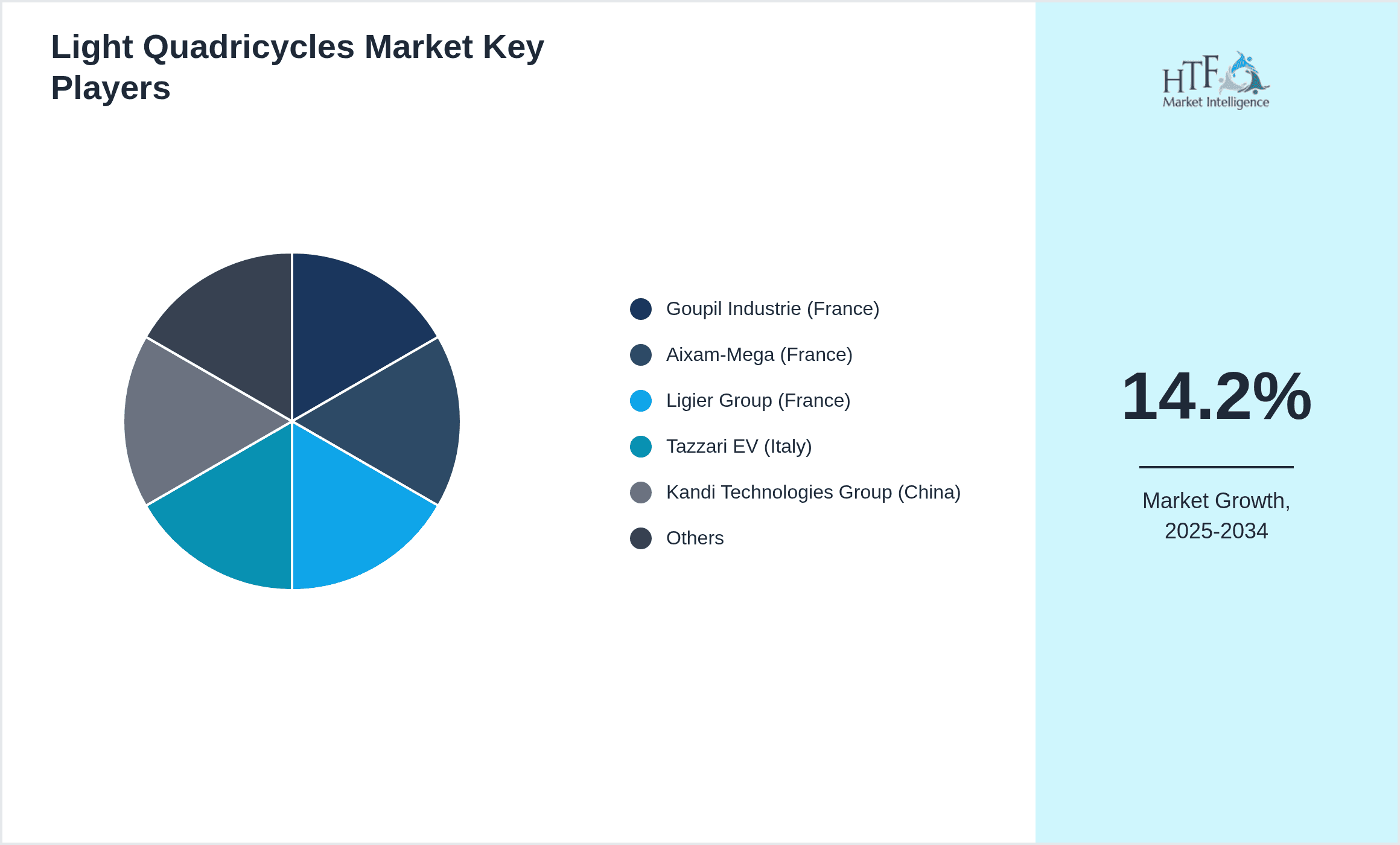
Prominent Players in Light Quadricycles Market
- •Goupil Industrie (France)
- •Aixam-Mega (France)
- •Ligier Group (France)
- •Tazzari EV (Italy)
- •Kandi Technologies Group (China)
- •Zhejiang Jonway Automobile Co. Ltd. (China)
- •Polaris Inc. (United States)
- •Arcimoto Inc. (United States)
- •Microlino AG (Switzerland)
- •Elio Motors (United States)
- •Okinawa Autotech Pvt. Ltd. (India)
- •Mahindra Electric Mobility Limited (India)
- •Rayttle Auto (China)
- •REVA Electric Car Company (India)
- •Chery New Energy Automobile Co. Ltd. (China)
- •Bajaj Auto Ltd. (India)
- •Renault S.A. (France)
- •Toyota Motor Corporation (Japan)
- •Hyundai Motor Company (South Korea)
- •Honda Motor Co. Ltd. (Japan)
- •Tesla Inc. (United States)
- •BYD Company Ltd. (China)
- •Volta Trucks (Sweden)
- •Nissan Motor Corporation (Japan)
- •Volkswagen AG (Germany)

Market Breakdown
- •By Product Type
- ◦Electric Light Quadricycles
- ◦Gasoline Light Quadricycles
- ◦Hybrid Light Quadricycles
- ◦Off-road Light Quadricycles
- ◦Utility Light Quadricycles
- •By Application
- ◦Personal Mobility
- ◦Urban Transportation
- ◦Commercial Use
- ◦Recreational Use
- ◦Delivery Services
- •By End-Use Industry
- ◦Logistics and Delivery
- ◦Tourism and Recreation
- ◦Public Transportation
- ◦Retail and E-commerce
- •By Distribution Channel
- ◦Dealerships
- ◦Direct Sales
- ◦Online Sales Platforms
Growth Dynamics
The global Light Quadricycles market is experiencing significant growth driven by increasing urbanization and the urgent need for sustainable transportation solutions. The escalating demand for compact, efficient vehicles in congested cities supports this trend, as light quadricycles offer low emissions and reduced operational costs. Technological advancements in battery energy density and charging infrastructure facilitate wider adoption of electric variants. Additionally, government incentives and stringent environmental regulations incentivize manufacturers and consumers to shift towards eco-friendly options. The expansion of e-commerce and last-mile delivery sectors creates robust commercial demand, further supporting market growth. Consumer preferences favor vehicles that combine affordability, convenience, and environmental responsibility, underpinning sustained market expansion. These growth dynamics are complemented by strategic investments in R&D and infrastructure development, establishing a favorable environment for innovation and long-term market resilience.

Market Trends
The Light Quadricycles market is witnessing a strong trend towards electrification, with manufacturers increasingly focusing on electric propulsion systems to meet regulatory mandates and consumer demand for green mobility. Integration of smart technologies, including IoT connectivity and advanced driver assistance systems, is enhancing vehicle safety and user experience. Additionally, modular vehicle designs and customizable features cater to diverse application needs, from personal transport to commercial logistics. The growing popularity of shared mobility models and urban micro-mobility solutions further drives market adoption. Sustainability initiatives and circular economy practices, such as battery recycling and lightweight materials, are gaining prominence within the industry, shaping product development and corporate strategies.
Market Opportunities
Emerging markets in Asia-Pacific and Latin America offer substantial growth opportunities due to rapid urbanization, increasing disposable incomes, and evolving regulatory frameworks favoring clean mobility. Expansion into last-mile delivery and logistics sectors presents avenues for product diversification and revenue enhancement. Advances in battery technology and cost reductions enable broader adoption of electric and hybrid light quadricycles. Collaborations between vehicle manufacturers and technology providers create potential for innovation in autonomous and connected vehicle features. Additionally, government incentives and infrastructure development programs provide a conducive environment for market penetration and scaling. These opportunities collectively support the global market’s robust growth trajectory.
Market Challenges
The Light Quadricycles market faces challenges including high initial vehicle costs, particularly for electric and hybrid models, which can limit consumer adoption in price-sensitive regions. Infrastructure constraints, such as insufficient charging stations and maintenance facilities, impede market expansion. Regulatory heterogeneity across regions complicates compliance and slows product rollout. Safety concerns and limited consumer awareness about light quadricycles’ capabilities also deter widespread acceptance. Supply chain disruptions and raw material price volatility affect production costs and timelines. Additionally, competition from alternative mobility solutions, including e-bikes and scooters, intensifies market pressure. Addressing these challenges requires strategic investments, policy support, and targeted consumer education to sustain growth.
Regulatory Framework
- •Between 2020 and 2025, global regulatory bodies introduced stringent emissions standards and safety requirements impacting the Light Quadricycles market significantly. The European Union implemented the Euro 6 emission norms with specific adaptations for light vehicles, compelling manufacturers to innovate greener propulsion technologies. North America enforced updated safety regulations including crashworthiness and occupant protection standards tailored for light quadricycles. Asia-Pacific countries, notably China and India, rolled out policies promoting electric vehicle adoption through subsidies, tax incentives, and infrastructure investments. These regulations aim to reduce urban pollution and support sustainable transportation goals. Compliance mandates have accelerated R&D efforts focusing on electric and hybrid systems. Additionally, standardization of charging infrastructure and battery recycling guidelines emerged as critical regulatory focus areas. Governments continue to update policies to balance environmental objectives with market growth, creating a dynamic regulatory landscape requiring agile industry responses.
- •Key regulations include the EU’s Clean Vehicles Directive enacted in 2021, mandating increasing quotas for electric and low-emission vehicles in public procurement. The U.S. Environmental Protection Agency's Tier 3 standards introduced tighter pollutant limits effective from 2022. China’s New Energy Vehicle mandate requires automakers to achieve specific electric vehicle sales ratios by 2025. India’s Faster Adoption and Manufacturing of Hybrid & Electric Vehicles (FAME) scheme provides financial incentives to accelerate adoption. These regulations collectively drive market transformation towards electrification and sustainability. Manufacturers must navigate varying compliance costs and certification procedures across regions. Regulatory developments also emphasize consumer safety through improved vehicle standards and testing protocols. Overall, the evolving policy environment is a key catalyst shaping product innovation, market entry strategies, and competitive dynamics globally.
- •Regional mandates on battery disposal and hazardous material management have been strengthened, with the EU’s Battery Directive revision in 2024 setting ambitious recycling targets. North American states introduced incentives for establishing charging infrastructure and grid integration. Asia-Pacific governments launched pilot programs for autonomous quadricycles, integrating regulatory frameworks for testing and deployment. These initiatives highlight the increasing regulatory complexity in the market. Ongoing policy updates require manufacturers and stakeholders to maintain compliance agility to mitigate risks and capitalize on incentives. The regulatory landscape continues to evolve in alignment with global climate commitments and urban mobility priorities, reinforcing the strategic importance of regulatory intelligence for market participants.
- •Country-specific mandates supplement global frameworks, including France’s low-emission zone policies restricting high-pollution vehicles in urban centers and Japan’s subsidies for eco-friendly vehicle purchases. These localized regulations create diverse market conditions influencing product design and marketing strategies. International harmonization efforts are underway to streamline standards and facilitate cross-border vehicle trade. Industry associations actively engage with policymakers to shape pragmatic regulations balancing innovation and safety. The regulatory framework thus represents both a challenge and an opportunity, fostering sustainable market growth while demanding continuous adaptation from industry players.
- •Government initiatives promoting clean transportation, such as the U.S. Infrastructure Investment and Jobs Act, allocate significant funding for EV infrastructure expansion. The European Green Deal integrates light quadricycles into broader climate action plans with dedicated support programs. Incentives including tax rebates, reduced registration fees, and preferential parking are widely adopted to stimulate market demand. Such policies enhance the economic viability of light quadricycles, encouraging consumer uptake and manufacturer investment. The regulatory environment remains a critical enabler for market expansion, underpinning technological advancement and competitive positioning globally.
Market Intelligence
- •15th January 2025, Goupil Industrie announced the launch of its new electric light quadricycle model featuring a 100 km range and enhanced battery management system designed for urban delivery fleets. The vehicle incorporates smart connectivity allowing real-time fleet tracking and predictive maintenance, aiming to reduce operational costs and environmental impact. This product update targets the expanding e-commerce logistics sector, reflecting growing demand for sustainable last-mile solutions. The strategic introduction is aligned with regulatory incentives promoting electric vehicle adoption across Europe and North America. Goupil’s innovation emphasizes lightweight materials and modular design, facilitating customization for various commercial applications. The launch is expected to strengthen Goupil’s market presence and contribute to global emissions reduction efforts. Source: Official Goupil Industrie press release.
- •30th March 2025, Kandi Technologies Group unveiled a hybrid light quadricycle model integrating a compact gasoline engine with an electric drivetrain to optimize range and emissions. Targeted primarily at Asian urban markets with limited charging infrastructure, this model offers flexibility and cost efficiency. The vehicle features advanced regenerative braking and a lightweight chassis to maximize energy efficiency. Kandi’s initiative responds to regional regulatory challenges and consumer preferences favoring hybrid solutions as transitional technologies towards full electrification. The company anticipates this product to capture significant market share in emerging economies, supporting its growth strategy. The hybrid quadricycle also includes smart safety features and digital connectivity enhancing user experience. Source: Kandi Technologies official release.
- •10th July 2025, Polaris Inc. announced a strategic partnership with a leading battery manufacturer to co-develop next-generation solid-state batteries for light quadricycles. This collaboration aims to improve battery safety, energy density, and charging speeds, addressing key market barriers to electric vehicle adoption. The partnership is part of Polaris’s broader innovation roadmap focusing on sustainable mobility solutions and expanding its product portfolio in the urban mobility segment. Expected to accelerate product development cycles and reduce costs, this initiative positions Polaris competitively in the evolving market landscape. The alliance also explores integration of IoT technologies for enhanced vehicle diagnostics and fleet management. Source: Polaris Inc. corporate announcement.
- •20th October 2025, Arcimoto Inc. completed the acquisition of a European light quadricycle startup specializing in autonomous vehicle technologies. This strategic move enhances Arcimoto’s technological capabilities and geographic footprint within the fast-growing European market. The acquired startup brings proprietary autonomous driving software and sensor integration expertise, enabling Arcimoto to accelerate development of self-driving quadricycles tailored for urban environments. This acquisition reflects a market trend towards automation and connectivity in light quadricycles, aiming to improve safety and operational efficiency. Financial synergies and expanded R&D resources are expected to drive innovation and competitive advantage. This consolidation marks a significant milestone in the market’s maturation phase. Source: Arcimoto Inc. official press release.
- •Recent market developments and strategic initiatives are continuously tracked through industry publications, company announcements, and regulatory filings. For the most current information, stakeholders are advised to monitor official corporate communications and recognized market intelligence platforms.
Regional Outlook
The North America currently holds a significant share of the market, primarily due to several key factors: increasing consumption rates, a burgeoning population, and robust economic momentum. These elements collectively drive demand, positioning this region as a leader in the market. On the other hand, Asia-Pacific is rapidly emerging as the fastest-growing area within the industry. This remarkable growth can be attributed to swift infrastructure development, the expansion of various industrial sectors, and a marked increase in consumer demand. These dynamics make this region a crucial player in shaping future market growth.
In our report, we cover a comprehensive analysis of the following regions and countries:
- North America
- LATAM
- West Europe
- Central & Eastern Europe
- Northern Europe
- Southern Europe
- East Asia
- Southeast Asia
- South Asia
- Central Asia
- Oceania
- MEA
| Feature | Details |
|---|---|
| Base Year Market Size | USD 3.8 Billion |
| Forecast Year Market Size | USD 12.7 Billion |
| CAGR | 14.2% |
| Forecast Period | 2026 to 2033 |
| YoY Growth | 13.5% |
| Scope of Report | Market is segmented by Product Type (Electric Light Quadricycles, Gasoline Light Quadricycles, Hybrid Light Quadricycles, Off-road Light Quadricycles, Utility Light Quadricycles), Application (Personal Mobility, Urban Transportation, Commercial Use, Recreational Use, Delivery Services), End-Use Industry (Logistics and Delivery, Tourism and Recreation, Public Transportation, Retail and E-commerce), Distribution Channel (Dealerships, Direct Sales, Online Sales Platforms) |
| Regions Covered | North America, LATAM, West Europe, Central & Eastern Europe, Northern Europe, Southern Europe, East Asia, Southeast Asia, South Asia, Central Asia, Oceania, MEA |
| Key Companies | Goupil Industrie (France), Aixam-Mega (France), Ligier Group (France), Tazzari EV (Italy), Kandi Technologies Group (China), Zhejiang Jonway Automobile Co. Ltd. (China), Polaris Inc. (United States), Arcimoto Inc. (United States), Microlino AG (Switzerland), Elio Motors (United States), Okinawa Autotech Pvt. Ltd. (India), Mahindra Electric Mobility Limited (India), Rayttle Auto (China), REVA Electric Car Company (India), Chery New Energy Automobile Co. Ltd. (China), Bajaj Auto Ltd. (India), Renault S.A. (France), Toyota Motor Corporation (Japan), Hyundai Motor Company (South Korea), Honda Motor Co. Ltd. (Japan), Tesla Inc. (United States), BYD Company Ltd. (China), Volta Trucks (Sweden), Nissan Motor Corporation (Japan), Volkswagen AG (Germany) |
Global Light Quadricycles Market Size, Growth & Revenue 2025-2034 - Table of Contents
Multidisciplinary researcher with 10+ years of experience uncovering insights across diverse domains focused on uncovering insights that drive informed decisions.
Frequently Asked Questions (FAQ):
The Compact Track Loaders market is expected to see value worth 5.3 Billion in 2025.
North America currently leads the market with approximately 45% market share, followed by Europe at 28% and Asia-Pacific at 22%. The remaining regions account for 5% of the global market.
Key growth drivers include increasing construction activities, rising demand for versatile equipment in agriculture, technological advancements in track loader design, and growing preference for compact equipment in urban construction projects.