
Global Personal Care Emollients Market Size, Growth & Revenue 2025-2034
Global Personal Care Emollients Market is segmented by Type (Esters, Fatty Alcohols, Fatty Acids, Hydrocarbons, Others), Application (Skin Care, Hair Care, Lip Care, Baby Care, Others), End-Use Industry (Cosmetics, Personal Care, Pharmaceuticals, Others), Distribution Channel (Direct Sales, Distributors, E-commerce), and Geography (North America, LATAM, West Europe, Central & Eastern Europe, Northern Europe, Southern Europe, East Asia, Southeast Asia, South Asia, Central Asia, Oceania, MEA)
Pricing
Report Overview
Executive Summary
- •The global personal care emollients market represents a critical segment of the cosmetic and personal care industry, focusing on ingredients that enhance skin moisture retention and improve sensory experience across multiple end-use applications. Emollients are chemical substances that provide softness and hydration to the skin surface, addressing dryness and enhancing skin barrier protection. The market encompasses diverse chemical types such as esters, fatty alcohols, fatty acids, and hydrocarbons utilized in formulations for skin care, hair care, lip care, and baby care products worldwide. Increasing consumer awareness of skin health, rising demand for natural and sustainable ingredients, and the expanding aging population contribute to the market’s growth trajectory. Geographic diversity affects product preferences and regulatory compliance, necessitating innovation and strategic product development. Market players focus on leveraging technological advancements, expanding product portfolios, and establishing global distribution networks to capture emerging opportunities. The market’s significance lies in its ability to meet evolving consumer needs while driving sustainability and efficacy within the personal care industry.
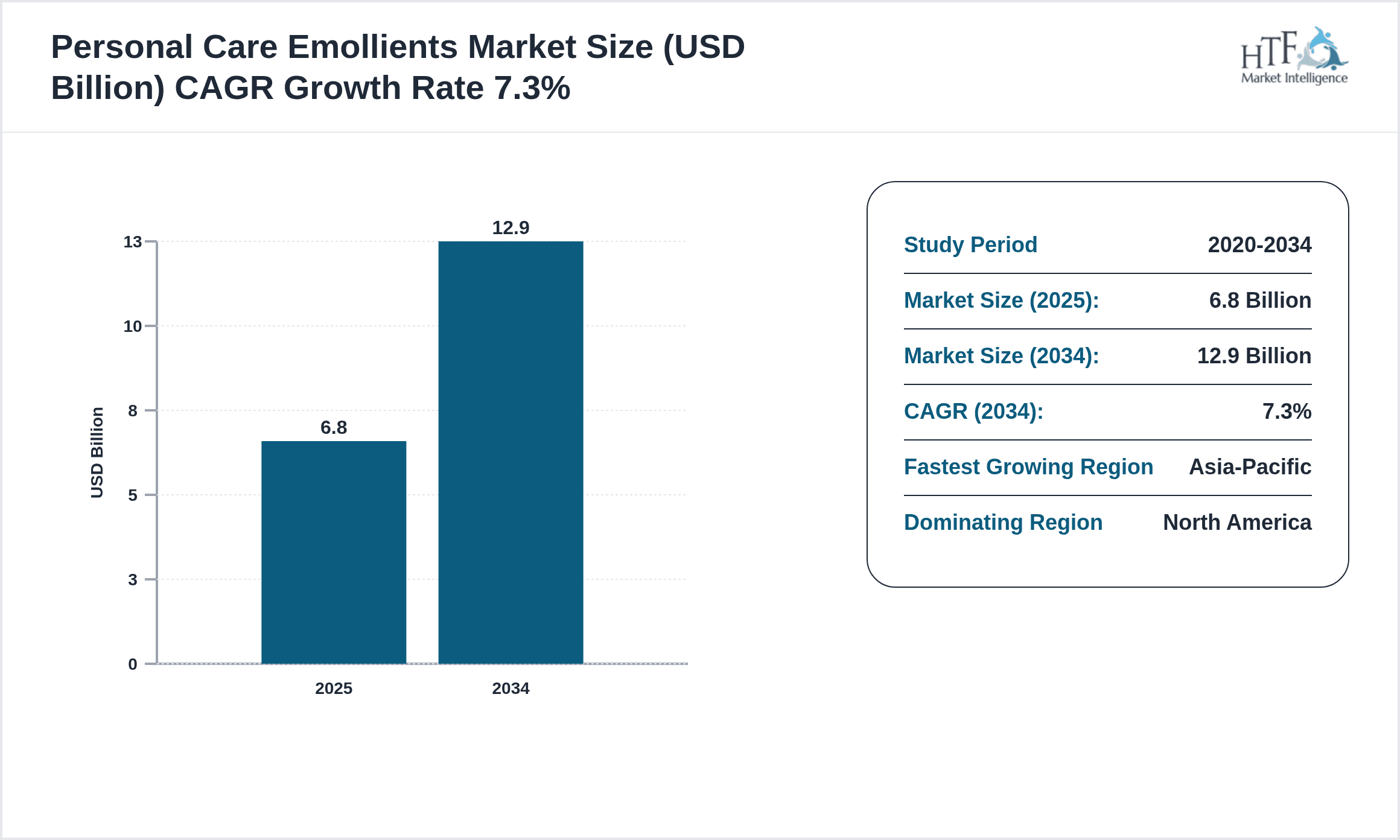
- •The personal care emollients market is projected to grow from USD 6.8 billion in 2025 to USD 12.9 billion by 2034, exhibiting a CAGR of 7.3 percent. North America maintains dominance due to high consumer spending and advanced personal care infrastructure, while Asia-Pacific demonstrates the fastest growth driven by rising disposable incomes and increasing urbanization. Esters lead product type revenue, favored for their superior skin feel and compatibility, whereas fatty alcohols emerge as the fastest-growing segment due to increasing demand for natural and bio-based ingredients. Skin care remains the primary application segment, supported by trends toward anti-aging and moisturizing products globally. Market dynamics are shaped by regulatory changes, sustainability trends, innovation in formulation technologies, and strategic partnerships, propelling growth and competitive differentiation.
- •This market offers significant value to cosmetic manufacturers, ingredient suppliers, and end consumers by providing essential components that improve product performance and consumer satisfaction. The strategic importance of personal care emollients lies in their versatility and efficacy across multiple product categories, enhancing both functional and sensory attributes. Industry stakeholders benefit from the expanding demand for specialty and natural emollients, aligning with consumer preferences for clean-label and eco-friendly products. The market’s expansion facilitates innovation in formulation science, sustainability initiatives, and global supply chain optimization. Investments in research and development, along with compliance with evolving regulatory frameworks, position companies to capitalize on market opportunities while addressing challenges related to raw material sourcing, cost pressures, and competitive intensity. Consequently, personal care emollients remain a pivotal ingredient class within the global personal care and cosmetics ecosystem.
Competitive Landscape
The competitive landscape of the global personal care emollients market is characterized by strategic partnerships, continuous product innovation, and geographic expansion to strengthen market presence. Companies invest heavily in research and development to introduce novel, sustainable, and multifunctional emollient ingredients that cater to evolving consumer demands. Adoption of bio-based and green chemistry technologies improves sustainability profiles and aligns with regulatory trends favoring environmentally responsible products. Market players deploy global distribution networks to penetrate emerging markets, leveraging digital marketing and e-commerce platforms to enhance reach. Collaborations with cosmetic formulators enable tailored ingredient solutions, driving customer loyalty and differentiation. Mergers and acquisitions play a crucial role in consolidating market share, expanding product portfolios, and acquiring technological capabilities. Competitive pricing strategies and supply chain optimization further bolster companies’ positioning. Overall, agility in innovation, compliance, and market responsiveness defines the competitive success and long-term sustainability of key industry participants.
Leading Companies in Personal Care Emollients Market
- •BASF SE (Germany)
- •Croda International Plc (United Kingdom)
- •Evonik Industries AG (Germany)
- •Clariant AG (Switzerland)
- •Stepan Company (United States)
- •Kostal Industrieprodukte GmbH (Germany)
- •Lubrizol Corporation (United States)
- •Ashland Global Holdings Inc. (United States)
- •Eastman Chemical Company (United States)
- •Croda International Plc (United Kingdom)
- •Clariant AG (Switzerland)
- •Mitsubishi Chemical Corporation (Japan)
- •Evonik Industries AG (Germany)
- •Croda International Plc (United Kingdom)
- •Innospec Inc. (United States)
- •Sasol Limited (South Africa)
- •Croda International Plc (United Kingdom)
- •Dow Inc. (United States)
- •Wacker Chemie AG (Germany)
- •Clariant AG (Switzerland)

Market Breakdown
- •By Type
- ◦Esters
- ◦Fatty Alcohols
- ◦Fatty Acids
- ◦Hydrocarbons
- ◦Others
- •By Application
- ◦Skin Care
- ◦Hair Care
- ◦Lip Care
- ◦Baby Care
- ◦Others
- •By End-Use Industry
- ◦Cosmetics
- ◦Personal Care
- ◦Pharmaceuticals
- ◦Others
- •By Distribution Channel
- ◦Direct Sales
- ◦Distributors
- ◦E-commerce
Growth Dynamics
Increasing consumer preference for natural and sustainable ingredients drives development and adoption of bio-based emollients, enhancing market growth. Recent launches of plant-based esters and fatty alcohols demonstrate industry commitment to eco-friendly formulations. Rising global awareness of skin health and anti-aging benefits propels demand for multifunctional emollients that provide hydration and protection. Expansion in emerging economies fueled by urbanization and higher disposable incomes broadens consumer base for premium personal care products. Regulatory encouragement for greener chemical alternatives accelerates innovation in ingredient sourcing and processing. Technological advancements improve emollient efficacy and sensory properties, facilitating differentiation in crowded markets. Strategic collaborations between ingredient manufacturers and cosmetic companies foster tailored solutions enhancing product performance. These factors collectively sustain steady growth, underpinning the market’s positive outlook and reinforcing the importance of innovation and sustainability in driving demand.

Market Trends
Rising incorporation of multifunctional emollients that combine moisturizing with anti-aging, UV protection, and skin barrier repair reflects evolving consumer expectations. The trend towards clean-label and organic personal care products stimulates demand for naturally derived emollients, prompting companies to reformulate existing products. Advances in green chemistry enable development of biodegradable and non-toxic emollients, supporting regulatory compliance and sustainability goals. Digitalization and e-commerce expansion facilitate personalized skincare solutions incorporating innovative emollient blends. Collaborations among biotech firms and cosmetic companies accelerate ingredient innovation, enhancing product efficacy and sensory appeal. Additionally, regional preferences influence formulation trends, with Asia-Pacific markets favoring lightweight and non-greasy textures, driving product differentiation. These trends indicate a shift towards holistic skin health solutions, emphasizing safety, efficacy, and environmental responsibility, shaping the future landscape of personal care emollients.

Market Opportunities
Emerging markets in Asia-Pacific and Latin America offer substantial growth potential owing to increasing urban populations and rising middle-class incomes seeking premium personal care products. Innovation in bio-based and sustainable emollients addresses growing regulatory and consumer demand for clean-label ingredients, opening avenues for new product development. Expansion into specialized applications such as baby care and sensitive skin formulations presents untapped segments with high-value prospects. Partnerships between ingredient suppliers and cosmetic manufacturers facilitate co-development of customized emollient blends tailored to specific consumer needs. Investment in digital marketing and e-commerce platforms enhances direct consumer engagement and market penetration. Furthermore, developments in encapsulation and delivery technologies improve emollient performance, enabling differentiation and premiumization. These opportunities combined with evolving consumer preferences support dynamic growth trajectories and encourage strategic investments within the personal care emollients market.
Market Challenges
Sourcing of sustainable and high-quality raw materials remains a significant challenge due to limited availability and price volatility impacting production costs. Strict regulatory frameworks across different regions require comprehensive compliance and testing, increasing time to market and operational expenses. Intense competition among established players and emerging companies leads to pricing pressures and margin erosion. Consumer skepticism towards synthetic ingredients necessitates continuous innovation to develop natural and safe alternatives without compromising product performance. Supply chain disruptions caused by geopolitical tensions and pandemic-related restrictions affect raw material procurement and distribution. Additionally, balancing formulation complexity with cost-effectiveness poses challenges for manufacturers aiming to meet diverse consumer expectations. These factors collectively constrain market expansion and require strategic risk management and innovation to overcome barriers effectively.
Regulatory Framework
Over the past five years, global regulatory bodies have implemented stringent safety and environmental standards impacting personal care emollients. The European Union’s Cosmetics Regulation mandates rigorous ingredient safety evaluations and labeling requirements to ensure consumer protection. The U.S. Food and Drug Administration has enhanced scrutiny on claims related to natural and organic products, affecting marketing and formulation practices. Several countries have introduced restrictions on certain petrochemical-derived emollients promoting the use of renewable and biodegradable alternatives. Compliance with REACH regulations in Europe requires comprehensive chemical registration and risk assessments, influencing raw material sourcing strategies. Additionally, voluntary certifications such as COSMOS and ECOCERT have gained prominence, promoting transparency and sustainability in ingredient supply chains. These regulatory developments drive innovation and accountability among manufacturers, shaping product portfolios and market dynamics globally.
Market Intelligence
- •Recent market developments and strategic initiatives are continuously tracked through industry publications, company announcements, and regulatory filings. For the most current information, stakeholders are advised to monitor official corporate communications and recognized market intelligence platforms.
- •Recent market developments and strategic initiatives are continuously tracked through industry publications, company announcements, and regulatory filings. For the most current information, stakeholders are advised to monitor official corporate communications and recognized market intelligence platforms.
- •Recent market developments and strategic initiatives are continuously tracked through industry publications, company announcements, and regulatory filings. For the most current information, stakeholders are advised to monitor official corporate communications and recognized market intelligence platforms.
- •Recent market developments and strategic initiatives are continuously tracked through industry publications, company announcements, and regulatory filings. For the most current information, stakeholders are advised to monitor official corporate communications and recognized market intelligence platforms.
- •Source: Market Intelligence Platforms, Company Reports, Industry Publications
Regional Outlook
The North America currently holds a significant share of the market, primarily due to several key factors: increasing consumption rates, a burgeoning population, and robust economic momentum. These elements collectively drive demand, positioning this region as a leader in the market. On the other hand, Asia-Pacific is rapidly emerging as the fastest-growing area within the industry. This remarkable growth can be attributed to swift infrastructure development, the expansion of various industrial sectors, and a marked increase in consumer demand. These dynamics make this region a crucial player in shaping future market growth.
In our report, we cover a comprehensive analysis of the following regions and countries:
- North America
- LATAM
- West Europe
- Central & Eastern Europe
- Northern Europe
- Southern Europe
- East Asia
- Southeast Asia
- South Asia
- Central Asia
- Oceania
- MEA
| Feature | Details |
|---|---|
| Base Year Market Size | USD 6.8 Billion |
| Forecast Year Market Size | USD 12.9 Billion |
| CAGR | 7.3% |
| Forecast Period | 2026 to 2033 |
| YoY Growth | 7.1% |
| Scope of Report | Market is segmented by Type (Esters, Fatty Alcohols, Fatty Acids, Hydrocarbons, Others), Application (Skin Care, Hair Care, Lip Care, Baby Care, Others), End-Use Industry (Cosmetics, Personal Care, Pharmaceuticals, Others), Distribution Channel (Direct Sales, Distributors, E-commerce) |
| Regions Covered | North America, LATAM, West Europe, Central & Eastern Europe, Northern Europe, Southern Europe, East Asia, Southeast Asia, South Asia, Central Asia, Oceania, MEA |
| Key Companies | BASF SE (Germany), Croda International Plc (United Kingdom), Evonik Industries AG (Germany), Clariant AG (Switzerland), Stepan Company (United States), Kostal Industrieprodukte GmbH (Germany), Lubrizol Corporation (United States), Ashland Global Holdings Inc. (United States), Eastman Chemical Company (United States), Croda International Plc (United Kingdom), Clariant AG (Switzerland), Mitsubishi Chemical Corporation (Japan), Evonik Industries AG (Germany), Croda International Plc (United Kingdom), Innospec Inc. (United States), Sasol Limited (South Africa), Croda International Plc (United Kingdom), Dow Inc. (United States), Wacker Chemie AG (Germany), Clariant AG (Switzerland) |
Global Personal Care Emollients Market Size, Growth & Revenue 2025-2034 - Table of Contents
Frequently Asked Questions (FAQ):
The Compact Track Loaders market is expected to see value worth 5.3 Billion in 2025.
North America currently leads the market with approximately 45% market share, followed by Europe at 28% and Asia-Pacific at 22%. The remaining regions account for 5% of the global market.
Key growth drivers include increasing construction activities, rising demand for versatile equipment in agriculture, technological advancements in track loader design, and growing preference for compact equipment in urban construction projects.