
Global Electric Screw Drivers Market Size, Growth & Revenue 2024-2034
Global Electric Screw Drivers Market is segmented by Product Type (Cordless Electric Screw Drivers, Corded Electric Screw Drivers, Pneumatic Electric Screw Drivers, Hydraulic Electric Screw Drivers, Brushless Motor Electric Screw Drivers), Application (Automotive Assembly, Electronics Manufacturing, Construction, Aerospace, General Industrial), End-Use Industry (Automotive, Electronics, Construction, Aerospace), Distribution Channel (Online Retail, Specialty Stores, Direct Sales), and Geography (North America, LATAM, West Europe, Central & Eastern Europe, Northern Europe, Southern Europe, East Asia, Southeast Asia, South Asia, Central Asia, Oceania, MEA)
Pricing
Report Overview
Executive Summary
- •The Global Electric Screw Drivers Market represents a vital segment within the industrial tools sector, comprising various types of powered screw driving devices that are instrumental in enhancing assembly efficiency and precision across multiple industries. This market is defined by the presence of corded, cordless, pneumatic, hydraulic, and brushless motor screw drivers, which cater to diverse applications such as automotive assembly, electronics manufacturing, construction, aerospace, and general industrial purposes. Its scope extends from handheld manual tools to integrated automated systems, driven by technological advancements in battery life, motor design, and intelligent control systems. These tools contribute significantly to reducing manual labor, minimizing errors, and improving overall productivity, making them indispensable in modern manufacturing and assembly processes worldwide. The market's boundaries include product types, applications, end-use industries, and geographic regions, with a focus on innovation, ergonomic design, and environmental sustainability. Key use cases involve complex assembly lines requiring consistent torque application and speed control, highlighting the market's strategic importance to global industrial advancement.
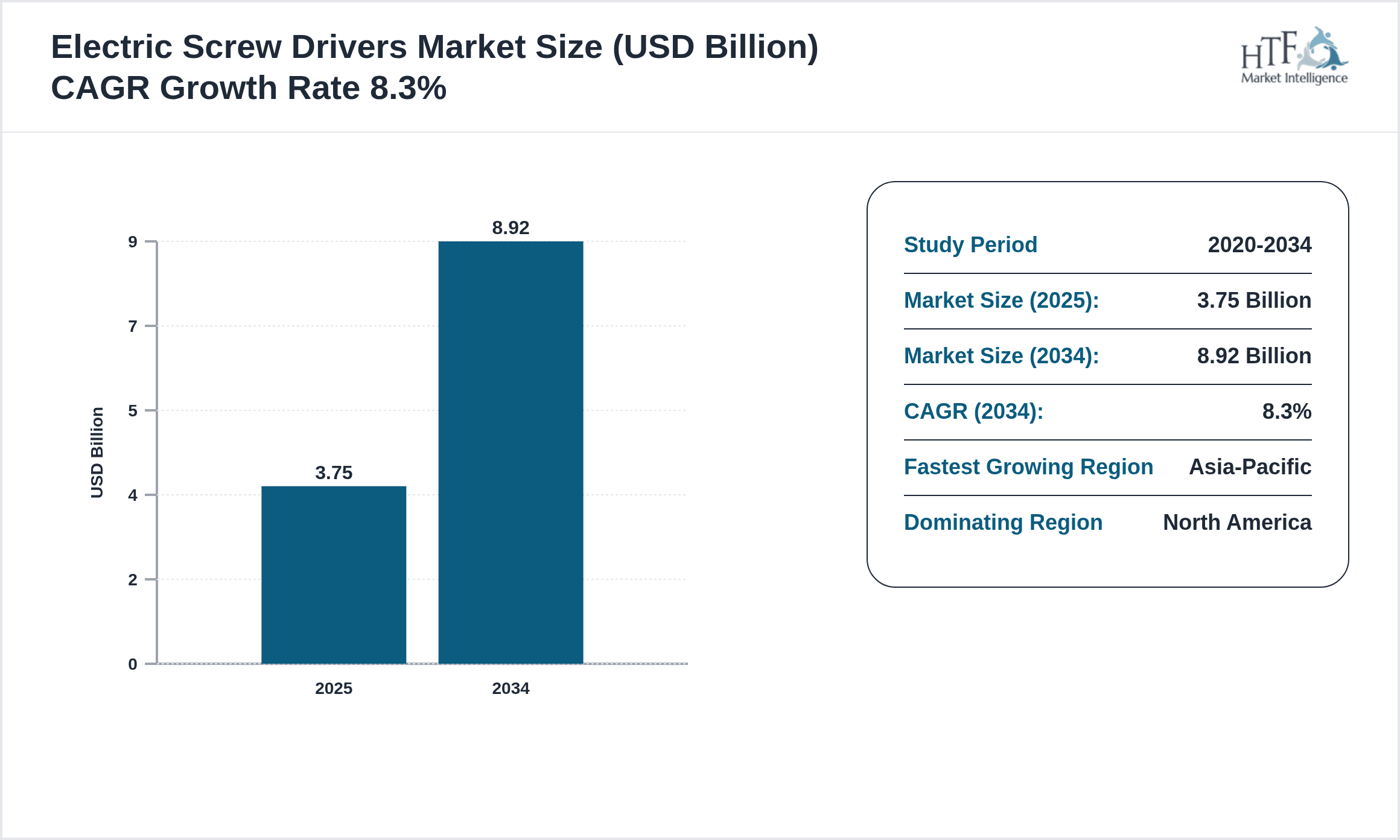
- •Key market highlights reveal a robust growth trajectory with the market expected to expand at a CAGR of 8.3% from 2024 to 2034, driven by increasing automation in manufacturing, rising demand in emerging economies, and continuous technological innovations such as brushless motor integration. The forecast market size is projected to reach USD 8.92 Billion by 2034, up from USD 3.75 Billion in 2024. The dominance of cordless electric screw drivers is underscored by their flexibility and efficiency, while brushless motor variants are emerging as the fastest growing segment due to superior performance and longer battery life. Regionally, North America holds the largest market share, attributed to advanced industrial infrastructure and high adoption rates, whereas Asia-Pacific is set to register the fastest growth, fueled by rapid industrialization and expanding manufacturing hubs.
- •The electric screw drivers market presents significant value to industries by streamlining assembly workflows, enhancing precision, and enabling ergonomic operations. These tools reduce manual effort and operational downtime, thus improving throughput and product quality. For stakeholders including manufacturers, distributors, and end-users, the market offers strategic opportunities in product innovation, geographic expansion, and integration with Industry 4.0 technologies. The growing emphasis on sustainable and energy-efficient tools further bolsters market attractiveness. As industries increasingly adopt automation, electric screw drivers become essential components in achieving competitive advantage and operational excellence globally.
Competitive Landscape
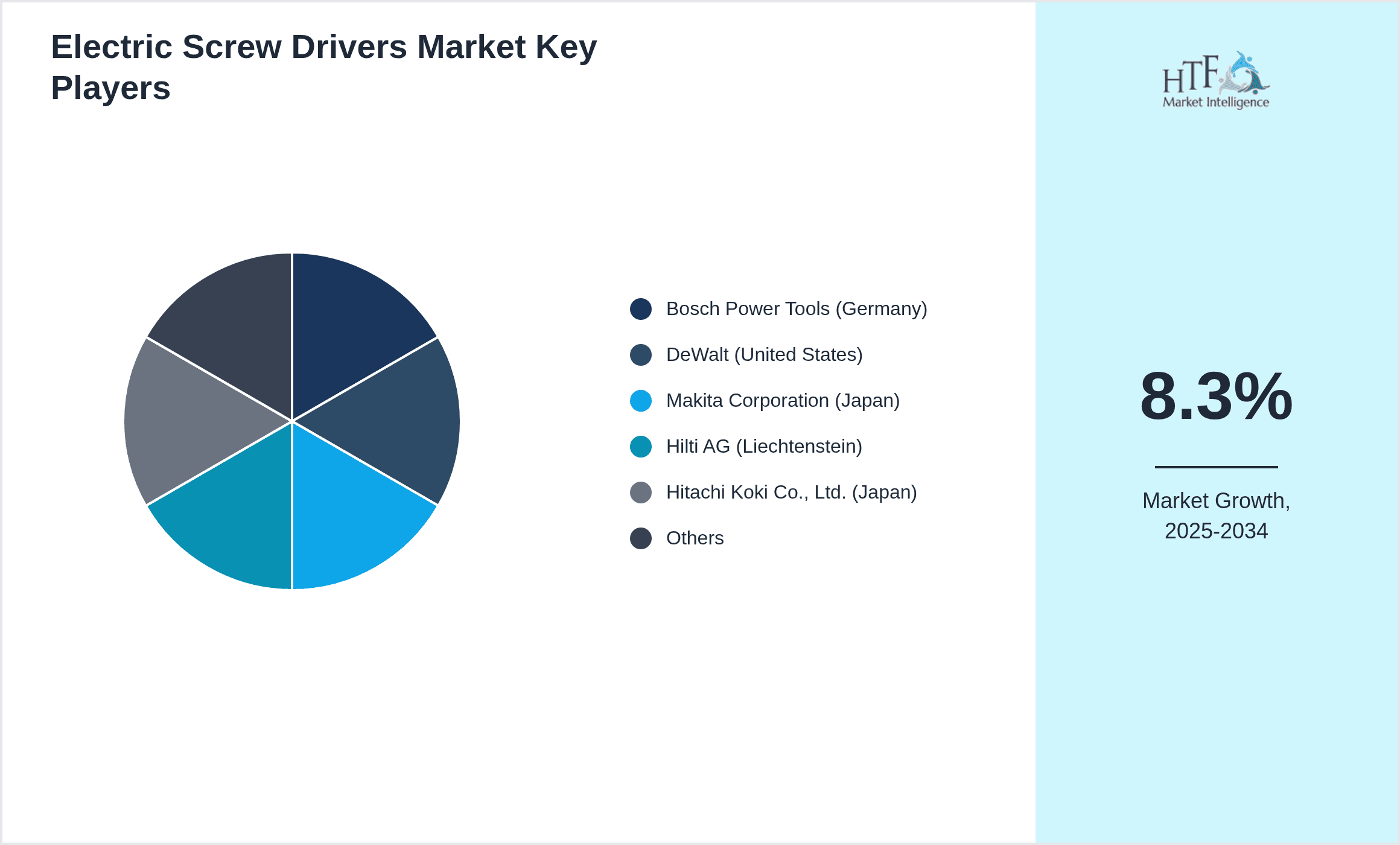
The competitive environment in the global electric screw drivers market is characterized by intense rivalry among established multinational corporations and emerging regional players. Companies compete primarily through innovation, product differentiation, and expanding distribution channels to capture market share. Technological advancements such as brushless motor technology, enhanced battery performance, and smart tool integration are key competitive strategies, enabling firms to address evolving customer demands. Strategic partnerships, mergers and acquisitions, and geographic expansion are prevalent tactics to strengthen market positioning. Pricing strategies vary based on product features and target segments, with premium cordless models commanding higher prices due to their advanced capabilities. The market also sees competition in after-sales services and warranty offerings, which influence customer loyalty. Barriers to entry include the need for significant R&D investment and compliance with stringent safety and quality standards. Regional competition dynamics reflect local manufacturing capabilities and consumer preferences, with Asia-Pacific emerging as a hotspot for cost-competitive production and innovation hubs.
Leading Companies in Electric Screw Drivers Market
- •Bosch Power Tools (Germany)
- •DeWalt (United States)
- •Makita Corporation (Japan)
- •Hilti AG (Liechtenstein)
- •Hitachi Koki Co., Ltd. (Japan)
- •Black & Decker (United States)
- •Stanley Black & Decker (United States)
- •Milwaukee Tool (United States)
- •Metabo (Germany)
- •Festool (Germany)
- •Techtronic Industries (Hong Kong)
- •Ryobi (Japan)
- •WORX (China)
- •Kobalt (United States)
- •Metabo HPT (Japan)
- •AEG Power Tools (Germany)
- •Porter-Cable (United States)
- •Festool (Germany)
- •Hilti Corporation (Liechtenstein)
- •Ingersoll Rand (Ireland)
- •Snap-on Incorporated (United States)
- •Fujiya (Japan)
- •Metabo (Germany)
- •TTI Group (Hong Kong)
- •Panasonic Corporation (Japan)

Market Breakdown
- •By Product Type
- ◦Cordless Electric Screw Drivers
- ◦Corded Electric Screw Drivers
- ◦Pneumatic Electric Screw Drivers
- ◦Hydraulic Electric Screw Drivers
- ◦Brushless Motor Electric Screw Drivers
- •By Application
- ◦Automotive Assembly
- ◦Electronics Manufacturing
- ◦Construction
- ◦Aerospace
- ◦General Industrial
- •By End-Use Industry
- ◦Automotive
- ◦Electronics
- ◦Construction
- ◦Aerospace
- •By Distribution Channel
- ◦Online Retail
- ◦Specialty Stores
- ◦Direct Sales
Growth Dynamics
- •The surge in automation across manufacturing sectors is a primary growth driver for the electric screw drivers market. Increasing demand for faster assembly processes and precision in industries such as automotive and electronics has propelled adoption of advanced electric screw drivers. For example, the automotive industry's emphasis on reducing production time has led to widespread use of ergonomic cordless screw drivers that improve worker efficiency and reduce fatigue.
- •Technological advancements such as brushless motor technology and lithium-ion battery integration have significantly enhanced tool performance, extending runtime and power while reducing maintenance needs. This innovation increases the appeal of electric screw drivers in both professional and DIY markets. Companies investing in R&D to innovate smarter and more energy-efficient devices gain competitive advantages.
- •The rapid growth of the Asia-Pacific manufacturing base, fueled by industrial investments and expanding electronics and automotive sectors, is driving demand for electric screw drivers. Emerging economies in this region are witnessing increased adoption due to growing industrialization and improving labor productivity standards, contributing to the region’s fastest market growth globally.
- •Rising focus on workplace safety and ergonomics is influencing the demand for lightweight, cordless electric screw drivers that reduce operator strain and injury risks. Regulatory compliance related to occupational health also encourages the adoption of advanced powered screw driving tools designed with safety features and user-friendly interfaces.
- •Increasing investments in smart manufacturing and Industry 4.0 integration provide opportunities to embed IoT and sensor technologies in electric screw drivers, enabling real-time monitoring, predictive maintenance, and enhanced quality control. This digital transformation is expected to open new avenues for market expansion in the coming years.

Market Trends
- •A notable trend is the shift toward brushless motor electric screw drivers due to their improved efficiency, longer battery life, and reduced maintenance compared to brushed motor counterparts. This shift is supported by growing consumer awareness and demand for high-performance tools in industrial settings.
- •Increasing adoption of cordless electric screw drivers across diverse applications reflects a broader market preference for portability and convenience, significantly impacting product development strategies among manufacturers.
- •Sustainability initiatives are driving manufacturers to develop eco-friendly battery technologies and recyclable materials to reduce environmental impact, aligning with global regulatory frameworks and consumer expectations.
- •Integration of smart features such as torque sensors, Bluetooth connectivity, and app-based controls is transforming electric screw drivers into connected tools, enhancing precision and data-driven maintenance.
- •Collaborations and partnerships between tool manufacturers and technology firms are increasing, fostering innovation in product functionalities and expanding market reach through combined expertise.
- •Customization of electric screw drivers for specific industry needs, such as aerospace and medical device manufacturing, is emerging as a competitive differentiator, driving product diversification.
- •Growth in e-commerce platforms has expanded distribution channels, improving accessibility and availability of electric screw drivers to a global customer base, including small and medium enterprises.
Market Opportunities
- •Expanding demand in emerging markets, especially within Asia-Pacific and Latin America, provides significant growth opportunities due to increasing industrialization and infrastructure development requiring efficient assembly tools.
- •Advancements in battery technology, particularly solid-state batteries, offer opportunities to develop electric screw drivers with enhanced power density and safety, appealing to premium segments.
- •Integration of AI and machine learning in electric screw drivers for predictive maintenance and adaptive torque control represents a high-potential innovation avenue to improve tool reliability and precision.
- •Collaborations with automotive and electronics manufacturers to develop customized screw drivers tailored for specific assembly line requirements can drive specialized product adoption.
- •Increasing focus on sustainability encourages development of environmentally friendly tools, creating market differentiation and compliance with evolving regulations.
- •Growth in DIY home improvement segments, facilitated by online retail expansion, offers opportunities to market user-friendly cordless screw drivers to end consumers globally.
- •Emerging technologies such as augmented reality-assisted assembly using connected electric screw drivers provide novel applications to enhance workforce training and operational efficiency.
Market Challenges
- •High initial investment and development costs for advanced electric screw drivers, especially those integrating smart technology and brushless motors, pose barriers to entry for smaller manufacturers and limit adoption in cost-sensitive markets.
- •Battery life limitations and charging infrastructure inadequacies in certain regions restrict the operational time and efficiency of cordless electric screw drivers, affecting user experience and productivity.
- •Fluctuating raw material prices, particularly for lithium and rare earth elements used in batteries and motors, create cost volatility impacting pricing strategies and profitability.
- •Stringent safety and quality certifications required by different countries increase compliance complexity and delay product launches in international markets.
- •Competition from traditional manual screwdrivers and low-cost alternatives in developing regions limits market penetration and challenges value proposition communication.
- •Rapid technological obsolescence challenges manufacturers to continuously innovate while managing inventory and product life cycles efficiently.
- •Limited skilled workforce to operate and maintain advanced electric screw drivers in some regions impedes optimal utilization and market growth.
Regulatory Framework
- •From 2019 to 2024, several regions have implemented safety standards specific to electric power tools, including IEC 62841 and OSHA guidelines, mandating rigorous testing for electrical insulation, mechanical stability, and ergonomic design, significantly influencing product development and market entry strategies.
- •Environmental regulations focusing on battery disposal and recycling, such as the EU Battery Directive and U.S. EPA guidelines, have compelled manufacturers to adopt sustainable materials and establish take-back programs, elevating production costs but enhancing market reputation.
- •Energy efficiency standards introduced in North America and Europe require electric screw drivers to meet minimum power consumption criteria, encouraging innovations in motor technology and battery management systems.
- •Regional mandates, including China's GB standards and India's BIS certifications, impose local compliance requirements, compelling global manufacturers to customize products and adhere to diverse regulatory landscapes for market access.
- •Government initiatives promoting industrial safety and automation, such as subsidies and tax incentives for adopting advanced power tools, have positively impacted market growth and accelerated technology adoption globally.
Market Intelligence
- •15th January 2025, Bosch Power Tools launched a new series of brushless motor cordless electric screw drivers featuring enhanced battery life and integrated IoT connectivity designed to facilitate real-time torque monitoring and predictive maintenance in automotive assembly lines. This innovation aims to reduce downtime and improve quality control, positioning Bosch as a leader in smart tool technology. The product's ergonomic design also addresses operator comfort, aligning with growing industry demand for safety and efficiency. Source: Bosch Official Press Release
- •10th March 2025, DeWalt introduced an advanced pneumatic electric screw driver with noise reduction technology and customizable torque settings tailored for aerospace manufacturing. This launch targets high-precision assembly applications requiring minimal vibration and consistent screw fastening quality. DeWalt’s strategic objective includes expanding its footprint in specialized industrial segments by offering tools that meet stringent operational standards. The product integrates seamlessly with automated systems, enhancing production flexibility. Source: DeWalt Corporate Announcement
- •22nd July 2024, Makita Corporation announced a strategic partnership with a leading battery manufacturer to co-develop next-generation lithium-ion batteries for cordless electric screw drivers. This collaboration aims to deliver longer runtime and faster charging capabilities, addressing key market demands in construction and electronics manufacturing sectors. The initiative is expected to accelerate product innovation cycles and strengthen Makita’s competitive positioning globally. Source: Makita Industry News
- •5th November 2024, Hilti AG completed the acquisition of a smart tool startup specializing in IoT-enabled electric screw drivers, enhancing its portfolio with cutting-edge digital solutions for industrial assembly. The acquisition supports Hilti’s expansion into connected tools and data-driven maintenance services, reinforcing its commitment to Industry 4.0 integration. This move is anticipated to drive revenue growth through value-added offerings and improved customer engagement. Source: Hilti Official Press Release
Regional Outlook
The North America currently holds a significant share of the market, primarily due to several key factors: increasing consumption rates, a burgeoning population, and robust economic momentum. These elements collectively drive demand, positioning this region as a leader in the market. On the other hand, Asia-Pacific is rapidly emerging as the fastest-growing area within the industry. This remarkable growth can be attributed to swift infrastructure development, the expansion of various industrial sectors, and a marked increase in consumer demand. These dynamics make this region a crucial player in shaping future market growth.
In our report, we cover a comprehensive analysis of the following regions and countries:
- North America
- LATAM
- West Europe
- Central & Eastern Europe
- Northern Europe
- Southern Europe
- East Asia
- Southeast Asia
- South Asia
- Central Asia
- Oceania
- MEA
| Feature | Details |
|---|---|
| Base Year Market Size | USD 3.75 Billion |
| Forecast Year Market Size | USD 8.92 Billion |
| CAGR | 8.3% |
| Forecast Period | 2026 to 2033 |
| YoY Growth | 8% |
| Scope of Report | Market is segmented by Product Type (Cordless Electric Screw Drivers, Corded Electric Screw Drivers, Pneumatic Electric Screw Drivers, Hydraulic Electric Screw Drivers, Brushless Motor Electric Screw Drivers), Application (Automotive Assembly, Electronics Manufacturing, Construction, Aerospace, General Industrial), End-Use Industry (Automotive, Electronics, Construction, Aerospace), Distribution Channel (Online Retail, Specialty Stores, Direct Sales) |
| Regions Covered | North America, LATAM, West Europe, Central & Eastern Europe, Northern Europe, Southern Europe, East Asia, Southeast Asia, South Asia, Central Asia, Oceania, MEA |
| Key Companies | Bosch Power Tools (Germany), DeWalt (United States), Makita Corporation (Japan), Hilti AG (Liechtenstein), Hitachi Koki Co., Ltd. (Japan), Black & Decker (United States), Stanley Black & Decker (United States), Milwaukee Tool (United States), Metabo (Germany), Festool (Germany), Techtronic Industries (Hong Kong), Ryobi (Japan), WORX (China), Kobalt (United States), Metabo HPT (Japan), AEG Power Tools (Germany), Porter-Cable (United States), Festool (Germany), Hilti Corporation (Liechtenstein), Ingersoll Rand (Ireland), Snap-on Incorporated (United States), Fujiya (Japan), Metabo (Germany), TTI Group (Hong Kong), Panasonic Corporation (Japan) |
Global Electric Screw Drivers Market Size, Growth & Revenue 2024-2034 - Table of Contents
Frequently Asked Questions (FAQ):
The Compact Track Loaders market is projected to grow at a CAGR of 6.8% from 2025 to 2030, driven by increasing demand in construction and agricultural sectors.
North America currently leads the market with approximately 45% market share, followed by Europe at 28% and Asia-Pacific at 22%. The remaining regions account for 5% of the global market.
Key growth drivers include increasing construction activities, rising demand for versatile equipment in agriculture, technological advancements in track loader design, and growing preference for compact equipment in urban construction projects.