
Global Lithium-ion Electric Counterbalanced Forklifts Market Size, Growth & Revenue 2024-2034
Global Lithium-ion Electric Counterbalanced Forklifts Market is segmented by Product Type (Standard Lift Lithium-ion Electric Counterbalanced Forklifts, High Lift Lithium-ion Electric Counterbalanced Forklifts, Heavy Duty Lithium-ion Electric Counterbalanced Forklifts, Compact Lithium-ion Electric Counterbalanced Forklifts, Rough Terrain Lithium-ion Electric Counterbalanced Forklifts), Application (Warehousing, Manufacturing, Logistics, Retail, Food & Beverage), End-Use Industry (Automotive, E-commerce & Retail, Food Processing & Packaging, Pharmaceuticals & Chemicals), Distribution Channel (Direct Sales, Dealerships, Online Platforms), and Geography (North America, LATAM, West Europe, Central & Eastern Europe, Northern Europe, Southern Europe, East Asia, Southeast Asia, South Asia, Central Asia, Oceania, MEA)
Pricing
Report Overview
Executive Summary
- •The Global Lithium-ion Electric Counterbalanced Forklifts Market is a rapidly evolving sector within the industrial vehicle industry, focusing on forklifts powered by advanced lithium-ion battery technology. These forklifts are designed for a variety of material handling applications, featuring counterbalanced systems that optimize load stability and maneuverability. The market's scope includes multiple forklift types differentiated by lift capacity and operational terrain, targeting industries such as warehousing, manufacturing, logistics, retail, and food & beverage. Lithium-ion batteries bring enhanced energy efficiency, reduced charging times, and longer operational hours compared to traditional power sources, driving market demand. This market also integrates technological advancements like battery management systems and automation to improve productivity and safety. Globally, increasing emphasis on sustainability and regulatory mandates to reduce carbon footprints are accelerating adoption. The market's growth is influenced by regional industrial expansion, infrastructure development, and the shift towards electrification in material handling equipment.
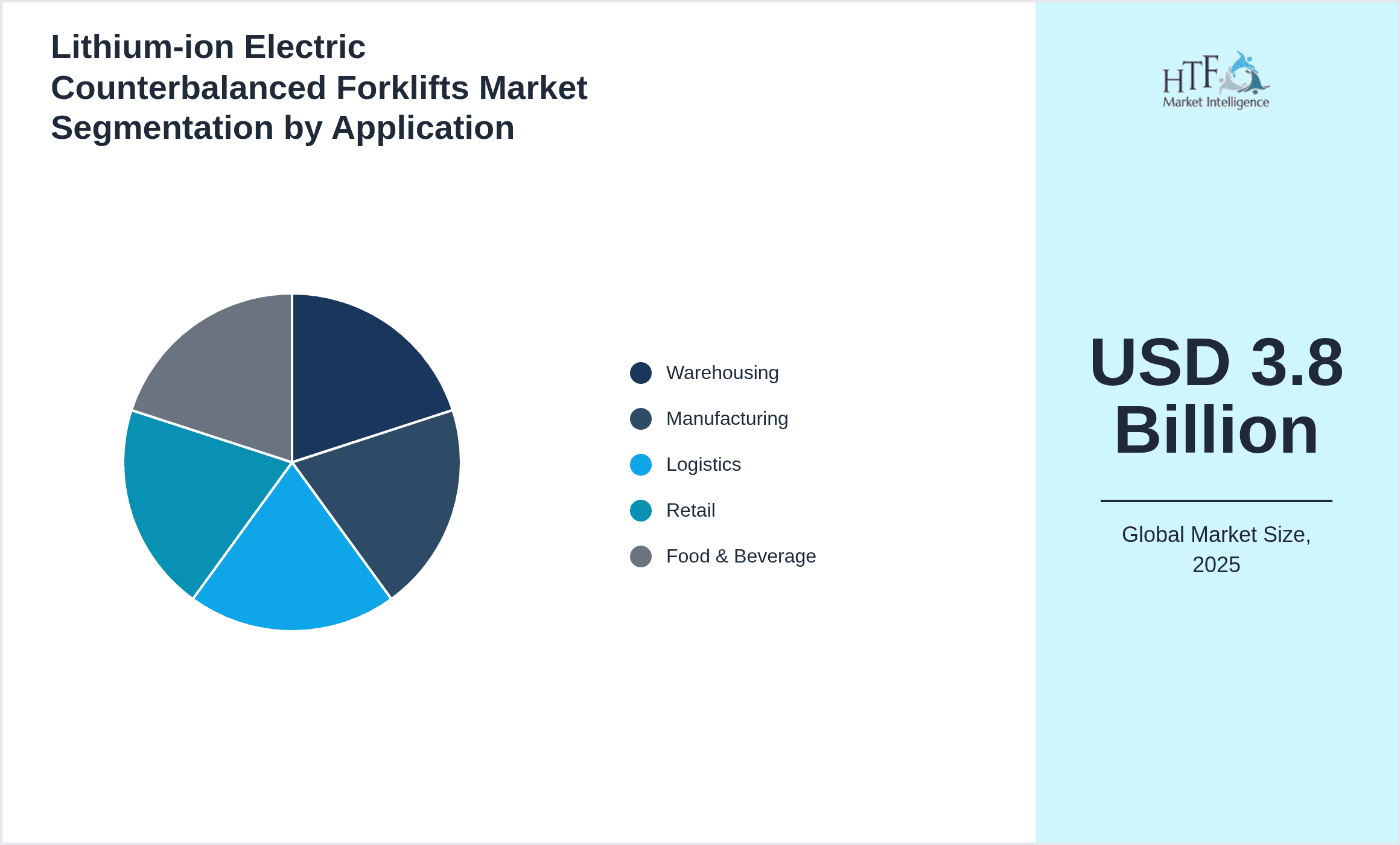
- •Key highlights include a base market size of USD 3.8 billion in 2024, projected to reach USD 9.7 billion by 2034 at a CAGR of 9.62%. North America currently dominates due to early adoption and stringent emissions regulations, while Asia-Pacific exhibits the fastest growth, driven by expanding manufacturing and logistics sectors. Standard lift forklifts hold the largest market share, with heavy-duty types growing rapidly due to increasing industrial demands. Warehousing is the leading application segment, supported by the rise in e-commerce and automated distribution centers. These dynamics underscore a robust market trajectory supported by technological innovation and sustainability trends.
- •The value proposition of lithium-ion electric counterbalanced forklifts lies in their operational efficiency, environmental benefits, and adaptability across industries. They offer stakeholders cost savings through reduced maintenance and energy consumption, while supporting regulatory compliance with emissions standards. The strategic importance spans logistics optimization, supply chain resilience, and industrial automation, making these forklifts pivotal in modern material handling ecosystems. Industry players leverage innovation and strategic partnerships to expand product portfolios and geographic reach, aligning with global sustainability goals and growing demand for cleaner, smarter industrial equipment.

Competitive Landscape
The competitive landscape of the Global Lithium-ion Electric Counterbalanced Forklifts Market is marked by intense rivalry among established global manufacturers and emerging regional players. Companies focus heavily on innovation in lithium-ion battery technology, automation integration, and product differentiation to build competitive advantage. Strategic initiatives include expanding manufacturing capacities, enhancing after-sales services, and forming partnerships with battery technology providers. Market positioning is influenced by the ability to offer sustainable, energy-efficient, and high-performance forklifts tailored to diverse applications. Pricing strategies vary with emphasis on total cost of ownership, and distribution channels are optimized to reach key industrial hubs worldwide. Mergers and acquisitions have accelerated market consolidation, enabling firms to expand portfolios and geographic presence. The landscape is expected to evolve with increasing adoption of IoT-enabled forklifts and green energy policies shaping competitive dynamics.
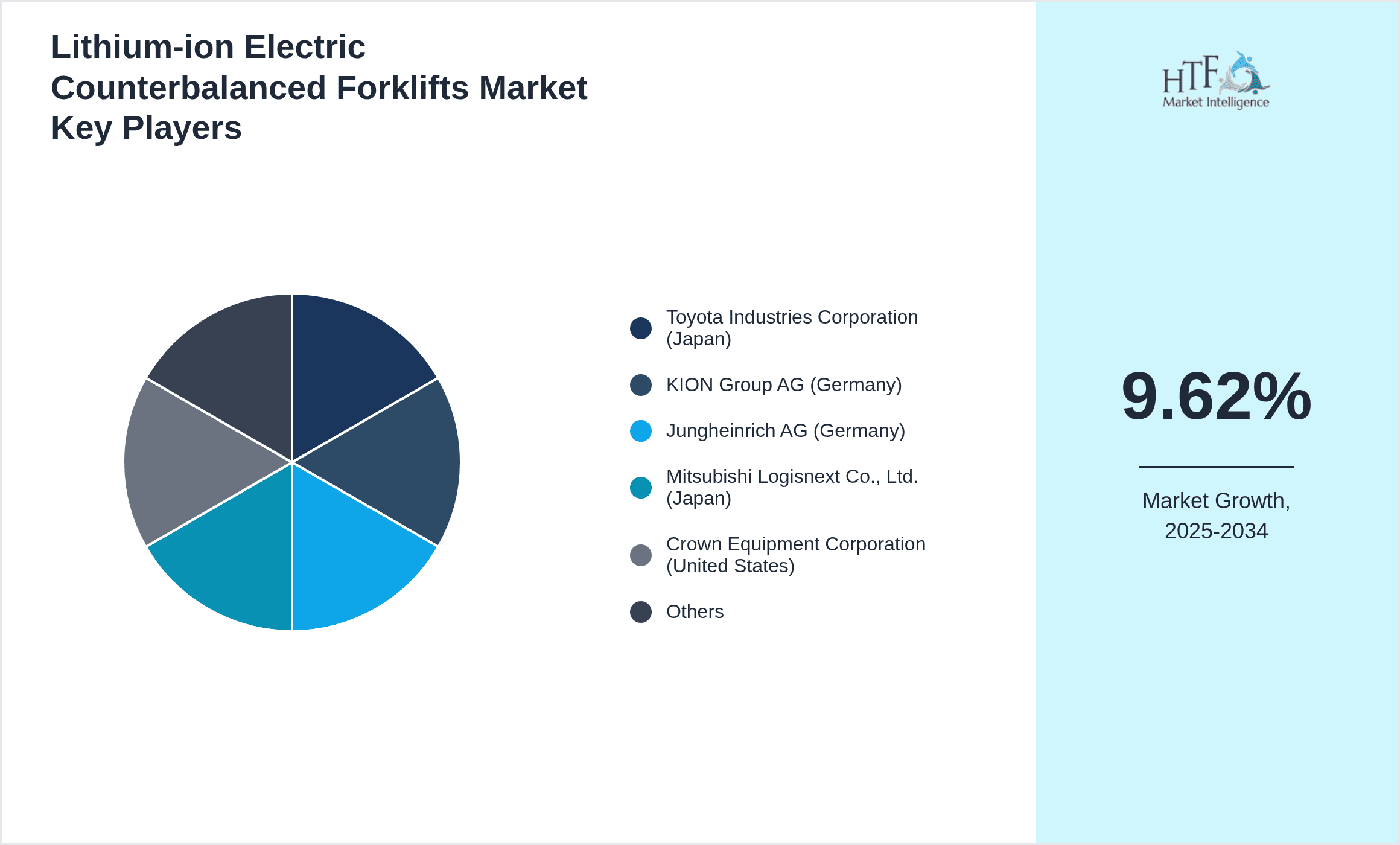
Leading Companies in Lithium-ion Electric Counterbalanced Forklifts Market
- •Toyota Industries Corporation (Japan)
- •KION Group AG (Germany)
- •Jungheinrich AG (Germany)
- •Mitsubishi Logisnext Co., Ltd. (Japan)
- •Crown Equipment Corporation (United States)
- •Hyster-Yale Materials Handling, Inc. (United States)
- •Doosan Industrial Vehicle Co., Ltd. (South Korea)
- •Komatsu Ltd. (Japan)
- •Clark Material Handling Company (United States)
- •Hyundai Heavy Industries Co., Ltd. (South Korea)
- •Hangcha Group Co., Ltd. (China)
- •Lonking Holdings Limited (China)
- •Noblelift Equipment Co., Ltd. (China)
- •HANGCHA Group Co., Ltd. (China)
- •Maximal Forklift Co., Ltd. (China)
- •Godrej & Boyce Manufacturing Company Limited (India)
- •Manitou BF (France)
- •Beijing EP Equipment Co., Ltd. (China)
- •Tailift Group (Taiwan)
- •Raymond Corporation (United States)
- •TCM Corporation (Japan)
- •Linde Material Handling GmbH (Germany)
- •Big Joe Forklifts (United States)
- •Moffett Engineering Ltd. (Ireland)
- •Doosan Bobcat Inc. (United States)
Market Breakdown
- •By Product Type
- ◦Standard Lift Lithium-ion Electric Counterbalanced Forklifts
- ◦High Lift Lithium-ion Electric Counterbalanced Forklifts
- ◦Heavy Duty Lithium-ion Electric Counterbalanced Forklifts
- ◦Compact Lithium-ion Electric Counterbalanced Forklifts
- ◦Rough Terrain Lithium-ion Electric Counterbalanced Forklifts
- •By Application
- ◦Warehousing
- ◦Manufacturing
- ◦Logistics
- ◦Retail
- ◦Food & Beverage
- •By End-Use Industry
- ◦Automotive
- ◦E-commerce & Retail
- ◦Food Processing & Packaging
- ◦Pharmaceuticals & Chemicals
- •By Distribution Channel
- ◦Direct Sales
- ◦Dealerships
- ◦Online Platforms
Growth Dynamics
- •Rising adoption of lithium-ion batteries in forklifts is driven by their superior energy efficiency and faster charging times compared to traditional lead-acid batteries, reducing downtime and enhancing operational productivity across industries.
- •Increasing governmental regulations worldwide aimed at reducing carbon emissions and promoting electric vehicles are encouraging logistics and warehousing companies to shift towards lithium-ion electric counterbalanced forklifts for sustainable operations.
- •Technological advancements such as integration of battery management systems, IoT connectivity, and automation in forklifts are propelling market growth by improving safety, efficiency, and ease of use in material handling applications.
- •Expansion of e-commerce and retail sectors globally is boosting demand for efficient warehousing and logistics solutions, directly increasing the need for reliable and high-performance lithium-ion electric forklifts.
- •Investments in warehouse modernization and smart factory initiatives across Asia-Pacific and Europe create significant opportunities for market players to introduce advanced lithium-ion forklift models tailored to diverse industrial requirements.
- •Increasing focus on reducing total cost of ownership in material handling operations is driving companies to adopt lithium-ion forklifts due to lower maintenance and energy costs over the lifecycle compared to conventional options.
- •The growing trend of electrification and automation in supply chain processes is fostering the integration of lithium-ion forklifts equipped with advanced features such as telematics, predictive maintenance, and energy optimization.

Market Trends
- •The market is witnessing a trend towards the adoption of smart forklifts equipped with IoT sensors and AI-driven analytics, enabling real-time monitoring and predictive maintenance to optimize fleet performance and reduce downtime.
- •Sustainability-driven innovation is leading to the development of more compact and lightweight lithium-ion batteries, enhancing forklift maneuverability and operational efficiency in confined warehouse spaces.
- •Collaborations between forklift manufacturers and battery technology firms are becoming common, accelerating the development of high-capacity batteries that support longer operational hours and faster charging cycles.
- •The shift towards automated guided vehicles (AGVs) and autonomous forklifts is gaining traction, integrating lithium-ion battery technology with robotics for enhanced productivity and safety in material handling operations.
- •Emerging economies in Asia-Pacific and Latin America are witnessing increased adoption of electric forklifts due to government incentives for green technologies and expanding industrial infrastructure.
- •The aftermarket services segment is growing, with companies offering battery leasing, maintenance contracts, and energy management solutions to support forklift operations and reduce lifecycle costs.
- •Integration of renewable energy sources for charging infrastructure in warehouses and logistics centers is becoming a key trend, aligning forklift operations with broader corporate sustainability goals.
Market Opportunities
- •Expanding e-commerce and third-party logistics sectors globally present vast opportunities to deploy lithium-ion electric counterbalanced forklifts for efficient inventory management and faster order fulfillment.
- •Emerging markets in Asia-Pacific and Latin America provide growth potential due to rapid industrialization, increasing infrastructure investments, and rising awareness of sustainable material handling solutions.
- •Advancements in battery technology, such as solid-state lithium-ion cells, offer opportunities to enhance forklift performance with higher energy densities and improved safety profiles.
- •Integration of AI and machine learning in forklift operations can unlock productivity gains through optimized routing, load handling, and predictive maintenance, creating new service offerings.
- •Partnerships between forklift manufacturers and software providers to develop fleet management platforms enable customers to track performance, reduce costs, and improve operational efficiency.
- •Government incentives and subsidies for electric vehicle adoption in warehouses and logistics centers create favorable conditions for market expansion and technology upgrades.
- •Development of modular forklift designs that allow battery upgrades and customization can cater to diverse industry needs, increasing market penetration and customer retention.
Market Challenges
- •High initial investment costs of lithium-ion electric counterbalanced forklifts compared to traditional lead-acid battery models can constrain adoption, especially among small and medium enterprises.
- •Limited availability of charging infrastructure in emerging markets poses operational challenges, affecting the seamless adoption of lithium-ion forklifts in these regions.
- •Concerns regarding battery safety, thermal runaway risks, and disposal regulations require stringent compliance and can increase operational complexities for manufacturers and users alike.
- •Volatility in raw material prices for lithium and other battery components can impact manufacturing costs and market pricing strategies negatively.
- •Lack of standardization in battery sizes and charging protocols across manufacturers complicates maintenance and interchangeability, limiting scalability and customer flexibility.
- •Intense competition and rapidly evolving technology necessitate continuous R&D investments, which may be challenging for smaller players with limited resources.
- •Supply chain disruptions, particularly for critical battery components, can delay production and affect market availability, impacting customer satisfaction and revenue growth.
Regulatory Framework
- •Between 2019 and 2024, global regulatory bodies have implemented stringent emission standards targeting material handling equipment, compelling manufacturers to accelerate the shift towards electric forklifts powered by lithium-ion batteries, thereby reducing greenhouse gas emissions and improving air quality in industrial environments.
- •Regulations concerning battery safety and recycling, such as the EU Battery Directive and U.S. EPA guidelines, have been enforced, mandating compliance with strict handling, disposal, and transportation protocols to minimize environmental impact and ensure workplace safety.
- •New safety standards introduced for electric forklifts include mandatory installation of advanced battery management systems and thermal sensors to prevent overheating and fire hazards, influencing product design and operational practices.
- •Country-specific mandates in North America and Europe require manufacturers to certify electric forklifts under energy efficiency and environmental performance labels, enhancing transparency and consumer confidence in sustainable material handling solutions.
- •Government incentive programs, including tax credits and subsidies for electric vehicle adoption in warehouses and logistics facilities, have been launched to promote cleaner technologies and reduce the total cost of ownership, stimulating market growth.
Market Intelligence
- •15th January 2025, Toyota Industries Corporation launched its latest lithium-ion electric counterbalanced forklift model featuring a new high-capacity battery technology that enables longer operational hours and faster recharge cycles. This innovation targets high-demand warehousing and logistics applications, offering enhanced energy efficiency and reduced maintenance costs. The product also integrates advanced telematics for real-time fleet management, aiming to improve overall productivity and operational control for global customers. Toyota’s strategic focus on sustainability and innovation reinforces its market leadership and commitment to reducing carbon footprints across industrial sectors. Source: Official Toyota Industries Corporation press release.
- •8th March 2025, KION Group AG introduced a new range of heavy-duty lithium-ion electric counterbalanced forklifts designed for rugged industrial environments. These forklifts incorporate cutting-edge battery management systems and modular design, allowing quick battery swaps and extended service life. The launch is part of KION's strategy to expand its electric forklift portfolio and meet growing demand in Asia-Pacific and European markets. The new models demonstrate superior energy efficiency and lower total cost of ownership, appealing to logistics and manufacturing sectors. Source: KION Group AG official announcement.
- •22nd June 2025, Crown Equipment Corporation announced a strategic partnership with a leading battery technology firm to co-develop next-generation lithium-ion batteries optimized for electric counterbalanced forklifts. The collaboration focuses on enhancing battery safety, energy density, and charging infrastructure compatibility. This initiative is expected to accelerate Crown’s product innovation pipeline and strengthen its competitive positioning globally, especially in North America and Europe. By leveraging combined expertise, the partnership aims to address key market challenges such as battery lifecycle management and operational costs. Source: Crown Equipment Corporation official news release.
- •10th September 2025, Jungheinrich AG completed the acquisition of a European battery recycling company to bolster its sustainability initiatives and supply chain resilience for lithium-ion battery components. This strategic move supports Jungheinrich's goals of circular economy integration and reducing environmental impact across its forklift manufacturing operations. The acquisition enhances Jungheinrich’s capabilities in battery lifecycle management and regulatory compliance, providing a competitive edge in markets with stringent environmental standards. The move aligns with growing customer demand for eco-friendly material handling solutions. Source: Jungheinrich AG corporate announcement.
Regional Outlook
The North America currently holds a significant share of the market, primarily due to several key factors: increasing consumption rates, a burgeoning population, and robust economic momentum. These elements collectively drive demand, positioning this region as a leader in the market. On the other hand, Asia-Pacific is rapidly emerging as the fastest-growing area within the industry. This remarkable growth can be attributed to swift infrastructure development, the expansion of various industrial sectors, and a marked increase in consumer demand. These dynamics make this region a crucial player in shaping future market growth.
In our report, we cover a comprehensive analysis of the following regions and countries:
- North America
- LATAM
- West Europe
- Central & Eastern Europe
- Northern Europe
- Southern Europe
- East Asia
- Southeast Asia
- South Asia
- Central Asia
- Oceania
- MEA
| Feature | Details |
|---|---|
| Base Year Market Size | USD 3.8 Billion |
| Forecast Year Market Size | USD 9.7 Billion |
| CAGR | 9.62% |
| Forecast Period | 2026 to 2033 |
| YoY Growth | 9.23% |
| Scope of Report | Market is segmented by Product Type (Standard Lift Lithium-ion Electric Counterbalanced Forklifts, High Lift Lithium-ion Electric Counterbalanced Forklifts, Heavy Duty Lithium-ion Electric Counterbalanced Forklifts, Compact Lithium-ion Electric Counterbalanced Forklifts, Rough Terrain Lithium-ion Electric Counterbalanced Forklifts), Application (Warehousing, Manufacturing, Logistics, Retail, Food & Beverage), End-Use Industry (Automotive, E-commerce & Retail, Food Processing & Packaging, Pharmaceuticals & Chemicals), Distribution Channel (Direct Sales, Dealerships, Online Platforms) |
| Regions Covered | North America, LATAM, West Europe, Central & Eastern Europe, Northern Europe, Southern Europe, East Asia, Southeast Asia, South Asia, Central Asia, Oceania, MEA |
| Key Companies | Toyota Industries Corporation (Japan), KION Group AG (Germany), Jungheinrich AG (Germany), Mitsubishi Logisnext Co., Ltd. (Japan), Crown Equipment Corporation (United States), Hyster-Yale Materials Handling, Inc. (United States), Doosan Industrial Vehicle Co., Ltd. (South Korea), Komatsu Ltd. (Japan), Clark Material Handling Company (United States), Hyundai Heavy Industries Co., Ltd. (South Korea), Hangcha Group Co., Ltd. (China), Lonking Holdings Limited (China), Noblelift Equipment Co., Ltd. (China), HANGCHA Group Co., Ltd. (China), Maximal Forklift Co., Ltd. (China), Godrej & Boyce Manufacturing Company Limited (India), Manitou BF (France), Beijing EP Equipment Co., Ltd. (China), Tailift Group (Taiwan), Raymond Corporation (United States), TCM Corporation (Japan), Linde Material Handling GmbH (Germany), Big Joe Forklifts (United States), Moffett Engineering Ltd. (Ireland), Doosan Bobcat Inc. (United States) |
Global Lithium-ion Electric Counterbalanced Forklifts Market Size, Growth & Revenue 2024-2034 - Table of Contents
Frequently Asked Questions (FAQ):
The Compact Track Loaders market is expected to see value worth 5.3 Billion in 2025.
North America currently leads the market with approximately 45% market share, followed by Europe at 28% and Asia-Pacific at 22%. The remaining regions account for 5% of the global market.
Key growth drivers include increasing construction activities, rising demand for versatile equipment in agriculture, technological advancements in track loader design, and growing preference for compact equipment in urban construction projects.