
Global 3D Real-time Imaging Sonar Market Size, Growth & Revenue 2024-2034
Global 3D Real-time Imaging Sonar Market is segmented by Product Type (Mechanical Scanning Sonar, Phased Array Sonar, Multibeam Sonar, Interferometric Sonar, Synthetic Aperture Sonar), Application (Underwater Exploration, Marine Surveying, Defense & Security, Fisheries, Environmental Monitoring), End-Use Industry (Defense & Military, Offshore Oil & Gas, Marine Research & Survey, Commercial Fisheries), Distribution Channel (Direct Sales, Distributors & Dealers, Online Sales), and Geography (North America, LATAM, West Europe, Central & Eastern Europe, Northern Europe, Southern Europe, East Asia, Southeast Asia, South Asia, Central Asia, Oceania, MEA)
Pricing
Report Overview
Executive Summary
- •The global 3D Real-time Imaging Sonar Market is a specialized segment of underwater sonar technology focused on delivering three-dimensional visualization with real-time processing capabilities. This market includes various sonar types such as mechanical scanning, phased array, multibeam, interferometric, and synthetic aperture sonars, each designed to meet different operational needs across underwater exploration, marine surveying, defense, fisheries, and environmental monitoring. The scope extends from equipment manufacturing to software integration and service deployment across commercial and governmental sectors worldwide. The market is characterized by rapid technological advancements, including AI-enabled data analysis, enhancing the precision and usability of sonar imaging. Increasing maritime security concerns, expanding offshore industrial activities, and environmental conservation efforts are key drivers shaping this market. The sector is poised for robust growth through 2034, driven by ongoing innovations and expanding applications in both civilian and defense domains, underscoring its strategic importance in global maritime operations.
- •The market is projected to grow from USD 1.12 Billion in 2024 to USD 3.45 Billion by 2034, exhibiting a CAGR of 11.2%. Key highlights include the dominance of phased array sonar technology due to its high resolution and adaptability, and the rapid adoption of synthetic aperture sonar as the fastest-growing segment. North America holds the largest market share driven by strong defense investments and technological leadership, while Asia-Pacific is the fastest-growing region fueled by expanding marine exploration and industrialization. Increasing demand from defense, offshore oil and gas, and environmental monitoring sectors underscores the growth momentum. Strategic partnerships and continuous R&D investments are also prominent growth factors. These trends indicate a dynamic market landscape with opportunities for technology providers, marine service companies, and defense contractors globally.
- •The 3D real-time imaging sonar market offers substantial value propositions including enhanced underwater situational awareness, improved resource management, and elevated maritime security. For industries such as defense and offshore exploration, these systems enable critical decision-making with real-time, high-resolution data. Environmental agencies benefit from accurate monitoring capabilities that support conservation efforts. The evolving technological landscape with AI integration enhances operational efficiency and reduces human error. Stakeholders including sonar manufacturers, maritime service providers, and government agencies find strategic importance in this market, as it supports sustainable development of underwater resources and strengthens security frameworks. Consequently, this market is integral to the future of maritime technology and oceanographic applications.

Competitive Landscape
The competitive landscape of the global 3D real-time imaging sonar market is marked by intense rivalry among established technology firms and emerging innovators. Leading companies focus heavily on research and development to deliver cutting-edge sonar systems with enhanced resolution, real-time processing, and AI integration to maintain technological leadership. Market players adopt varied strategies including strategic alliances, partnerships, and mergers to expand their product portfolios and geographic reach. Pricing competition is moderated by the high complexity and customization required for advanced sonar systems, with companies differentiating through innovation, service quality, and after-sales support. Regional competition is influenced by defense budgets and offshore industry investments, notably in North America and Asia-Pacific. The market exhibits moderate entry barriers due to technological complexity and regulatory requirements, fostering competition primarily among seasoned industry participants. Future trends indicate increased convergence of sonar technology with data analytics and autonomous systems, reshaping the competitive dynamics and creating opportunities for new entrants with specialized capabilities.
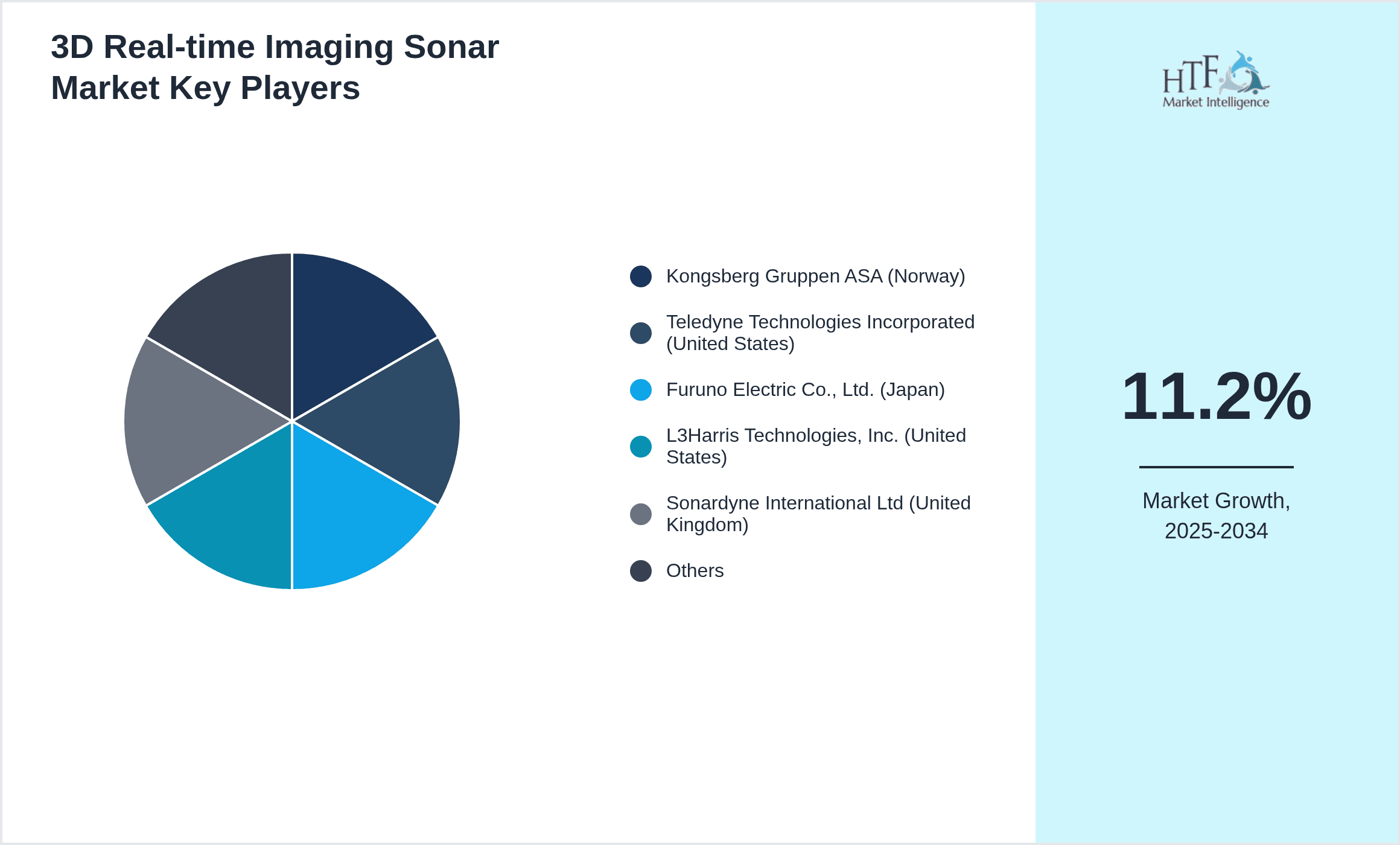
Prominent Players in 3D Real-time Imaging Sonar Market
- •Kongsberg Gruppen ASA (Norway)
- •Teledyne Technologies Incorporated (United States)
- •Furuno Electric Co., Ltd. (Japan)
- •L3Harris Technologies, Inc. (United States)
- •Sonardyne International Ltd (United Kingdom)
- •Echologics LLC (Canada)
- •Norbit ASA (Norway)
- •EdgeTech, Inc. (United States)
- •R2Sonic LLC (United States)
- •Raytheon Technologies Corporation (United States)
- •Atlas Elektronik GmbH (Germany)
- •Marine Sonic Technology Ltd (United Kingdom)
- •Blue Robotics, Inc. (United States)
- •Applied Acoustics Limited (United Kingdom)
- •SonarTech Atlas (Germany)
- •Gavial Technologies Pvt Ltd (India)
- •Hydroacoustics Inc. (United States)
- •Simrad (Norway)
- •Saab AB (Sweden)
- •Oceaneering International, Inc. (United States)
- •InnovaSea Systems (United States)
- •Marine Instruments S.A. (Spain)
- •Teledyne CARIS (Canada)
- •Helix Technologies, Inc. (United States)
- •Sonardyne Asia Pacific (Singapore)
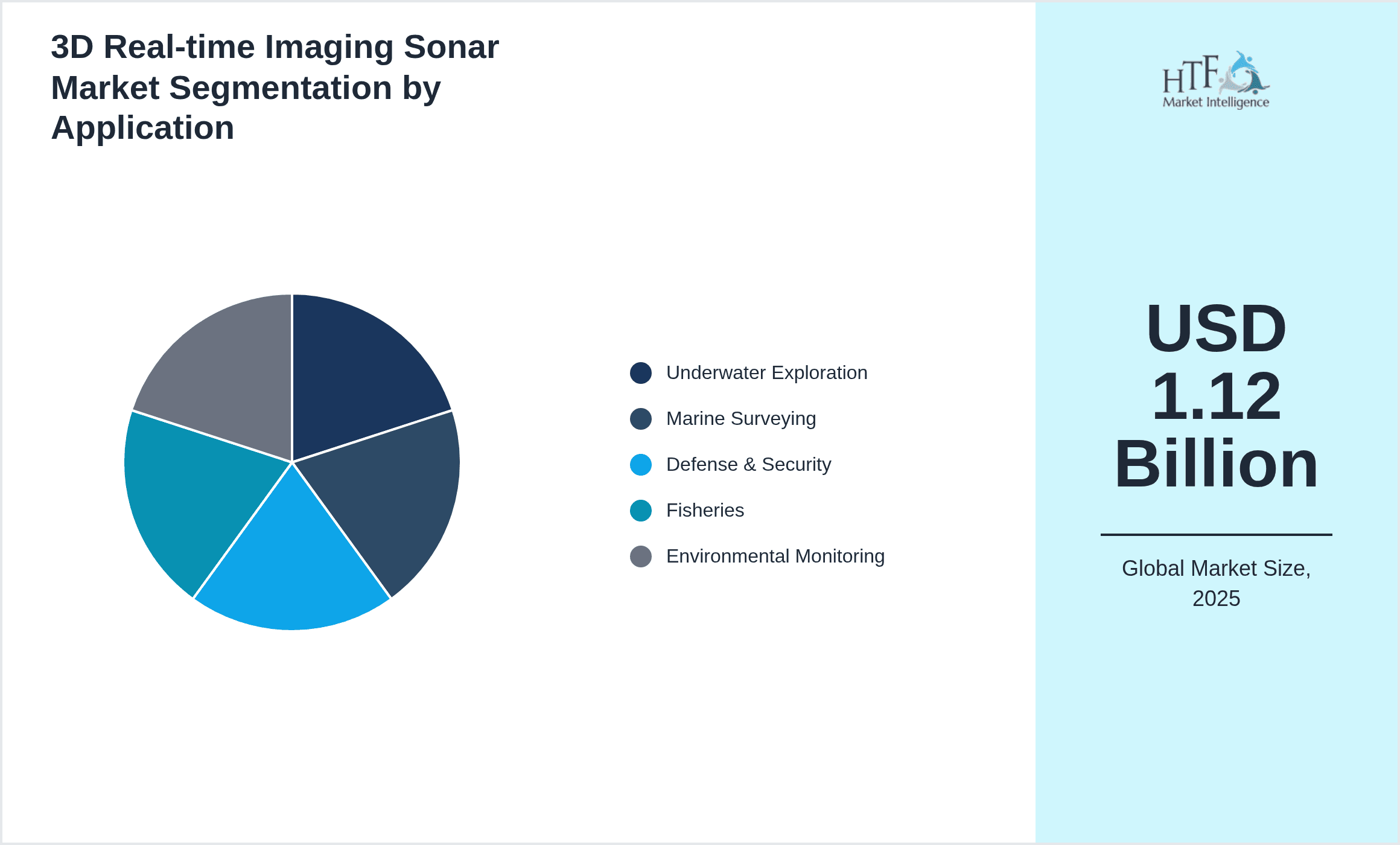
Market Breakdown
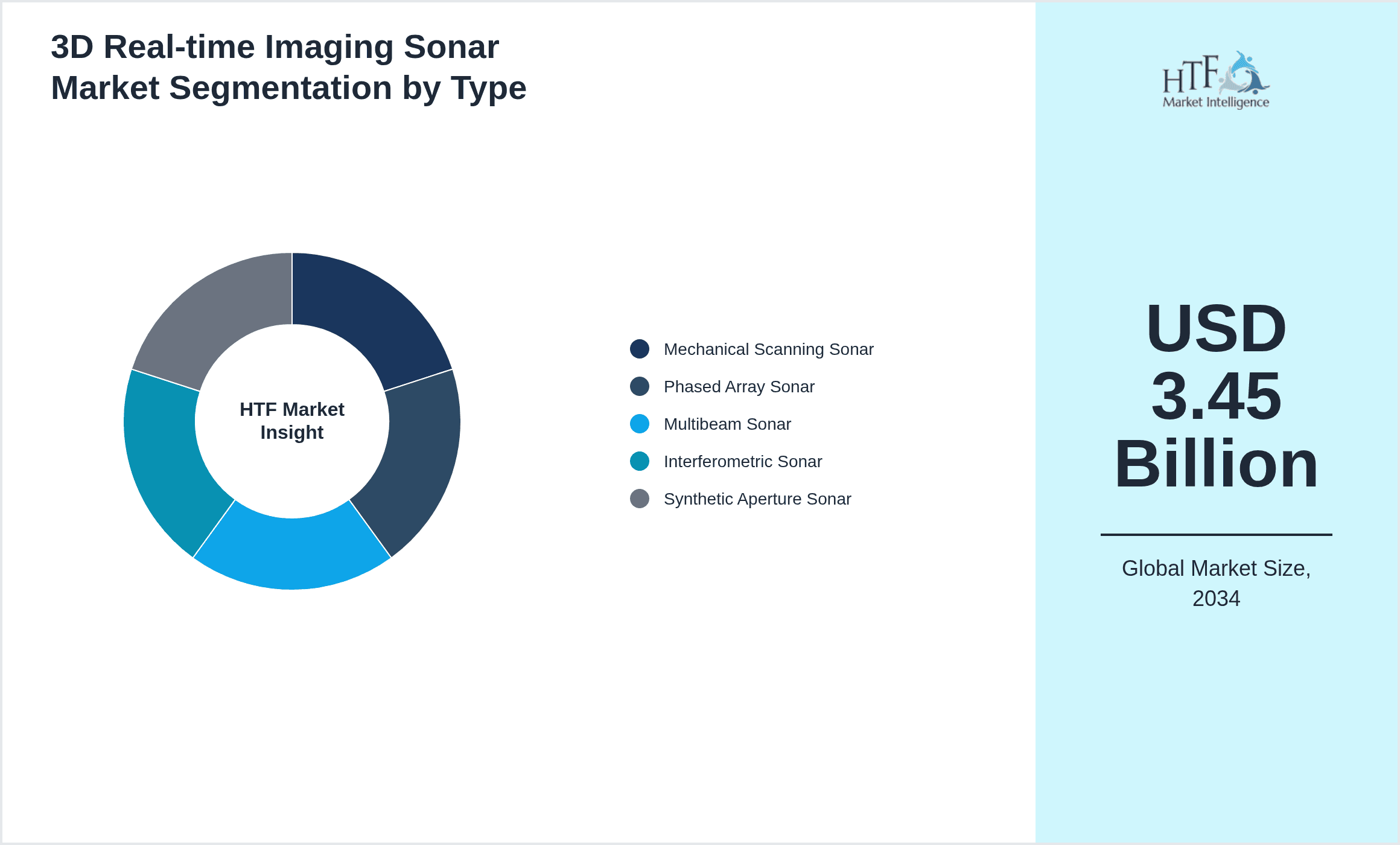
- •By Product Type
- ◦Mechanical Scanning Sonar
- ◦Phased Array Sonar
- ◦Multibeam Sonar
- ◦Interferometric Sonar
- ◦Synthetic Aperture Sonar
- •By Application
- ◦Underwater Exploration
- ◦Marine Surveying
- ◦Defense & Security
- ◦Fisheries
- ◦Environmental Monitoring
- •By End-Use Industry
- ◦Defense & Military
- ◦Offshore Oil & Gas
- ◦Marine Research & Survey
- ◦Commercial Fisheries
- •By Distribution Channel
- ◦Direct Sales
- ◦Distributors & Dealers
- ◦Online Sales
Growth Dynamics
- •Rising defense and maritime security investments are a primary growth driver, with governments increasing budgets to deploy advanced 3D sonar technology for coastal surveillance and submarine detection, directly boosting market demand.
- •Technological advancements such as AI-enabled real-time data processing and integration with autonomous underwater vehicles enhance the accuracy and operational efficiency of 3D imaging sonar, encouraging adoption across industries.
- •Expansion of offshore oil and gas exploration activities necessitates precise underwater mapping and inspection, driving demand for high-resolution 3D sonar systems to ensure operational safety and environmental compliance.
- •Growing environmental concerns and regulatory mandates for marine ecosystem monitoring foster increased use of 3D sonar technology in assessing underwater habitats and detecting ecological changes.
- •The fisheries sector benefits from improved fish stock assessment and habitat mapping via 3D sonar imaging, enabling sustainable harvesting practices and contributing to market growth.
Market Trends
- •Integration of machine learning algorithms with 3D sonar systems is becoming widespread, enabling enhanced object recognition and anomaly detection in complex underwater environments, thus improving operational outcomes.
- •There is an increasing trend toward compact and portable 3D sonar units, facilitating deployment on unmanned surface and underwater vehicles for diversified applications across defense and commercial sectors.
- •Collaborative development partnerships between sonar manufacturers and maritime research institutes are driving innovation and accelerating commercialization of next-generation sonar technologies.
- •Sustainability trends emphasize the use of eco-friendly sonar technologies that minimize acoustic disturbance to marine life, influencing product design and regulatory compliance.
- •Cloud-based sonar data processing and analytics platforms are emerging, allowing real-time remote monitoring and decision-making for marine operations.
Market Opportunities
- •Expanding applications in deep-sea exploration and renewable energy sectors such as offshore wind farms present new opportunities for 3D sonar system providers to offer specialized imaging solutions.
- •Emerging markets in Asia-Pacific and Latin America with increasing maritime infrastructure investments offer substantial growth potential for sonar technology adoption.
- •Advancements in synthetic aperture sonar technology provide opportunities for enhanced resolution and range, appealing to defense and scientific communities requiring detailed underwater imagery.
- •Integration of 3D sonar with autonomous underwater vehicles (AUVs) opens avenues for automated seabed mapping and inspection services, reducing operational costs and enhancing efficiency.
- •Growing demand for environmental monitoring driven by stricter regulations supports development of specialized sonar solutions tailored for ecological assessments and compliance reporting.
Market Challenges
- •High capital expenditure required for advanced 3D sonar systems limits adoption among smaller enterprises and emerging market players, restricting market penetration.
- •Technical complexity and need for skilled operators pose significant barriers to widespread deployment, necessitating extensive training and support infrastructure.
- •Interference from underwater environmental factors such as turbidity and acoustic noise can degrade sonar image quality, limiting operational effectiveness in certain scenarios.
- •Regulatory uncertainties and varying environmental protection standards across regions complicate product certification and market entry strategies for manufacturers.
- •Competition from alternative underwater imaging technologies such as lidar and optical systems challenges sonar’s market share in specific applications.
Regulatory Framework
- •Between 2019 and 2024, international maritime organizations implemented stricter acoustic emission standards to protect marine wildlife, requiring sonar manufacturers to innovate low-impact technologies without compromising imaging quality.
- •Environmental regulations in North America and Europe mandate comprehensive impact assessments for underwater surveying equipment, influencing design and deployment protocols of 3D sonar systems.
- •Defense-related export controls enforced globally affect the distribution and technology transfer of advanced sonar systems, requiring compliance with multiple jurisdictional regulations.
- •Certification frameworks such as IEC standards for sonar equipment safety and performance have been updated recently, with a focus on interoperability and electromagnetic compatibility.
- •Government incentives promoting technological innovation in maritime surveillance have led to increased funding for sonar research and development, accelerating market growth.
Market Intelligence
- •15th January 2025, Kongsberg Gruppen ASA launched the latest phased array 3D imaging sonar system featuring enhanced real-time processing capabilities and AI-powered target recognition, targeting defense and offshore oil sectors globally. This system offers improved resolution and range, supporting complex underwater missions with greater accuracy and operational efficiency. The launch aims to strengthen Kongsberg's leadership in advanced sonar technology and expand its market footprint in Asia-Pacific and North America. Source: Kongsberg Official Press Release
- •3rd March 2025, Teledyne Technologies Incorporated introduced a compact synthetic aperture sonar designed for integration with autonomous underwater vehicles, providing high-resolution seabed mapping in challenging environments. This product enhances marine research capabilities and supports underwater infrastructure inspection with real-time data transmission. The innovation reflects Teledyne’s strategic focus on autonomous systems and data analytics, expected to drive adoption in scientific and commercial markets. Source: Teledyne Corporate News
- •27th July 2024, L3Harris Technologies, Inc. announced a strategic partnership with a leading marine research institute to co-develop next-generation 3D real-time imaging sonar systems incorporating machine learning algorithms for improved anomaly detection. This collaboration aims to accelerate product innovation and address emerging market demands in defense and environmental monitoring. The initiative underscores the importance of cross-sector partnerships in advancing sonar technology capabilities. Source: L3Harris Press Statement
- •10th October 2024, Sonardyne International Ltd expanded its global service network by opening new regional centers in Asia-Pacific and Latin America to provide enhanced customer support and rapid deployment of 3D sonar solutions. This expansion facilitates faster maintenance services and technical assistance, improving customer satisfaction and operational uptime. The move is part of Sonardyne’s growth strategy targeting emerging markets with rising demand for underwater imaging technologies. Source: Sonardyne Corporate Announcement
Regional Outlook
The North America currently holds a significant share of the market, primarily due to several key factors: increasing consumption rates, a burgeoning population, and robust economic momentum. These elements collectively drive demand, positioning this region as a leader in the market. On the other hand, Asia-Pacific is rapidly emerging as the fastest-growing area within the industry. This remarkable growth can be attributed to swift infrastructure development, the expansion of various industrial sectors, and a marked increase in consumer demand. These dynamics make this region a crucial player in shaping future market growth.
In our report, we cover a comprehensive analysis of the following regions and countries:
- North America
- LATAM
- West Europe
- Central & Eastern Europe
- Northern Europe
- Southern Europe
- East Asia
- Southeast Asia
- South Asia
- Central Asia
- Oceania
- MEA
| Feature | Details |
|---|---|
| Base Year Market Size | USD 1.12 Billion |
| Forecast Year Market Size | USD 3.45 Billion |
| CAGR | 11.2% |
| Forecast Period | 2026 to 2033 |
| YoY Growth | 10.7% |
| Scope of Report | Market is segmented by Product Type (Mechanical Scanning Sonar, Phased Array Sonar, Multibeam Sonar, Interferometric Sonar, Synthetic Aperture Sonar), Application (Underwater Exploration, Marine Surveying, Defense & Security, Fisheries, Environmental Monitoring), End-Use Industry (Defense & Military, Offshore Oil & Gas, Marine Research & Survey, Commercial Fisheries), Distribution Channel (Direct Sales, Distributors & Dealers, Online Sales) |
| Regions Covered | North America, LATAM, West Europe, Central & Eastern Europe, Northern Europe, Southern Europe, East Asia, Southeast Asia, South Asia, Central Asia, Oceania, MEA |
| Key Companies | Kongsberg Gruppen ASA (Norway), Teledyne Technologies Incorporated (United States), Furuno Electric Co., Ltd. (Japan), L3Harris Technologies, Inc. (United States), Sonardyne International Ltd (United Kingdom), Echologics LLC (Canada), Norbit ASA (Norway), EdgeTech, Inc. (United States), R2Sonic LLC (United States), Raytheon Technologies Corporation (United States), Atlas Elektronik GmbH (Germany), Marine Sonic Technology Ltd (United Kingdom), Blue Robotics, Inc. (United States), Applied Acoustics Limited (United Kingdom), SonarTech Atlas (Germany), Gavial Technologies Pvt Ltd (India), Hydroacoustics Inc. (United States), Simrad (Norway), Saab AB (Sweden), Oceaneering International, Inc. (United States), InnovaSea Systems (United States), Marine Instruments S.A. (Spain), Teledyne CARIS (Canada), Helix Technologies, Inc. (United States), Sonardyne Asia Pacific (Singapore) |
Global 3D Real-time Imaging Sonar Market Size, Growth & Revenue 2024-2034 - Table of Contents
Multidisciplinary researcher with 10+ years of experience uncovering insights across diverse domains focused on uncovering insights that drive informed decisions.
Frequently Asked Questions (FAQ):
The Compact Track Loaders market is projected to grow at a CAGR of 6.8% from 2025 to 2030, driven by increasing demand in construction and agricultural sectors.
North America currently leads the market with approximately 45% market share, followed by Europe at 28% and Asia-Pacific at 22%. The remaining regions account for 5% of the global market.
Key growth drivers include increasing construction activities, rising demand for versatile equipment in agriculture, technological advancements in track loader design, and growing preference for compact equipment in urban construction projects.