
Global Fiber Laser Ranging Module Market Size, Growth & Revenue 2024-2034
Global Fiber Laser Ranging Module Market is segmented by Product Type (Pulsed Fiber Laser, Continuous Wave Fiber Laser, Q-switched Fiber Laser, Mode-locked Fiber Laser, Fiber Amplifier Modules), Application (Industrial Measurement, Defense & Security, Autonomous Vehicles, Surveying & Mapping, Aerospace), End-Use Industry (Manufacturing, Defense, Automotive, Aerospace & Aviation), Distribution Channel (Direct Sales, System Integrators, Distributors), and Geography (North America, LATAM, West Europe, Central & Eastern Europe, Northern Europe, Southern Europe, East Asia, Southeast Asia, South Asia, Central Asia, Oceania, MEA)
Pricing
Report Overview
Executive Summary
- •The global Fiber Laser Ranging Module market comprises precision laser modules that utilize fiber laser technology to measure distances with exceptional accuracy across various industries. These modules are integral to applications such as industrial process control, defense targeting, autonomous vehicle navigation, surveying and mapping, as well as aerospace system integration. The market boundary includes different types of fiber lasers—pulsed, continuous wave, Q-switched, mode-locked lasers, and fiber amplifier modules—each offering unique operational characteristics suited to specific use cases. The technology enables robust, compact, and high-performance ranging solutions that meet the demands of precision-critical environments. The overall market landscape is shaped by rapid advancements in laser diode technology, increased adoption in automated and defense systems, and the growing emphasis on safety and efficiency in industrial and aerospace sectors. This has fostered a competitive environment with innovation-driven product development and expanding global demand, underpinning the market's growth trajectory through 2034.
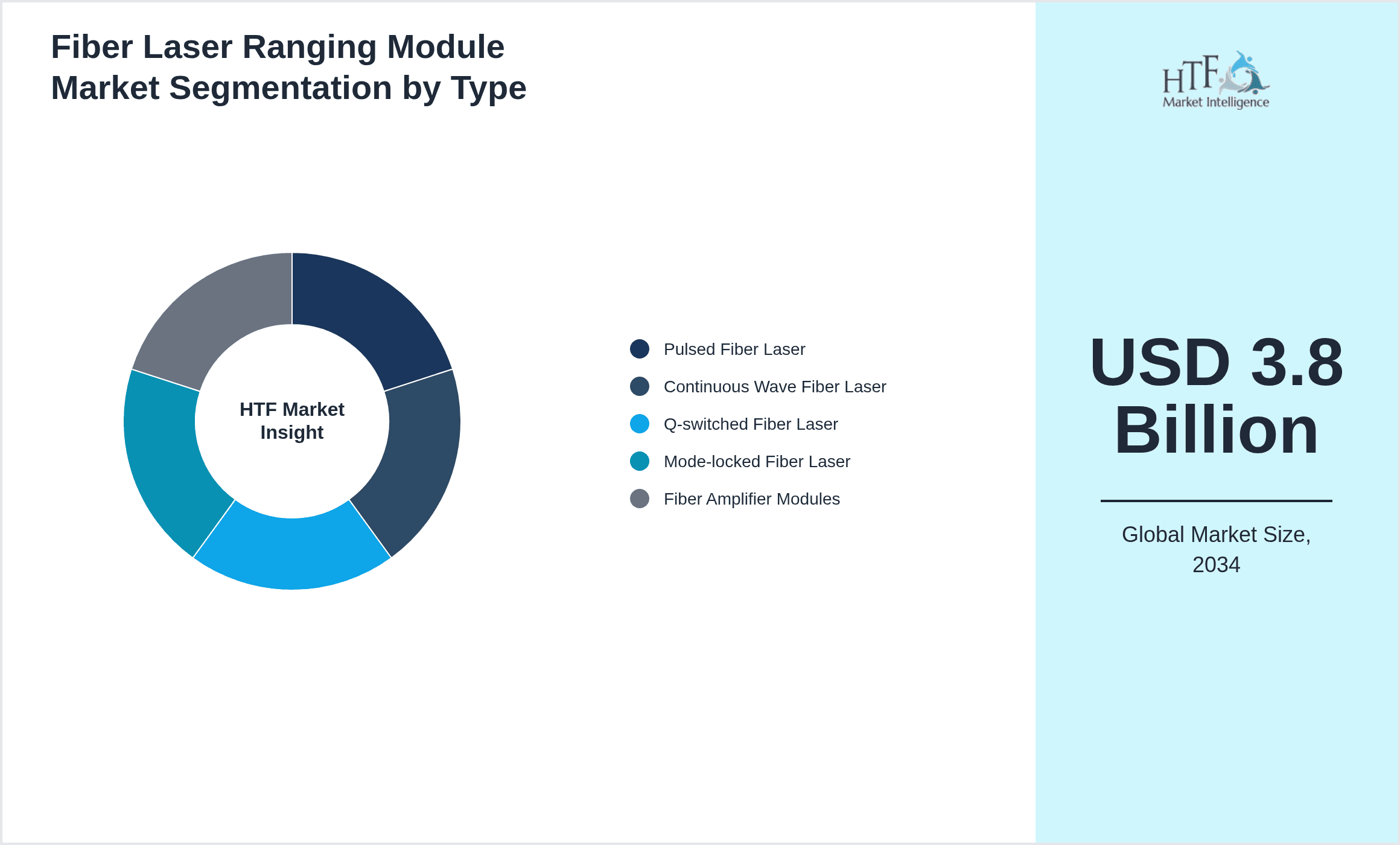
- •Key market highlights include a base market size of USD 1.2 Billion in 2024 projected to reach USD 3.8 Billion by 2034, reflecting a robust CAGR of 11.5%. Pulsed fiber lasers currently dominate the product segment due to their versatility and precision in ranging applications. North America holds the largest regional market share, driven by strong defense and industrial automation sectors, while Asia-Pacific is the fastest-growing region owing to rapid industrialization and investment in autonomous vehicle technologies. The market exhibits dynamic growth fueled by innovation in fiber laser architectures and expanding application horizons, supported by strategic collaborations among leading technology providers.
- •The Fiber Laser Ranging Module market presents strategic importance to multiple industries by enabling enhanced safety, operational efficiency, and precise measurement capabilities. For stakeholders ranging from system integrators to end users in defense, industrial automation, and aerospace, these modules provide a critical technology foundation. The market's value proposition lies in delivering reliable, compact, and high-precision laser ranging solutions that support the shift toward automated and intelligent systems globally. Moreover, continuous technological evolution and expanding application sectors offer significant growth opportunities, positioning the market as a key enabler of next-generation sensing and navigation technologies.

Competitive Landscape
The competitive environment within the global Fiber Laser Ranging Module market is characterized by intense rivalry among established laser technology manufacturers and emerging entrants focused on innovation and niche applications. Key players adopt strategies such as continuous product development, strategic partnerships, and geographic expansion to strengthen market presence. Innovation plays a pivotal role, with companies investing heavily in R&D to enhance laser performance parameters like range accuracy, pulse repetition rates, and module compactness. Market positioning is often defined by the ability to offer integrated solutions tailored to specific industries such as defense and autonomous vehicles. Pricing strategies balance premium technology offerings with competitive affordability. Additionally, mergers and acquisitions serve as significant tactics to consolidate technological capabilities and expand customer bases. Distribution channels vary from direct sales to specialized system integrators, amplifying market reach. Regional competition also influences strategy, with players tailoring solutions to meet region-specific regulatory and application requirements. Future competitive trends point toward increased customization, integration with AI, and expansion in emerging markets.
Leading Companies in Fiber Laser Ranging Module Market
- •IPG Photonics Corporation (United States)
- •Coherent, Inc. (United States)
- •TRUMPF GmbH + Co. KG (Germany)
- •NKT Photonics (Denmark)
- •Lumentum Holdings Inc. (United States)
- •Hamamatsu Photonics K.K. (Japan)
- •Jenoptik AG (Germany)
- •Raytheon Technologies Corporation (United States)
- •Thorlabs, Inc. (United States)
- •Finisar Corporation (United States)
- •II-VI Incorporated (United States)
- •Lumentum Japan, Inc. (Japan)
- •Hamamatsu Laser Systems (Japan)
- •MKS Instruments, Inc. (United States)
- •Laserline GmbH (Germany)
- •Gooch & Housego PLC (United Kingdom)
- •Coherent Japan KK (Japan)
- •Toptica Photonics AG (Germany)
- •Jenoptik Laser GmbH (Germany)
- •Finisar Japan, Inc. (Japan)
- •IPG Asia Pacific Pte Ltd (Singapore)
- •Lumentum China Co., Ltd. (China)
- •Raytheon UK Limited (United Kingdom)
- •Thorlabs GmbH (Germany)
- •MKS Instruments Europe GmbH (Germany)

Market Breakdown
- •By Product Type
- ◦Pulsed Fiber Laser
- ◦Continuous Wave Fiber Laser
- ◦Q-switched Fiber Laser
- ◦Mode-locked Fiber Laser
- ◦Fiber Amplifier Modules
- •By Application
- ◦Industrial Measurement
- ◦Defense & Security
- ◦Autonomous Vehicles
- ◦Surveying & Mapping
- ◦Aerospace
- •By End-Use Industry
- ◦Manufacturing
- ◦Defense
- ◦Automotive
- ◦Aerospace & Aviation
- •By Distribution Channel
- ◦Direct Sales
- ◦System Integrators
- ◦Distributors
Growth Dynamics
The global Fiber Laser Ranging Module market growth is primarily driven by escalating demand in industrial automation and manufacturing sectors, where precision measurement is critical for quality control and process optimization. The rise of autonomous vehicles has further accelerated adoption, as fiber laser modules provide reliable environmental sensing essential for navigation and safety functions. Additionally, increasing military investments worldwide have bolstered demand for advanced ranging modules in defense and security applications. Technological advancements such as enhanced pulse repetition rates and miniaturization have improved module performance, making them more attractive for aerospace and surveying applications. Moreover, growing emphasis on safety, accuracy, and efficiency across industries continues to fuel market expansion. The integration of fiber laser modules into smart systems and IoT-enabled devices presents new growth avenues. Together, these factors create a strong growth trajectory with widespread applicability and increasing penetration across diverse end-use sectors.
Market Trends
Emerging trends in the Fiber Laser Ranging Module market include the shift towards mode-locked fiber lasers that offer ultra-short pulse widths enabling higher resolution ranging. Industry players are adopting integrated photonics to reduce module size and enhance reliability, facilitating deployment in compact autonomous systems. The rise of AI-driven data analytics coupled with fiber laser modules is enhancing real-time decision-making in manufacturing and defense. Sustainability initiatives have driven development of energy-efficient laser modules, aligning with global environmental goals. Additionally, collaborations between laser manufacturers and automotive companies have accelerated innovation in lidar and sensing technologies. The modular design approach is gaining popularity, allowing customizable solutions tailored to specific applications. These trends collectively usher in a new era of high-performance, versatile fiber laser ranging modules that meet evolving market needs.

Market Opportunities
Significant opportunities exist in expanding application areas such as autonomous vehicle navigation and aerospace systems, where demand for compact, high-precision fiber laser ranging modules is rapidly growing. Emerging markets in Asia-Pacific present vast potential due to accelerating industrialization and infrastructure development. Investment in R&D for mode-locked and Q-switched lasers offers avenues for product differentiation and performance enhancement. Strategic partnerships between laser module manufacturers and technology integrators can unlock new customer segments. Furthermore, the transition to Industry 4.0 and smart manufacturing environments creates demand for integrated sensing solutions, enabling fiber laser modules to capture critical position and distance data. Opportunities also lie in aftermarket services and maintenance contracts, contributing to recurring revenue streams. Overall, tapping into these growth areas can significantly enhance market penetration and profitability.
Market Challenges
The Fiber Laser Ranging Module market faces challenges such as high initial costs associated with advanced fiber laser technologies, which can limit adoption among cost-sensitive end users. Technical complexities in integrating laser modules into existing systems, particularly in autonomous vehicles and aerospace platforms, pose barriers that require significant engineering expertise. Supply chain disruptions impacting critical components like specialty optical fibers and diodes have occasionally hindered manufacturing continuity. Regulatory compliance and certification processes in defense and automotive sectors add to time-to-market delays. Moreover, competition from alternative ranging technologies such as solid-state and semiconductor lasers exerts pressure on market growth. Addressing these challenges requires continuous innovation, cost optimization, and strategic collaborations to ensure scalability and reliability across diverse applications.
Regulatory Framework
Between 2020 and 2024, regulatory developments impacting the global Fiber Laser Ranging Module market have focused on laser safety standards, electromagnetic compatibility, and export control regulations, especially relevant for defense-related applications. The International Electrotechnical Commission (IEC) updated laser safety classifications to tighten controls on accessible emission limits, mandating compliance for manufacturers selling modules globally. Additionally, the U.S. Department of Commerce implemented stricter export licensing requirements for advanced laser technologies to safeguard national security interests. In Europe, the CE marking requirements have been refined to include enhanced testing protocols for optical devices. These regulatory frameworks have increased the complexity of product certification but also ensure safer, higher-quality products in the market. Companies have adapted by investing in compliance management and incorporating regulatory expertise early in product development cycles, facilitating smoother market access and reducing risk of non-compliance.
Market Intelligence
- •15th January 2024, IPG Photonics Corporation launched a new pulsed fiber laser ranging module featuring enhanced pulse repetition rates and increased measurement accuracy tailored for autonomous vehicle applications. This product integrates advanced heat dissipation technology enabling longer operational lifetimes and reduced maintenance. The module supports a wide range of industrial and defense use cases, positioning IPG Photonics as a key innovator in high-performance laser measurement solutions. Strategic objectives include expanding market share in the rapidly growing autonomous systems segment and strengthening partnerships with system integrators across North America and Asia-Pacific. The launch has been well received by early adopters seeking reliable, compact ranging modules for complex sensing environments. Source: IPG Photonics Official Press Release
- •30th November 2023, Coherent, Inc. introduced an integrated continuous wave fiber laser module designed for aerospace and surveying applications. This innovation offers ultra-stable output power and enhanced beam quality, improving the precision of distance measurements in challenging environmental conditions. The module’s compact design facilitates easy integration into unmanned aerial vehicles and satellite systems. Market positioning emphasizes reliability and adaptability, targeting customers requiring robust ranging solutions for mapping and reconnaissance missions. This launch reinforces Coherent’s commitment to advancing fiber laser technology and expanding its footprint in high-value sectors. Source: Coherent, Inc. Product Announcement
- •20th August 2024, Raytheon Technologies Corporation announced a strategic partnership with a leading autonomous vehicle manufacturer to co-develop mode-locked fiber laser ranging modules optimized for real-time navigation and obstacle detection. This collaboration aims to accelerate the deployment of advanced lidar systems by leveraging Raytheon’s laser expertise and the partner’s vehicle integration capabilities. The initiative focuses on enhancing range accuracy and response times while maintaining cost efficiencies. The partnership is expected to drive innovation in safety-critical applications and strengthen Raytheon’s position in the growing autonomous vehicles market segment. Source: Raytheon Technologies Corporate News
- •5th March 2024, TRUMPF GmbH + Co. KG completed the acquisition of a specialized fiber amplifier module manufacturer to broaden its product portfolio in high-power fiber laser components. This strategic move enhances TRUMPF’s capabilities in delivering comprehensive fiber laser ranging solutions with improved power scalability and reliability. The acquisition supports TRUMPF’s growth strategy focused on expanding into emerging applications such as defense and aerospace while accelerating R&D efforts. Market analysts view this consolidation as a positive step toward strengthening TRUMPF’s competitive positioning in the global fiber laser market. Source: TRUMPF Official Statement
Regional Outlook
The North America currently holds a significant share of the market, primarily due to several key factors: increasing consumption rates, a burgeoning population, and robust economic momentum. These elements collectively drive demand, positioning this region as a leader in the market. On the other hand, Asia-Pacific is rapidly emerging as the fastest-growing area within the industry. This remarkable growth can be attributed to swift infrastructure development, the expansion of various industrial sectors, and a marked increase in consumer demand. These dynamics make this region a crucial player in shaping future market growth.
In our report, we cover a comprehensive analysis of the following regions and countries:
- North America
- LATAM
- West Europe
- Central & Eastern Europe
- Northern Europe
- Southern Europe
- East Asia
- Southeast Asia
- South Asia
- Central Asia
- Oceania
- MEA
| Feature | Details |
|---|---|
| Base Year Market Size | USD 1.2 Billion |
| Forecast Year Market Size | USD 3.8 Billion |
| CAGR | 11.5% |
| Forecast Period | 2026 to 2033 |
| YoY Growth | 11% |
| Scope of Report | Market is segmented by Product Type (Pulsed Fiber Laser, Continuous Wave Fiber Laser, Q-switched Fiber Laser, Mode-locked Fiber Laser, Fiber Amplifier Modules), Application (Industrial Measurement, Defense & Security, Autonomous Vehicles, Surveying & Mapping, Aerospace), End-Use Industry (Manufacturing, Defense, Automotive, Aerospace & Aviation), Distribution Channel (Direct Sales, System Integrators, Distributors) |
| Regions Covered | North America, LATAM, West Europe, Central & Eastern Europe, Northern Europe, Southern Europe, East Asia, Southeast Asia, South Asia, Central Asia, Oceania, MEA |
| Key Companies | IPG Photonics Corporation (United States), Coherent, Inc. (United States), TRUMPF GmbH + Co. KG (Germany), NKT Photonics (Denmark), Lumentum Holdings Inc. (United States), Hamamatsu Photonics K.K. (Japan), Jenoptik AG (Germany), Raytheon Technologies Corporation (United States), Thorlabs, Inc. (United States), Finisar Corporation (United States), II-VI Incorporated (United States), Lumentum Japan, Inc. (Japan), Hamamatsu Laser Systems (Japan), MKS Instruments, Inc. (United States), Laserline GmbH (Germany), Gooch & Housego PLC (United Kingdom), Coherent Japan KK (Japan), Toptica Photonics AG (Germany), Jenoptik Laser GmbH (Germany), Finisar Japan, Inc. (Japan), IPG Asia Pacific Pte Ltd (Singapore), Lumentum China Co., Ltd. (China), Raytheon UK Limited (United Kingdom), Thorlabs GmbH (Germany), MKS Instruments Europe GmbH (Germany) |
Global Fiber Laser Ranging Module Market Size, Growth & Revenue 2024-2034 - Table of Contents
Frequently Asked Questions (FAQ):
The Compact Track Loaders market is expected to see value worth 5.3 Billion in 2025.
North America currently leads the market with approximately 45% market share, followed by Europe at 28% and Asia-Pacific at 22%. The remaining regions account for 5% of the global market.
Key growth drivers include increasing construction activities, rising demand for versatile equipment in agriculture, technological advancements in track loader design, and growing preference for compact equipment in urban construction projects.