
Global Fuel Management Systems Market Size, Growth & Revenue 2024-2034
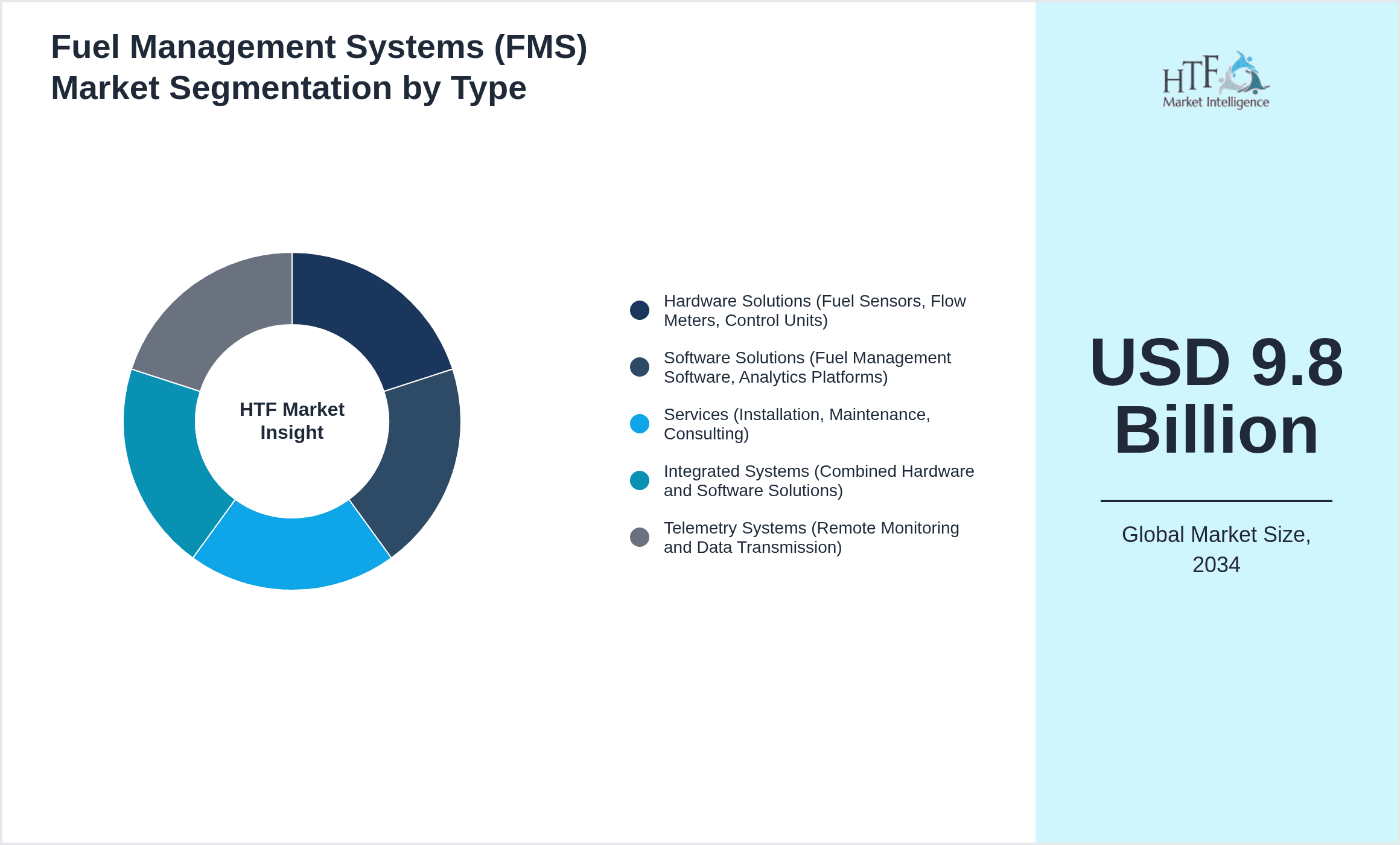
Global Fuel Management Systems Market is segmented by Product Type (Hardware Solutions (Fuel Sensors, Flow Meters, Control Units), Software Solutions (Fuel Management Software, Analytics Platforms), Services (Installation, Maintenance, Consulting), Integrated Systems (Combined Hardware and Software Solutions), Telemetry Systems (Remote Monitoring and Data Transmission)), Application (Fleet Management, Industrial Equipment, Construction Machinery, Agricultural Machinery, Mining Equipment), End-Use Industry (Transportation & Logistics, Construction, Agriculture, Mining), Distribution Channel (Direct Sales, Dealer Network, Online Sales), and Geography (North America, LATAM, West Europe, Central & Eastern Europe, Northern Europe, Southern Europe, East Asia, Southeast Asia, South Asia, Central Asia, Oceania, MEA)
Pricing
Report Overview
Executive Summary
- •The global Fuel Management Systems (FMS) market is a dynamic sector focused on delivering technological solutions for effective fuel utilization across multiple industries such as transportation, construction, agriculture, and mining. Fuel Management Systems integrate hardware devices like fuel sensors, flow meters, and telemetry units with software platforms that provide real-time monitoring, analytics, and reporting capabilities. These systems help companies reduce fuel theft, improve fuel efficiency, and comply with environmental regulations by offering precise control and transparency over fuel consumption. The market scope extends to standalone hardware, comprehensive software solutions, integrated systems combining hardware and software, and related services including installation, maintenance, and consulting. Increasing adoption of IoT-based technologies, cloud computing, and data analytics has further propelled the development of sophisticated FMS solutions. The primary applications include fleet management, industrial equipment monitoring, and agricultural machinery fuel tracking. Growing environmental concerns and rising fuel costs continue to drive demand for efficient fuel management globally, making the FMS market a crucial component in operational efficiency strategies worldwide.
- •Key highlights of the global Fuel Management Systems market include a base market size of USD 3.5 Billion in 2024 and a projected growth to USD 9.8 Billion by 2034, registering a CAGR of 10.7%. The market is predominantly led by hardware solutions, with software solutions emerging as the fastest-growing segment due to increasing demand for data-driven fuel optimization. North America currently dominates the market, supported by advanced infrastructure and stringent fuel management regulations, while Asia-Pacific is identified as the region with the highest growth potential, driven by rapid industrialization and fleet expansion. The market growth is underpinned by rising fuel costs, the need to reduce carbon footprints, and increasing government initiatives promoting resource efficiency.
- •Fuel Management Systems offer significant value propositions for industries by enhancing fuel accountability, reducing operational costs, and improving sustainability metrics. These systems enable real-time fuel consumption tracking, automated reporting, and theft prevention, thereby assisting fleet operators, construction companies, and agricultural businesses in optimizing their fuel usage. The strategic importance extends to governments and regulatory bodies focused on environmental compliance and energy conservation. As fuel management becomes a critical operational priority, stakeholders across the supply chain are adopting advanced FMS technologies to gain competitive advantage, comply with environmental standards, and achieve cost savings, positioning the market for substantial future growth.

Competitive Landscape
The competitive landscape of the global Fuel Management Systems market is characterized by intense rivalry among well-established multinational corporations and emerging technology innovators. Market leaders leverage continuous innovation in hardware miniaturization, cloud-based software solutions, and AI-driven analytics to differentiate their offerings. Strategic partnerships and collaborations with OEMs, telematics providers, and telecommunication companies are common to expand market reach and integrate complementary technologies. Companies adopt aggressive pricing strategies and offer customized solutions to cater to diverse industry needs and regional regulatory requirements. Mergers and acquisitions are frequent as firms seek to consolidate technological capabilities and geographic presence. Additionally, the adoption of subscription-based software services and SaaS models is reshaping competitive dynamics, enabling flexible deployment and recurring revenue streams. Regional competition varies, with North America hosting major players focusing on innovation and Europe emphasizing regulatory compliance, while Asia-Pacific markets attract new entrants driven by expanding industrial demand. The future competition will likely center on enhancing interoperability, data security, and end-user experience to maintain competitive advantages.
Key Participants in Fuel Management Systems Market
- •Dover Fueling Solutions (United States)
- •Gilbarco Veeder-Root (United States)
- •Fleet Complete (Canada)
- •Zonar Systems (United States)
- •Baker Hughes (United States)
- •Honeywell International Inc. (United States)
- •FuelQuest (United States)
- •Verizon Connect (United States)
- •Samsara Networks (United States)
- •Trimble Inc. (United States)
- •Teletrac Navman (United States)
- •Emerson Electric Co. (United States)
- •Siemens AG (Germany)
- •Bosch Automotive Service Solutions (Germany)
- •Veeder-Root (United States)
- •Fleetmatics (Ireland)
- •Geotab Inc. (Canada)
- •Continental AG (Germany)
- •CalAmp Corp (United States)
- •Octo Telematics (Italy)
- •Innocomm (United States)
- •Omnitracs LLC (United States)
- •Pioneer Fuel Management (Australia)
- •FuelCloud (United States)
- •SmartDrive Systems (United States)

Market Breakdown
- •By Product Type
- ◦Hardware Solutions (Fuel Sensors, Flow Meters, Control Units)
- ◦Software Solutions (Fuel Management Software, Analytics Platforms)
- ◦Services (Installation, Maintenance, Consulting)
- ◦Integrated Systems (Combined Hardware and Software Solutions)
- ◦Telemetry Systems (Remote Monitoring and Data Transmission)
- •By Application
- ◦Fleet Management
- ◦Industrial Equipment
- ◦Construction Machinery
- ◦Agricultural Machinery
- ◦Mining Equipment
- •By End-Use Industry
- ◦Transportation & Logistics
- ◦Construction
- ◦Agriculture
- ◦Mining
- •By Distribution Channel
- ◦Direct Sales
- ◦Dealer Network
- ◦Online Sales
Growth Dynamics
- •Rising fuel costs across global markets have compelled industries to adopt Fuel Management Systems to optimize fuel consumption and reduce operating expenses. Companies are increasingly investing in real-time monitoring technologies that provide actionable insights to prevent fuel theft and wastage, thus enhancing cost efficiency and operational transparency.
- •Technological advancements in IoT and cloud computing have accelerated the integration of sophisticated telemetry and data analytics capabilities within FMS solutions. These innovations enable seamless remote monitoring, predictive maintenance, and automated reporting, driving broader adoption among fleet operators and industrial users.
- •Growing environmental regulations and sustainability initiatives worldwide are pushing organizations to adopt fuel management solutions that help monitor and reduce carbon emissions. Compliance with stringent emission norms is a key driver encouraging investment in advanced FMS technologies.
- •The expanding commercial vehicle and construction equipment sectors in emerging economies, particularly in Asia-Pacific, are fueling demand for efficient fuel management solutions. Increasing infrastructure development projects and fleet expansions contribute significantly to market growth in these regions.
- •Integration of AI and machine learning algorithms into FMS software is enhancing predictive analytics and fuel usage optimization, enabling stakeholders to make informed decisions and improve overall operational efficiency.
- •Government subsidies and incentives promoting resource efficiency and emission reduction in developed regions are encouraging adoption of advanced Fuel Management Systems across various industries.
- •Increasing awareness among end-users regarding the benefits of fuel management, including cost savings, regulatory compliance, and sustainability, is driving market penetration globally.
Market Trends
- •There is a significant shift towards adoption of cloud-based Fuel Management Systems, providing scalable, flexible, and cost-effective solutions that facilitate remote monitoring and centralized data management across distributed fleets and equipment.
- •Integration of telematics and GPS tracking within FMS platforms is becoming increasingly prevalent, enabling comprehensive asset monitoring and enhanced route optimization for fleet operators.
- •Emerging trend of combining fuel management with overall fleet management software suites is gaining traction, offering holistic operational insights and improving decision-making processes.
- •Sustainability-driven innovations such as fuel consumption benchmarking and emission tracking features are being incorporated into FMS solutions to align with global environmental goals.
- •Collaborations between hardware manufacturers and software developers are intensifying to deliver integrated, user-friendly solutions that simplify deployment and enhance system interoperability.
- •Subscription-based and as-a-service business models are becoming more common, lowering entry barriers for small and mid-sized enterprises to adopt fuel management technologies.
- •Advancements in sensor accuracy and wireless communication technologies are improving data reliability and real-time responsiveness of fuel monitoring systems.
Market Opportunities
- •Expansion into emerging markets with growing industrialization offers substantial growth potential for Fuel Management System providers, particularly in Asia-Pacific and Latin America where fleet and equipment modernization are priorities.
- •Development of AI-powered predictive maintenance solutions integrated with FMS can open new revenue streams by reducing downtime and enhancing asset life cycle management.
- •Increasing adoption of electric and hybrid vehicles presents opportunities for specialized fuel management and energy consumption monitoring systems tailored to new propulsion technologies.
- •Strategic partnerships with telematics and IoT companies enable providers to offer comprehensive, end-to-end fuel and fleet management solutions, enhancing customer value proposition.
- •Customization of Fuel Management Systems to comply with region-specific regulatory requirements can drive adoption among multinational corporations seeking standardized compliance solutions.
- •Integration of blockchain technology for fuel transaction transparency and fraud prevention is an emerging opportunity to enhance security and trust in fuel management processes.
- •Offering modular and scalable FMS solutions caters to diverse customer segments, from small fleets to large industrial operators, maximizing market reach and revenue potential.
Market Challenges
- •High initial investment costs associated with advanced Fuel Management Systems can deter small and medium enterprises from adoption, limiting market penetration in certain regions.
- •Integration complexities between legacy equipment and modern FMS technologies pose technical challenges, requiring customized solutions and additional implementation efforts.
- •Data security and privacy concerns related to fuel consumption monitoring and telemetry can hinder acceptance among cautious end-users.
- •Inconsistent regulatory frameworks and lack of standardization across regions complicate compliance and system interoperability for global FMS providers.
- •Limited awareness and technical expertise among end-users regarding sophisticated fuel management solutions restrict market growth in developing economies.
- •Competitive pricing pressures from low-cost regional players challenge profitability and innovation investments for established companies.
- •Supply chain disruptions affecting hardware components can delay product delivery and impact customer satisfaction.
Regulatory Framework
- •Between 2019 and 2024, several regions implemented stringent fuel efficiency and emission standards, such as the European Union's Stage V regulations and North America's EPA Tier 4 standards, compelling industries to adopt advanced Fuel Management Systems for compliance.
- •Data protection laws, including GDPR in Europe and CCPA in California, have introduced compliance requirements for fuel consumption data collection and processing, influencing FMS software design and deployment.
- •Environmental mandates incentivizing reduction of greenhouse gas emissions have accelerated governmental support programs and subsidies for fuel management technology adoption, particularly in Asia-Pacific and Europe.
- •Mandatory installation of fuel monitoring systems in commercial fleets has been legislated in specific countries to combat fuel theft and improve operational transparency.
- •International standards organizations, such as ISO, have released guidelines for telemetry and sensor interoperability, facilitating global standardization efforts in Fuel Management Systems.
Market Intelligence
- •15th January 2025, Dover Fueling Solutions launched an advanced telemetry-based Fuel Management System that features AI-driven analytics and real-time theft detection capabilities. This product targets fleet operators seeking to reduce fuel losses and optimize consumption while complying with stringent emission regulations. The new solution integrates seamlessly with existing fleet management platforms and offers cloud-based reporting tools enabling enhanced operational insights and decision-making. Dover’s strategic objective is to strengthen its market leadership by addressing evolving customer needs for efficiency and sustainability in fuel management. Source: Official Dover Fueling Solutions Press Release
- •23rd March 2025, Samsara Networks introduced a next-generation Fuel Management Software platform that leverages machine learning to predict fuel consumption patterns and automate maintenance scheduling. The platform supports integration with IoT-enabled sensors and GPS tracking to provide comprehensive fleet visibility and fuel cost control. Samsara’s innovation aims to reduce downtime and operational costs for logistics companies by enabling proactive management of fuel resources. The launch has been well-received in North American and European markets, reinforcing Samsara’s position as a technology leader. Source: Samsara Networks Corporate Announcement
- •10th February 2025, Honeywell International Inc. announced a strategic partnership with a leading telematics provider to co-develop integrated Fuel Management Systems combining hardware sensors and cloud analytics. The collaboration focuses on delivering end-to-end solutions tailored for construction and mining industries, enhancing fuel monitoring accuracy and operational efficiency. This initiative is expected to accelerate Honeywell’s expansion into emerging markets and respond to increasing demand for smart fuel management solutions amid tightening environmental regulations. The partnership aligns with Honeywell’s broader digital transformation strategy. Source: Honeywell Newsroom
- •5th April 2025, Fleet Complete expanded its global presence by acquiring a regional fuel monitoring software provider to strengthen its product portfolio in Asia-Pacific. This acquisition enables Fleet Complete to offer enhanced fuel management and telematics solutions tailored to the fast-growing commercial vehicle market in the region. The strategic move supports the company’s objective to deliver integrated fleet optimization services and capitalize on rising demand for fuel efficiency technologies. Market analysts view this acquisition as a significant step towards consolidating Fleet Complete’s competitive position globally. Source: Fleet Complete Press Release
Regional Outlook
The North America currently holds a significant share of the market, primarily due to several key factors: increasing consumption rates, a burgeoning population, and robust economic momentum. These elements collectively drive demand, positioning this region as a leader in the market. On the other hand, Asia-Pacific is rapidly emerging as the fastest-growing area within the industry. This remarkable growth can be attributed to swift infrastructure development, the expansion of various industrial sectors, and a marked increase in consumer demand. These dynamics make this region a crucial player in shaping future market growth.
In our report, we cover a comprehensive analysis of the following regions and countries:
- North America
- LATAM
- West Europe
- Central & Eastern Europe
- Northern Europe
- Southern Europe
- East Asia
- Southeast Asia
- South Asia
- Central Asia
- Oceania
- MEA
| Feature | Details |
|---|---|
| Base Year Market Size | USD 3.5 Billion |
| Forecast Year Market Size | USD 9.8 Billion |
| CAGR | 10.7% |
| Forecast Period | 2026 to 2033 |
| YoY Growth | 10.2% |
| Scope of Report | Market is segmented by Product Type (Hardware Solutions (Fuel Sensors, Flow Meters, Control Units), Software Solutions (Fuel Management Software, Analytics Platforms), Services (Installation, Maintenance, Consulting), Integrated Systems (Combined Hardware and Software Solutions), Telemetry Systems (Remote Monitoring and Data Transmission)), Application (Fleet Management, Industrial Equipment, Construction Machinery, Agricultural Machinery, Mining Equipment), End-Use Industry (Transportation & Logistics, Construction, Agriculture, Mining), Distribution Channel (Direct Sales, Dealer Network, Online Sales) |
| Regions Covered | North America, LATAM, West Europe, Central & Eastern Europe, Northern Europe, Southern Europe, East Asia, Southeast Asia, South Asia, Central Asia, Oceania, MEA |
| Key Companies | Expansion into emerging markets with growing industrialization offers substantial growth potential for Fuel Management System providers, particularly in Asia-Pacific and Latin America where fleet and equipment modernization are priorities., Development of AI-powered predictive maintenance solutions integrated with FMS can open new revenue streams by reducing downtime and enhancing asset life cycle management., Increasing adoption of electric and hybrid vehicles presents opportunities for specialized fuel management and energy consumption monitoring systems tailored to new propulsion technologies., Strategic partnerships with telematics and IoT companies enable providers to offer comprehensive, end-to-end fuel and fleet management solutions, enhancing customer value proposition., Customization of Fuel Management Systems to comply with region-specific regulatory requirements can drive adoption among multinational corporations seeking standardized compliance solutions., Integration of blockchain technology for fuel transaction transparency and fraud prevention is an emerging opportunity to enhance security and trust in fuel management processes., Offering modular and scalable FMS solutions caters to diverse customer segments, from small fleets to large industrial operators, maximizing market reach and revenue potential. |
Global Fuel Management Systems Market Size, Growth & Revenue 2024-2034 - Table of Contents
Frequently Asked Questions (FAQ):
The Compact Track Loaders market is projected to grow at a CAGR of 6.8% from 2025 to 2030, driven by increasing demand in construction and agricultural sectors.
North America currently leads the market with approximately 45% market share, followed by Europe at 28% and Asia-Pacific at 22%. The remaining regions account for 5% of the global market.
Key growth drivers include increasing construction activities, rising demand for versatile equipment in agriculture, technological advancements in track loader design, and growing preference for compact equipment in urban construction projects.