
Europe Bitumen Testing Equipment Market - Europe Size & Outlook 2025-2034
Europe Bitumen Testing Equipment Market is segmented by Type (Penetration Testers, Softening Point Apparatus, Ductility Testers, Viscosity Testers, Flash Point Testers), Application (Road Construction, Asphalt Production, Quality Control Laboratories, Research & Development, Infrastructure Projects), End-Use Industry (Construction, Transportation, Government Agencies, Private Infrastructure Firms), Distribution Channel (Direct Sales, Distributors, Online Platforms), and Geography (Germany, France, The United Kingdom, BeNeLux, Spain, Italy, NORDIC, CEE, Others)
Pricing
Report Overview
Executive Summary
- •The Europe Bitumen Testing Equipment market includes devices engineered to evaluate bitumen properties vital for construction and infrastructure quality assurance. The market's scope covers equipment such as penetration testers, softening point apparatus, ductility testers, viscosity testers, and flash point testers, which analyze physical and chemical attributes of bitumen for compliance with European standards. This equipment is indispensable in applications including road construction, asphalt production, quality control laboratories, research and development, and large-scale infrastructure projects. Its importance is underscored by the growing emphasis on durable, safe, and sustainable infrastructure across Europe. As governments and private sectors invest heavily in road and infrastructure modernization, demand for precise and reliable bitumen testing equipment escalates. Technological advancements in automated and digital testing solutions enhance operational efficiency and accuracy, further fueling market expansion. The market's trajectory reflects the critical role of bitumen quality assurance in prolonging infrastructure lifespan and enabling environmentally compliant construction practices within the European context.
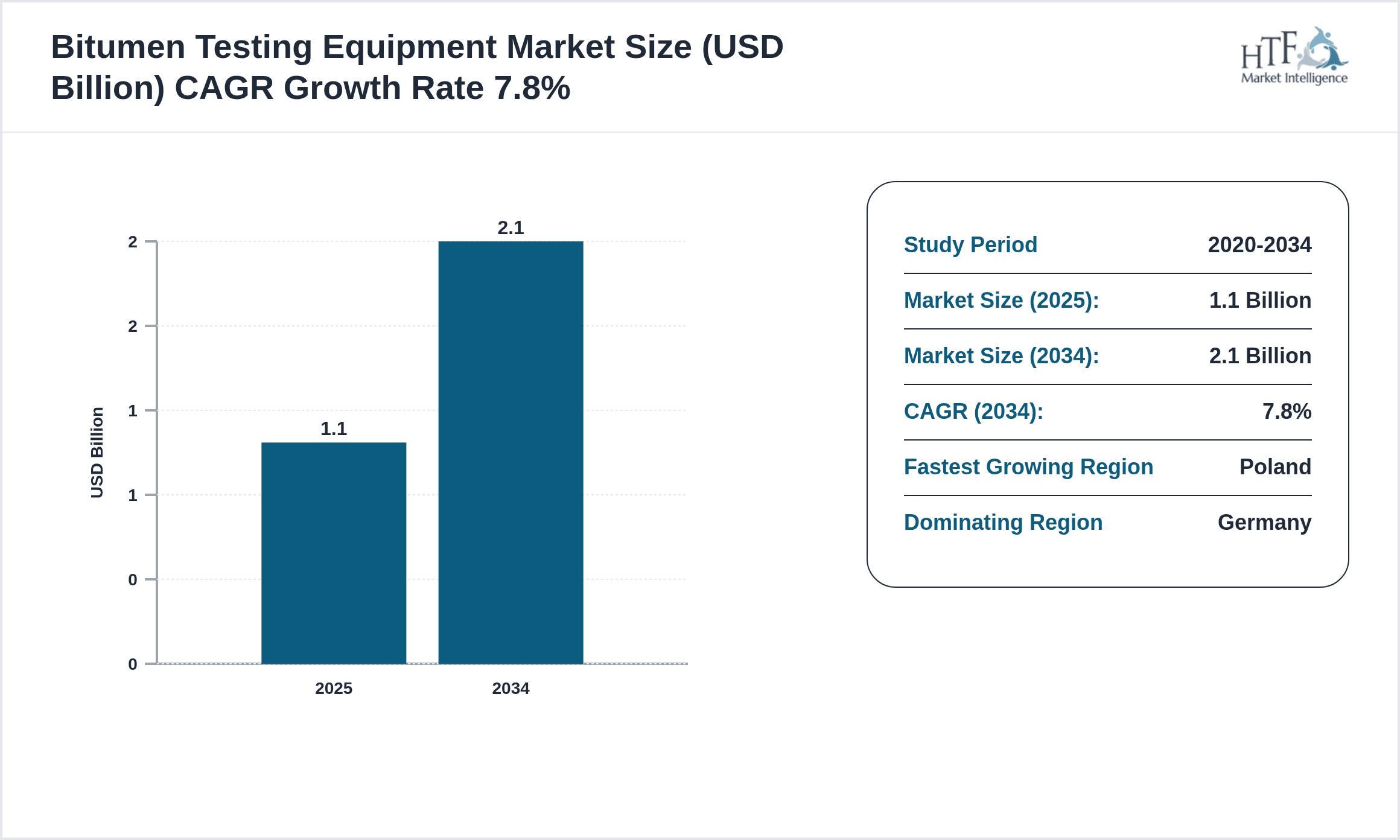
- •Key highlights include a base market valuation of USD 1.1 Billion in 2025 with projections to reach USD 2.10 Billion by 2034, exhibiting a CAGR of 7.8%. Germany dominates the regional market, representing the largest share, while Poland emerges as the fastest-growing country within Europe. Penetration testers hold the leading product segment status, supported by increasing demand for precise hardness and consistency measurements. Concurrently, ductility testers present the fastest growth owing to infrastructure projects emphasizing bitumen elasticity. The road construction application segment commands the highest market share, driven by extensive European Union infrastructure initiatives and regulatory frameworks enforcing stringent quality controls. Recent industry news highlights technological innovations and strategic collaborations among leading manufacturers, underpinning competitive dynamics and market growth.
- •The Europe Bitumen Testing Equipment market delivers significant value to civil engineering, construction, and materials testing stakeholders by enabling accurate and standardized assessment of bitumen properties. This facilitates enhanced road safety, infrastructure durability, and regulatory compliance, mitigating project risks and reducing maintenance costs. Strategic importance is amplified by the market's alignment with sustainability mandates and the increasing incorporation of recycled materials in asphalt production. Consequently, manufacturers and end-users benefit from advancements in testing technology, including automation and digital integration, which streamline quality control processes. The market’s evolution supports Europe’s infrastructure modernization goals, ensuring robust, resilient, and eco-friendly construction practices.
Competitive Landscape
Companies in the Europe Bitumen Testing Equipment market adopt multifaceted strategies to maintain and enhance their market presence. These include investing in research and development to introduce innovative and automated testing solutions that meet stringent European standards. Strategic partnerships with construction firms and quality control laboratories facilitate market penetration and service expansion. Global expansion efforts focus on strengthening distribution networks within emerging European countries such as Poland and the Czech Republic. Product innovation centers on integrating digital interfaces, data analytics, and remote monitoring capabilities, enhancing operational efficiency and accuracy. Companies also pursue mergers and acquisitions to consolidate market share and diversify product portfolios. Pricing strategies are optimized to balance competitiveness and profitability amid fluctuating raw material costs. Furthermore, compliance with evolving regulations and sustainability initiatives drives continuous technological advancement, ensuring long-term competitiveness. Regional competition remains robust, with manufacturers tailoring offerings to specific country requirements and infrastructure needs, positioning themselves advantageously for future growth.
Key Players in Bitumen Testing Equipment Market
- •Thermo Fisher Scientific (United States)
- •Malvern Panalytical (United Kingdom)
- •Matest S.p.A. (Italy)
- •Controls Group (Italy)
- •ELE International (United Kingdom)
- •ZwickRoell GmbH & Co. KG (Germany)
- •Avery Weigh-Tronix (United Kingdom)
- •GCTS Testing Systems (Germany)
- •Pavement Technologies Limited (United Kingdom)
- •Tinius Olsen Testing Machine Company (United States)
- •Cannon Instrument Company (Italy)
- •James Heal (United Kingdom)
- •FrymaKoruma (Germany)
- •Ammann Group (Switzerland)
- •Geosense (United Kingdom)
- •Schenck Process (Germany)
- •Testing Machines Inc. (United States)
- •Controls Group (Italy)
- •Teledyne Instruments (United States)
- •AGT Group (Italy)

Market Breakdown
- •By Type
- ◦Penetration Testers
- ◦Softening Point Apparatus
- ◦Ductility Testers
- ◦Viscosity Testers
- ◦Flash Point Testers
- •By Application
- ◦Road Construction
- ◦Asphalt Production
- ◦Quality Control Laboratories
- ◦Research & Development
- ◦Infrastructure Projects
- •By End-Use Industry
- ◦Construction
- ◦Transportation
- ◦Government Agencies
- ◦Private Infrastructure Firms
- •By Distribution Channel
- ◦Direct Sales
- ◦Distributors
- ◦Online Platforms
Growth Dynamics
The Europe Bitumen Testing Equipment market is driven by increasing infrastructure investments across the region, particularly in road construction and maintenance projects funded by the European Union. For instance, the EU’s Trans-European Transport Network (TEN-T) program allocates substantial budgets towards upgrading highways and transport corridors, necessitating precise bitumen quality assessments. Technological advancements in automated testing devices improve accuracy and reduce operator dependency, boosting market adoption. Demand for sustainable construction materials, including recycled asphalt, elevates the need for advanced testing equipment to ensure compliance with environmental and performance standards. Recent product launches featuring digital integration and remote monitoring capabilities further enhance operational efficiency. Additionally, stringent regulatory frameworks mandating bitumen quality testing in countries like Germany and France enforce market growth. The rising focus on infrastructure resilience amid climate change impacts also escalates demand for reliable testing solutions that assure material durability under varying environmental conditions.

Market Trends
Future trends in the Europe Bitumen Testing Equipment market include increased adoption of IoT-enabled and automated testing instruments, enabling real-time data acquisition and remote quality monitoring. Integration of AI and machine learning algorithms facilitates predictive maintenance and analytics, optimizing bitumen performance assessment. Growing emphasis on sustainability propels demand for testing solutions capable of evaluating recycled and modified bitumen types, supporting circular economy initiatives. Expansion of infrastructure projects in Eastern European countries such as Poland and the Czech Republic presents new growth avenues. Collaborative efforts between testing equipment manufacturers and construction technology firms promote innovation in multi-parameter testing devices combining multiple test standards. Moreover, demand for portable and user-friendly testing equipment rises, addressing on-site testing needs for rapid decision-making. Industry events and exhibitions in Europe spotlight emerging technologies, accelerating market transformation toward digital and eco-friendly solutions.

Market Opportunities
Opportunities in the Europe Bitumen Testing Equipment market stem from increasing public-private partnerships focused on smart city infrastructure and sustainable urban mobility projects requiring stringent material testing. The rise in government-funded road rehabilitation and expansion initiatives opens demand for advanced testing apparatus ensuring long-term pavement performance. Vendors can capitalize on growing requirements for equipment servicing, calibration, and training services, adding value beyond product sales. Expansion into emerging Eastern European markets with rising infrastructure budgets offers significant growth potential. Development of multi-functional testing platforms integrating several bitumen property tests into single devices presents innovation opportunities. Additionally, incorporating eco-friendly manufacturing processes and energy-efficient equipment aligns with Europe's sustainability agenda. Strategic alliances with construction material suppliers and certification bodies enhance market reach and credibility, facilitating entry into niche application segments such as high-performance asphalt and polymer-modified bitumen testing.
Market Challenges
Challenges confronting the Europe Bitumen Testing Equipment market include high capital investment requirements for advanced and automated testing systems, limiting adoption among smaller laboratories and contractors. Variations in regulatory standards and testing protocols across European countries complicate product development and market penetration. Supply chain disruptions, exacerbated by geopolitical uncertainties, affect timely delivery of precision instruments and components. Skilled labor shortages hinder optimal utilization of sophisticated equipment, necessitating comprehensive training programs. Intense competition from low-cost manufacturers offering basic testing devices pressures pricing and profitability. Additionally, prolonged project timelines and budget constraints in public infrastructure projects delay equipment procurement cycles. Environmental regulations imposing restrictions on chemical usage and waste disposal during testing processes increase operational complexities. Addressing interoperability issues among legacy and modern digital systems remains a technical challenge for vendors seeking seamless integration within existing quality control frameworks.
Regulatory Framework
Since 2020, Europe has enforced updated standards such as EN 1426, EN 1427, and EN 13398 which govern bitumen testing procedures to ensure uniformity and reliability across member states. The European Committee for Standardization (CEN) mandates compliance with these standards, compelling manufacturers to align equipment capabilities accordingly. National regulations in Germany and France further require periodic accreditation and calibration of bitumen testing instruments to uphold quality control in construction projects. Environmental directives emphasize minimizing hazardous waste generated during testing, influencing equipment design towards eco-friendly operations. Additionally, the EU’s Construction Products Regulation (CPR) enforces strict performance declarations for bitumen used in infrastructure, increasing demand for precise and certified testing equipment. Compliance with these evolving regulatory frameworks enhances market credibility and drives adoption of technologically advanced testing solutions across Europe.
Market Intelligence
- •Recent market developments and strategic initiatives are continuously tracked through industry publications, company announcements, and regulatory filings. For the most current information, stakeholders are advised to monitor official corporate communications and recognized market intelligence platforms.
- •Recent market developments and strategic initiatives are continuously tracked through industry publications, company announcements, and regulatory filings. For the most current information, stakeholders are advised to monitor official corporate communications and recognized market intelligence platforms.
- •Recent market developments and strategic initiatives are continuously tracked through industry publications, company announcements, and regulatory filings. For the most current information, stakeholders are advised to monitor official corporate communications and recognized market intelligence platforms.
- •Recent market developments and strategic initiatives are continuously tracked through industry publications, company announcements, and regulatory filings. For the most current information, stakeholders are advised to monitor official corporate communications and recognized market intelligence platforms.
Regional Outlook
The Germany currently holds a significant share of the market, primarily due to several key factors: increasing consumption rates, a burgeoning population, and robust economic momentum. These elements collectively drive demand, positioning this region as a leader in the market. On the other hand, Poland is rapidly emerging as the fastest-growing area within the industry. This remarkable growth can be attributed to swift infrastructure development, the expansion of various industrial sectors, and a marked increase in consumer demand. These dynamics make this region a crucial player in shaping future market growth.
In our report, we cover a comprehensive analysis of the following regions and countries:
- Germany
- France
- The United Kingdom
- BeNeLux
- Spain
- Italy
- NORDIC
- CEE
- Others
| Feature | Details |
|---|---|
| Base Year Market Size | USD 1.1 Billion |
| Forecast Year Market Size | USD 2.1 Billion |
| CAGR | 7.8% |
| Forecast Period | 2026 to 2033 |
| YoY Growth | 7.2% |
| Scope of Report | Market is segmented by Type (Penetration Testers, Softening Point Apparatus, Ductility Testers, Viscosity Testers, Flash Point Testers), Application (Road Construction, Asphalt Production, Quality Control Laboratories, Research & Development, Infrastructure Projects), End-Use Industry (Construction, Transportation, Government Agencies, Private Infrastructure Firms), Distribution Channel (Direct Sales, Distributors, Online Platforms) |
| Regions Covered | Germany, France, The United Kingdom, BeNeLux, Spain, Italy, NORDIC, CEE, Others |
| Key Companies | Thermo Fisher Scientific (United States), Malvern Panalytical (United Kingdom), Matest S.p.A. (Italy), Controls Group (Italy), ELE International (United Kingdom), ZwickRoell GmbH & Co. KG (Germany), Avery Weigh-Tronix (United Kingdom), GCTS Testing Systems (Germany), Pavement Technologies Limited (United Kingdom), Tinius Olsen Testing Machine Company (United States), Cannon Instrument Company (Italy), James Heal (United Kingdom), FrymaKoruma (Germany), Ammann Group (Switzerland), Geosense (United Kingdom), Schenck Process (Germany), Testing Machines Inc. (United States), Controls Group (Italy), Teledyne Instruments (United States), AGT Group (Italy) |
Europe Bitumen Testing Equipment Market - Europe Size & Outlook 2025-2034 - Table of Contents
Frequently Asked Questions (FAQ):
The Compact Track Loaders market is expected to see value worth 5.3 Billion in 2025.
North America currently leads the market with approximately 45% market share, followed by Europe at 28% and Asia-Pacific at 22%. The remaining regions account for 5% of the global market.
Key growth drivers include increasing construction activities, rising demand for versatile equipment in agriculture, technological advancements in track loader design, and growing preference for compact equipment in urban construction projects.