
Molecular Spectroscopy Instruments Market - Europe Size & Outlook 2025-2034
Europe Molecular Spectroscopy Instruments Market is segmented by Product Type (Ultraviolet-Visible (UV-Vis) Spectroscopy Instruments, Infrared (IR) Spectroscopy Instruments, Raman Spectroscopy Instruments, Nuclear Magnetic Resonance (NMR) Spectroscopy Instruments, Mass Spectrometry Instruments), Application (Pharmaceutical Analysis, Environmental Monitoring, Food & Beverage Testing, Chemical Analysis, Academic Research), End-Use Industry (Pharmaceutical & Biotechnology, Environmental Agencies, Food & Beverage Industry, Chemical Manufacturing), Distribution Channel (Direct Sales, Distributors & Dealers, Online Sales Platforms), and Geography (Germany, France, The United Kingdom, BeNeLux, Spain, Italy, NORDIC, CEE, Others)
Pricing
Report Overview
Executive Summary
- •The Europe Molecular Spectroscopy Instruments market comprises sophisticated analytical devices designed to elucidate molecular structures and compositions through their interaction with electromagnetic radiation. This market includes key instrument types such as UV-Visible, Infrared, Raman, Nuclear Magnetic Resonance (NMR), and Mass Spectrometry, serving a broad range of applications including pharmaceutical analysis, environmental monitoring, food and beverage testing, chemical analysis, and academic research. The instruments enable both qualitative and quantitative assessments vital for product development, quality assurance, and regulatory compliance across multiple sectors. The market's boundaries are defined by the technological advancements enhancing sensitivity, accuracy, and portability of instruments, alongside increasing adoption of hyphenated techniques that combine multiple spectroscopy methods. European regulatory frameworks emphasizing stringent quality standards and environmental safety further fuel demand. Additionally, the rising R&D investments and growing awareness about food safety and environmental pollutants propel market growth. This market is poised for sustained expansion driven by innovation, diverse applications, and evolving end-user requirements across Europe.
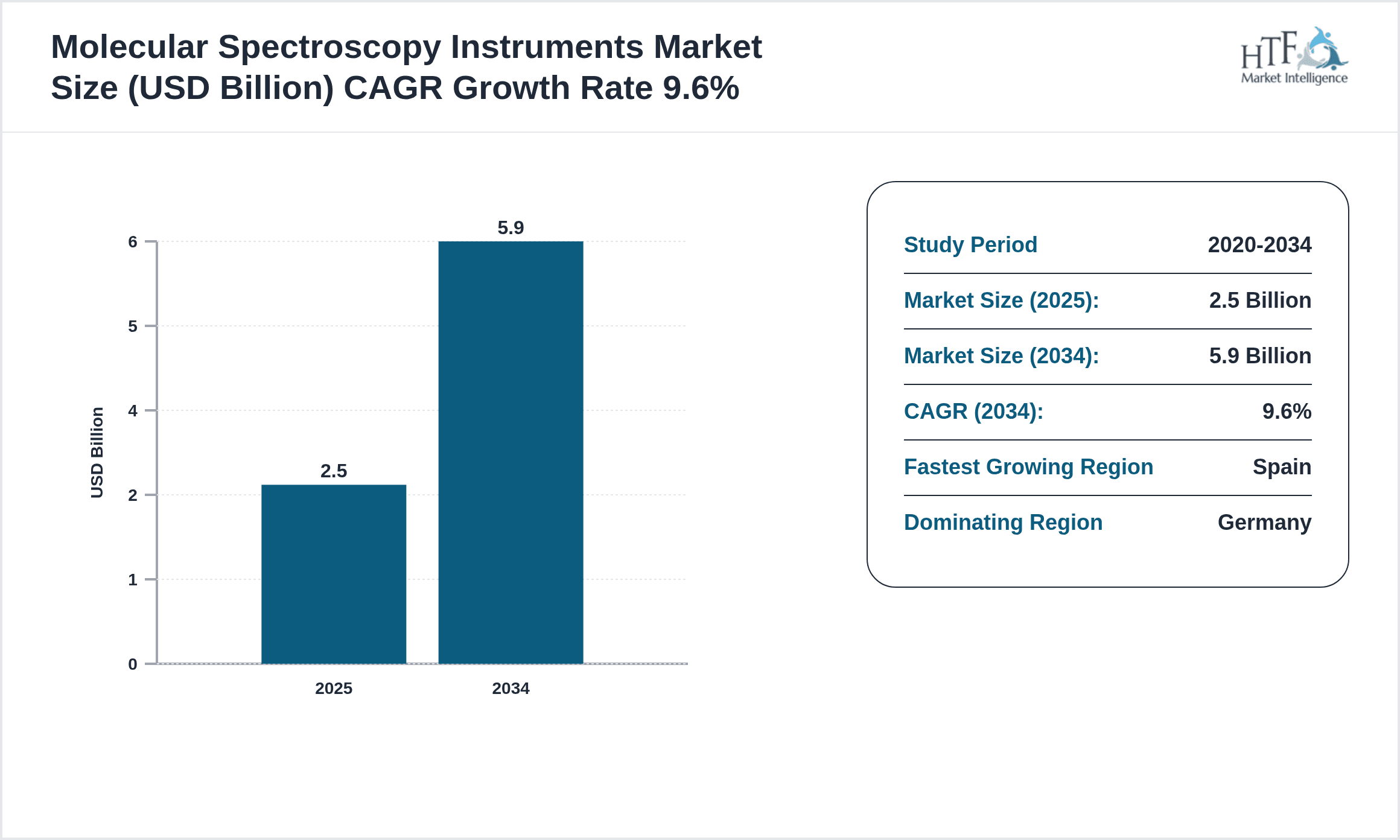
- •Key highlights reveal a Europe Molecular Spectroscopy Instruments market valued at USD 2.5 Billion in 2025, forecasted to reach USD 5.9 Billion by 2034 at a CAGR of 9.6%. Infrared Spectroscopy dominates the product segment, while Pharmaceutical Analysis leads application-wise. Germany holds the largest market share, with Spain identified as the fastest growing country. Advancements in Raman Spectroscopy and increasing demand for portable spectrometers are significant growth catalysts. Regulatory mandates on environmental and food testing enhance market penetration. The competitive landscape features innovative product launches and strategic collaborations, indicating a dynamic industry environment.
- •This market offers substantial value to pharmaceutical companies, environmental agencies, food manufacturers, chemical industries, and academic institutions by providing precise molecular insights crucial for compliance and innovation. For stakeholders, it represents an opportunity to leverage technological advancements to enhance analytical capabilities and operational efficiencies. Strategic investments in R&D and partnerships can unlock new applications and regional expansions, reinforcing Europe's position as a hub for molecular spectroscopy technology development.
Competitive Landscape
The Europe Molecular Spectroscopy Instruments market is characterized by intense competition among global and regional manufacturers striving to enhance product portfolios through continuous innovation and technological advancements. Market players differentiate themselves by focusing on developing high-precision, user-friendly, and portable instruments with enhanced sensitivity and faster analysis times. Strategic collaborations, mergers, and acquisitions are common to expand geographic reach and integrate complementary technologies. Pricing strategies balance premium product offerings with mid-range accessible solutions to capture diverse customer segments. Distribution channels are optimized for both direct sales to large enterprises and partnerships with specialized distributors targeting SMEs and academic institutions. The competitive environment is also influenced by regulatory compliance demands, driving companies to invest heavily in certification and quality assurance. Future trends indicate increasing emphasis on digital integration, software enhancements, and customized solutions to maintain competitive advantage.
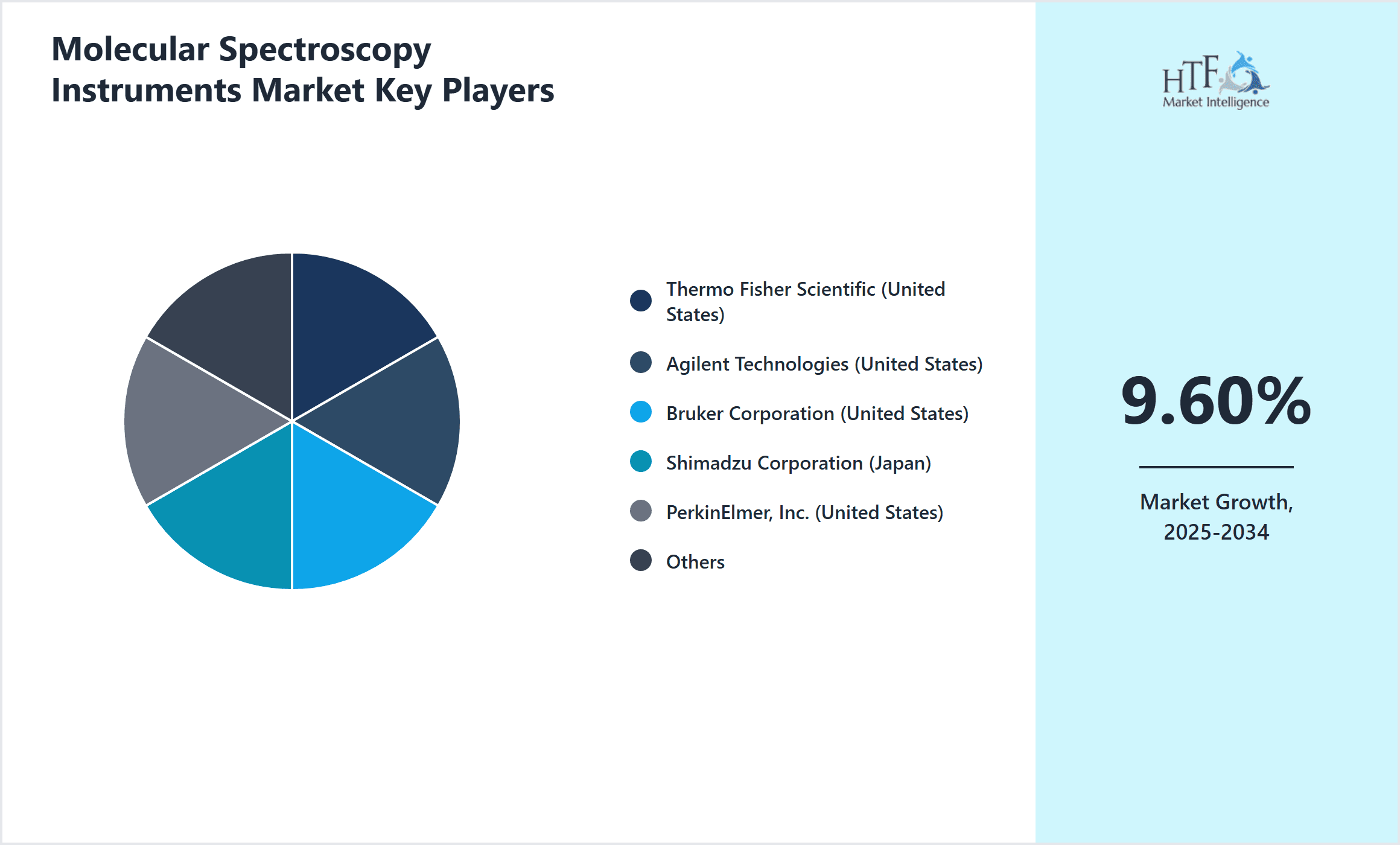
Prominent Players in Molecular Spectroscopy Instruments Market
- •Thermo Fisher Scientific (United States)
- •Agilent Technologies (United States)
- •Bruker Corporation (United States)
- •Shimadzu Corporation (Japan)
- •PerkinElmer, Inc. (United States)
- •HORIBA, Ltd. (Japan)
- •JEOL Ltd. (Japan)
- •JASCO Corporation (Japan)
- •Analytik Jena AG (Germany)
- •Metrohm AG (Switzerland)
- •Waters Corporation (United States)
- •Hitachi High-Technologies Corporation (Japan)
- •Brimrose Corporation of America (United States)
- •Bio-Rad Laboratories, Inc. (United States)
- •Malvern Panalytical Ltd. (United Kingdom)
- •Sartorius AG (Germany)
- •Analytica Biosystems (United States)
- •Buchi Labortechnik AG (Switzerland)
- •Anton Paar GmbH (Austria)
- •LGC Limited (United Kingdom)
- •Thermo Haake (Germany)
- •Analytik Ltd. (United Kingdom)
- •Knauer Wissenschaftliche Geräte GmbH (Germany)
- •Malvern Instruments Ltd. (United Kingdom)
- •Analytica Instruments SA (Switzerland)
Market Breakdown
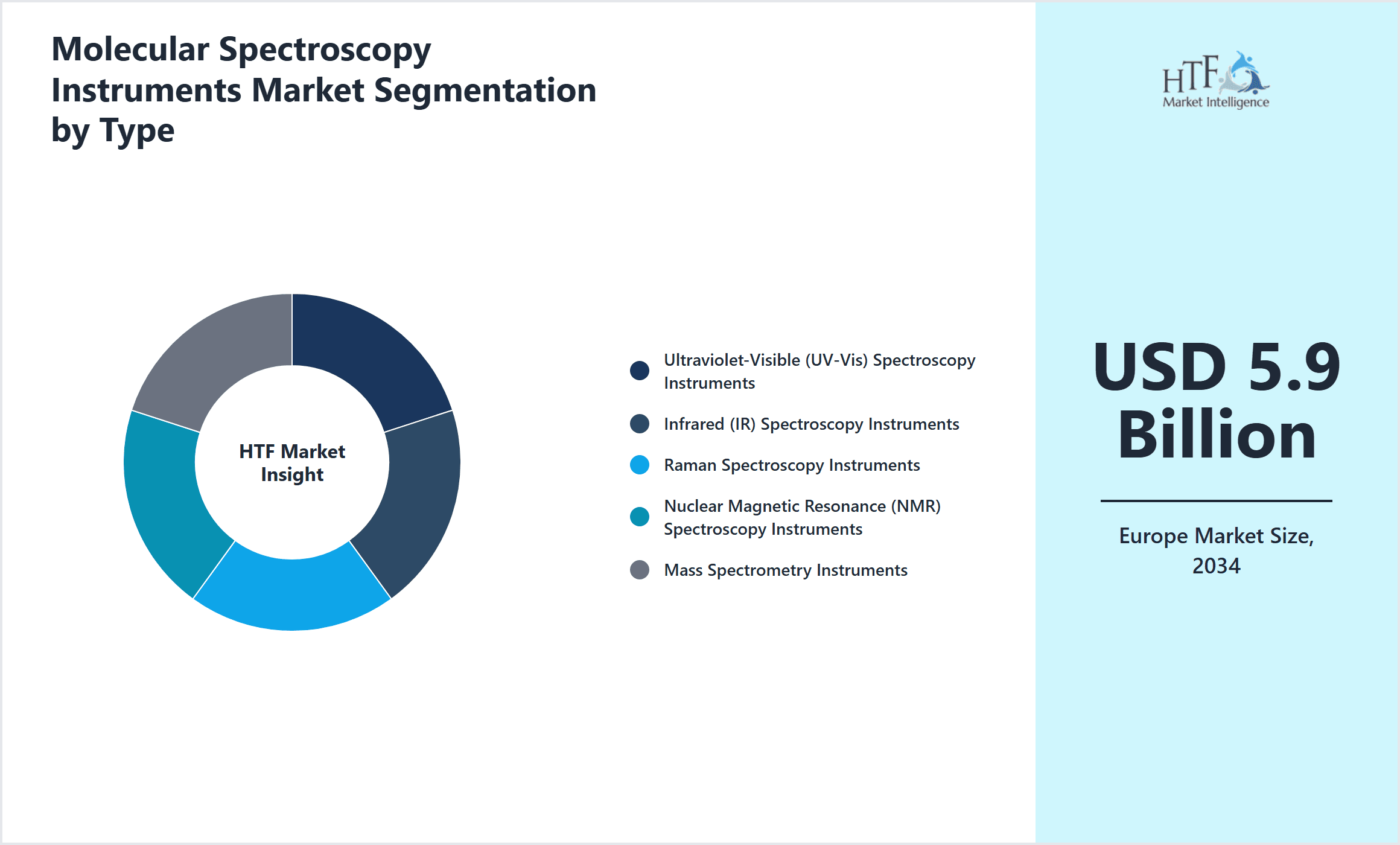
- •By Product Type
- ◦Ultraviolet-Visible (UV-Vis) Spectroscopy Instruments
- ◦Infrared (IR) Spectroscopy Instruments
- ◦Raman Spectroscopy Instruments
- ◦Nuclear Magnetic Resonance (NMR) Spectroscopy Instruments
- ◦Mass Spectrometry Instruments
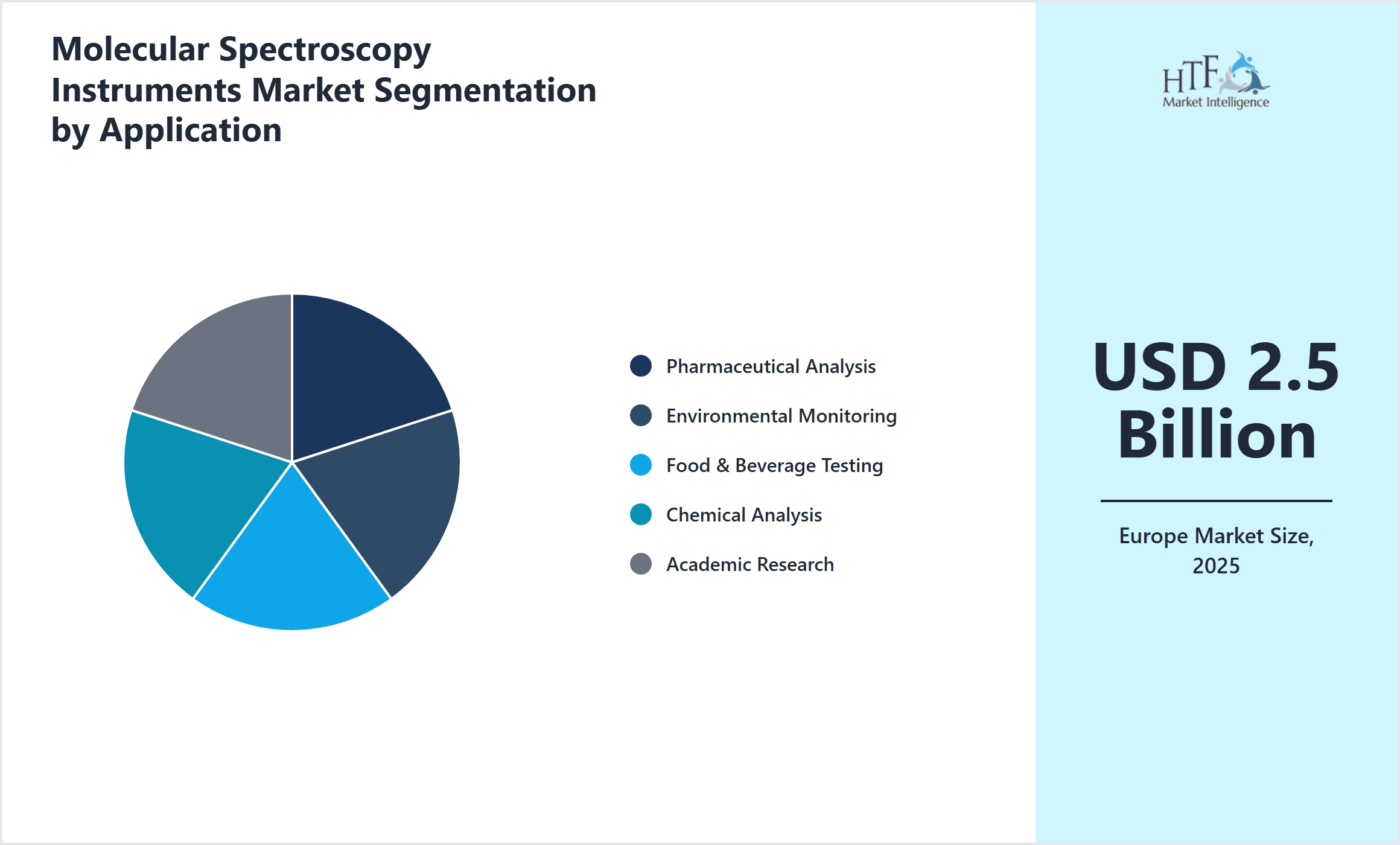
- •By Application
- ◦Pharmaceutical Analysis
- ◦Environmental Monitoring
- ◦Food & Beverage Testing
- ◦Chemical Analysis
- ◦Academic Research
- •By End-Use Industry
- ◦Pharmaceutical & Biotechnology
- ◦Environmental Agencies
- ◦Food & Beverage Industry
- ◦Chemical Manufacturing
- •By Distribution Channel
- ◦Direct Sales
- ◦Distributors & Dealers
- ◦Online Sales Platforms
Growth Dynamics
- •Increasing pharmaceutical R&D investments across Europe are driving demand for high-precision molecular spectroscopy instruments, essential for drug discovery and quality control processes. Pharmaceutical companies require advanced spectrometry to meet stringent regulatory standards, fueling market growth.
- •Environmental monitoring initiatives led by European governments to control pollution and ensure sustainability create a growing market for spectroscopy instruments capable of detecting trace contaminants in air, water, and soil samples with high accuracy.
- •Advancements in Raman spectroscopy technology, including portable and handheld devices, enable real-time and on-site analysis, broadening application scope in food safety and forensic investigations, which promotes rapid market expansion.
- •The adoption of hyphenated techniques combining molecular spectroscopy with chromatography enhances analytical capabilities, providing comprehensive molecular profiling that benefits chemical manufacturing and research sectors.
- •Growing awareness and regulatory mandates on food safety testing within the European Union stimulate demand for reliable spectroscopic methods to detect adulterants and contaminants, fostering increased market penetration.
Market Trends
- •Integration of artificial intelligence and machine learning with spectroscopy instruments is revolutionizing data analysis, enabling faster interpretation and predictive maintenance, which enhances operational efficiency.
- •Miniaturization and development of portable molecular spectroscopy devices are gaining traction, allowing in-field testing and expanding applications beyond traditional laboratory settings.
- •Sustainability-focused innovation drives the production of eco-friendly and energy-efficient spectroscopy instruments, aligning with European environmental policies and customer preferences.
- •Collaborative partnerships between instrument manufacturers and software developers are creating integrated solutions that streamline workflows and improve user experience.
- •Increased focus on multiplexing capabilities and multi-modal spectroscopy systems enhances analytical throughput and versatility, meeting complex industry demands.
Market Opportunities
- •Expanding applications in personalized medicine and biomarker discovery present significant opportunities for molecular spectroscopy instruments, especially NMR and Mass Spectrometry, to gain deeper insights into molecular interactions.
- •Emerging markets within Europe, such as Eastern European countries, offer growth potential due to increasing industrialization and adoption of advanced analytical technologies.
- •Development of user-friendly, AI-powered software platforms integrated with spectroscopy instruments opens avenues for market expansion by lowering skill barriers for end users.
- •Strategic collaborations with academic and research institutions can drive innovation and early adoption of cutting-edge spectroscopy techniques, fostering long-term growth.
- •Growing demand for non-destructive testing methods in food and environmental sectors encourages the adoption of Raman and Infrared spectroscopy systems, creating new revenue streams.
Market Challenges
- •High initial investment costs for advanced molecular spectroscopy instruments limit accessibility for small and medium-sized enterprises, restraining market growth in certain segments.
- •Complexity of operation and need for specialized training pose barriers to widespread adoption, particularly in emerging applications requiring expert interpretation.
- •Stringent and evolving regulatory compliance requirements can delay product launches and increase development costs, affecting market dynamics negatively.
- •Competition from alternative analytical techniques such as chromatography and bioassays challenges molecular spectroscopy’s market share in specific applications.
- •Supply chain disruptions and component shortages, exacerbated by geopolitical tensions, impact manufacturing timelines and pricing stability.
Regulatory Framework
- •Between 2020 and 2025, the European Union implemented the In Vitro Diagnostic Regulation (IVDR) requiring rigorous validation and certification of analytical instruments used in clinical diagnostics, impacting molecular spectroscopy device compliance.
- •REACH regulation updates enforced stricter controls on chemical substances, necessitating enhanced analytical testing by spectroscopy instruments to ensure compliance across industries.
- •Environmental directives such as the EU Water Framework Directive mandate precise monitoring of pollutants, driving demand for highly sensitive molecular spectroscopy instruments in environmental applications.
- •The EU Food Safety Authority introduced new guidelines for rapid detection of contaminants in food products, influencing the adoption of spectroscopic methods for routine testing.
- •National agencies across Europe have strengthened calibration and quality assurance standards for analytical instruments, promoting harmonized practices and market confidence.
Market Intelligence
- •15th January 2025, Thermo Fisher Scientific launched an advanced Raman spectroscopy system designed for pharmaceutical quality control, featuring enhanced sensitivity and integrated AI-driven data analytics to accelerate compound identification. The new system targets the growing demand for rapid, non-destructive testing methods in drug manufacturing environments, aiming to reduce analysis time by 30%. This launch reinforces the company’s commitment to innovation and strengthens its competitive position in the European market. Source: Thermo Fisher Scientific Official Press Release
- •7th March 2025, Bruker Corporation introduced a next-generation NMR spectroscopy platform with improved magnetic field homogeneity and automated sample handling capabilities. The product is intended for academic and pharmaceutical research institutions seeking higher throughput and precision in molecular structure elucidation. By incorporating enhanced software for spectral analysis, Bruker aims to facilitate more complex research workflows and expand its footprint in Europe. Source: Bruker Corporation News
- •22nd May 2025, Agilent Technologies announced a strategic partnership with a leading software developer to integrate cloud-based data management solutions with its infrared spectroscopy instruments. This collaboration enhances real-time data sharing and remote instrument monitoring, addressing the growing trend of digitalization in laboratory environments. The initiative is poised to improve user experience and operational efficiency for European customers. Source: Agilent Technologies Corporate Announcement
- •30th June 2025, Shimadzu Corporation completed the acquisition of a European spectroscopy software firm specializing in AI-powered spectral interpretation. This acquisition aims to boost Shimadzu’s capabilities in delivering advanced analytical solutions and supports its expansion strategy in Europe by offering integrated hardware-software products that meet evolving market demands. Source: Shimadzu Corporation Press Release
Regional Outlook
The Germany currently holds a significant share of the market, primarily due to several key factors: increasing consumption rates, a burgeoning population, and robust economic momentum. These elements collectively drive demand, positioning this region as a leader in the market. On the other hand, Spain is rapidly emerging as the fastest-growing area within the industry. This remarkable growth can be attributed to swift infrastructure development, the expansion of various industrial sectors, and a marked increase in consumer demand. These dynamics make this region a crucial player in shaping future market growth.
In our report, we cover a comprehensive analysis of the following regions and countries:
- Germany
- France
- The United Kingdom
- BeNeLux
- Spain
- Italy
- NORDIC
- CEE
- Others
| Feature | Details |
|---|---|
| Base Year Market Size | USD 2.5 Billion |
| Forecast Year Market Size | USD 5.9 Billion |
| CAGR | 9.6% |
| Forecast Period | 2026 to 2033 |
| YoY Growth | 9.2% |
| Scope of Report | Market is segmented by Product Type (Ultraviolet-Visible (UV-Vis) Spectroscopy Instruments, Infrared (IR) Spectroscopy Instruments, Raman Spectroscopy Instruments, Nuclear Magnetic Resonance (NMR) Spectroscopy Instruments, Mass Spectrometry Instruments), Application (Pharmaceutical Analysis, Environmental Monitoring, Food & Beverage Testing, Chemical Analysis, Academic Research), End-Use Industry (Pharmaceutical & Biotechnology, Environmental Agencies, Food & Beverage Industry, Chemical Manufacturing), Distribution Channel (Direct Sales, Distributors & Dealers, Online Sales Platforms) |
| Regions Covered | Germany, France, The United Kingdom, BeNeLux, Spain, Italy, NORDIC, CEE, Others |
| Key Companies | Thermo Fisher Scientific (United States), Agilent Technologies (United States), Bruker Corporation (United States), Shimadzu Corporation (Japan), PerkinElmer, Inc. (United States), HORIBA, Ltd. (Japan), JEOL Ltd. (Japan), JASCO Corporation (Japan), Analytik Jena AG (Germany), Metrohm AG (Switzerland), Waters Corporation (United States), Hitachi High-Technologies Corporation (Japan), Brimrose Corporation of America (United States), Bio-Rad Laboratories, Inc. (United States), Malvern Panalytical Ltd. (United Kingdom), Sartorius AG (Germany), Analytica Biosystems (United States), Buchi Labortechnik AG (Switzerland), Anton Paar GmbH (Austria), LGC Limited (United Kingdom), Thermo Haake (Germany), Analytik Ltd. (United Kingdom), Knauer Wissenschaftliche Geräte GmbH (Germany), Malvern Instruments Ltd. (United Kingdom), Analytica Instruments SA (Switzerland) |
Molecular Spectroscopy Instruments Market - Europe Size & Outlook 2025-2034 - Table of Contents
Research enthusiast focused on transforming data uncovering into actionable insights through data-driven decision-making.
Frequently Asked Questions (FAQ):
The Compact Track Loaders market is projected to grow at a CAGR of 6.8% from 2025 to 2030, driven by increasing demand in construction and agricultural sectors.
North America currently leads the market with approximately 45% market share, followed by Europe at 28% and Asia-Pacific at 22%. The remaining regions account for 5% of the global market.
Key growth drivers include increasing construction activities, rising demand for versatile equipment in agriculture, technological advancements in track loader design, and growing preference for compact equipment in urban construction projects.