
Global Pipe Bending Machines Market - Outlook 2025-2034
Global Pipe Bending Machines Market is segmented by Type (Hydraulic Pipe Bending Machines, Electric Pipe Bending Machines, CNC Pipe Bending Machines, Manual Pipe Bending Machines, Mechanical Pipe Bending Machines), Application (Construction, Automotive, Oil & Gas, Aerospace, Shipbuilding), End-Use Industry (Infrastructure Development, Manufacturing, Energy & Utilities, Transportation), Distribution Channel (Direct Sales, Distributors, Online Platforms), and Geography (North America, LATAM, West Europe, Central & Eastern Europe, Northern Europe, Southern Europe, East Asia, Southeast Asia, South Asia, Central Asia, Oceania, MEA)
Pricing
Report Overview
Executive Summary
- •The global Pipe Bending Machines market involves the production and utilization of specialized machinery designed to bend pipes and tubes with precision for industrial, commercial, and infrastructural applications. This market includes a diverse range of equipment such as hydraulic, electric, CNC, manual, and mechanical pipe bending machines, each serving different operational needs and complexity levels. These machines find extensive applications across various sectors including construction, automotive manufacturing, oil and gas pipeline infrastructure, aerospace engineering, and shipbuilding. The market’s importance is underscored by the growing demand for sophisticated manufacturing processes that improve productivity and maintain structural integrity in critical applications. Advancements in automation and CNC technologies have expanded the capabilities and efficiency of pipe bending systems, positioning this market as a pivotal component in modern industrial manufacturing and infrastructure development globally. Increasing urbanization, infrastructure projects, and technological upgrades in manufacturing processes further consolidate the market’s growth trajectory.
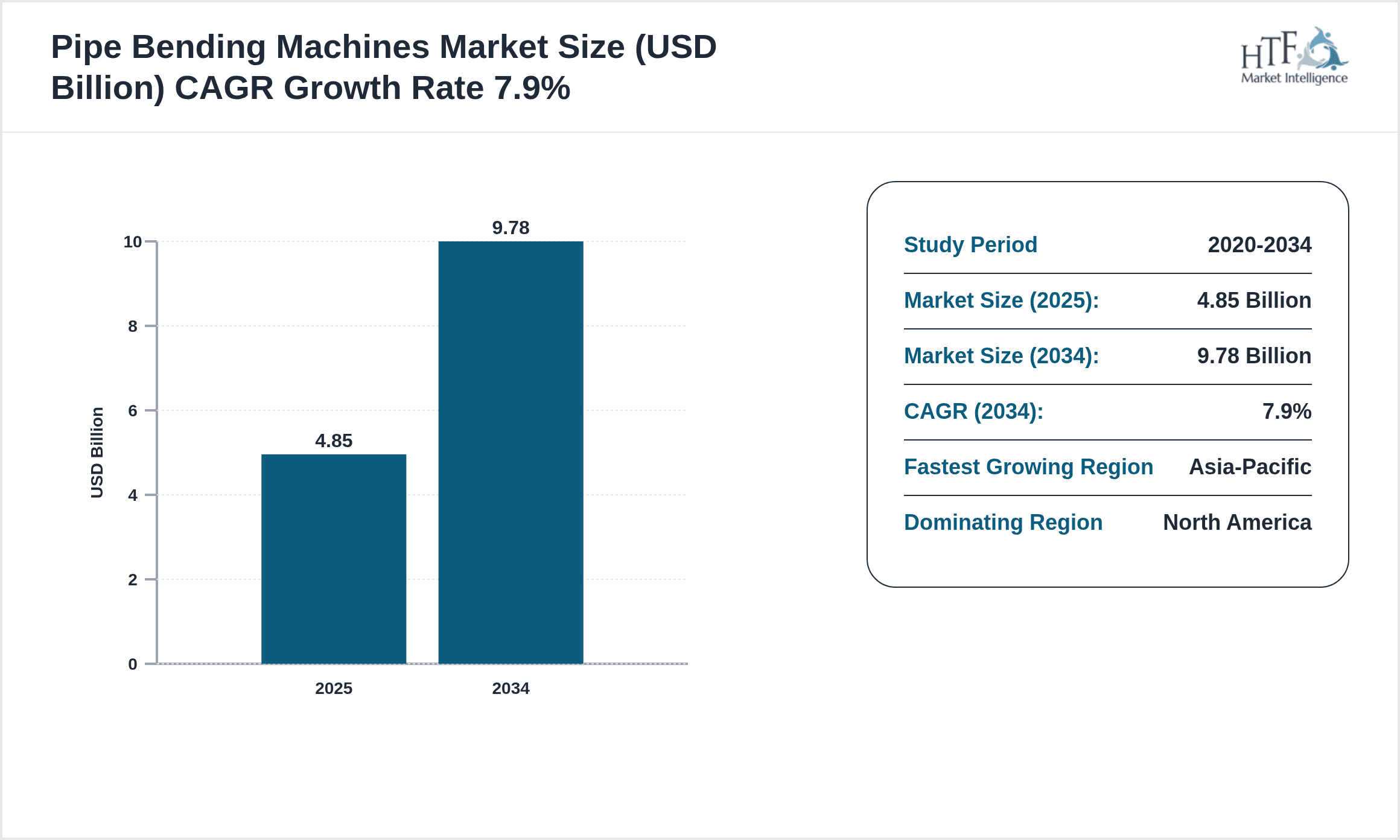
- •The market is projected to grow from USD 4.85 Billion in 2025 to USD 9.78 Billion by 2034, reflecting a robust CAGR of 7.9% driven by escalating demand in emerging economies and technological advancements in pipe bending equipment. North America currently dominates the market with over 31% share, supported by established manufacturing infrastructure and innovation in CNC and electric pipe bending machines. Asia-Pacific leads as the fastest-growing region due to rapid industrialization and infrastructure expansion in countries across the region. The CNC pipe bending machines segment holds the largest market share, attributed to precision, automation, and efficiency benefits, while electric pipe bending machines are anticipated to register the highest growth rate due to rising adoption of energy-efficient solutions.
- •The pipe bending machines market offers significant strategic value to industries reliant on customized pipe fabrication, providing enhanced operational efficiency and precision shaping capabilities. Key stakeholders including manufacturers, construction firms, automotive companies, and oil & gas operators benefit from innovations in bending technologies that reduce material wastage and improve production throughput. With ongoing investments in infrastructure and industrial automation worldwide, the market presents substantial opportunities for technological integration, product diversification, and geographic expansion. The strategic importance of this market is further highlighted by the push towards sustainability and energy efficiency, which drives the adoption of electric and CNC-based pipe bending machines capable of delivering consistent quality with reduced environmental impact. Consequently, the market remains a critical enabler of manufacturing excellence and infrastructure development on a global scale.
Competitive Landscape
The competitive environment in the global Pipe Bending Machines market is characterized by strong emphasis on technological innovation, strategic partnerships, and geographic expansion to capture new growth avenues. Leading players focus on integrating advanced CNC controls and electric drive systems to enhance machine precision, energy efficiency, and operational flexibility. Companies pursue collaborations with technology providers to develop smart and automated bending solutions incorporating IoT and Industry 4.0 capabilities. Global expansion is pursued through establishing manufacturing facilities and sales networks in key emerging markets such as Asia-Pacific and Latin America to leverage rising industrial activities. Product differentiation through customizable solutions tailored to specific industry needs strengthens market positioning. Mergers and acquisitions remain a favored strategy to consolidate market share, acquire new technologies, and expand product portfolios. Pricing strategies are aligned with value-added features and after-sales service quality, supporting customer retention and competitive advantage. The market’s competitive dynamics are influenced by increasing demand for precision, speed, and sustainability in pipe bending processes, shaping future innovation trajectories.
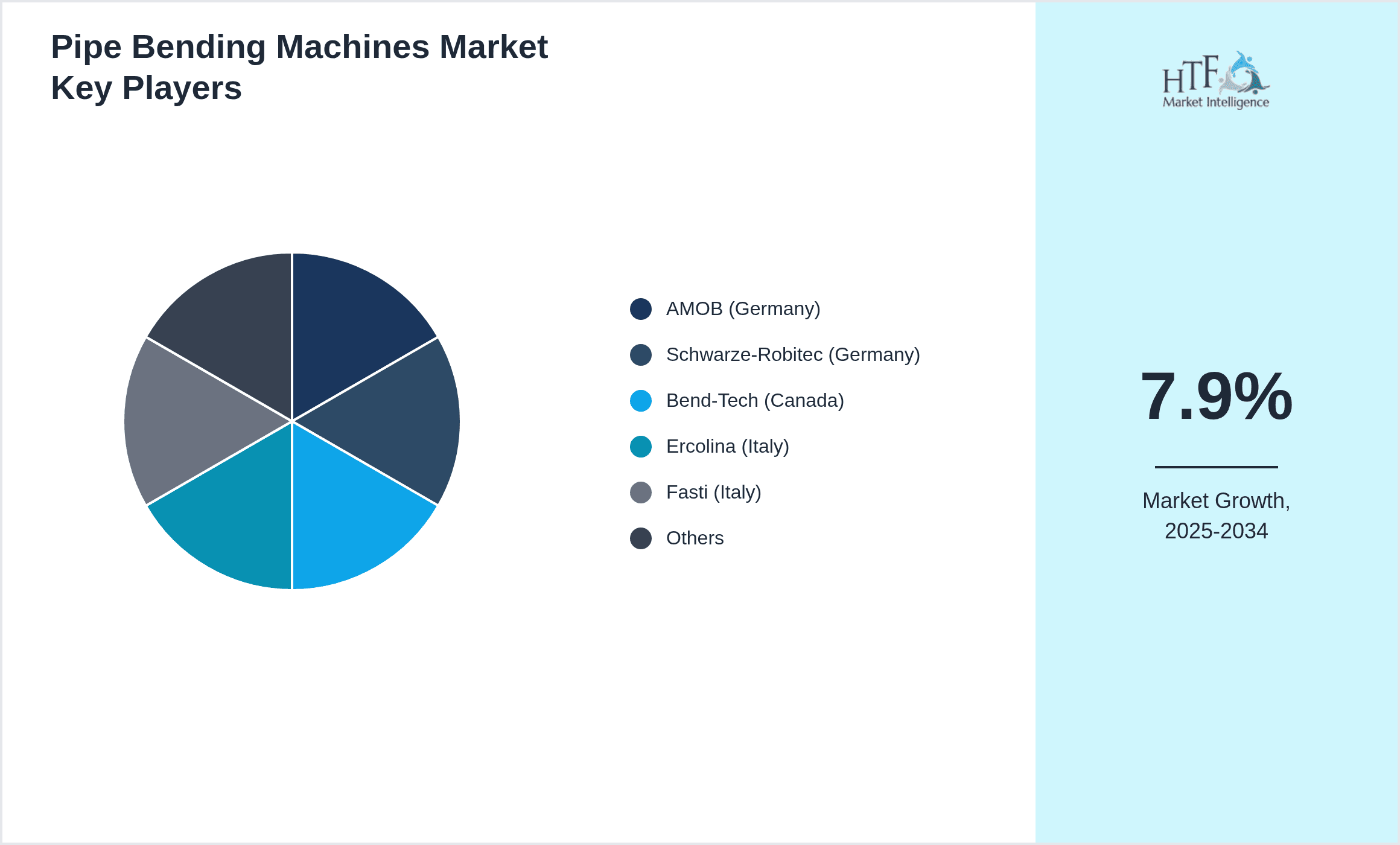
Leading Companies in Pipe Bending Machines Market
- •AMOB (Germany)
- •Schwarze-Robitec (Germany)
- •Bend-Tech (Canada)
- •Ercolina (Italy)
- •Fasti (Italy)
- •Huth (Germany)
- •O.M.A.R. (Italy)
- •Messer Cutting Systems (Germany)
- •Baileigh Industrial (United States)
- •Hydmech (United States)
- •Huth Ben Pearson (Germany)
- •Dartek (United Kingdom)
- •Jantz Machine Works (United States)
- •LVD Group (Belgium)
- •Rothenberger (Germany)
- •Peddinghaus (Germany)
- •Verson (United States)
- •Accurpress (United States)
- •Promecam (France)
- •OMCN (Italy)
Market Breakdown
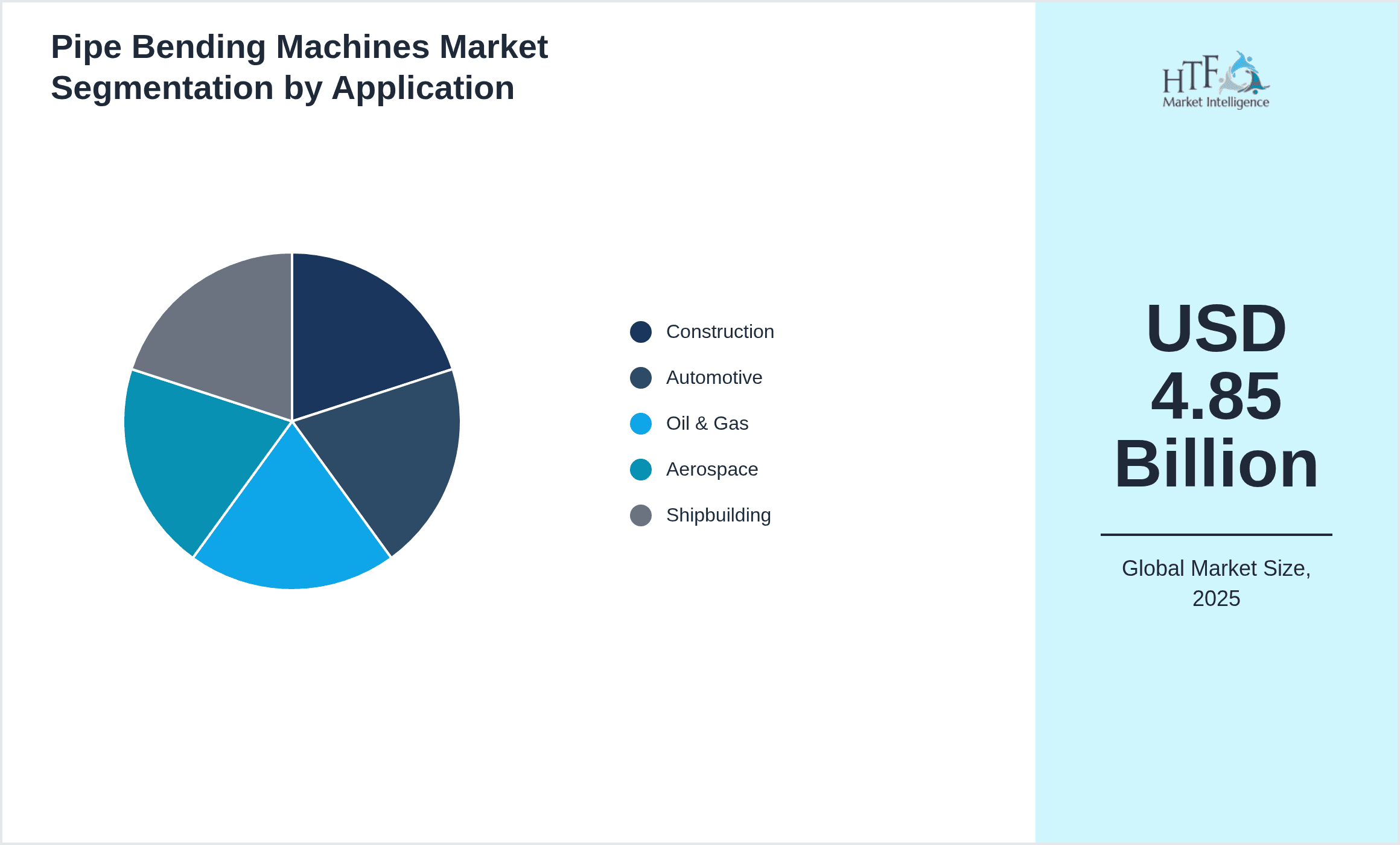
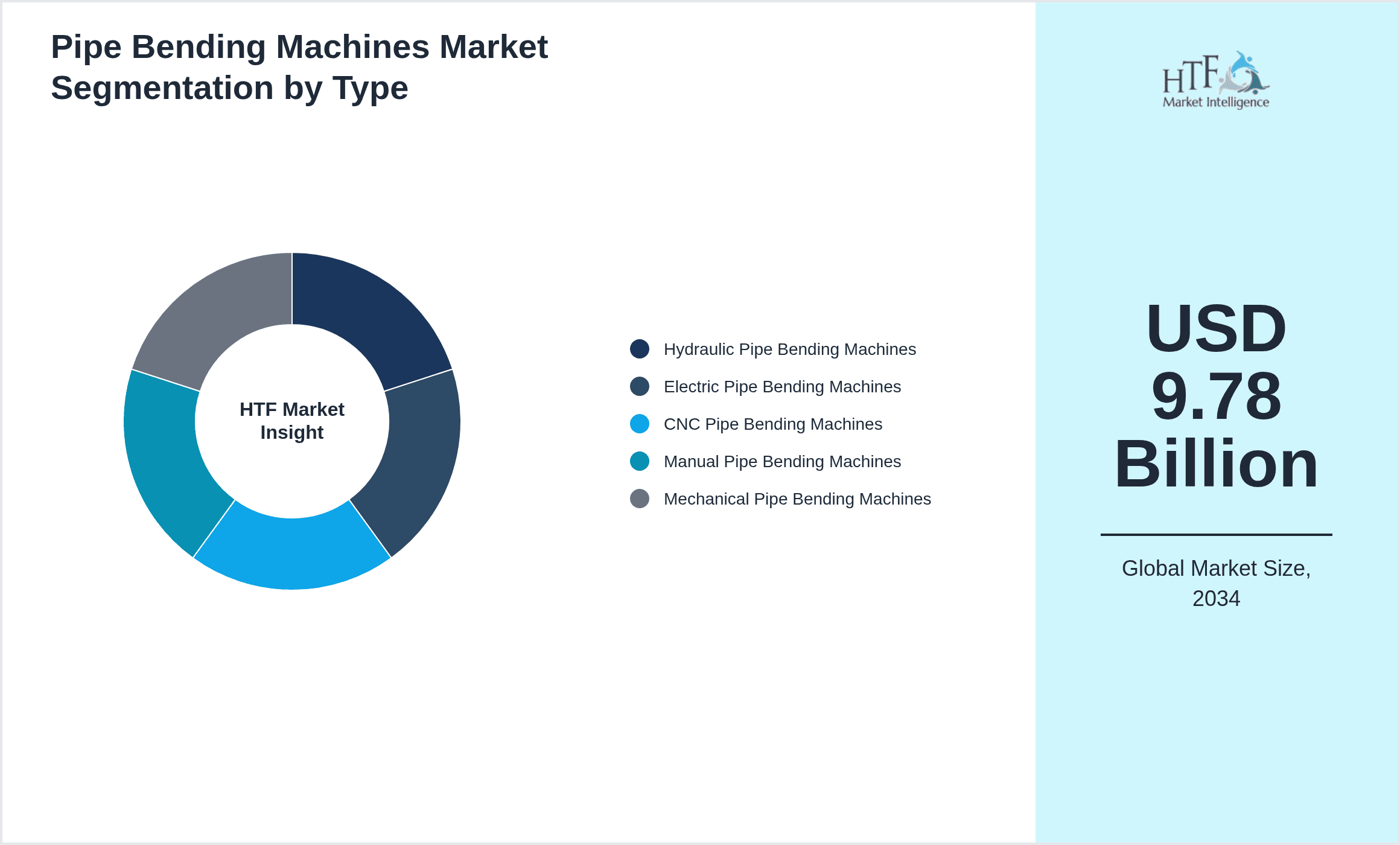
- •By Type
- ◦Hydraulic Pipe Bending Machines
- ◦Electric Pipe Bending Machines
- ◦CNC Pipe Bending Machines
- ◦Manual Pipe Bending Machines
- ◦Mechanical Pipe Bending Machines
- •By Application
- ◦Construction
- ◦Automotive
- ◦Oil & Gas
- ◦Aerospace
- ◦Shipbuilding
- •By End-Use Industry
- ◦Infrastructure Development
- ◦Manufacturing
- ◦Energy & Utilities
- ◦Transportation
- •By Distribution Channel
- ◦Direct Sales
- ◦Distributors
- ◦Online Platforms
Growth Dynamics
The global Pipe Bending Machines market growth is propelled by escalating infrastructure development projects worldwide, particularly in urbanization and energy sectors, demanding advanced pipe fabrication. Adoption of CNC and electric pipe bending machines enhances operational precision and reduces material wastage, providing competitive advantages to manufacturers. Technological progress in automation and digital controls facilitates faster setup and bending cycles, meeting the increasing production throughput requirements in automotive and aerospace industries. Rising demand for energy-efficient and environmentally friendly machinery drives growth, as electric pipe bending machines reduce carbon footprint and operational costs. The growing preference for customized pipe bending solutions tailored to specific industrial applications further fuels market expansion. Strategic investments by key players in research and development accelerate innovation in bending technologies, strengthening their market position. Additionally, the expansion of regional manufacturing hubs in Asia-Pacific and Latin America supports market penetration and addresses increasing local demand efficiently.
Market Trends
Emerging trends in the Pipe Bending Machines market include the integration of Industry 4.0 technologies such as IoT-enabled monitoring and predictive maintenance, enhancing machine uptime and process optimization. Manufacturers increasingly focus on developing compact, user-friendly CNC pipe bending machines with enhanced software interfaces for greater precision and flexibility. The shift towards electric-powered bending machines aligns with global sustainability goals, reducing energy consumption and emissions. There is a growing trend of incorporating robotic automation in pipe bending lines to improve throughput and consistency, particularly in the automotive and aerospace sectors. Collaborative partnerships between machine manufacturers and software developers facilitate seamless integration of digital twins and simulation tools for process validation. Market players also explore modular machine designs that allow scalability and customization based on application needs. These trends indicate an ongoing transformation towards smarter, efficient, and eco-friendly pipe bending solutions, reshaping industry standards and customer expectations.
Market Opportunities
Significant opportunities lie in expanding pipe bending machine adoption across emerging economies driven by rapid industrialization and infrastructure investments. The rising demand for lightweight and complex pipe geometries in aerospace and automotive sectors opens avenues for advanced CNC and electric pipe bending machines with superior precision. Integration of artificial intelligence and machine learning algorithms for process optimization presents new growth prospects, enhancing operational efficiency and reducing downtime. Market players can capitalize on developing retrofit solutions to upgrade existing manual and hydraulic machines with automation features, addressing cost-conscious customers. Expansion into renewable energy infrastructure, such as wind and solar installations requiring specialized pipe bending, offers untapped potential. Strategic collaborations and joint ventures to localize manufacturing and services in high-growth regions can accelerate market penetration. Additionally, increasing regulatory emphasis on manufacturing quality and environmental compliance drives demand for technologically advanced, compliant pipe bending equipment, further broadening market opportunities.
Market Challenges
The Pipe Bending Machines market faces challenges related to high initial capital investment for advanced CNC and electric models, limiting accessibility for small and medium enterprises. Complex machine programming and operation require skilled labor, creating a talent shortage and increasing training costs. Supply chain disruptions for critical components such as precision sensors and electric drives impact production schedules and lead times. Variability in global regulatory standards and certification requirements poses compliance complexities for manufacturers targeting multiple regions. Intense competition among established players and low-cost regional manufacturers exerts pricing pressure, affecting profit margins. Additionally, maintenance and repair of sophisticated bending machines demand specialized service infrastructure, which is underdeveloped in certain emerging markets. Recent disruptions due to geopolitical tensions and raw material price volatility have further constrained market growth. Companies must navigate these challenges through innovation, workforce development, and supply chain resilience to sustain competitive advantage.
Regulatory Framework
Recent regulatory developments emphasize safety, energy efficiency, and environmental impact of industrial machinery, including pipe bending machines. The Machinery Directive updated in the European Union between 2020 and 2024 mandates stringent safety compliance and CE marking for pipe bending equipment sold within member states. North American standards such as OSHA regulations and energy efficiency guidelines have tightened to ensure operator safety and minimize machine energy consumption. Additionally, countries in Asia-Pacific have introduced certification requirements aimed at reducing industrial emissions and promoting sustainable manufacturing processes. Compliance with RoHS and REACH directives has become mandatory for materials used in machine components to limit hazardous substances. These regulations impact design, manufacturing, and testing protocols, requiring companies to invest in research and certification processes. Adherence ensures market access and builds customer confidence, influencing purchasing decisions across global regions.
Market Intelligence
- •Recent market developments and strategic initiatives are continuously tracked through industry publications, company announcements, and regulatory filings. For the most current information, stakeholders are advised to monitor official corporate communications and recognized market intelligence platforms.
- •Recent market developments and strategic initiatives are continuously tracked through industry publications, company announcements, and regulatory filings. For the most current information, stakeholders are advised to monitor official corporate communications and recognized market intelligence platforms.
- •Recent market developments and strategic initiatives are continuously tracked through industry publications, company announcements, and regulatory filings. For the most current information, stakeholders are advised to monitor official corporate communications and recognized market intelligence platforms.
- •Recent market developments and strategic initiatives are continuously tracked through industry publications, company announcements, and regulatory filings. For the most current information, stakeholders are advised to monitor official corporate communications and recognized market intelligence platforms.
- •Source: Official industry reports and market research publications
Regional Outlook
The North America currently holds a significant share of the market, primarily due to several key factors: increasing consumption rates, a burgeoning population, and robust economic momentum. These elements collectively drive demand, positioning this region as a leader in the market. On the other hand, Asia-Pacific is rapidly emerging as the fastest-growing area within the industry. This remarkable growth can be attributed to swift infrastructure development, the expansion of various industrial sectors, and a marked increase in consumer demand. These dynamics make this region a crucial player in shaping future market growth.
In our report, we cover a comprehensive analysis of the following regions and countries:
- North America
- LATAM
- West Europe
- Central & Eastern Europe
- Northern Europe
- Southern Europe
- East Asia
- Southeast Asia
- South Asia
- Central Asia
- Oceania
- MEA
| Feature | Details |
|---|---|
| Base Year Market Size | USD 4.85 Billion |
| Forecast Year Market Size | USD 9.78 Billion |
| CAGR | 7.9% |
| Forecast Period | 2026 to 2033 |
| YoY Growth | 7.6% |
| Scope of Report | Market is segmented by Type (Hydraulic Pipe Bending Machines, Electric Pipe Bending Machines, CNC Pipe Bending Machines, Manual Pipe Bending Machines, Mechanical Pipe Bending Machines), Application (Construction, Automotive, Oil & Gas, Aerospace, Shipbuilding), End-Use Industry (Infrastructure Development, Manufacturing, Energy & Utilities, Transportation), Distribution Channel (Direct Sales, Distributors, Online Platforms) |
| Regions Covered | North America, LATAM, West Europe, Central & Eastern Europe, Northern Europe, Southern Europe, East Asia, Southeast Asia, South Asia, Central Asia, Oceania, MEA |
| Key Companies | AMOB (Germany), Schwarze-Robitec (Germany), Bend-Tech (Canada), Ercolina (Italy), Fasti (Italy), Huth (Germany), O.M.A.R. (Italy), Messer Cutting Systems (Germany), Baileigh Industrial (United States), Hydmech (United States), Huth Ben Pearson (Germany), Dartek (United Kingdom), Jantz Machine Works (United States), LVD Group (Belgium), Rothenberger (Germany), Peddinghaus (Germany), Verson (United States), Accurpress (United States), Promecam (France), OMCN (Italy) |
Global Pipe Bending Machines Market - Outlook 2025-2034 - Table of Contents
Frequently Asked Questions (FAQ):
The Compact Track Loaders market is projected to grow at a CAGR of 6.8% from 2025 to 2030, driven by increasing demand in construction and agricultural sectors.
North America currently leads the market with approximately 45% market share, followed by Europe at 28% and Asia-Pacific at 22%. The remaining regions account for 5% of the global market.
Key growth drivers include increasing construction activities, rising demand for versatile equipment in agriculture, technological advancements in track loader design, and growing preference for compact equipment in urban construction projects.