
Global Optical Sorting Machines Market Size, Growth & Revenue 2025-2034
Global Optical Sorting Machines Market is segmented by Product Type (Color Sorters, Shape Sorters, X-ray Sorters, Laser Sorters, Multi-sensor Sorters), Application (Food Processing, Recycling, Mining, Pharmaceuticals, Agriculture), End-Use Industry (Food & Beverage, Waste Management, Mining & Minerals, Pharmaceutical Manufacturing), Distribution Channel (Direct Sales, Distributors, System Integrators), and Geography (North America, LATAM, West Europe, Central & Eastern Europe, Northern Europe, Southern Europe, East Asia, Southeast Asia, South Asia, Central Asia, Oceania, MEA)
Pricing
Report Overview
Executive Summary
- •The global optical sorting machines market is a vital segment of the automation and quality control industries, employing sophisticated sensor-based technologies to enhance sorting accuracy and efficiency in various sectors. These machines utilize advanced optical sensors including color, shape, X-ray, laser, and multi-sensor systems to identify and separate materials based on their physical and chemical characteristics. Their application spans food processing, recycling, mining, pharmaceuticals, and agriculture, providing critical benefits such as improved product purity, reduced manual labor, and enhanced processing speed. The market value chain consists of raw material providers, technology developers, original equipment manufacturers, system integrators, and end users, ensuring a comprehensive ecosystem that drives innovation and adoption. Increasing consumer demand for high-quality products, stringent regulatory standards, and the push towards automation across industries underpin market growth. Technological advances in sensor accuracy, integration with AI and IoT, and rising investments in sustainable processes further fuel this expansion globally.
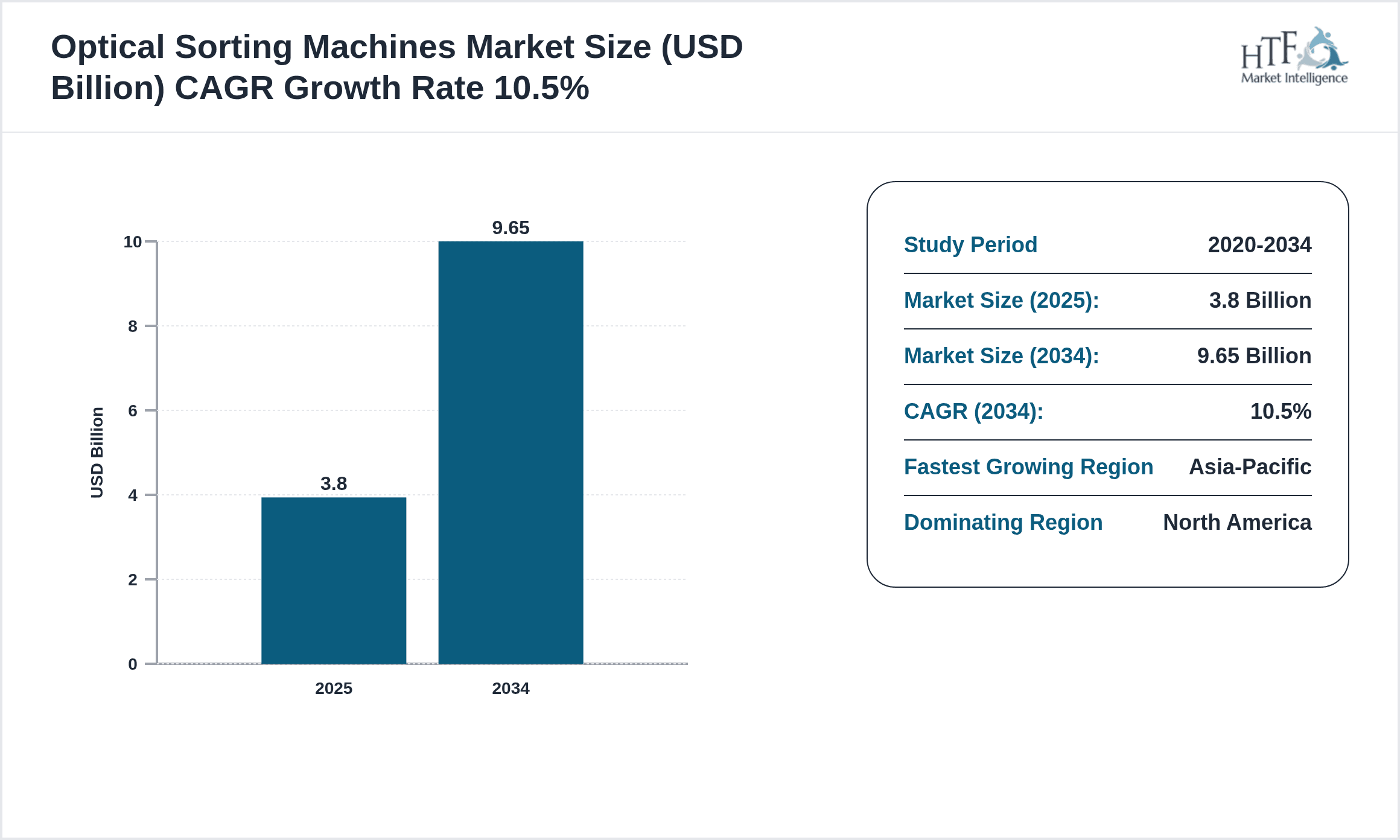
- •Key market highlights include a robust CAGR of approximately 10.5% from 2025 to 2034, with the market size expanding from USD 3.8 billion in 2025 to an estimated USD 9.65 billion by 2034. The North American region currently dominates the market due to high adoption rates and technological advancements, while Asia-Pacific emerges as the fastest-growing region driven by industrialization and increasing demand for automation. Color sorters remain the leading product type, with multi-sensor sorters exhibiting the highest growth potential owing to their enhanced sorting precision. Market drivers include growing food safety concerns, stringent quality standards in pharmaceuticals, and expansion of recycling initiatives worldwide.
- •Optical sorting machines offer compelling value propositions to industries by improving operational efficiency, reducing waste, and ensuring compliance with regulatory standards. Their strategic importance is evident in sectors demanding high throughput and quality assurance, such as food processing and recycling, where they minimize contamination and improve product yields. Stakeholders including manufacturers, system integrators, and end-users benefit from enhanced process automation, cost savings, and sustainable practices. The market’s trajectory is shaped by continuous innovation, increasing environmental awareness, and expanding applications, positioning optical sorting machines as essential tools in the transition towards smart manufacturing and circular economy models.
Competitive Landscape
The competitive environment in the global optical sorting machines market is characterized by intense rivalry among established multinational corporations and innovative regional players. Key competitive strategies include continuous investment in research and development to enhance sensor technologies, expand product portfolios, and improve sorting accuracy. Companies focus on forming strategic partnerships and collaborations to access new markets and integrate complementary technologies such as artificial intelligence and machine learning. Market positioning is often achieved through differentiation by product performance, customization capabilities, and after-sales services. Pricing strategies vary by region and application, with premium products targeting high-end food processing and pharmaceutical sectors, while cost-effective solutions cater to recycling and agriculture industries. Distribution channels are diversified, including direct sales, authorized dealers, and system integrators, facilitating broad market reach. Additionally, mergers and acquisitions, though limited recently, remain a potential avenue for market consolidation and expansion. Regional competition is notable, with North American and European players leading in technology innovation, while Asia-Pacific companies focus on scaling production and cost competitiveness. Future trends indicate increased digitalization, integration with Industry 4.0, and sustainability-driven innovations shaping competitive dynamics.
Prominent Players in Optical Sorting Machines Market
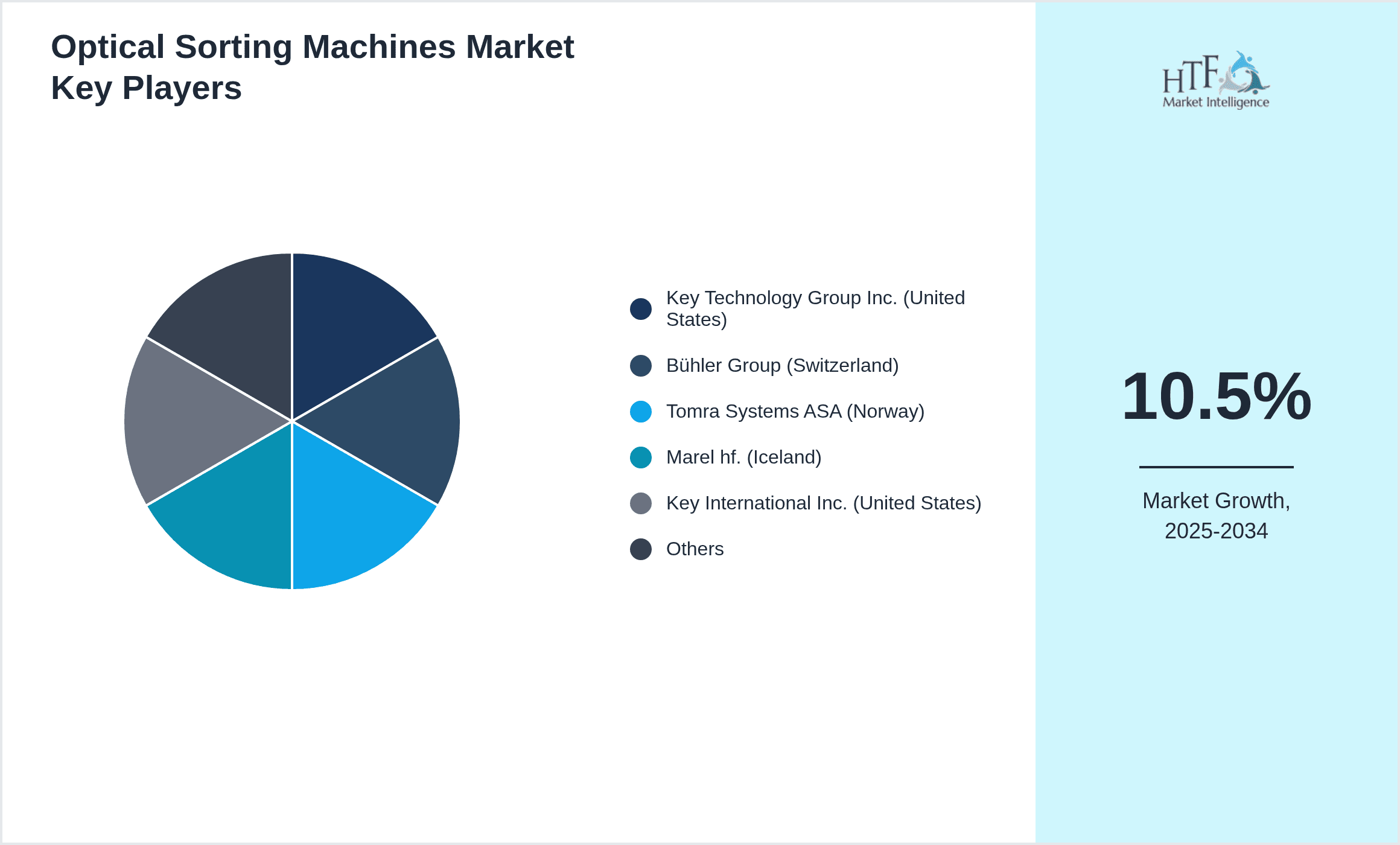
- •Key Technology Group Inc. (United States)
- •Bühler Group (Switzerland)
- •Tomra Systems ASA (Norway)
- •Marel hf. (Iceland)
- •Key International Inc. (United States)
- •Satake Corporation (Japan)
- •Aweta B.V. (Netherlands)
- •Sesotec GmbH (Germany)
- •Compac Sorting Equipment Ltd. (New Zealand)
- •Raytec Vision S.r.l. (Italy)
- •Bühler Sortex (Switzerland)
- •Cama Group (Italy)
- •Chopin Technologies (France)
- •Pellenc ST (France)
- •Mecatherm (France)
- •Compac Industries Ltd. (New Zealand)
- •Tomra Food (Norway)
- •Key Technology (United States)
- •Sesotec Gmbh (Germany)
- •Satake Corporation (Japan)
- •Aweta B.V. (Netherlands)
- •Raytec Vision (Italy)
- •Marel hf. (Iceland)
- •Compac Sorting Equipment (New Zealand)
- •Pellenc ST (France)
Market Breakdown
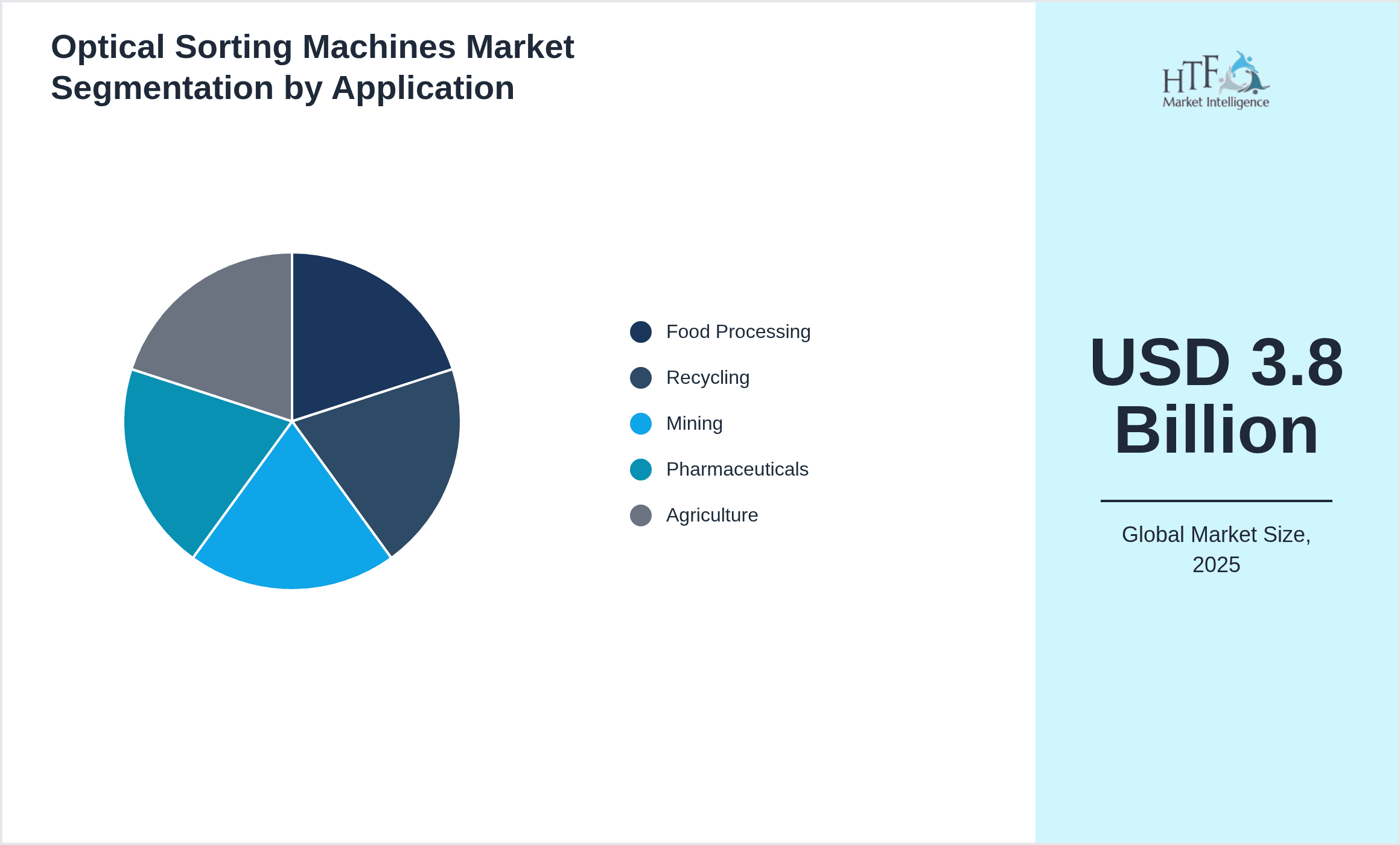
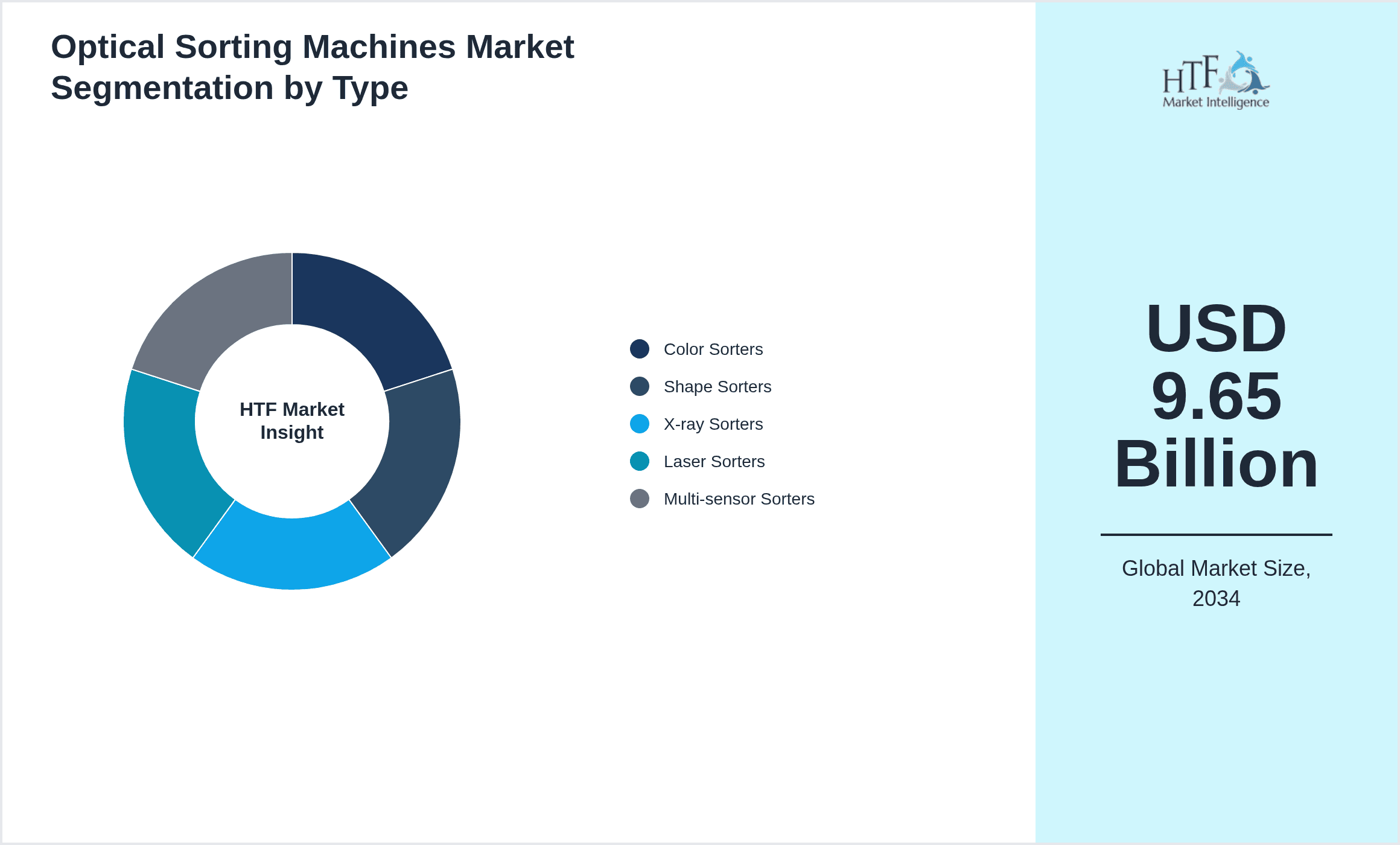
- •By Product Type
- ◦Color Sorters
- ◦Shape Sorters
- ◦X-ray Sorters
- ◦Laser Sorters
- ◦Multi-sensor Sorters
- •By Application
- ◦Food Processing
- ◦Recycling
- ◦Mining
- ◦Pharmaceuticals
- ◦Agriculture
- •By End-Use Industry
- ◦Food & Beverage
- ◦Waste Management
- ◦Mining & Minerals
- ◦Pharmaceutical Manufacturing
- •By Distribution Channel
- ◦Direct Sales
- ◦Distributors
- ◦System Integrators
Growth Dynamics
- •Rising demand for automation in food processing industries is a primary growth driver, with companies seeking to improve product quality and reduce contamination risks. Optical sorting machines help achieve these objectives by accurately separating defective or foreign materials from raw and processed food products.
- •Increasing regulatory standards worldwide related to food safety, pharmaceuticals, and waste management are compelling industries to adopt advanced sorting technologies. Compliance with such standards fosters market growth by necessitating precise and reliable sorting solutions.
- •Technological advancements, particularly the integration of AI and machine learning algorithms with multi-sensor sorting systems, enhance sorting accuracy and operational efficiency, attracting investments and expanding market reach.
- •Growth in recycling initiatives due to environmental sustainability concerns is propelling demand for optical sorting machines that can efficiently segregate recyclable materials, thereby supporting circular economy models globally.
- •Expansion of mining activities in emerging economies is driving the adoption of optical sorting machines to optimize ore beneficiation, reduce processing costs, and improve resource utilization.
- •Rising labor costs and shortage of skilled workers encourage industries to implement automated optical sorting systems, which reduce dependency on manual sorting and improve throughput.
- •Investment in smart manufacturing and Industry 4.0 adoption is encouraging integration of optical sorting machines with IoT and data analytics platforms, enabling real-time monitoring and predictive maintenance.
Market Trends
- •The adoption of multi-sensor sorting technology combining optical, X-ray, and laser sensors is becoming prevalent to achieve higher sorting precision across diverse applications, especially in complex food products and recycled materials.
- •Increasing incorporation of AI-driven analytics and machine learning to enhance defect detection and classification accuracy is reshaping the optical sorting machines market, enabling adaptive and intelligent sorting.
- •Sustainability trends are influencing the development of energy-efficient optical sorting machines with reduced carbon footprints, aligning with corporate social responsibility and regulatory demands.
- •Strategic collaborations between optical sorting equipment manufacturers and software companies to develop integrated sorting solutions are on the rise, enabling comprehensive quality control systems.
- •The increasing use of optical sorting in pharmaceutical manufacturing for quality assurance and counterfeiting prevention is emerging as a significant market trend.
- •Growing demand for smaller, modular, and portable sorting machines that cater to SMEs and decentralized operations is influencing product development strategies.
- •Expansion of the global recycling market is driving customization of sorting machines to handle diverse waste streams, including plastics, metals, and electronic waste.
Market Opportunities
- •Emerging markets in Asia-Pacific and Latin America present significant growth opportunities due to increasing industrialization, rising food processing activities, and government initiatives supporting automation.
- •Integration of AI and IoT technologies offers avenues for developing advanced sorting machines with predictive maintenance, remote monitoring, and enhanced operational analytics.
- •Expansion into untapped applications such as pharmaceutical quality control and electronic waste recycling can diversify market reach and revenue streams.
- •Development of customized sorting solutions for small and medium enterprises (SMEs) can capture niche segments seeking affordable automation options.
- •Strategic partnerships with regional distributors and system integrators can facilitate market penetration in developing regions with growing demand.
- •Rising consumer awareness regarding product safety and sustainability can drive demand for high-precision sorting machines emphasizing quality and environmental benefits.
- •Government incentives and subsidies aimed at promoting sustainable waste management and food safety can stimulate investments in optical sorting technology adoption.
Market Challenges
- •High capital investment and maintenance costs of advanced optical sorting machines pose barriers for small and medium enterprises, limiting widespread adoption in price-sensitive markets.
- •Technical complexities associated with integrating multi-sensor systems and AI technologies require skilled personnel and robust infrastructure, challenging market expansion in developing regions.
- •Variability in product characteristics and contamination types can reduce sorting accuracy, necessitating continuous calibration and customization which increase operational costs.
- •Lack of standardized regulations and certification for optical sorting technologies across different regions creates compliance challenges for manufacturers and end-users.
- •Supply chain disruptions and component shortages can delay equipment delivery and affect market growth, especially during global crises such as pandemics or geopolitical tensions.
- •Competition from low-cost manual sorting alternatives in emerging markets can hinder adoption of automated optical sorting machines.
- •Data security and privacy concerns related to IoT-enabled sorting systems require stringent safeguards, adding complexity to technology deployment.
Regulatory Framework
- •The Food Safety Modernization Act (FSMA) enacted in 2011 and gaining enforcement momentum through 2020-2025 mandates rigorous contamination prevention measures in food processing, driving adoption of optical sorting machines for quality assurance.
- •European Union regulations on waste management and recycling, such as the Waste Framework Directive revised between 2018-2020, require efficient sorting technologies to enhance recycling rates and reduce landfill usage.
- •Pharmaceutical industry standards including Good Manufacturing Practices (GMP) updated continually up to 2025 emphasize the need for precise quality control, encouraging optical sorting integration in drug manufacturing.
- •Regulations on electronic waste recycling in key markets, including the Restriction of Hazardous Substances (RoHS) directive enforced globally by 2020, necessitate advanced sorting solutions to separate hazardous materials safely.
- •Government incentives such as tax credits and grants for adopting sustainable technologies have been introduced in North America and Europe during 2020-2025, supporting investments in optical sorting machinery.
Market Intelligence
- •15th February 2025, Bühler Group announced the launch of its latest color sorting machine equipped with AI-powered defect detection designed for the food processing industry. This new model enhances sorting speed by 20% while reducing false rejects by leveraging deep learning algorithms to analyze product attributes in real-time. The company aims to target large-scale food manufacturers seeking to improve quality control and operational efficiency through automation. This innovation aligns with growing demand for precision sorting driven by stringent food safety regulations globally. Source: Bühler Official Press Release
- •10th May 2025, Tomra Systems ASA introduced an advanced multi-sensor sorting system integrating X-ray, laser, and optical sensors tailored for recycling operations. The system improves material recovery rates by 15% and supports sorting of complex waste streams including plastics, metals, and electronic components. Tomra’s solution incorporates cloud-based analytics for remote monitoring and predictive maintenance, enhancing uptime and reducing operational costs. The launch strengthens Tomra’s position in the sustainable waste management market amid increasing regulatory pressure on recycling standards. Source: Tomra Systems Annual Report 2025
- •3rd August 2024, Satake Corporation announced a strategic partnership with a leading AI software firm to develop intelligent optical sorting machines for the pharmaceutical sector. The collaboration focuses on integrating AI-driven image recognition to detect product defects and contaminants with higher accuracy, thereby supporting compliance with GMP standards. This initiative aims to accelerate automation adoption in pharmaceutical manufacturing and improve product safety. Satake plans to pilot the technology in key markets during late 2024 with commercial rollout expected in early 2025. Source: Satake Corporation Newsroom
- •22nd November 2024, Key Technology Group Inc. completed the acquisition of a European sensor technology startup specializing in laser-based sorting solutions. This acquisition expands Key Technology's product portfolio with innovative laser sensors that enhance sorting precision for mining and agricultural applications. The integration is expected to drive revenue growth and provide competitive advantages through technology differentiation. The deal also facilitates entry into new regional markets in Europe and strengthens R&D capabilities. Source: Key Technology Investor Relations
Regional Outlook
The North America currently holds a significant share of the market, primarily due to several key factors: increasing consumption rates, a burgeoning population, and robust economic momentum. These elements collectively drive demand, positioning this region as a leader in the market. On the other hand, Asia-Pacific is rapidly emerging as the fastest-growing area within the industry. This remarkable growth can be attributed to swift infrastructure development, the expansion of various industrial sectors, and a marked increase in consumer demand. These dynamics make this region a crucial player in shaping future market growth.
In our report, we cover a comprehensive analysis of the following regions and countries:
- North America
- LATAM
- West Europe
- Central & Eastern Europe
- Northern Europe
- Southern Europe
- East Asia
- Southeast Asia
- South Asia
- Central Asia
- Oceania
- MEA
| Feature | Details |
|---|---|
| Base Year Market Size | USD 3.8 Billion |
| Forecast Year Market Size | USD 9.65 Billion |
| CAGR | 10.5% |
| Forecast Period | 2026 to 2033 |
| YoY Growth | 10% |
| Scope of Report | Market is segmented by Product Type (Color Sorters, Shape Sorters, X-ray Sorters, Laser Sorters, Multi-sensor Sorters), Application (Food Processing, Recycling, Mining, Pharmaceuticals, Agriculture), End-Use Industry (Food & Beverage, Waste Management, Mining & Minerals, Pharmaceutical Manufacturing), Distribution Channel (Direct Sales, Distributors, System Integrators) |
| Regions Covered | North America, LATAM, West Europe, Central & Eastern Europe, Northern Europe, Southern Europe, East Asia, Southeast Asia, South Asia, Central Asia, Oceania, MEA |
| Key Companies | Key Technology Group Inc. (United States), Bühler Group (Switzerland), Tomra Systems ASA (Norway), Marel hf. (Iceland), Key International Inc. (United States), Satake Corporation (Japan), Aweta B.V. (Netherlands), Sesotec GmbH (Germany), Compac Sorting Equipment Ltd. (New Zealand), Raytec Vision S.r.l. (Italy), Bühler Sortex (Switzerland), Cama Group (Italy), Chopin Technologies (France), Pellenc ST (France), Mecatherm (France), Compac Industries Ltd. (New Zealand), Tomra Food (Norway), Key Technology (United States), Sesotec Gmbh (Germany), Satake Corporation (Japan), Aweta B.V. (Netherlands), Raytec Vision (Italy), Marel hf. (Iceland), Compac Sorting Equipment (New Zealand), Pellenc ST (France) |
Global Optical Sorting Machines Market Size, Growth & Revenue 2025-2034 - Table of Contents
Frequently Asked Questions (FAQ):
The Compact Track Loaders market is projected to grow at a CAGR of 6.8% from 2025 to 2030, driven by increasing demand in construction and agricultural sectors.
North America currently leads the market with approximately 45% market share, followed by Europe at 28% and Asia-Pacific at 22%. The remaining regions account for 5% of the global market.
Key growth drivers include increasing construction activities, rising demand for versatile equipment in agriculture, technological advancements in track loader design, and growing preference for compact equipment in urban construction projects.