
Global Manufactured Housing Market Size, Growth & Revenue 2024-2034
Global Manufactured Housing Market is segmented by Product Type (Single-Section Manufactured Homes, Multi-Section Manufactured Homes, Modular Homes, Panelized Homes, Hybrid Homes), Application (Residential, Commercial, Institutional, Recreational, Emergency Housing), End-Use Industry (Housing Development, Disaster Relief, Tourism & Recreation, Government & Military), Distribution Channel (Direct Manufacturer Sales, Dealer Networks, Online Platforms), and Geography (North America, LATAM, West Europe, Central & Eastern Europe, Northern Europe, Southern Europe, East Asia, Southeast Asia, South Asia, Central Asia, Oceania, MEA)
Pricing
Report Overview
Executive Summary
- •The global manufactured housing market represents an innovative segment of the construction industry focusing on factory-built homes transported and installed at designated sites. This market includes diverse product types such as single-section, multi-section, modular, panelized, and hybrid units, catering to residential, commercial, institutional, recreational, and emergency housing applications. The sector addresses the demand for affordable, rapid, and sustainable housing solutions amid rising urban populations and economic shifts worldwide. Technological advancements in prefabrication and materials have enhanced construction efficiency, customization, and energy performance, broadening market appeal across developed and emerging economies. Key regions such as North America lead the market in adoption due to established infrastructure and regulatory support, while Asia-Pacific exhibits the fastest growth driven by urbanization and housing shortages. This report presents an in-depth analysis of market dynamics, competitive landscape, regulatory environment, and future opportunities, offering stakeholders strategic insights into growth potential and challenges through 2034.
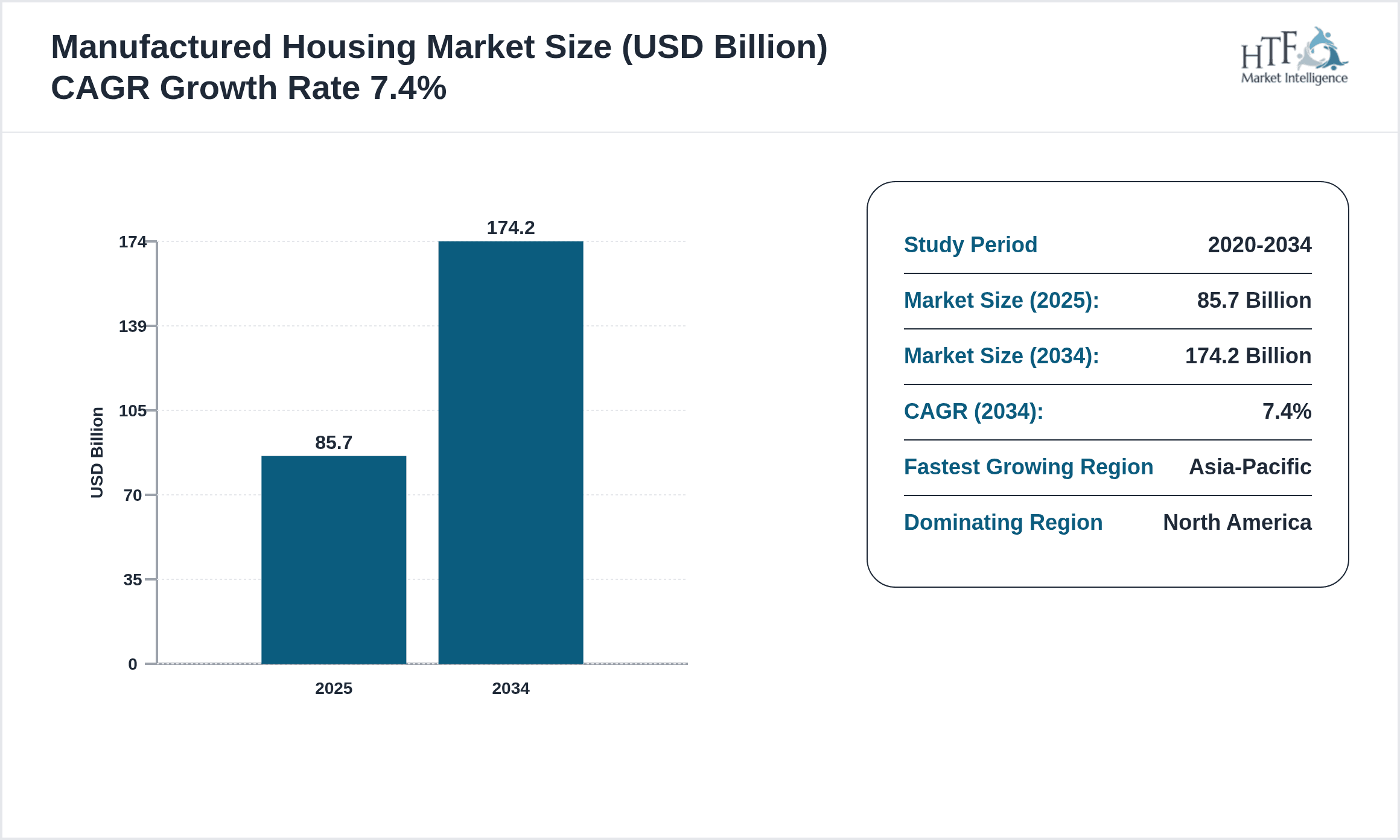
- •The global manufactured housing market is projected to grow from USD 85.7 Billion in 2024 to USD 174.2 Billion by 2034, reflecting a CAGR of 7.4%. Multi-section homes dominate with the largest market share, while panelized housing is the fastest-growing product segment. Residential applications hold the highest penetration, followed by commercial uses. North America leads the market, accounting for the largest share due to mature demand and regulatory frameworks, whereas Asia-Pacific is the fastest-growing region, propelled by rapid urban expansion and government initiatives. Key highlights include increasing investments in modular construction technologies and rising consumer preference for sustainable and affordable housing. Strategic mergers, technology integration, and regional market expansions characterize competitive activities shaping the industry landscape.
- •This market offers significant value propositions by delivering cost-effective, time-efficient, and customizable housing solutions that meet global housing shortages and sustainability goals. Stakeholders such as manufacturers, developers, investors, and policymakers benefit from insights into evolving consumer preferences, technological trends, and regulatory impacts. The industry's strategic importance is underscored by its potential to address socio-economic challenges including disaster relief, affordable housing deficits, and environmental concerns. As the market advances, continuous innovation, regional adaptation, and policy support will be critical to unlocking growth and enhancing global housing accessibility.
Competitive Landscape
The global manufactured housing market is characterized by intense competition among multinational corporations, regional manufacturers, and emerging players focusing on innovation, product differentiation, and regional expansion to capture market share. Leading companies invest heavily in advanced prefabrication technologies, sustainable materials, and modular design to enhance product quality and reduce construction timelines. Competitive strategies include strategic partnerships, acquisitions, and collaborations to broaden geographic reach and diversify product portfolios. Market rivalry is also driven by pricing strategies and customization options tailored to customer segments spanning residential, commercial, and emergency housing needs. Barriers to entry include capital-intensive manufacturing setups and compliance with diverse international standards. Future competitive trends highlight increased emphasis on digitalization, smart home integration, and eco-friendly construction practices to meet evolving consumer and regulatory demands, positioning market leaders for sustained growth in a fragmented yet rapidly consolidating industry landscape.
Key Participants in Manufactured Housing Market
- •Clayton Homes (North America)
- •Cavco Industries (North America)
- •Champion Home Builders (North America)
- •Nobility Homes (North America)
- •Fleetwood Homes (North America)
- •Sekisui House (Asia-Pacific)
- •Sunshine Homes (Asia-Pacific)
- •RedSea Housing Services (Middle East & Africa)
- •Palm Harbor Homes (North America)
- •CIMC Modular Building Systems (Asia-Pacific)
- •Laing O'Rourke (Europe)
- •Modular Building Systems (Europe)
- •Guerdon Modular Buildings (North America)
- •Windsor Homes (North America)
- •Katerra Inc. (North America)
- •Skanska Modular (Europe)
- •Sekisui Chemical Co., Ltd. (Asia-Pacific)
- •Brooks Modular (North America)
- •Modular Space Corporation (North America)
- •Guerdon Modular (Europe)
- •BMarko Structures (North America)
- •RedSea Housing (Middle East & Africa)
- •Schaefer Kalk (Europe)
- •Sonic Modular (Asia-Pacific)
- •Modscape (Asia-Pacific)
Market Breakdown
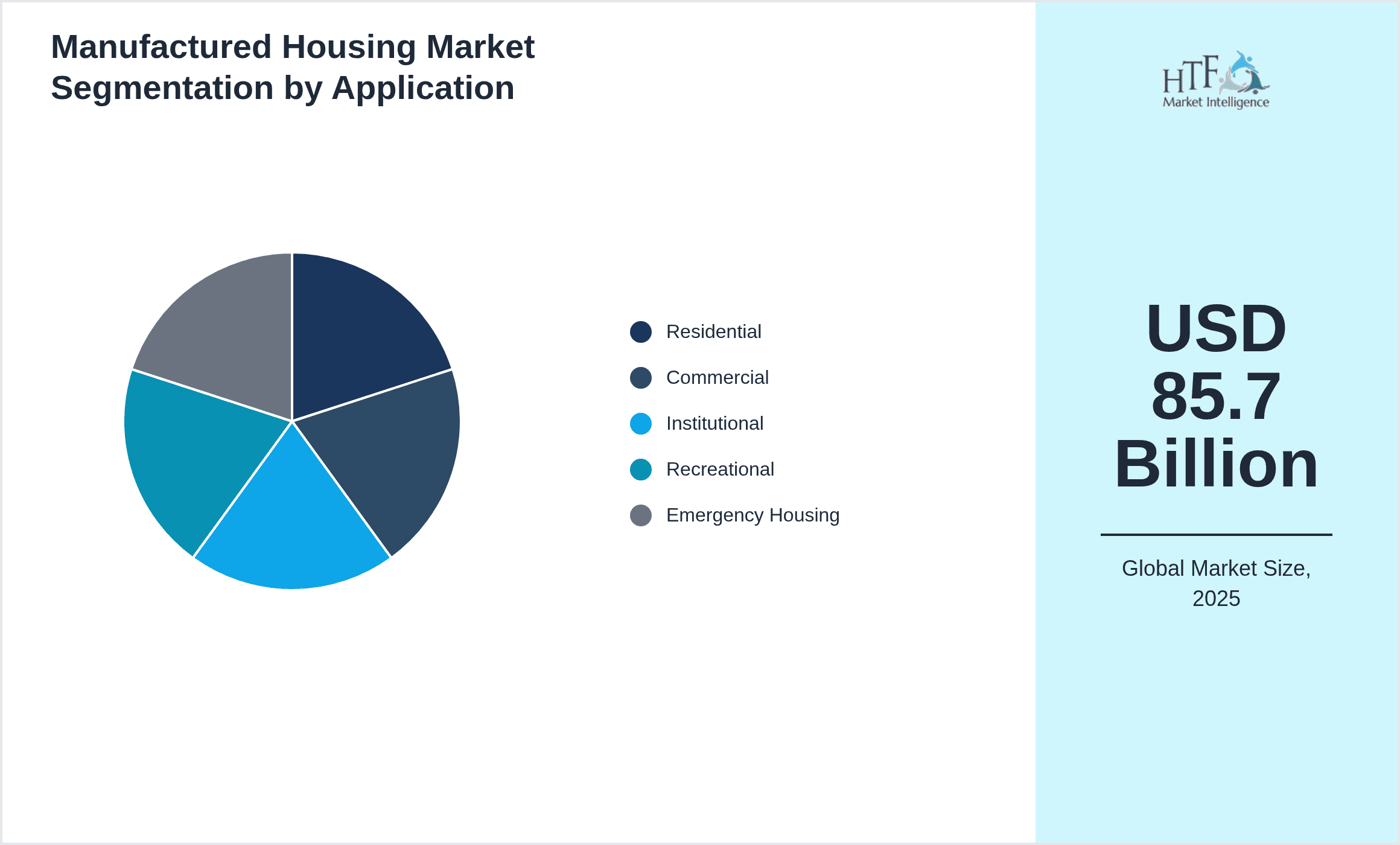
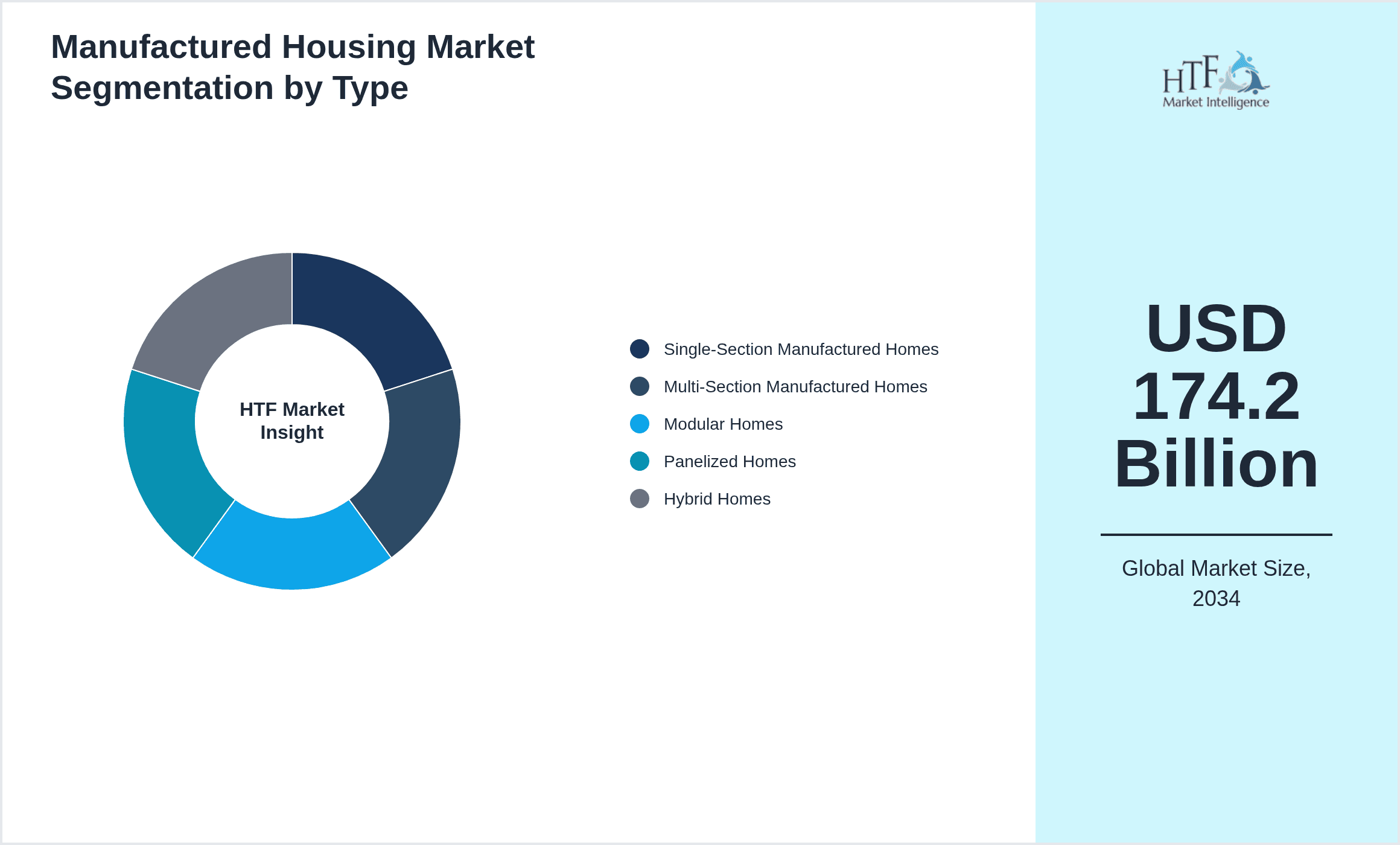
- •By Product Type
- ◦Single-Section Manufactured Homes
- ◦Multi-Section Manufactured Homes
- ◦Modular Homes
- ◦Panelized Homes
- ◦Hybrid Homes
- •By Application
- ◦Residential
- ◦Commercial
- ◦Institutional
- ◦Recreational
- ◦Emergency Housing
- •By End-Use Industry
- ◦Housing Development
- ◦Disaster Relief
- ◦Tourism & Recreation
- ◦Government & Military
- •By Distribution Channel
- ◦Direct Manufacturer Sales
- ◦Dealer Networks
- ◦Online Platforms
Growth Dynamics
The global manufactured housing market is propelled by urbanization and increasing demand for affordable housing solutions amid rising population density. Rapid technological advancements in prefabrication and modular construction techniques enable reduced build times and cost efficiencies, attracting both private and public sector investments. Government initiatives promoting sustainable and disaster-resilient housing further stimulate market expansion by facilitating easy financing and regulatory approvals. Additionally, increasing environmental awareness encourages adoption of energy-efficient and eco-friendly manufactured homes, aligning with global sustainability goals. Consumer preference for customizable and quick-to-deploy housing options boosts demand across residential, commercial, and emergency applications. The integration of smart home technologies and digital design tools supports enhanced living experiences and operational efficiencies, shaping market growth trajectories through 2034.
Market Trends
Market trends highlight a growing emphasis on sustainability with manufacturers adopting green building materials and energy-efficient designs to reduce carbon footprints. The rise of digital twin technology and BIM (Building Information Modeling) enables precise manufacturing and enhanced customization, improving quality and client satisfaction. Increasing collaborations between technology firms and housing manufacturers foster innovation in smart housing solutions integrating IoT and automation. Regionally, Asia-Pacific exhibits rapid adoption driven by urban housing shortages and government incentives. Additionally, disaster-resistant and rapid-deployment housing solutions gain prominence due to increasing natural calamities worldwide. Modular construction is increasingly preferred for its scalability and adaptability in diverse applications including commercial and institutional sectors. These trends collectively advance the manufactured housing market’s evolution towards a technology-driven, sustainable, and customer-centric industry.
Market Opportunities
Significant growth opportunities exist in emerging economies where urban migration and housing deficits are acute, presenting untapped markets for affordable manufactured homes. Innovations in eco-friendly materials and renewable energy integration offer avenues for product differentiation and compliance with tightening environmental regulations. Expansion into disaster relief and emergency housing sectors provides critical social impact benefits and steady demand streams. Adoption of digital platforms for sales and virtual customization can enhance customer engagement and streamline distribution. Partnerships between manufacturers and government agencies facilitate access to subsidies and infrastructure projects, accelerating market penetration. Furthermore, advancements in modular construction allow for diversification into commercial and institutional applications, broadening revenue base. These opportunities underscore the market’s potential for sustainable growth through innovation, strategic alliances, and geographic expansion.
Market Challenges
The manufactured housing market faces challenges including regulatory complexities varying across regions, which can delay approvals and increase compliance costs. High initial capital investment in factory setup and technology integration can be prohibitive for smaller manufacturers, limiting market entry. Consumer perceptions around quality and durability compared to traditional construction methods create adoption barriers in certain markets. Supply chain disruptions, including raw material shortages and transportation constraints, impact production timelines and costs. Additionally, competition from conventional construction and emerging alternative housing solutions intensifies market rivalry. Addressing workforce skill gaps in prefabrication technologies and ensuring consistent quality standards across diverse geographies remain ongoing challenges. These factors necessitate strategic planning and innovation to mitigate risks and sustain market growth amidst evolving dynamics.
Regulatory Framework
From 2023 to 2024, key regulatory updates have emphasized stricter energy efficiency standards and enhanced safety codes for manufactured homes globally. Regions like North America and Europe have introduced mandates requiring compliance with green building certifications such as LEED and Energy Star, encouraging sustainable construction practices. Building codes have been harmonized to facilitate cross-border acceptance of modular units, reducing administrative hurdles. Governments have implemented incentive programs and subsidies to support affordable housing initiatives, especially targeting disaster-prone and underserved areas. Additionally, regulations increasingly address material standards to ensure durability and environmental safety. These evolving frameworks necessitate manufacturers to adapt designs and processes to meet compliance, fostering innovation while ensuring market access and consumer protection.
Market Intelligence
- •15th January 2024, Clayton Homes launched a next-generation modular housing line featuring advanced energy-efficient technologies and customizable smart home integrations targeting urban residential markets worldwide. This product line aims to reduce construction time by 30% and enhance sustainability, addressing growing consumer demand for eco-friendly living spaces. The strategic objective is to expand Clayton Homes’ global footprint by leveraging digital design tools and sustainable materials, positioning the company as a leader in innovative manufactured housing solutions. Source: Official Clayton Homes press release.
- •2nd November 2023, Sekisui House introduced a new panelized housing system in Asia-Pacific that integrates seismic resistance and rapid assembly features to cater to earthquake-prone regions. This innovation supports government disaster mitigation programs and offers scalable solutions for affordable housing projects. The launch reflects Sekisui House’s commitment to combining technology and safety standards, enhancing market competitiveness in the region. Source: Sekisui House corporate announcement.
- •10th August 2024, Cavco Industries announced a strategic partnership with a leading IoT technology firm to integrate smart home automation into its modular housing portfolio. This collaboration aims to enhance user experience through energy management, security, and remote monitoring features, positioning Cavco at the forefront of digital transformation in the manufactured housing market. Source: Industry publication.
- •Market Intelligence: Recent developments and industry insights are being continuously monitored. For the most current information, stakeholders are advised to consult official corporate communications and recognized market intelligence platforms.
Regional Outlook
The North America currently holds a significant share of the market, primarily due to several key factors: increasing consumption rates, a burgeoning population, and robust economic momentum. These elements collectively drive demand, positioning this region as a leader in the market. On the other hand, Asia-Pacific is rapidly emerging as the fastest-growing area within the industry. This remarkable growth can be attributed to swift infrastructure development, the expansion of various industrial sectors, and a marked increase in consumer demand. These dynamics make this region a crucial player in shaping future market growth.
In our report, we cover a comprehensive analysis of the following regions and countries:
- North America
- LATAM
- West Europe
- Central & Eastern Europe
- Northern Europe
- Southern Europe
- East Asia
- Southeast Asia
- South Asia
- Central Asia
- Oceania
- MEA
| Feature | Details |
|---|---|
| Base Year Market Size | USD 85.7 Billion |
| Forecast Year Market Size | USD 174.2 Billion |
| CAGR | 7.4% |
| Forecast Period | 2026 to 2033 |
| YoY Growth | 7.2% |
| Scope of Report | Market is segmented by Product Type (Single-Section Manufactured Homes, Multi-Section Manufactured Homes, Modular Homes, Panelized Homes, Hybrid Homes), Application (Residential, Commercial, Institutional, Recreational, Emergency Housing), End-Use Industry (Housing Development, Disaster Relief, Tourism & Recreation, Government & Military), Distribution Channel (Direct Manufacturer Sales, Dealer Networks, Online Platforms) |
| Regions Covered | North America, LATAM, West Europe, Central & Eastern Europe, Northern Europe, Southern Europe, East Asia, Southeast Asia, South Asia, Central Asia, Oceania, MEA |
| Key Companies | Significant growth opportunities exist in emerging economies where urban migration and housing deficits are acute, presenting untapped markets for affordable manufactured homes. Innovations in eco-friendly materials and renewable energy integration offer avenues for product differentiation and compliance with tightening environmental regulations. Expansion into disaster relief and emergency housing sectors provides critical social impact benefits and steady demand streams. Adoption of digital platforms for sales and virtual customization can enhance customer engagement and streamline distribution. Partnerships between manufacturers and government agencies facilitate access to subsidies and infrastructure projects, accelerating market penetration. Furthermore, advancements in modular construction allow for diversification into commercial and institutional applications, broadening revenue base. These opportunities underscore the market’s potential for sustainable growth through innovation, strategic alliances, and geographic expansion. |
Global Manufactured Housing Market Size, Growth & Revenue 2024-2034 - Table of Contents
Frequently Asked Questions (FAQ):
The Compact Track Loaders market is expected to see value worth 5.3 Billion in 2025.
North America currently leads the market with approximately 45% market share, followed by Europe at 28% and Asia-Pacific at 22%. The remaining regions account for 5% of the global market.
Key growth drivers include increasing construction activities, rising demand for versatile equipment in agriculture, technological advancements in track loader design, and growing preference for compact equipment in urban construction projects.