
Global Optical Coordinate Measuring Machines Market Size, Growth & Revenue 2025-2034
Global Optical Coordinate Measuring Machines Market is segmented by Type (Laser Scanners, Video Measuring Systems, White Light Scanners, Confocal Microscopes, Others), Application (Automotive, Aerospace, Electronics, Medical Devices, General Manufacturing), End-Use Industry (Automotive Manufacturing, Aerospace & Defense, Electronics & Electricals, Healthcare & Medical Devices), Distribution Channel (Direct Sales, Distributors, Online Channels), and Geography (North America, LATAM, West Europe, Central & Eastern Europe, Northern Europe, Southern Europe, East Asia, Southeast Asia, South Asia, Central Asia, Oceania, MEA)
Pricing
Report Overview
Executive Summary
- •Optical Coordinate Measuring Machines represent a vital segment of precision metrology, leveraging optical technologies to provide detailed three-dimensional measurements crucial for quality assurance in multiple high-value industries. These machines utilize non-contact methods like laser scanning and video measurement to capture precise geometric data, enabling manufacturers to adhere to stringent tolerance requirements and optimize product design. The market covers a broad spectrum of applications, including automotive parts inspection, aerospace component analysis, electronics manufacturing, and medical device validation, reflecting its extensive industrial relevance. The adoption of advanced optical technologies increases measurement speed and accuracy, significantly reducing production cycle times and improving overall operational efficiency. The market's scope further includes diverse machine types such as laser scanners, white light scanners, video measuring systems, and confocal microscopes, each offering unique capabilities tailored to specific inspection needs. This comprehensive market analysis highlights the rapid technological advancements and growing demand driven by automation and quality control imperatives globally.
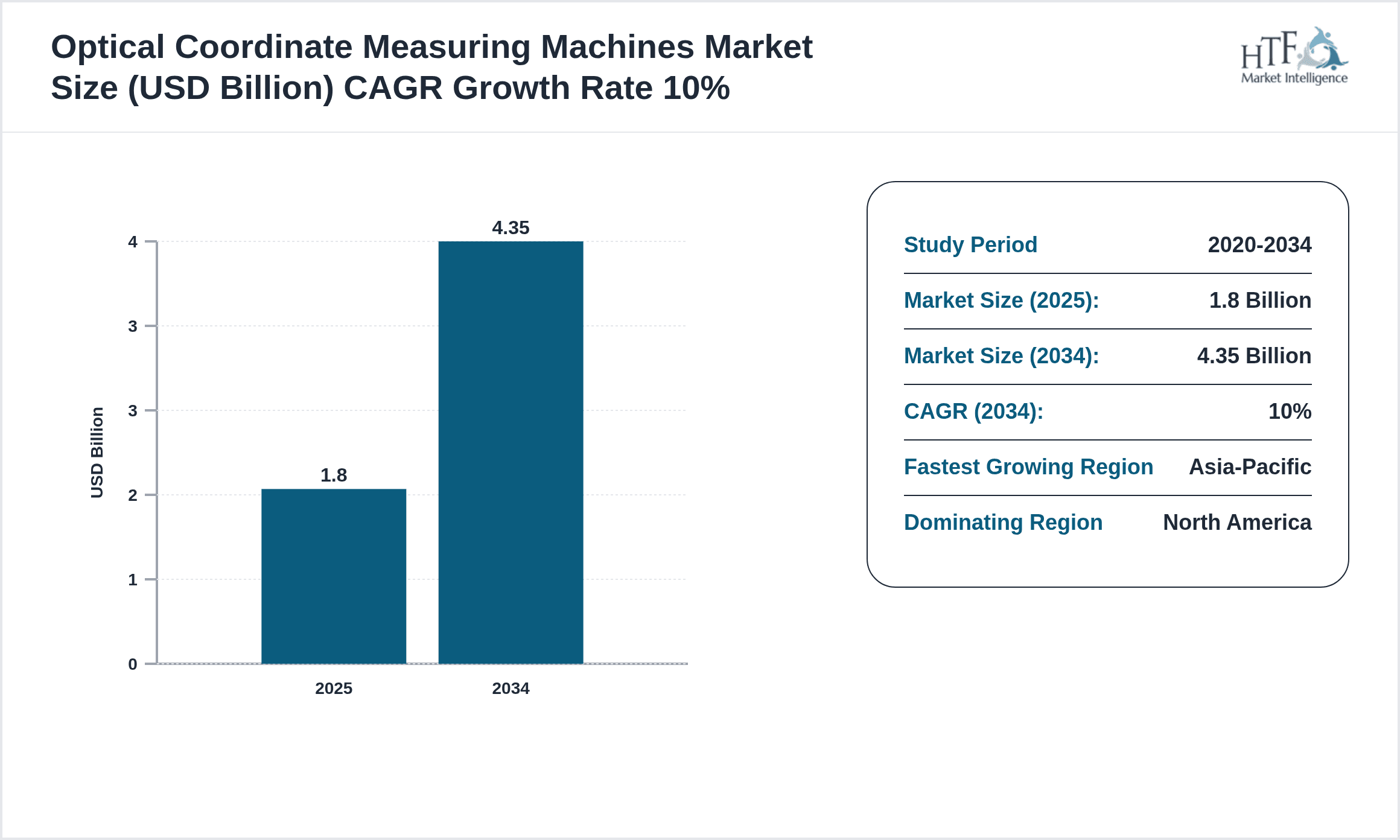
- •The global Optical Coordinate Measuring Machines market reached a base size of USD 1.8 billion in 2025 and is projected to expand to USD 4.35 billion by 2034, exhibiting a robust CAGR of 10.0%. North America currently dominates the market with the largest share, supported by advanced manufacturing infrastructure and extensive adoption of automated quality control systems. Asia-Pacific is the fastest-growing region fueled by rapid industrialization and increasing investments in manufacturing technologies in countries like China, Japan, and South Korea. Laser scanners maintain leadership as the dominant product type, accounting for the highest market share due to their versatility and precision. White light scanners are the fastest-growing segment, driven by innovations that enhance surface measurement accuracy. Automotive and aerospace sectors remain key applications, demanding high precision and reliability in component inspection. The market growth is bolstered by technological advancements, rising quality standards, and growing emphasis on reducing manufacturing defects globally.
- •Optical Coordinate Measuring Machines offer strategic value across industries by enabling faster, more accurate inspection processes which lead to improved product quality and reduced waste. Their non-contact measurement capabilities make them indispensable for sensitive and complex parts where traditional contact methods pose risks of damage or insufficient precision. The integration of these machines in automated production lines supports smart manufacturing initiatives and Industry 4.0 transformations. For stakeholders, including manufacturers, suppliers, and quality assurance providers, investing in optical CMM technologies translates into competitive advantages through enhanced process control, regulatory compliance adherence, and shortened time-to-market for new products. Furthermore, advancements in software integration and data analytics are increasing the functionality and usability of these systems, reinforcing their critical role in modern manufacturing ecosystems worldwide.
Competitive Landscape
The global Optical Coordinate Measuring Machines market is characterized by intense competition among established multinational corporations and emerging technology innovators. Companies are leveraging strategies such as continuous product innovation, strategic partnerships, and global expansion to maintain and enhance their market presence. Product innovation focuses on integrating advanced optical sensors, improving software capabilities for enhanced data analysis, and developing portable and versatile measurement solutions. Partnerships with research institutions and technology providers accelerate development cycles and enable access to emerging technologies. Geographic expansion into high-growth regions such as Asia-Pacific and Latin America is pursued to capitalize on increasing industrialization and rising quality control demands. Competitive pricing strategies and comprehensive after-sales services further differentiate market players. The adoption of Industry 4.0 and smart manufacturing trends compels companies to invest in digital connectivity and automation features within their product offerings. Market entry barriers remain high due to technological complexity and capital intensity, favoring incumbents with established R&D capabilities and distribution networks. Future competition is expected to focus on software integration, AI-enabled measurement analytics, and sustainability-driven innovations.
Leading Companies in Optical Coordinate Measuring Machines Market
- •Hexagon AB (Sweden)
- •Zeiss Group (Germany)
- •Nikon Corporation (Japan)
- •Mitutoyo Corporation (Japan)
- •Faro Technologies Inc. (United States)
- •Jenoptik AG (Germany)
- •Perceptron Inc. (United States)
- •Wenzel Group (Germany)
- •LK Metrology (United Kingdom)
- •Optical Gaging Products (United States)
- •Taylor Hobson (United Kingdom)
- •Creaform (Canada)
- •API Technologies Corp. (United States)
- •Carl Zeiss Industrial Metrology (Germany)
- •OGP Messtechnik GmbH (Germany)
- •Nikon Metrology NV (Belgium)
- •Mitutoyo America Corporation (United States)
- •Hexagon Manufacturing Intelligence (United States)
- •CMM Technologies (United States)
- •Renishaw plc (United Kingdom)

Market Breakdown
- •By Type
- ◦Laser Scanners
- ◦Video Measuring Systems
- ◦White Light Scanners
- ◦Confocal Microscopes
- ◦Others
- •By Application
- ◦Automotive
- ◦Aerospace
- ◦Electronics
- ◦Medical Devices
- ◦General Manufacturing
- •By End-Use Industry
- ◦Automotive Manufacturing
- ◦Aerospace & Defense
- ◦Electronics & Electricals
- ◦Healthcare & Medical Devices
- •By Distribution Channel
- ◦Direct Sales
- ◦Distributors
- ◦Online Channels
Growth Dynamics
Technological advancements in optical sensing and imaging systems significantly accelerate the growth of the Optical Coordinate Measuring Machines market. Enhanced laser scanning precision and integration of AI-driven analytics enable manufacturers to detect defects with unprecedented accuracy and speed. The automotive industry’s increasing demand for high-quality components fuels adoption, with recent launches of electric vehicles necessitating stringent quality checks supported by optical CMMs. Additionally, rising automation and Industry 4.0 initiatives promote the incorporation of these machines into smart factories, enhancing process efficiency and reducing inspection times. Government initiatives aimed at promoting advanced manufacturing technologies in Asia-Pacific further stimulate market expansion. For example, Japan’s investment in automated metrology solutions and China’s manufacturing digitization programs create lucrative growth opportunities. The growing need to minimize material waste and improve product lifecycle management also drives the deployment of optical coordinate measuring machines across sectors. These factors collectively underpin robust market growth and expanding application scopes.

Market Trends
The Optical Coordinate Measuring Machines market is witnessing a surge in adoption of hybrid measurement systems combining optical and tactile technologies, enhancing versatility and measurement accuracy. Increasing integration of cloud-based data management and IoT connectivity enables real-time monitoring and remote inspections, aligning with Industry 4.0 standards. Furthermore, miniaturization trends facilitate portable and handheld optical CMM devices, broadening usability in field applications and small batch manufacturing. Software innovations focusing on AI and machine learning improve defect detection capabilities and predictive maintenance. Companies are also investing in sustainability by developing energy-efficient machines and eco-friendly manufacturing processes. Recent industry developments include collaborations to integrate augmented reality (AR) for interactive measurement visualization, enhancing operator efficiency. These trends indicate a shift toward smarter, connected, and environmentally conscious metrology solutions that cater to evolving industrial demands and compliance requirements worldwide.

Market Opportunities
Expanding industrial automation and smart factory implementations offer significant growth opportunities for optical coordinate measuring machines globally. Emerging economies in Asia-Pacific and Latin America are investing heavily in manufacturing infrastructure upgrades, presenting untapped markets for advanced metrology tools. The rise of electric vehicles and aerospace innovations demands ultra-precise component inspection, creating new application segments. Integration of AI and big data analytics within optical CMMs opens avenues for enhanced quality control and predictive maintenance, enabling companies to reduce costs and improve product reliability. Additionally, growing adoption in healthcare for medical device validation and electronics for micro-component inspection diversifies market potential. Strategic partnerships between metrology companies and technology providers for customized solutions will further accelerate market penetration. Opportunities also exist in developing portable, user-friendly devices tailored to small and medium enterprises, broadening accessibility and fostering inclusive growth within the sector.
Market Challenges
High initial capital investment and complexity of optical coordinate measuring machines restrict adoption among small and medium-sized enterprises, limiting market penetration. The need for skilled operators and ongoing maintenance adds to operational costs and presents barriers in regions with limited technical expertise. Technical challenges related to measurement accuracy on reflective or transparent surfaces require continuous innovation and calibration efforts, increasing R&D expenses for manufacturers. Market growth is also restrained by competition from traditional tactile CMMs in certain applications where cost considerations dominate. Supply chain disruptions and component shortages during recent geopolitical uncertainties have impacted production schedules and delivery timelines. Furthermore, stringent regulatory standards across different regions necessitate compliance adaptations, complicating international market entry. These challenges collectively hinder rapid adoption and require strategic initiatives focusing on cost reduction, training, and technological advancements to ensure sustained market growth.
Regulatory Framework
In the past five years, key regulations such as the ISO 10360 series have been updated to standardize acceptance and verification tests for coordinate measuring machines globally, enhancing measurement reliability and consistency. Regional compliance requirements, including the European Union’s Machinery Directive and the United States’ ANSI standards, enforce stringent safety and operational guidelines applicable to optical CMM manufacturers and users. Additionally, data security regulations related to Industry 4.0 implementations require secure handling of measurement data, prompting companies to adopt advanced cybersecurity measures. Environmental regulations encourage energy-efficient machine designs and reduction of hazardous materials in production. These evolving regulatory landscapes necessitate continuous adaptation by market players to ensure compliance and maintain competitive advantage in international markets.
Market Intelligence
- •Recent market developments and strategic initiatives are continuously tracked through industry publications, company announcements, and regulatory filings. For the most current information, stakeholders are advised to monitor official corporate communications and recognized market intelligence platforms.
- •Recent market developments and strategic initiatives are continuously tracked through industry publications, company announcements, and regulatory filings. For the most current information, stakeholders are advised to monitor official corporate communications and recognized market intelligence platforms.
- •Recent market developments and strategic initiatives are continuously tracked through industry publications, company announcements, and regulatory filings. For the most current information, stakeholders are advised to monitor official corporate communications and recognized market intelligence platforms.
- •Recent market developments and strategic initiatives are continuously tracked through industry publications, company announcements, and regulatory filings. For the most current information, stakeholders are advised to monitor official corporate communications and recognized market intelligence platforms.
- •Source: Industry Publications, Company Announcements, Regulatory Filings
Regional Outlook
The North America currently holds a significant share of the market, primarily due to several key factors: increasing consumption rates, a burgeoning population, and robust economic momentum. These elements collectively drive demand, positioning this region as a leader in the market. On the other hand, Asia-Pacific is rapidly emerging as the fastest-growing area within the industry. This remarkable growth can be attributed to swift infrastructure development, the expansion of various industrial sectors, and a marked increase in consumer demand. These dynamics make this region a crucial player in shaping future market growth.
In our report, we cover a comprehensive analysis of the following regions and countries:
- North America
- LATAM
- West Europe
- Central & Eastern Europe
- Northern Europe
- Southern Europe
- East Asia
- Southeast Asia
- South Asia
- Central Asia
- Oceania
- MEA
| Feature | Details |
|---|---|
| Base Year Market Size | USD 1.8 Billion |
| Forecast Year Market Size | USD 4.35 Billion |
| CAGR | 10% |
| Forecast Period | 2026 to 2033 |
| YoY Growth | 9.6% |
| Scope of Report | Market is segmented by Type (Laser Scanners, Video Measuring Systems, White Light Scanners, Confocal Microscopes, Others), Application (Automotive, Aerospace, Electronics, Medical Devices, General Manufacturing), End-Use Industry (Automotive Manufacturing, Aerospace & Defense, Electronics & Electricals, Healthcare & Medical Devices), Distribution Channel (Direct Sales, Distributors, Online Channels) |
| Regions Covered | North America, LATAM, West Europe, Central & Eastern Europe, Northern Europe, Southern Europe, East Asia, Southeast Asia, South Asia, Central Asia, Oceania, MEA |
| Key Companies | Hexagon AB (Sweden), Zeiss Group (Germany), Nikon Corporation (Japan), Mitutoyo Corporation (Japan), Faro Technologies Inc. (United States), Jenoptik AG (Germany), Perceptron Inc. (United States), Wenzel Group (Germany), LK Metrology (United Kingdom), Optical Gaging Products (United States), Taylor Hobson (United Kingdom), Creaform (Canada), API Technologies Corp. (United States), Carl Zeiss Industrial Metrology (Germany), OGP Messtechnik GmbH (Germany), Nikon Metrology NV (Belgium), Mitutoyo America Corporation (United States), Hexagon Manufacturing Intelligence (United States), CMM Technologies (United States), Renishaw plc (United Kingdom) |
Global Optical Coordinate Measuring Machines Market Size, Growth & Revenue 2025-2034 - Table of Contents
Frequently Asked Questions (FAQ):
The Compact Track Loaders market is expected to see value worth 5.3 Billion in 2025.
North America currently leads the market with approximately 45% market share, followed by Europe at 28% and Asia-Pacific at 22%. The remaining regions account for 5% of the global market.
Key growth drivers include increasing construction activities, rising demand for versatile equipment in agriculture, technological advancements in track loader design, and growing preference for compact equipment in urban construction projects.