
Global Tapioca Starch Market Size, Growth & Revenue 2025-2034
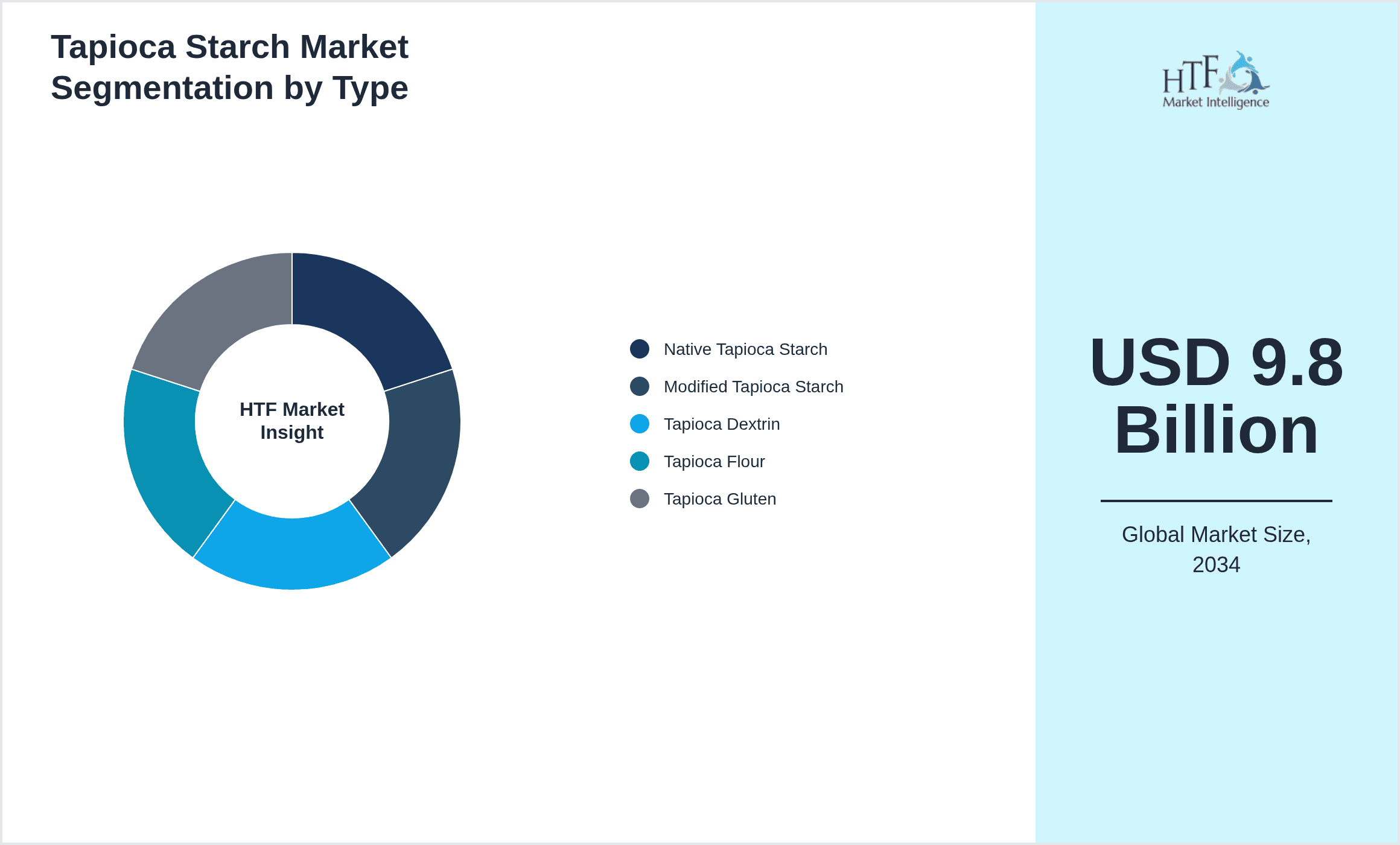
Global Tapioca Starch Market is segmented by Product Type (Native Tapioca Starch, Modified Tapioca Starch, Tapioca Dextrin, Tapioca Flour, Tapioca Gluten), Application (Food Industry, Paper Industry, Textile Industry, Pharmaceuticals, Adhesives), End-Use Industry (Food & Beverage, Paper & Packaging, Textiles, Pharmaceuticals), Distribution Channel (Direct Sales, Distributors, Online Retail), and Geography (North America, LATAM, West Europe, Central & Eastern Europe, Northern Europe, Southern Europe, East Asia, Southeast Asia, South Asia, Central Asia, Oceania, MEA)
Pricing
Report Overview
Executive Summary
- •The global tapioca starch market is defined by the extraction and commercialization of starch derived from cassava roots, a key agricultural commodity predominantly cultivated in tropical regions. This starch serves as a critical ingredient across diverse applications including the food industry, where it functions as a gluten-free thickening agent, stabilizer, and texture enhancer; the paper industry, contributing to improved paper strength and quality; the textile industry, offering finishing and sizing benefits; pharmaceuticals, where it acts as a binder and disintegrant in drug formulations; and adhesives manufacturing. The market segments into various product types such as native tapioca starch, which is unmodified and used for general purposes; modified tapioca starch, chemically or physically altered to enhance specific properties; tapioca dextrin, employed as a binding agent; tapioca flour, a coarser starch form; and tapioca gluten, a protein component. Key market drivers include rising consumer preference for natural and gluten-free ingredients, growing demand in emerging economies, and technological innovations in starch modification. Challenges such as price volatility of raw cassava and regulatory compliance are also shaping market dynamics. The competitive landscape features established multinational corporations and regional producers leveraging strategic partnerships and product innovation to expand their market presence globally.
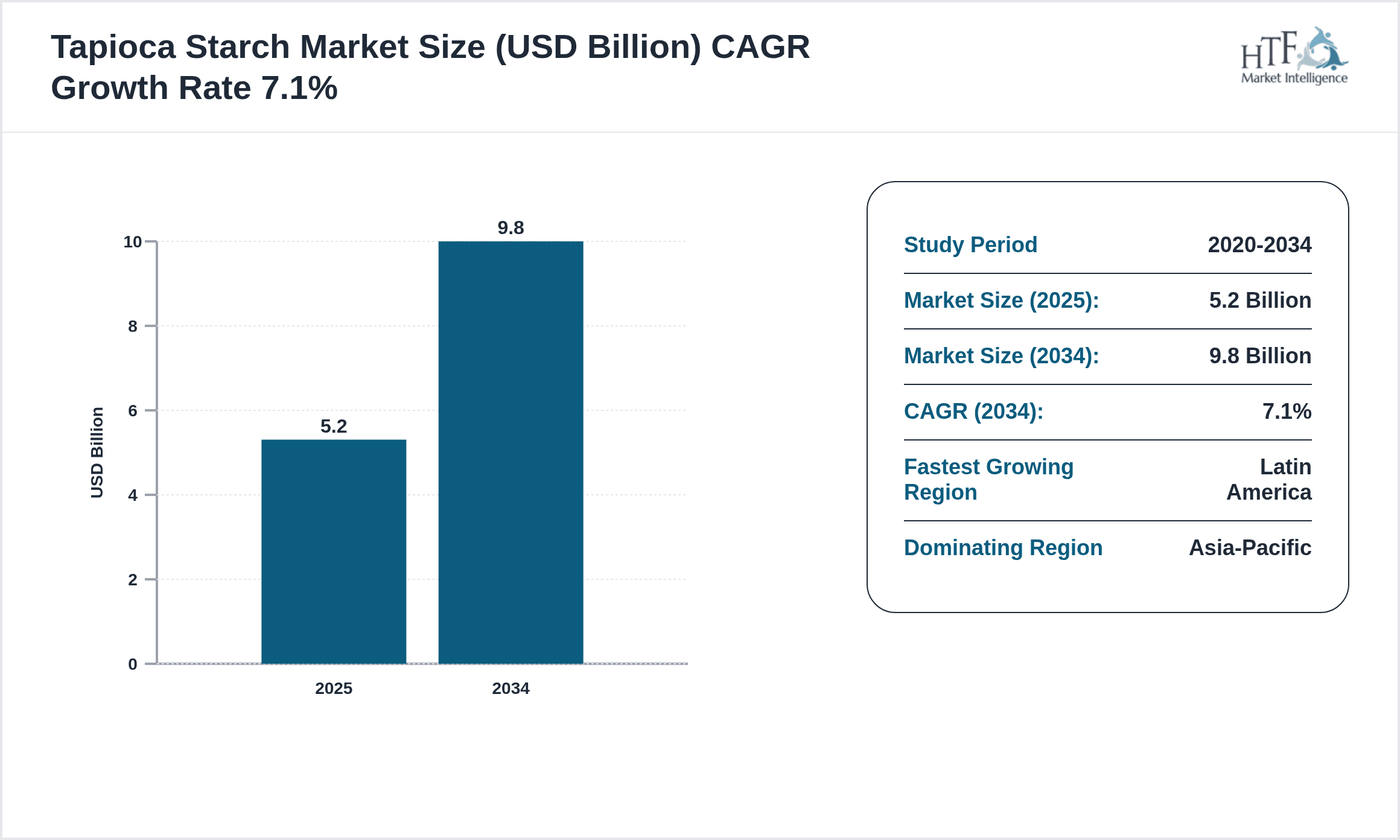
- •In 2025, the global tapioca starch market is valued at USD 5.2 Billion, with projections estimating growth to USD 9.8 Billion by 2034 at a CAGR of 7.1%. The Asia-Pacific region remains the dominant market due to extensive cassava cultivation and high consumption across food and industrial applications. Latin America is identified as the fastest growing region, driven by expanding agricultural production and increasing industrial use. Market growth is supported by trends such as the rising demand for clean-label and sustainable food ingredients, innovations in starch modification technologies, and expanding applications in pharmaceuticals and biodegradable adhesives. However, challenges including price fluctuations, supply chain disruptions, and stringent regulatory standards pose constraints to rapid expansion.
- •The tapioca starch market offers significant value propositions to stakeholders by providing a natural, biodegradable, and versatile raw material that caters to multiple industrial sectors. Its strategic importance lies in meeting consumer demands for gluten-free and sustainable products, supporting eco-friendly manufacturing processes, and enabling innovation in product formulations. For food manufacturers, tapioca starch enhances texture and shelf life, while in paper and textile sectors it improves product durability and finish. Pharmaceutical companies benefit from its binding and disintegration properties facilitating effective drug delivery. Investors and producers can capitalize on emerging markets and technological advancements to strengthen competitive positioning and capture new growth avenues globally.
Competitive Landscape
The global tapioca starch market is characterized by a competitive environment where key players focus on product innovation, strategic collaborations, and capacity expansions to consolidate market presence. Industry leaders invest heavily in research and development to enhance starch modification techniques, aiming to improve product functionality and cater to evolving application needs across food, pharmaceuticals, and industrial sectors. Market competition is also driven by pricing strategies amidst raw material price volatility, necessitating efficient supply chain management and cost optimization. Strategic partnerships and mergers are utilized to access new geographies and technologies, while companies emphasize sustainability and natural sourcing to meet regulatory and consumer expectations. Regional producers compete by leveraging local cassava cultivation advantages, creating a diverse and dynamic market landscape. Emerging players are adopting niche product development and customization to differentiate offerings, contributing to increased market fragmentation. The competitive landscape is expected to evolve with technological advancements, regulatory changes, and growing demand for sustainable starch alternatives, shaping future market trajectories.
Key Participants in Tapioca Starch Market
- •Cargill, Incorporated (United States)
- •Tate & Lyle PLC (United Kingdom)
- •Ingredion Incorporated (United States)
- •Roquette Frères (France)
- •Südzucker AG (Germany)
- •ADM (Archer Daniels Midland Company) (United States)
- •Penford Corporation (United States)
- •PT Indofood Sukses Makmur Tbk (Indonesia)
- •Jiangsu Yabang Dyestuff Technology Co., Ltd. (China)
- •AVEBE (Netherlands)
- •Emsland Group (Germany)
- •Sinarmas Group (Indonesia)
- •National Starch and Chemical Company (United States)
- •Mitsubishi Corporation (Japan)
- •Yihai Kerry Arawana Holdings Co., Ltd. (China)
- •Tapioca Enterprises Pvt. Ltd. (India)
- •MGP Ingredients, Inc. (United States)
- •Crown Flour Mills Ltd (Nigeria)
- •PT Panca Amara Utama (Indonesia)
- •Linyi Luhua Starch Co., Ltd. (China)
- •Noble Group Limited (Hong Kong)
- •PT Singa Agro Persada (Indonesia)
- •Taiwan Starch Co., Ltd. (Taiwan)
- •Tapioca Starch Industries Ltd. (Thailand)
- •Hubei Green Health Biotechnology Co., Ltd. (China)

Market Breakdown
- •By Product Type
- ◦Native Tapioca Starch
- ◦Modified Tapioca Starch
- ◦Tapioca Dextrin
- ◦Tapioca Flour
- ◦Tapioca Gluten
- •By Application
- ◦Food Industry
- ◦Paper Industry
- ◦Textile Industry
- ◦Pharmaceuticals
- ◦Adhesives
- •By End-Use Industry
- ◦Food & Beverage
- ◦Paper & Packaging
- ◦Textiles
- ◦Pharmaceuticals
- •By Distribution Channel
- ◦Direct Sales
- ◦Distributors
- ◦Online Retail
Growth Dynamics
The global tapioca starch market is propelled by increasing consumer demand for natural and gluten-free food ingredients, which has significantly expanded its adoption in various food processing applications. Additionally, the growing paper and textile industries in emerging economies require tapioca starch for enhancing product quality, durability, and sustainability, further driving market expansion. Technological advancements in the modification of tapioca starch have enabled the creation of specialized starches with improved functionalities such as better viscosity, stability, and texture, catering to diverse industrial needs. Rising awareness regarding sustainable and biodegradable raw materials also supports increased usage of tapioca starch as an eco-friendly alternative to synthetic polymers. Furthermore, expanding pharmaceutical applications, leveraging tapioca starch as an excipient in drug formulations, contribute to the market's robust growth trajectory over the forecast period.
Market Trends
A key trend in the tapioca starch market is the shift towards clean-label and natural ingredients in food and beverage products, driving manufacturers to prefer tapioca starch over synthetic additives. Innovations in starch modification techniques, including physical and enzymatic methods, are enabling customized starches with enhanced properties tailored for specific applications. There is also a growing trend toward the use of tapioca starch in biodegradable packaging and adhesive solutions, aligning with global sustainability goals. Increased adoption of tapioca starch in pharmaceutical formulations as a binder and disintegrant reflects its expanding functional roles beyond traditional sectors. Additionally, strategic collaborations between starch producers and end-use industries are becoming common to foster product innovation and improve market reach.
Market Opportunities
The tapioca starch market presents significant opportunities in developing novel modified starches to meet the specialized demands of the food, pharmaceutical, and packaging industries. Emerging markets in Latin America and Middle East & Africa offer untapped potential due to expanding industrialization and growing consumer awareness of natural ingredients. There is also opportunity in leveraging tapioca starch for biodegradable and sustainable product applications, which aligns with increasing regulatory support for eco-friendly materials. Investment in advanced processing technologies can enhance product quality and diversify application segments. Collaborations and joint ventures between cassava producers and starch manufacturers can optimize supply chains and reduce raw material costs, further unlocking growth potential.
Market Challenges
The tapioca starch market faces challenges including the volatility of raw cassava prices, which can impact production costs and pricing strategies. Supply chain disruptions caused by climatic conditions and geopolitical factors pose risks to consistent raw material availability. Regulatory compliance across different regions, especially regarding food safety and environmental standards, requires continuous monitoring and adaptation by producers. Competition from alternative starch sources such as corn and potato starch can limit market share growth. Additionally, technological limitations in processing and modification can constrain product innovation and functional enhancements. Addressing these challenges is critical for sustained market growth and competitive advantage.
Regulatory Framework
Between 2020 and 2025, several key regulations have shaped the global tapioca starch market. The Food Safety Modernization Act (FSMA) enacted in the United States mandates stringent safety protocols for starch producers, impacting processing and quality control measures. The European Union's Regulation (EC) No 1333/2008 on food additives sets standards for starch use in food products, requiring compliance for market access. In Asia-Pacific, countries like China and India have implemented updated agricultural and food safety regulations to ensure sustainable sourcing and product safety, influencing tapioca starch production practices. Environmental regulations targeting sustainable agricultural practices and waste management have gained prominence worldwide, promoting eco-friendly starch production. Additionally, labeling regulations emphasizing clean-label and allergen information have affected marketing and product formulation strategies globally, requiring manufacturers to adapt accordingly.
Market Intelligence
- •15th January 2025, Cargill, Incorporated launched a new range of modified tapioca starch products designed specifically for the pharmaceutical industry, offering enhanced binding properties and improved solubility to support advanced drug delivery systems. This product line aims to meet rising demand for natural excipients in oral and topical formulations. The launch includes detailed technical support and collaboration with pharmaceutical manufacturers to optimize formulation processes, positioning Cargill as a leader in starch innovation. This strategic introduction is expected to strengthen Cargill's presence in the pharmaceutical excipients market globally. Source: Cargill Official Press Release
- •20th March 2025, Tate & Lyle PLC announced the expansion of its tapioca starch production capacity in Southeast Asia with the commissioning of a new facility in Indonesia. The state-of-the-art plant incorporates advanced enzymatic modification technologies to produce high-quality specialized starches catering to food, paper, and textile industries. This expansion aligns with growing regional demand and sustainability initiatives, enabling Tate & Lyle to enhance supply chain resilience and meet evolving customer requirements. The company aims to leverage this investment to capture significant market share in Asia-Pacific. Source: Tate & Lyle Corporate News
- •5th June 2025, Ingredion Incorporated announced a strategic partnership with a leading cassava producer in Latin America to secure raw material supply and jointly develop innovative tapioca starch variants for the adhesive sector. This collaboration focuses on tailoring starch functionalities to improve adhesive performance and environmental sustainability. By combining Ingredion's modification expertise and the partner's agricultural capabilities, the alliance aims to accelerate product development and market penetration in the Americas. This initiative is expected to enhance competitive positioning and drive revenue growth. Source: Ingredion Investor Relations
- •Recent market developments and strategic initiatives are continuously tracked through industry publications, company announcements, and regulatory filings. For the most current information, stakeholders are advised to monitor official corporate communications and recognized market intelligence platforms.
Regional Outlook
The Asia-Pacific currently holds a significant share of the market, primarily due to several key factors: increasing consumption rates, a burgeoning population, and robust economic momentum. These elements collectively drive demand, positioning this region as a leader in the market. On the other hand, Latin America is rapidly emerging as the fastest-growing area within the industry. This remarkable growth can be attributed to swift infrastructure development, the expansion of various industrial sectors, and a marked increase in consumer demand. These dynamics make this region a crucial player in shaping future market growth.
In our report, we cover a comprehensive analysis of the following regions and countries:
- North America
- LATAM
- West Europe
- Central & Eastern Europe
- Northern Europe
- Southern Europe
- East Asia
- Southeast Asia
- South Asia
- Central Asia
- Oceania
- MEA
| Feature | Details |
|---|---|
| Base Year Market Size | USD 5.2 Billion |
| Forecast Year Market Size | USD 9.8 Billion |
| CAGR | 7.1% |
| Forecast Period | 2026 to 2033 |
| YoY Growth | 7% |
| Scope of Report | Market is segmented by Product Type (Native Tapioca Starch, Modified Tapioca Starch, Tapioca Dextrin, Tapioca Flour, Tapioca Gluten), Application (Food Industry, Paper Industry, Textile Industry, Pharmaceuticals, Adhesives), End-Use Industry (Food & Beverage, Paper & Packaging, Textiles, Pharmaceuticals), Distribution Channel (Direct Sales, Distributors, Online Retail) |
| Regions Covered | North America, LATAM, West Europe, Central & Eastern Europe, Northern Europe, Southern Europe, East Asia, Southeast Asia, South Asia, Central Asia, Oceania, MEA |
| Key Companies | The tapioca starch market presents significant opportunities in developing novel modified starches to meet the specialized demands of the food, pharmaceutical, and packaging industries. Emerging markets in Latin America and Middle East & Africa offer untapped potential due to expanding industrialization and growing consumer awareness of natural ingredients. There is also opportunity in leveraging tapioca starch for biodegradable and sustainable product applications, which aligns with increasing regulatory support for eco-friendly materials. Investment in advanced processing technologies can enhance product quality and diversify application segments. Collaborations and joint ventures between cassava producers and starch manufacturers can optimize supply chains and reduce raw material costs, further unlocking growth potential. |
Global Tapioca Starch Market Size, Growth & Revenue 2025-2034 - Table of Contents
Multidisciplinary researcher with 10+ years of experience uncovering insights across diverse domains focused on uncovering insights that drive informed decisions.
Frequently Asked Questions (FAQ):
The Compact Track Loaders market is projected to grow at a CAGR of 6.8% from 2025 to 2030, driven by increasing demand in construction and agricultural sectors.
North America currently leads the market with approximately 45% market share, followed by Europe at 28% and Asia-Pacific at 22%. The remaining regions account for 5% of the global market.
Key growth drivers include increasing construction activities, rising demand for versatile equipment in agriculture, technological advancements in track loader design, and growing preference for compact equipment in urban construction projects.