
Global Biaxially Oriented Polyamide Films Market Size, Growth & Revenue 2025-2034
Global Biaxially Oriented Polyamide (BOPA) Films Market is segmented by Product Type (Standard Biaxially Oriented Polyamide (BOPA) Films, High Barrier Biaxially Oriented Polyamide Films, Transparent Biaxially Oriented Polyamide Films, Metallized Biaxially Oriented Polyamide Films, Coated Biaxially Oriented Polyamide Films), Application (Food Packaging, Industrial Packaging, Electrical & Electronics, Automotive, Medical), End-Use Industry (Food & Beverage, Pharmaceuticals, Automotive Components, Consumer Electronics), Distribution Channel (Direct Sales, Distributors, Converters), and Geography (North America, LATAM, West Europe, Central & Eastern Europe, Northern Europe, Southern Europe, East Asia, Southeast Asia, South Asia, Central Asia, Oceania, MEA)
Pricing
Report Overview
Executive Summary
- •The global Biaxially Oriented Polyamide (BOPA) Films market is a rapidly evolving sector characterized by the production and application of specialized polyamide films that are biaxially stretched to improve strength, clarity, and barrier performance. These films serve diverse industries including food packaging, where they protect perishable goods with excellent oxygen and moisture barriers; industrial packaging, offering durability and chemical resistance; automotive and electronics sectors, demanding thermal stability and electrical insulation; and the medical field, requiring sterile and protective packaging solutions. The market is segmented into various product types such as standard BOPA films, metallized films that provide enhanced barrier properties, coated films offering surface modifications, transparent films for visibility, and high barrier films for superior protection. Technological advancements in coating and metallization techniques have expanded the applications and improved performance characteristics. Additionally, increasing consumer demand for sustainable packaging and regulatory pressures for food safety drive innovation and market growth. The BOPA films market is highly competitive with numerous global and regional players focusing on product differentiation, strategic partnerships, and capacity expansions to capture market share. Market dynamics are also influenced by raw material availability, fluctuating polymer prices, and evolving end-user requirements. This comprehensive analysis covers historical trends since 2020, base year 2025 data, and forecasts through 2034, providing insights into growth drivers, challenges, regional performance, and technological developments shaping the future of BOPA films globally.
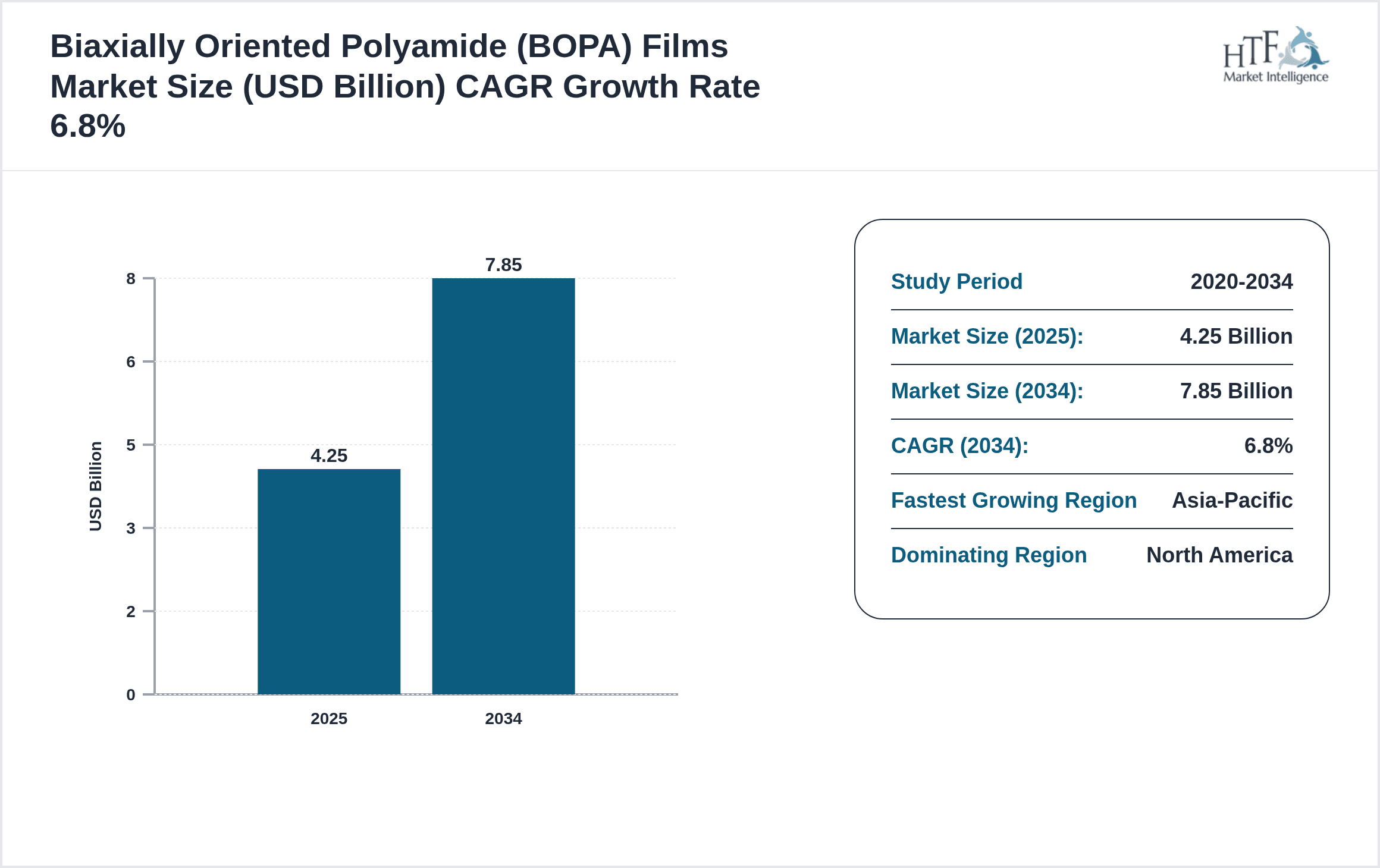
- •Key market highlights include a base market size of USD 4.25 billion in 2025 with a forecasted growth to USD 7.85 billion by 2034, reflecting a CAGR of approximately 6.8%. North America currently dominates the market due to established packaging industries and advanced manufacturing infrastructure, while Asia-Pacific is the fastest-growing region driven by expanding food and industrial packaging sectors, increasing urbanization, and rising disposable incomes. High barrier BOPA films lead the product segment owing to their enhanced protective properties essential for sensitive food and pharmaceutical packaging. Coated BOPA films demonstrate the fastest growth rate, fueled by demand for improved surface characteristics and compatibility with printing and lamination. The market exhibits strong year-on-year growth near 6.5%, supported by innovation and increasing adoption across emerging applications. Strategic importance lies in the films’ ability to replace traditional materials, offering superior performance and enabling compliance with environmental and safety regulations, thereby appealing to diverse stakeholders from manufacturers to end users.
- •The value proposition of BOPA films is grounded in their unique combination of mechanical strength, barrier properties, and versatility. These attributes enable industries such as food and beverage, pharmaceuticals, automotive, and electronics to enhance product protection, extend shelf life, and improve consumer appeal. As sustainability trends gain momentum, BOPA films’ recyclability and compatibility with eco-friendly packaging systems further increase their strategic relevance. Industry participants benefit from investing in advanced film technologies, tapping into growing demand for high-performance packaging solutions, and leveraging market expansion across developing regions. The market’s growth trajectory is underpinned by continuous innovation, regulatory frameworks promoting food safety and environmental standards, and expanding end-user industries seeking differentiation through superior packaging materials.
Competitive Landscape
The global Biaxially Oriented Polyamide (BOPA) Films market features a highly competitive environment with numerous multinational corporations and regional manufacturers vying for market share. Companies focus on strategic initiatives such as product innovation, capacity expansion, and geographic diversification to maintain and enhance their competitive positioning. Innovation in coating technologies and barrier enhancements are key differentiators allowing firms to cater to specialized applications including high-barrier food packaging and advanced industrial uses. Market players adopt pricing strategies that balance cost competitiveness with value-added features, while partnerships and joint ventures facilitate access to emerging markets and new customer segments. Mergers and acquisitions, though limited recently, remain a strategic tool for consolidation and capability expansion. Distribution channels are diversified, with direct sales complemented by distributors and converters to serve wide end-user industries efficiently. Challenges such as raw material price volatility and regulatory compliance add complexity to market competition. Regional competition dynamics vary, with North America and Europe hosting established players, while Asia-Pacific sees rapid market entry from local and international firms. Looking ahead, competitive trends indicate a focus on sustainability, digitalization of supply chains, and alignment with circular economy principles to address evolving consumer and regulatory demands.
Prominent Players in Biaxially Oriented Polyamide Films Market
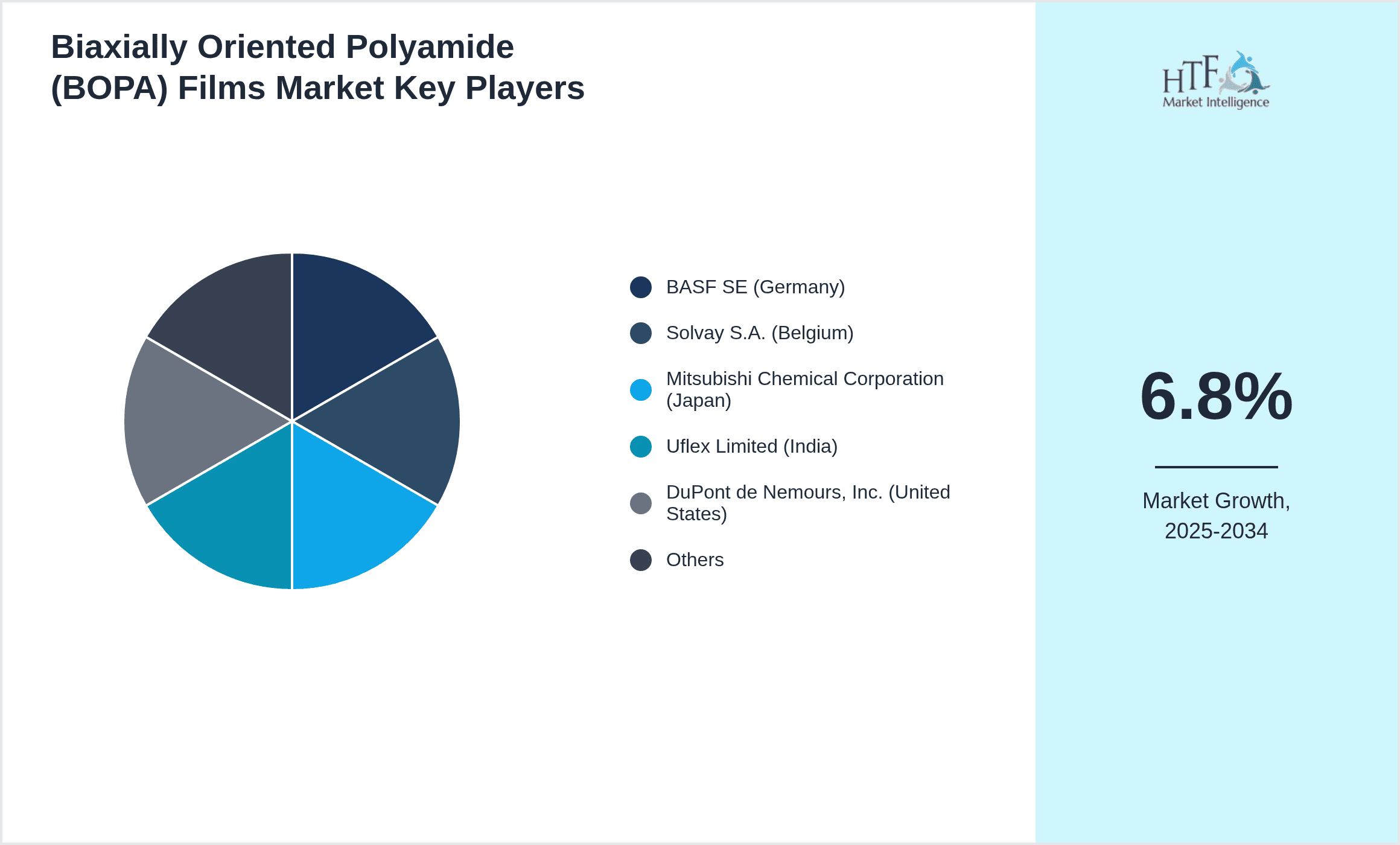
- •BASF SE (Germany)
- •Solvay S.A. (Belgium)
- •Mitsubishi Chemical Corporation (Japan)
- •Uflex Limited (India)
- •DuPont de Nemours, Inc. (United States)
- •Toray Industries, Inc. (Japan)
- •Kolon Industries, Inc. (South Korea)
- •Jindal Poly Films Ltd (India)
- •Innovia Films Ltd (United Kingdom)
- •SKC Co., Ltd. (South Korea)
- •Amcor plc (Australia)
- •Constantia Flexibles Group GmbH (Austria)
- •Sealed Air Corporation (United States)
- •Mondi Group (United Kingdom)
- •Clondalkin Group Holdings B.V. (Netherlands)
- •Taghleef Industries (United Arab Emirates)
- •Bemis Company, Inc. (United States)
- •UFP Technologies, Inc. (United States)
- •Berry Global, Inc. (United States)
- •Covestro AG (Germany)
- •Mitsui Chemicals, Inc. (Japan)
- •Avery Dennison Corporation (United States)
- •Polyplex Corporation Limited (India)
- •Schoeller Holdings AG (Switzerland)
- •Winpak Ltd. (Canada)

Market Breakdown
- •By Product Type
- ◦Standard Biaxially Oriented Polyamide (BOPA) Films
- ◦High Barrier Biaxially Oriented Polyamide Films
- ◦Transparent Biaxially Oriented Polyamide Films
- ◦Metallized Biaxially Oriented Polyamide Films
- ◦Coated Biaxially Oriented Polyamide Films
- •By Application
- ◦Food Packaging
- ◦Industrial Packaging
- ◦Electrical & Electronics
- ◦Automotive
- ◦Medical
- •By End-Use Industry
- ◦Food & Beverage
- ◦Pharmaceuticals
- ◦Automotive Components
- ◦Consumer Electronics
- •By Distribution Channel
- ◦Direct Sales
- ◦Distributors
- ◦Converters
Growth Dynamics
The global BOPA films market growth is primarily driven by escalating demand for high-performance packaging materials that extend shelf life and improve product safety, especially in the food and pharmaceutical industries. Increasing urbanization and changing consumer lifestyles worldwide have resulted in growing demand for packaged and processed foods, which require reliable barrier films. Technological advancements in film coatings and metallization have enhanced product properties, facilitating entry into new applications such as automotive insulation and electronics. Additionally, regulatory mandates on food safety and sustainability encourage manufacturers to adopt recyclable and compostable packaging solutions, further boosting BOPA films demand. The rising trend towards lightweight yet durable packaging to reduce transportation costs and environmental impact also supports market expansion. Investment in research to develop bio-based polyamide films and collaboration between raw material suppliers and converters contribute to continuous innovation and value addition, shaping the market's positive growth trajectory.

Market Trends
A prominent trend in the BOPA films market is the increasing adoption of sustainable and eco-friendly materials, prompted by stringent environmental regulations and consumer awareness. Industry players are focusing on developing recyclable and compostable BOPA films without compromising performance to meet circular economy goals. Enhanced barrier properties through advanced metallization and coating techniques enable the replacement of multi-layered laminates with single-material films, simplifying recycling processes. Digital printing and surface modification technologies are being integrated to improve customization and aesthetic appeal, enabling brand differentiation. Additionally, the rise of e-commerce and demand for protective packaging solutions is driving innovations in film durability and flexibility. These trends collectively position BOPA films as essential materials in the evolving packaging landscape, emphasizing sustainability and technological sophistication.
Market Opportunities
The global BOPA films market presents significant opportunities in emerging economies where rapid urbanization and industrialization are fueling demand for packaged goods and advanced packaging solutions. Expansion into sectors such as medical packaging and automotive insulation offers avenues for product diversification and higher value applications. Technological innovations focusing on bio-based and biodegradable polyamides create opportunities to tap into the growing green packaging segment. Collaborations between film manufacturers and converters to develop application-specific solutions, such as enhanced barrier properties or improved printability, can unlock new customer segments. Moreover, increasing demand for flexible and lightweight packaging in logistics and e-commerce sectors opens avenues for growth. Strategic investments in capacity expansions within Asia-Pacific and Latin America also present opportunities to leverage cost advantages and proximity to end-users.
Market Challenges
The BOPA films market faces challenges related to raw material price volatility, particularly fluctuations in polyamide resin costs, which can impact profit margins and pricing strategies. Complex regulatory compliance across different countries regarding food safety, environmental standards, and chemical usage imposes additional operational burdens on manufacturers. The presence of alternative packaging materials such as polyethylene terephthalate (PET) and polypropylene (PP) films, which may be more cost-effective, intensifies competitive pressure. Recycling infrastructure limitations in several regions hinder the adoption of sustainable BOPA films despite growing demand. Furthermore, technical challenges in maintaining performance while developing bio-based or compostable films pose R&D hurdles. Supply chain disruptions, especially during global crises, affect raw material availability and timely delivery, impacting production continuity.
Regulatory Framework
Between 2020 and 2025, key regulations shaping the BOPA films market focused on enhancing food contact safety and environmental sustainability. The European Union’s Framework Regulation (EC) No 1935/2004 mandates stringent compliance for materials in contact with food, requiring manufacturers to demonstrate inertness and absence of harmful substances, influencing film formulations and additive choices. The U.S. Food and Drug Administration (FDA) enforces the Code of Federal Regulations Title 21, setting standards for food packaging materials that impact raw material sourcing and processing. Additionally, the EU’s Packaging and Packaging Waste Directive (94/62/EC) promotes reduction, reuse, and recycling of packaging materials, prompting innovation in recyclable BOPA films. In Asia-Pacific, countries like Japan and South Korea have introduced regulations encouraging sustainable packaging and reduction of plastic waste, driving demand for eco-friendly BOPA variants. Globally, extended producer responsibility (EPR) policies and bans on single-use plastics impact market strategies. These regulations have led to increased R&D investments to develop compliant products and adoption of certification standards such as ISO 22000 for food safety management, ensuring market access and consumer trust.
Market Intelligence
- •15th January 2025, BASF SE announced the launch of a new high-barrier BOPA film designed for sustainable food packaging applications. This film features enhanced oxygen and moisture barrier properties combined with improved recyclability, targeting the growing demand for eco-friendly packaging solutions in Europe and North America. The product utilizes advanced coating technology to achieve performance comparable to multi-layer laminates while supporting circular economy initiatives. BASF’s strategic objective is to enable food manufacturers and converters to reduce packaging waste without compromising product shelf life. The launch is anticipated to strengthen BASF’s market position as a leader in innovative polymer films and drive adoption in key regional markets. Source: BASF Official Press Release
- •22nd March 2025, Mitsubishi Chemical Corporation introduced a bio-based BOPA film variant that incorporates renewable feedstocks to reduce carbon footprint. The film maintains high mechanical strength and barrier properties suitable for pharmaceutical and medical packaging. This innovation aligns with global sustainability trends and regulatory pressures, positioning Mitsubishi Chemical as a pioneer in green polymer films. The company plans to scale production by 2026 to meet increasing demand from environmentally conscious sectors across Asia-Pacific and Europe. Industry experts expect this development to accelerate adoption of bio-based films and influence competitor strategies. Source: Mitsubishi Chemical Corporation Annual Report 2025
- •10th May 2024, Uflex Limited announced a strategic partnership with a leading European converter to expand its BOPA film manufacturing footprint in the Asia-Pacific region. The collaboration aims to leverage Uflex’s technological capabilities and the partner’s distribution network to penetrate emerging markets with customized high-barrier packaging solutions. This initiative is expected to enhance supply chain efficiency, reduce lead times, and increase market responsiveness. The partnership also focuses on joint R&D efforts to develop sustainable films meeting regional regulatory requirements. This move signifies growing cross-border cooperation in the BOPA films sector to address global demand and competitive pressures. Source: Uflex Limited Corporate News
- •Market Intelligence: Recent developments and industry insights are being monitored. For latest updates, consult official company announcements and industry publications.
Regional Outlook
The North America currently holds a significant share of the market, primarily due to several key factors: increasing consumption rates, a burgeoning population, and robust economic momentum. These elements collectively drive demand, positioning this region as a leader in the market. On the other hand, Asia-Pacific is rapidly emerging as the fastest-growing area within the industry. This remarkable growth can be attributed to swift infrastructure development, the expansion of various industrial sectors, and a marked increase in consumer demand. These dynamics make this region a crucial player in shaping future market growth.
In our report, we cover a comprehensive analysis of the following regions and countries:
- North America
- LATAM
- West Europe
- Central & Eastern Europe
- Northern Europe
- Southern Europe
- East Asia
- Southeast Asia
- South Asia
- Central Asia
- Oceania
- MEA
| Feature | Details |
|---|---|
| Base Year Market Size | USD 4.25 Billion |
| Forecast Year Market Size | USD 7.85 Billion |
| CAGR | 6.8% |
| Forecast Period | 2026 to 2033 |
| YoY Growth | 6.5% |
| Scope of Report | Market is segmented by Product Type (Standard Biaxially Oriented Polyamide (BOPA) Films, High Barrier Biaxially Oriented Polyamide Films, Transparent Biaxially Oriented Polyamide Films, Metallized Biaxially Oriented Polyamide Films, Coated Biaxially Oriented Polyamide Films), Application (Food Packaging, Industrial Packaging, Electrical & Electronics, Automotive, Medical), End-Use Industry (Food & Beverage, Pharmaceuticals, Automotive Components, Consumer Electronics), Distribution Channel (Direct Sales, Distributors, Converters) |
| Regions Covered | North America, LATAM, West Europe, Central & Eastern Europe, Northern Europe, Southern Europe, East Asia, Southeast Asia, South Asia, Central Asia, Oceania, MEA |
| Key Companies | BASF SE (Germany), Solvay S.A. (Belgium), Mitsubishi Chemical Corporation (Japan), Uflex Limited (India), DuPont de Nemours, Inc. (United States), Toray Industries, Inc. (Japan), Kolon Industries, Inc. (South Korea), Jindal Poly Films Ltd (India), Innovia Films Ltd (United Kingdom), SKC Co., Ltd. (South Korea), Amcor plc (Australia), Constantia Flexibles Group GmbH (Austria), Sealed Air Corporation (United States), Mondi Group (United Kingdom), Clondalkin Group Holdings B.V. (Netherlands), Taghleef Industries (United Arab Emirates), Bemis Company, Inc. (United States), UFP Technologies, Inc. (United States), Berry Global, Inc. (United States), Covestro AG (Germany), Mitsui Chemicals, Inc. (Japan), Avery Dennison Corporation (United States), Polyplex Corporation Limited (India), Schoeller Holdings AG (Switzerland), Winpak Ltd. (Canada) |
Global Biaxially Oriented Polyamide Films Market Size, Growth & Revenue 2025-2034 - Table of Contents
Research enthusiast focused on transforming data uncovering into actionable insights through data-driven decision-making.
Frequently Asked Questions (FAQ):
The Compact Track Loaders market is expected to see value worth 5.3 Billion in 2025.
North America currently leads the market with approximately 45% market share, followed by Europe at 28% and Asia-Pacific at 22%. The remaining regions account for 5% of the global market.
Key growth drivers include increasing construction activities, rising demand for versatile equipment in agriculture, technological advancements in track loader design, and growing preference for compact equipment in urban construction projects.