
Global Online Language Subscription Courses Market Size, Growth & Revenue 2025-2034
Global Online Language Subscription Courses Market is segmented by Type (Basic, Intermediate, Advanced, Specialty, Kids), Application (Academic Learning, Corporate Training, Travel & Tourism, Personal Development, Others), End-User (Students, Professionals, Businesses, Government), Distribution Channel (Mobile Application, Web Platform, Hybrid), and Geography (North America, LATAM, West Europe, Central & Eastern Europe, Northern Europe, Southern Europe, East Asia, Southeast Asia, South Asia, Central Asia, Oceania, MEA)
Pricing
Report Overview
Executive Summary
- •The global online language subscription courses market comprises digital platforms offering language learning through subscription models that enable access to various languages worldwide. These services cater to diverse applications such as academic learning, corporate training, travel preparation, and personal development, across multiple proficiency levels including basic, intermediate, advanced, specialty, and kids. The market scope involves mobile applications, web-based platforms, and interactive digital content designed to provide personalized and flexible language learning experiences. Technological advancements such as AI-driven tutors, speech recognition, and gamification have enhanced course engagement and efficacy. The increasing globalization and demand for multilingual communication skills across industries have established these subscription courses as vital educational tools. This market connects learners globally, providing scalable and cost-effective alternatives to traditional language education, thus broadening language accessibility and fostering cross-cultural communication.
- •The market exhibits robust growth propelled by rising internet penetration, smartphone adoption, and the surge in remote learning post-pandemic. It witnessed a base market size of USD 8.2 Billion in 2025 and is forecasted to reach USD 25.1 Billion by 2034, growing at a CAGR of 12.5%. North America dominates due to early digital adoption and high demand for English and other languages in corporate sectors, while Asia-Pacific is the fastest-growing region driven by expanding internet infrastructure and increasing demand for English proficiency. The advanced subscription courses segment leads the product type category, reflecting demand for higher proficiency. Corporate training and academic learning are the major application segments. Market growth is further supported by strategic partnerships, innovative content delivery, and government initiatives promoting language education.
- •Online language subscription courses present significant value to educational institutions, corporations, governments, and individual learners by offering accessible, personalized, and scalable language learning solutions. These platforms enable continuous learning outside conventional classrooms, facilitating linguistic skill enhancement critical for globalization, career advancement, and cultural integration. The subscription model ensures affordability and flexibility, allowing users to learn at their own pace. Industry stakeholders benefit from data-driven insights and adaptive technologies that optimize content and engagement. The strategic importance of this market is underscored by the growing emphasis on multilingualism in global trade, education, and diplomacy, positioning online language subscription courses as a pivotal component in the future of language education worldwide.

Competitive Landscape
The global online language subscription courses market is characterized by intense competition among established e-learning providers and emerging startups, leveraging technological innovation and strategic collaborations to enhance market share. Companies employ multi-faceted strategies including product innovation with AI-enabled personalized learning paths, incorporation of gamification elements, and expanding language offerings to cater to diverse learner segments. Global expansion through partnerships with educational institutions and corporate clients broadens user bases. Technological adoption such as speech recognition, real-time feedback, and mobile accessibility improves learner engagement and retention. Market players engage in aggressive digital marketing, subscription pricing models, and freemium offerings to attract and retain subscribers. Strategic mergers and acquisitions enhance capabilities and geographic reach, while continuous content updates and user experience improvements remain central to sustaining competitive advantage. Companies also respond to regional language demands and regulatory requirements, ensuring compliance and localization to penetrate emerging markets effectively.
Leading Companies in Online Language Subscription Courses Market
- •Duolingo Inc. (United States)
- •Babbel GmbH (Germany)
- •Rosetta Stone Inc. (United States)
- •Busuu Limited (United Kingdom)
- •Lingoda GmbH (Germany)
- •Memrise Ltd. (United Kingdom)
- •Mondly (Cyprus)
- •OpenLanguage (United States)
- •Lingvist Technologies OÜ (Estonia)
- •italki (China)
- •Preply (Ukraine)
- •HelloTalk Inc. (China)
- •Mango Languages (United States)
- •FluentU (United States)
- •Voxy (United States)
- •Clozemaster (Sweden)
- •LingQ (Canada)
- •Pimsleur Language Programs (United States)
- •Speaky (France)
- •Tandem (Germany)
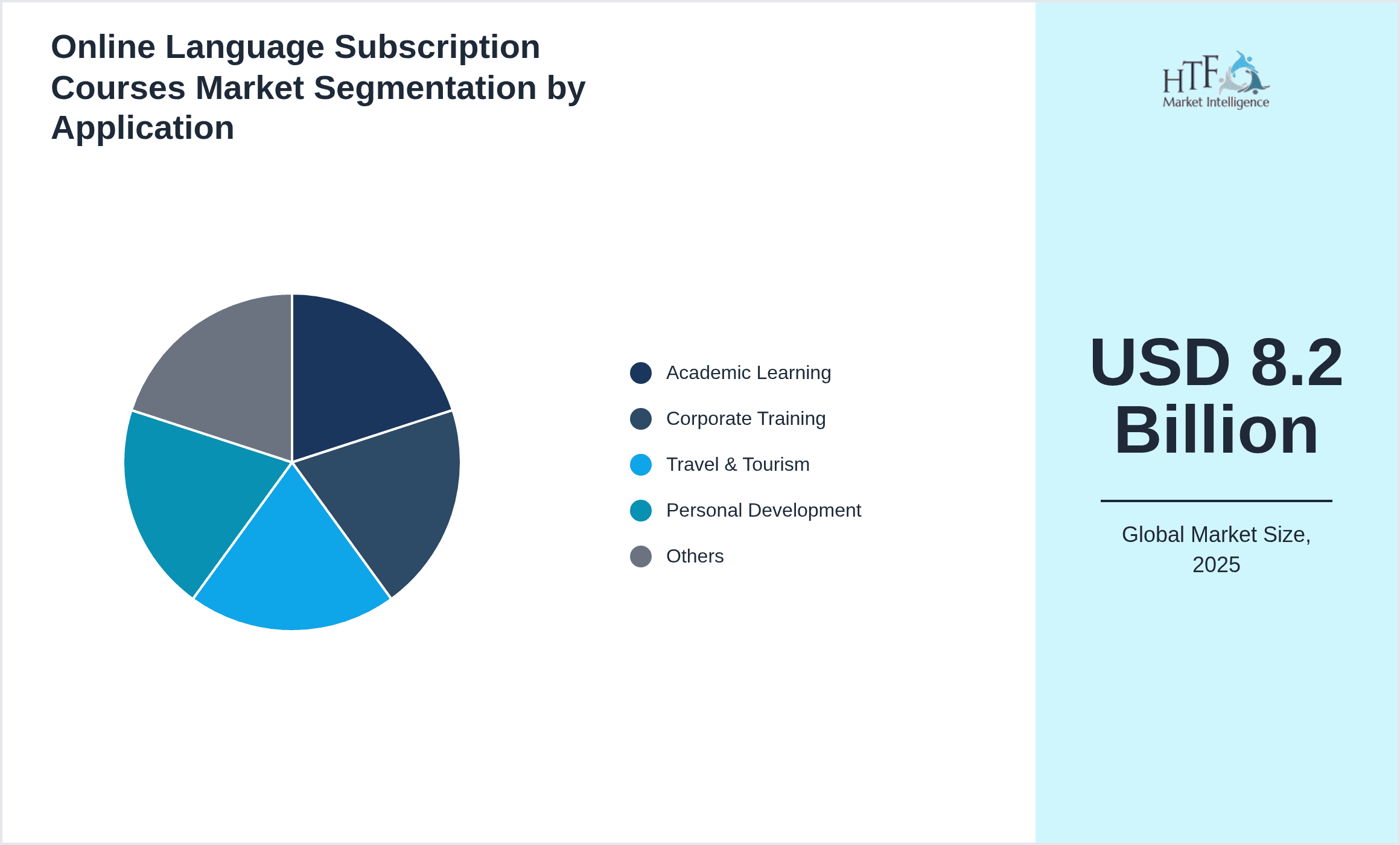
Market Breakdown
- •By Type
- ◦Basic
- ◦Intermediate
- ◦Advanced
- ◦Specialty
- ◦Kids
- •By Application
- ◦Academic Learning
- ◦Corporate Training
- ◦Travel & Tourism
- ◦Personal Development
- ◦Others
- •By End-User
- ◦Students
- ◦Professionals
- ◦Businesses
- ◦Government
- •By Distribution Channel
- ◦Mobile Application
- ◦Web Platform
- ◦Hybrid
Growth Dynamics
The global online language subscription courses market growth is fueled by the increasing need for multilingual communication in global commerce and education sectors. Rapid digital transformation and widespread smartphone penetration enable convenient access to language learning anytime and anywhere. The demand for corporate language training programs to support international business operations has surged, exemplified by companies investing in employee language upskilling. Additionally, the COVID-19 pandemic accelerated adoption of remote learning, prompting educational institutions to integrate subscription-based language courses into curricula. AI and machine learning technologies enhance personalized learning experiences, improving user engagement and outcomes. For instance, Duolingo's AI-driven interface optimizes lesson plans based on user progress, contributing to user retention. Government initiatives promoting language diversity and cultural exchange further stimulate demand. The proliferation of specialty courses targeting niche languages and professional jargon addresses varied learner needs, supporting market expansion globally.

Market Trends
Emerging trends in the online language subscription courses market include increased integration of artificial intelligence and natural language processing to deliver adaptive learning pathways and instant feedback. Platforms are incorporating immersive technologies such as augmented reality to simulate real-life conversational scenarios, enhancing practical language skills. Subscription models are evolving with tiered offerings providing customizable content bundles tailored to user goals. Collaborative learning through community features and peer-to-peer interaction is gaining traction, fostering engagement and motivation. Expansion of language options beyond widely spoken languages to include indigenous and less commonly taught languages addresses cultural preservation and niche demands. Partnerships between language course providers and educational institutions or corporations enable blended learning solutions. The trend toward microlearning delivers bite-sized lessons compatible with busy lifestyles, increasing course accessibility. Recent launches of specialized courses for business communication and exam preparation reflect market responsiveness to professional and academic needs.

Market Opportunities
Significant opportunities arise from expanding internet connectivity in emerging economies, unlocking new customer bases for online language subscription courses. Increasing cross-border trade and globalization necessitate multilingual proficiency, creating demand for corporate and academic language training. Integration of AI and machine learning offers potential for enhanced personalized content and predictive analytics to optimize learning outcomes. Collaborations with educational institutions and governments provide avenues for large-scale adoption and funding support. The rising popularity of remote work worldwide increases the need for language skills facilitating virtual communication across geographies. Expansion into underserved linguistic markets and development of specialty courses addressing professional jargon or regional dialects offer niche growth prospects. Additionally, rising awareness of lifelong learning and self-improvement fuels subscription renewals. Strategic acquisitions and partnerships can broaden product portfolios and geographic reach. For instance, companies investing in mobile-first platforms can capitalize on smartphone penetration in Asia-Pacific and Latin America, driving market growth.
Market Challenges
The online language subscription courses market faces challenges including intense competition leading to pricing pressures and user churn. High customer acquisition costs impact profitability, especially for emerging players lacking brand recognition. Technical limitations such as inconsistent internet access in developing regions restrict market penetration. Language learning effectiveness varies by individual motivation and learning styles, creating challenges in user retention. Content localization and cultural adaptation require significant investment. Data privacy concerns and compliance with diverse regional regulations impose operational complexities. Additionally, some learners prefer traditional classroom instruction, limiting full digital adoption. The proliferation of free language learning resources creates market saturation, necessitating differentiation through innovative features and superior user experience. Recent reports highlight difficulties in maintaining subscriber engagement over time, with many users discontinuing courses prematurely. Companies must continuously update content and leverage emerging technologies to sustain relevance and competitive advantage in an evolving market landscape.
Regulatory Framework
Regulatory developments in the online language subscription courses market over the past five years emphasize data privacy, digital content standards, and consumer protection. The European Union’s General Data Protection Regulation enacted stringent rules on user data handling, impacting global operators serving EU learners. Similar regulations in North America and Asia-Pacific necessitate compliance frameworks around data security and user consent. Educational content standards and accreditation requirements introduced by various governments ensure quality and reliability of online courses. Some countries have implemented mandates for inclusive language education, promoting access for diverse populations. Platforms offering corporate training must adhere to workplace compliance and intellectual property laws. These regulations influence platform design, subscription management, and cross-border service delivery, shaping market strategies. Continuous monitoring of evolving digital education policies remains critical for sustained market operation and trust-building among users and institutions worldwide.
Market Intelligence
- •Recent market developments and strategic initiatives are continuously tracked through industry publications, company announcements, and regulatory filings. For the most current information, stakeholders are advised to monitor official corporate communications and recognized market intelligence platforms.
- •Recent market developments and strategic initiatives are continuously tracked through industry publications, company announcements, and regulatory filings. For the most current information, stakeholders are advised to monitor official corporate communications and recognized market intelligence platforms.
- •Recent market developments and strategic initiatives are continuously tracked through industry publications, company announcements, and regulatory filings. For the most current information, stakeholders are advised to monitor official corporate communications and recognized market intelligence platforms.
- •Recent market developments and strategic initiatives are continuously tracked through industry publications, company announcements, and regulatory filings. For the most current information, stakeholders are advised to monitor official corporate communications and recognized market intelligence platforms.
- •Source: Industry publications, Company websites, Regulatory bodies
Regional Outlook
The North America currently holds a significant share of the market, primarily due to several key factors: increasing consumption rates, a burgeoning population, and robust economic momentum. These elements collectively drive demand, positioning this region as a leader in the market. On the other hand, Asia-Pacific is rapidly emerging as the fastest-growing area within the industry. This remarkable growth can be attributed to swift infrastructure development, the expansion of various industrial sectors, and a marked increase in consumer demand. These dynamics make this region a crucial player in shaping future market growth.
In our report, we cover a comprehensive analysis of the following regions and countries:
- North America
- LATAM
- West Europe
- Central & Eastern Europe
- Northern Europe
- Southern Europe
- East Asia
- Southeast Asia
- South Asia
- Central Asia
- Oceania
- MEA
| Feature | Details |
|---|---|
| Base Year Market Size | USD 8.2 Billion |
| Forecast Year Market Size | USD 25.1 Billion |
| CAGR | 12.5% |
| Forecast Period | 2026 to 2033 |
| YoY Growth | 12.5% |
| Scope of Report | Market is segmented by Type (Basic, Intermediate, Advanced, Specialty, Kids), Application (Academic Learning, Corporate Training, Travel & Tourism, Personal Development, Others), End-User (Students, Professionals, Businesses, Government), Distribution Channel (Mobile Application, Web Platform, Hybrid) |
| Regions Covered | North America, LATAM, West Europe, Central & Eastern Europe, Northern Europe, Southern Europe, East Asia, Southeast Asia, South Asia, Central Asia, Oceania, MEA |
| Key Companies | Duolingo Inc. (United States), Babbel GmbH (Germany), Rosetta Stone Inc. (United States), Busuu Limited (United Kingdom), Lingoda GmbH (Germany), Memrise Ltd. (United Kingdom), Mondly (Cyprus), OpenLanguage (United States), Lingvist Technologies OÜ (Estonia), italki (China), Preply (Ukraine), HelloTalk Inc. (China), Mango Languages (United States), FluentU (United States), Voxy (United States), Clozemaster (Sweden), LingQ (Canada), Pimsleur Language Programs (United States), Speaky (France), Tandem (Germany) |
Global Online Language Subscription Courses Market Size, Growth & Revenue 2025-2034 - Table of Contents
Frequently Asked Questions (FAQ):
The Compact Track Loaders market is expected to see value worth 5.3 Billion in 2025.
North America currently leads the market with approximately 45% market share, followed by Europe at 28% and Asia-Pacific at 22%. The remaining regions account for 5% of the global market.
Key growth drivers include increasing construction activities, rising demand for versatile equipment in agriculture, technological advancements in track loader design, and growing preference for compact equipment in urban construction projects.