
United States Adaptive Learning Software Market Size, Growth & Revenue 2025-2034
United States Adaptive Learning Software Market is segmented by Product Type (Rule-Based Systems, Machine Learning Systems, Natural Language Processing Systems, Deep Learning Systems, Hybrid Systems), Application (K-12 Education, Higher Education, Corporate Training, Professional Certification, Personal Learning), End-Use Industry (Education Institutions, Corporate Sector, Government and Public Sector, Individual Learners), Distribution Channel (Direct Sales, Online Platforms, Channel Partners), and Geography (Northeast, Southwest, The South, The Midwest)
Pricing
Report Overview
Executive Summary
- •The United States Adaptive Learning Software market is a dynamic sector focusing on personalized, technology-driven education solutions that tailor learning experiences based on individual learner needs. It spans multiple educational segments including K-12, higher education, corporate training, professional certification, and personal learning, making it an essential tool for enhancing educational outcomes and workforce development. The market integrates sophisticated technologies such as machine learning, natural language processing, and deep learning within software platforms to adapt content, assessments, and feedback in real-time. This customization facilitates increased learner engagement and efficacy, addressing diverse learning styles and paces. The value chain comprises software developers, content creators, implementation service providers, and end-users including schools, universities, corporations, and individual learners. The market has shown robust growth, driven by the increasing digitization of education, demand for scalable and flexible learning solutions, and governmental initiatives promoting STEM and digital literacy. Strategic partnerships, technological innovations, and expanding applications in corporate upskilling further enhance the market’s potential. This report provides an in-depth analysis of market size, growth trends, competitive landscape, regulatory environment, and future opportunities specific to the United States from 2020 to 2034.
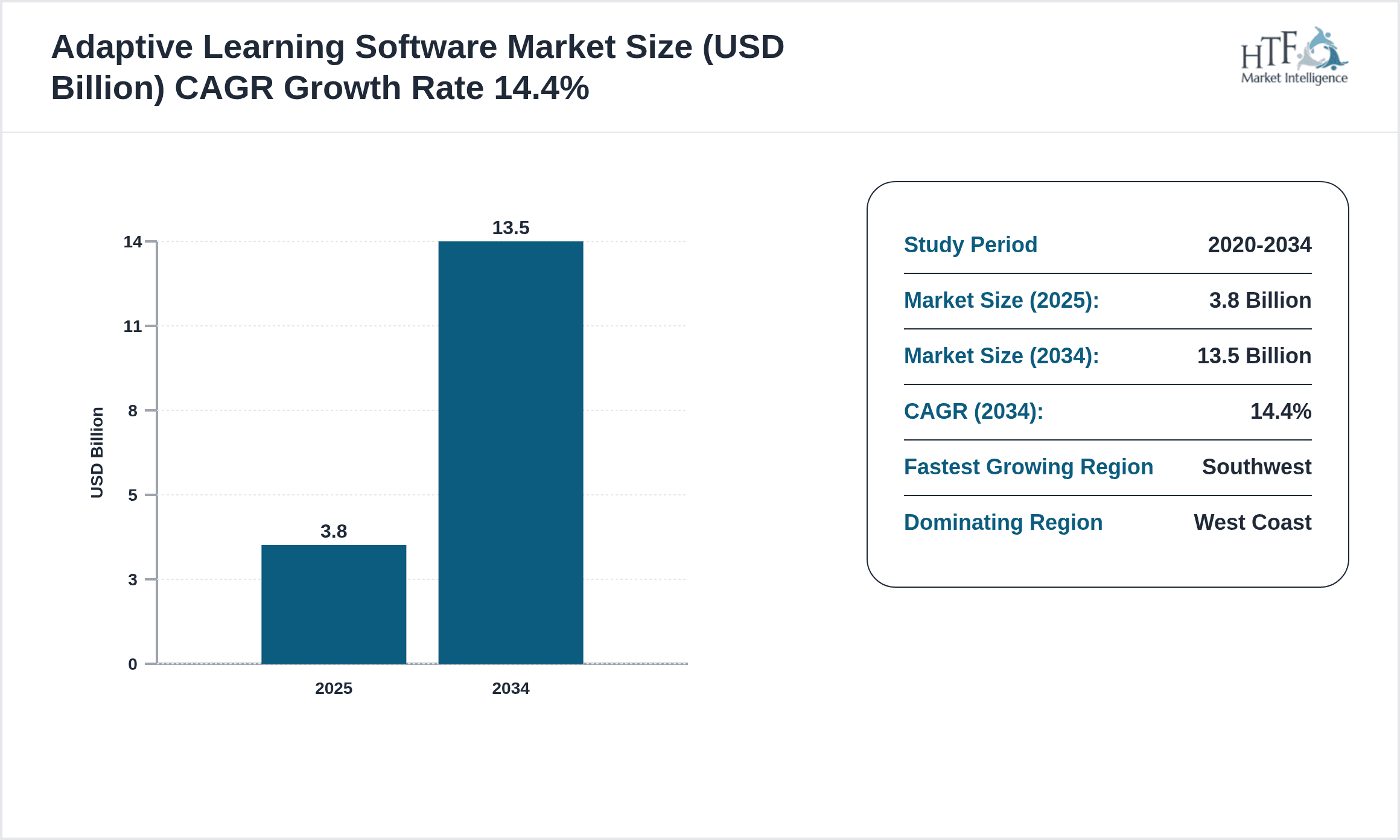
- •Key highlights reveal that the market reached USD 3.8 Billion in 2025, expanding from USD 1.8 Billion in 2020, with a forecasted CAGR of 14.4% through 2034, expected to surpass USD 13.5 Billion. The West Coast region dominates due to its concentration of technology companies and educational institutions, while the Southwest is the fastest-growing zone driven by increasing investment and adoption in corporate and higher education sectors. Machine Learning Systems lead product adoption, reflecting maturity in AI-driven personalization, whereas Hybrid Systems are emerging rapidly due to their capability to combine rule-based and AI methods for enhanced adaptability. The market is marked by significant innovation, strategic collaborations, and supportive regulatory frameworks encouraging digital learning adoption.
- •Adaptive learning software serves as a pivotal enabler of personalized education and continuous professional development, providing stakeholders with scalable, efficient, and data-driven learning solutions. For educational institutions, it offers improved learner outcomes and resource optimization; for corporations, it enhances employee skill development and compliance training effectiveness. The software’s ability to deliver tailored content and real-time feedback supports diverse learner populations, including K-12 students, university learners, and professionals seeking certification. As digital transformation accelerates across industries, adaptive learning platforms represent a strategic investment to address skill gaps and foster lifelong learning, making them a critical component of the future educational and corporate training landscape in the United States.
Competitive Landscape
The United States Adaptive Learning Software market is characterized by intense competition driven by rapid technological innovation, diverse product portfolios, and strategic partnerships. Market players focus heavily on integrating cutting-edge AI and machine learning capabilities to enhance personalization and predictive analytics in learning platforms. Competitive strategies include mergers and acquisitions to consolidate market presence, collaborations with educational institutions and corporate clients to tailor solutions, and continuous investment in R&D to expand platform functionalities. Market entrants face high barriers due to the need for robust technology infrastructure, compliance with educational standards, and capability to scale across multiple sectors. Pricing strategies vary from subscription-based models to enterprise licensing, reflecting the diverse customer base. Distribution channels involve direct sales, online platforms, and partnerships with resellers and education technology providers. The competitive environment is further shaped by regional dynamics within the United States, with technology hubs fostering innovation and adoption. Future trends indicate an increasing focus on cloud-based solutions, mobile accessibility, and integration with Learning Management Systems (LMS), intensifying the competitive landscape and driving continuous evolution in product offerings.
Key Participants in Adaptive Learning Software Market
- •McGraw Hill (United States)
- •Pearson Education (United States)
- •Knewton (United States)
- •DreamBox Learning (United States)
- •Smart Sparrow (United States)
- •Cerego (United States)
- •Realizeit (United States)
- •Squirrel AI Learning (United States)
- •Area9 Lyceum (United States)
- •Cogbooks (United States)
- •Aleks Corporation (United States)
- •Carnegie Learning (United States)
- •Edmentum (United States)
- •Knewton (United States)
- •Instructure, Inc. (United States)
- •Saba Software (United States)
- •Otus (United States)
- •AdaptedMind (United States)
- •Knewton (United States)
- •Knowre (United States)
- •SmartyAnts (United States)
- •MobyMax (United States)
- •IXL Learning (United States)
- •Learnosity (United States)
- •Knewton (United States)
Market Breakdown
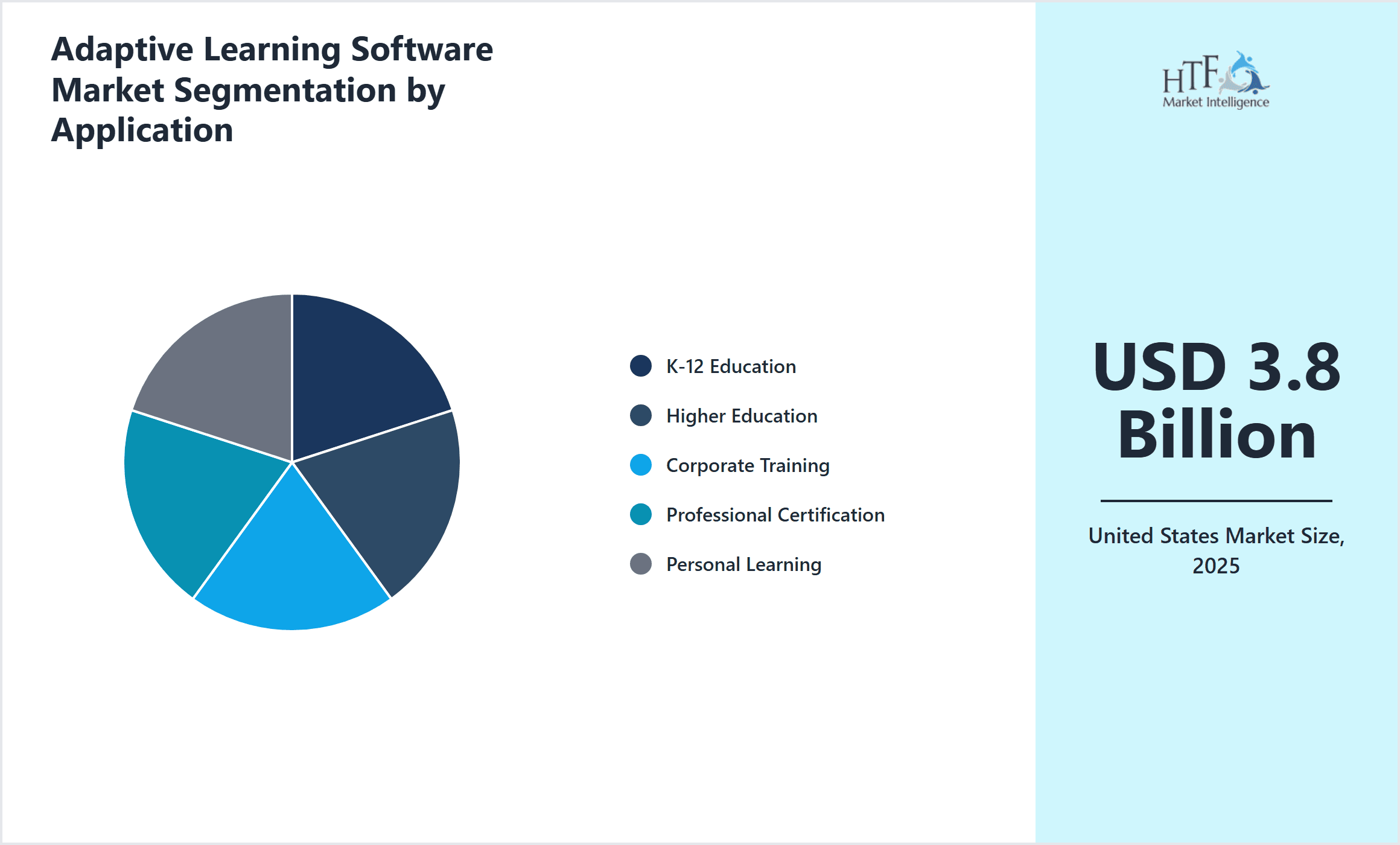
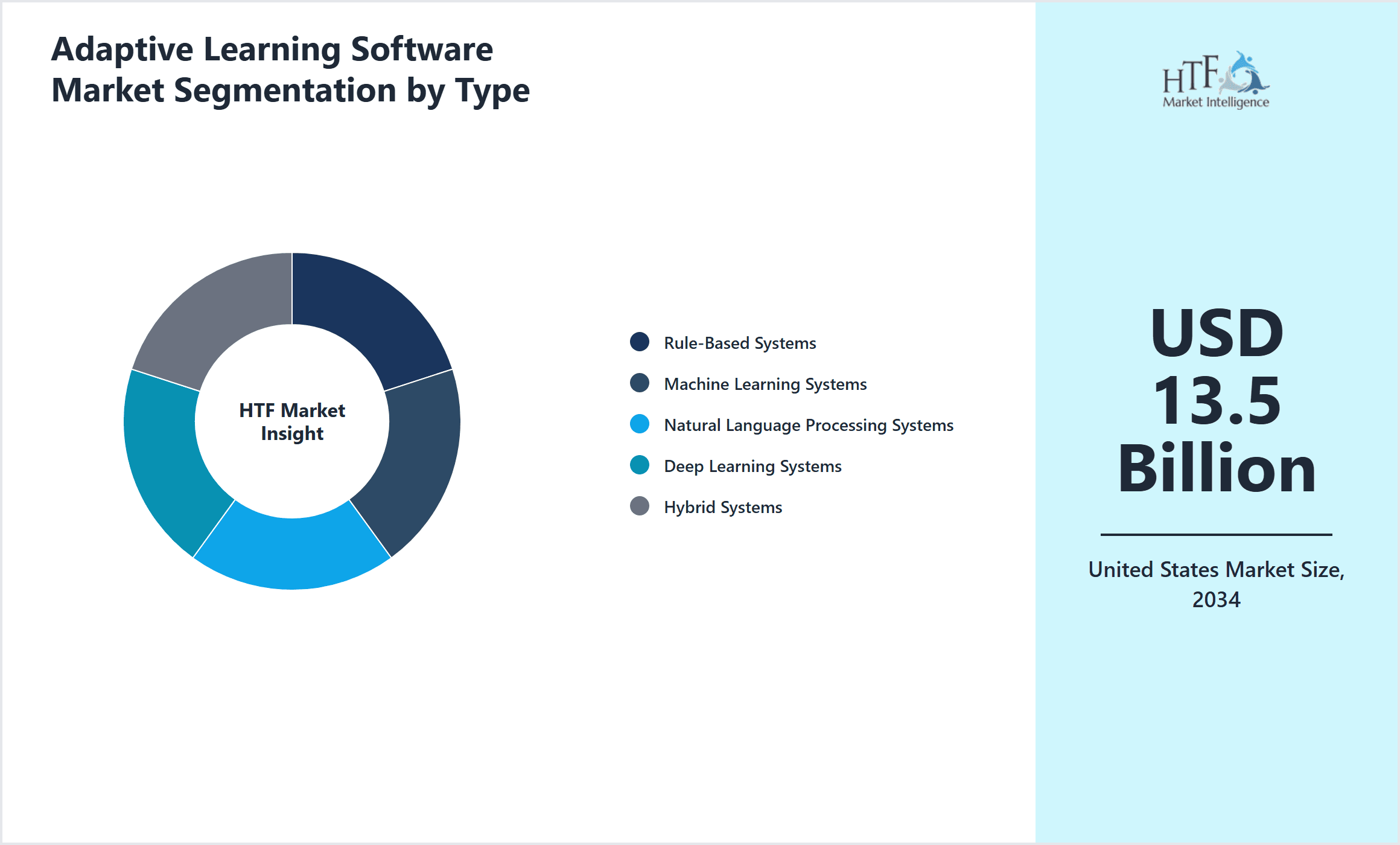
- •By Product Type
- ◦Rule-Based Systems
- ◦Machine Learning Systems
- ◦Natural Language Processing Systems
- ◦Deep Learning Systems
- ◦Hybrid Systems
- •By Application
- ◦K-12 Education
- ◦Higher Education
- ◦Corporate Training
- ◦Professional Certification
- ◦Personal Learning
- •By End-Use Industry
- ◦Education Institutions
- ◦Corporate Sector
- ◦Government and Public Sector
- ◦Individual Learners
- •By Distribution Channel
- ◦Direct Sales
- ◦Online Platforms
- ◦Channel Partners
Growth Dynamics
- •Rising demand for personalized learning experiences drives adoption of adaptive learning software, enabling tailored content delivery that accommodates diverse learning styles and paces across educational and corporate sectors.
- •Advancements in AI and machine learning technologies improve platform capabilities, allowing for real-time learner analytics and predictive assessments that enhance engagement and educational outcomes.
- •Increased government initiatives and funding to promote digital education infrastructure fuel market growth, particularly in public K-12 and higher education institutions adopting adaptive learning solutions.
- •Growing corporate investment in employee training and upskilling programs creates substantial demand, as adaptive learning software enables scalable, efficient, and measurable workforce development.
- •Expansion of cloud computing and mobile device penetration facilitates easy accessibility and scalability of adaptive learning software, broadening its reach across geographical and demographic segments in the United States.
- •Strategic collaborations between software providers and educational content creators enhance product offerings, integrating rich, curriculum-aligned materials that increase software adoption rates.
- •Consumer preference for flexible, self-paced learning models encourages adoption of adaptive platforms, especially among adult learners and professionals seeking continuous education.
Market Trends
- •Integration of AI-driven analytics tools into adaptive learning platforms is enabling more precise learner performance tracking and personalized intervention strategies.
- •Increasing use of gamification and interactive multimedia content within adaptive learning software enhances learner engagement and motivation across various age groups.
- •The rise of hybrid learning models combining in-person and digital adaptive learning solutions addresses diverse educational needs post-pandemic, fostering blended instructional approaches.
- •Expansion of corporate adaptive learning programs driven by compliance training requirements and the need for continuous professional development is reshaping workforce training paradigms.
- •Growing emphasis on data privacy and security within educational software platforms influences product development and regulatory compliance strategies.
- •Adoption of cloud-native adaptive learning solutions promotes scalability, cost-efficiency, and seamless updates, accelerating market penetration especially in smaller educational institutions.
- •Emerging partnerships between adaptive learning providers and Learning Management System (LMS) vendors enhance interoperability and user experience across education and corporate sectors.
Market Opportunities
- •Untapped segments in adult education and lifelong learning present significant opportunities for adaptive learning software providers to expand their user base and product offerings.
- •Advancements in natural language processing offer opportunities to develop more intuitive conversational interfaces and multilingual support within adaptive platforms.
- •Expansion into underserved regional zones such as the Southwest and Midwest with customized solutions tailored to local education standards and corporate needs can drive new market growth.
- •Integration with emerging technologies such as augmented reality (AR) and virtual reality (VR) can create immersive adaptive learning experiences, differentiating products in competitive markets.
- •Growing demand for certification and professional development programs opens avenues for adaptive learning software to partner with accrediting bodies and industry associations.
- •Increasing interest from corporate clients for real-time skills gap analysis and personalized training solutions offers a lucrative opportunity for adaptive learning platforms.
- •Government and private funding initiatives aimed at digital transformation in education can be leveraged to accelerate product adoption and market expansion.
Market Challenges
- •High initial costs and complexity of deploying adaptive learning software limit adoption among smaller educational institutions and budget-constrained organizations.
- •Integration challenges with existing legacy systems and Learning Management Systems (LMS) pose technical barriers that can delay implementation and reduce user satisfaction.
- •Concerns about data privacy, security, and compliance with regulations such as FERPA and COPPA require continuous investment in robust safeguards and transparent policies.
- •Resistance from educators and learners accustomed to traditional teaching methods can impede adoption, necessitating targeted training and change management initiatives.
- •Rapid technological changes demand ongoing software updates and feature enhancements, straining resources for smaller vendors and complicating customer retention.
- •Market fragmentation and presence of numerous niche players create competitive pressure and pricing challenges for established companies.
- •Uneven internet connectivity and technological infrastructure across regional zones limit access and usability of cloud-based adaptive learning solutions.
Regulatory Framework
- •The Family Educational Rights and Privacy Act (FERPA) updated between 2020 and 2025 mandates strict controls on student data privacy, requiring adaptive learning software providers to implement robust data protection measures and transparent data usage policies to comply with federal guidelines.
- •The Children’s Online Privacy Protection Act (COPPA) enforcement during 2021-2025 requires companies to obtain verifiable parental consent before collecting data from children under 13, influencing product design and compliance efforts in K-12 focused adaptive learning solutions.
- •The Every Student Succeeds Act (ESSA) provisions updated in 2020 emphasize evidence-based educational technologies, encouraging adoption of adaptive learning software through grants and funding while ensuring alignment with state academic standards.
- •The Americans with Disabilities Act (ADA) compliance requirements enacted through 2020-2025 compel software vendors to ensure accessibility features in adaptive learning platforms, supporting learners with disabilities and meeting legal standards.
- •State-level regulations such as California Consumer Privacy Act (CCPA) introduced during 2020-2025 impose additional data privacy obligations on adaptive learning providers operating within the state, necessitating regional compliance strategies and data governance frameworks.
Market Intelligence
- •15th February 2025, McGraw Hill launched its enhanced adaptive learning platform integrating advanced machine learning algorithms that personalize content delivery based on real-time student performance analytics. This update expands capabilities for K-12 and higher education sectors, enabling educators to track progress with granular insights and tailor interventions effectively. The platform also introduces mobile optimization features and cloud-based scalability, aiming to increase accessibility and user engagement across the United States. Strategic objectives include strengthening market leadership and expanding corporate training offerings by leveraging AI-driven personalization. Source: McGraw Hill official press release
- •10th April 2025, Pearson Education introduced a new hybrid adaptive learning system combining rule-based logic with deep learning techniques to enhance learner interaction and assessment accuracy. Targeting professional certification and corporate training markets, the system supports multilingual content and real-time feedback mechanisms that improve learner retention and motivation. The innovation aligns with Pearson’s vision to integrate AI technologies deeply into its educational products, addressing the growing demand for personalized learning paths in workforce development. Expected market impact includes increased adoption in large enterprises and higher education institutions seeking scalable adaptive solutions. Source: Pearson Education corporate announcement
- •22nd June 2025, DreamBox Learning announced a strategic partnership with a leading Learning Management System provider to integrate its adaptive math platform seamlessly into corporate and K-12 LMS environments. This collaboration enhances interoperability, enabling unified data analytics and streamlined user experiences across platforms. The initiative aims to expand DreamBox’s footprint in corporate training while reinforcing its presence in education technology markets. The partnership is expected to drive adoption through improved ease of use and comprehensive reporting capabilities, addressing client demand for integrated digital learning ecosystems. Source: DreamBox Learning press release
- •Recent market developments and strategic initiatives are continuously tracked through industry publications, company announcements, and regulatory filings. For the most current information, stakeholders are advised to monitor official corporate communications and recognized market intelligence platforms.
Regional Outlook
The West Coast currently holds a significant share of the market, primarily due to several key factors: increasing consumption rates, a burgeoning population, and robust economic momentum. These elements collectively drive demand, positioning this region as a leader in the market. On the other hand, Southwest is rapidly emerging as the fastest-growing area within the industry. This remarkable growth can be attributed to swift infrastructure development, the expansion of various industrial sectors, and a marked increase in consumer demand. These dynamics make this region a crucial player in shaping future market growth.
In our report, we cover a comprehensive analysis of the following regions and countries:
- Northeast
- Southwest
- The South
- The Midwest
| Feature | Details |
|---|---|
| Base Year Market Size | USD 3.8 Billion |
| Forecast Year Market Size | USD 13.5 Billion |
| CAGR | 14.4% |
| Forecast Period | 2026 to 2033 |
| YoY Growth | 14.4% |
| Scope of Report | Market is segmented by Product Type (Rule-Based Systems, Machine Learning Systems, Natural Language Processing Systems, Deep Learning Systems, Hybrid Systems), Application (K-12 Education, Higher Education, Corporate Training, Professional Certification, Personal Learning), End-Use Industry (Education Institutions, Corporate Sector, Government and Public Sector, Individual Learners), Distribution Channel (Direct Sales, Online Platforms, Channel Partners) |
| Regions Covered | Northeast, Southwest, The South, The Midwest |
| Key Companies | Untapped segments in adult education and lifelong learning present significant opportunities for adaptive learning software providers to expand their user base and product offerings., Advancements in natural language processing offer opportunities to develop more intuitive conversational interfaces and multilingual support within adaptive platforms., Expansion into underserved regional zones such as the Southwest and Midwest with customized solutions tailored to local education standards and corporate needs can drive new market growth., Integration with emerging technologies such as augmented reality (AR) and virtual reality (VR) can create immersive adaptive learning experiences, differentiating products in competitive markets., Growing demand for certification and professional development programs opens avenues for adaptive learning software to partner with accrediting bodies and industry associations. |
United States Adaptive Learning Software Market Size, Growth & Revenue 2025-2034 - Table of Contents
Frequently Asked Questions (FAQ):
The Compact Track Loaders market is projected to grow at a CAGR of 6.8% from 2025 to 2030, driven by increasing demand in construction and agricultural sectors.
North America currently leads the market with approximately 45% market share, followed by Europe at 28% and Asia-Pacific at 22%. The remaining regions account for 5% of the global market.
Key growth drivers include increasing construction activities, rising demand for versatile equipment in agriculture, technological advancements in track loader design, and growing preference for compact equipment in urban construction projects.