
Global Liquid Penetrant Testing Market Scope & Changing Dynamics 2024-2034
Global Liquid Penetrant Testing Market is segmented by Product Type (Fluorescent Penetrant, Visible Dye Penetrant, Solvent Removable Penetrant, Water Washable Penetrant, Post Emulsifiable Penetrant), Application (Aerospace, Automotive, Manufacturing, Oil & Gas, Power Generation), End-Use Industry (Aerospace & Defense, Automotive Manufacturing, Industrial Manufacturing, Energy & Utilities), Distribution Channel (Direct Sales, Distributors & Dealers, Online Platforms), and Geography (North America, LATAM, West Europe, Central & Eastern Europe, Northern Europe, Southern Europe, East Asia, Southeast Asia, South Asia, Central Asia, Oceania, MEA)
Pricing
Report Overview
Executive Summary
- •Liquid Penetrant Testing (LPT) is a critical nondestructive testing technique used globally to identify surface defects in metals, plastics, and ceramics across key industries such as aerospace, automotive, manufacturing, oil & gas, and power generation. The market covers a broad scope of penetrant types including fluorescent, visible dye, solvent removable, water washable, and post emulsifiable, each designed to meet specific inspection requirements. This testing method plays an essential role in ensuring safety, compliance with regulatory standards, and quality assurance, helping to prevent structural failures and costly downtimes. The global LPT market is driven by increasing industrial automation, stringent safety regulations, and the rising demand for advanced inspection solutions. Innovations in penetrant formulations and application technologies have expanded its usability and efficiency. The market dynamics also reflect regional variations in adoption rates, with North America dominating due to established industrial frameworks, whereas Asia-Pacific represents the fastest-growing region owing to rapid industrialization and infrastructure development.
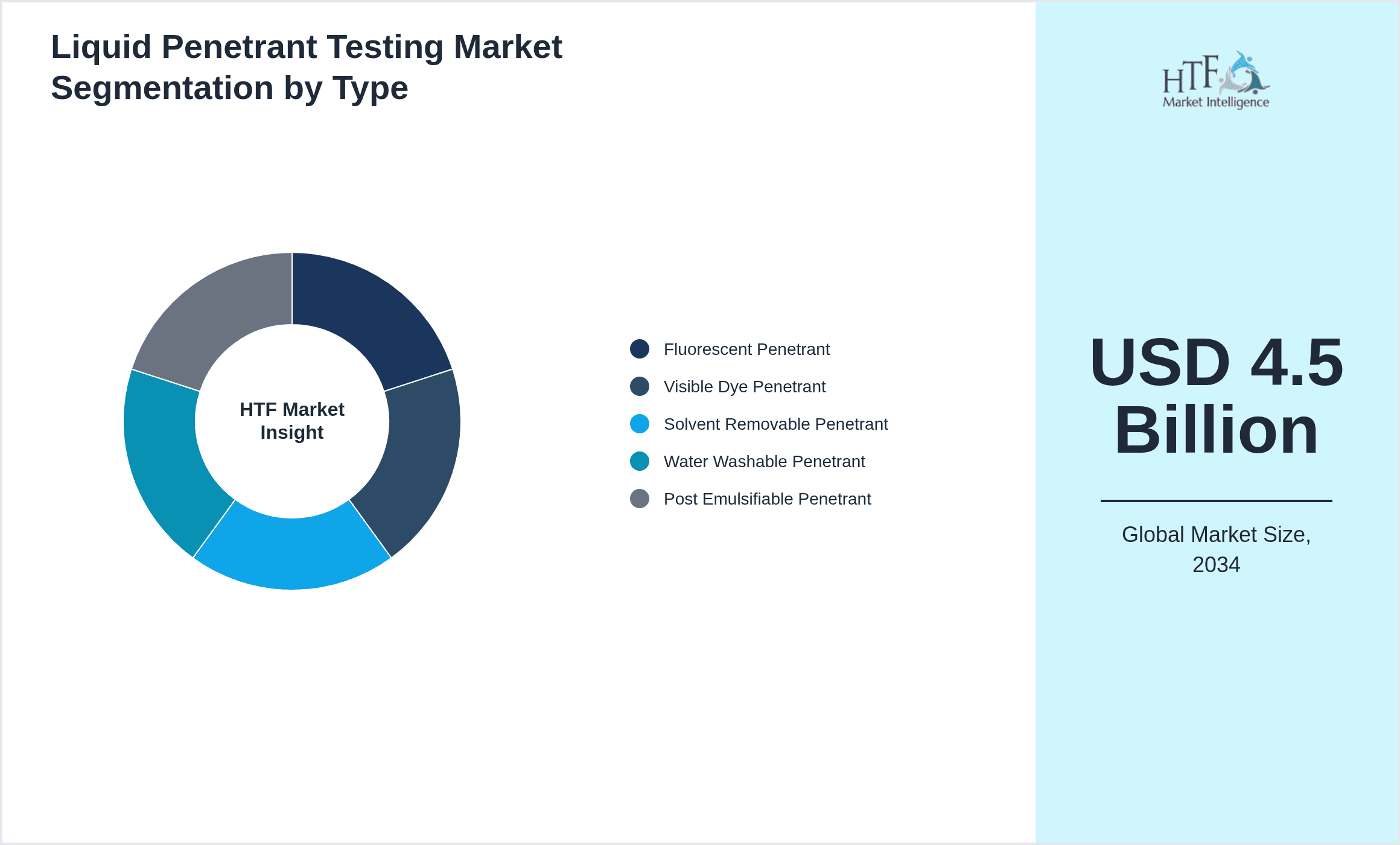
- •Key market highlights include a base market size of USD 1.8 Billion in 2024, projected to reach USD 4.5 Billion by 2034, reflecting a robust CAGR of approximately 9.8%. The Fluorescent Penetrant segment currently leads the product category, while the Post Emulsifiable Penetrant segment is anticipated to grow at the fastest pace, driven by evolving inspection complexities and environmental regulations. Aerospace and automotive sectors remain the largest application areas, benefiting from stringent safety and quality control mandates. North America maintains a dominant market share due to mature industrial presence and regulatory frameworks, whereas Asia-Pacific offers significant growth opportunities with expanding manufacturing and energy sectors. Market challenges include environmental concerns related to chemical use and the emergence of alternative nondestructive testing technologies. Nevertheless, the market is poised for innovation-led expansion supported by increasing investments and technological advancements.
- •The Liquid Penetrant Testing market provides substantial value to industries by enabling early detection of material surface flaws, thereby reducing failure risks and enhancing product reliability. Its non-invasive nature and cost-effectiveness compared to other inspection methods make it strategically important for quality assurance and regulatory compliance worldwide. Stakeholders such as manufacturers, service providers, and regulatory bodies benefit from the continuous evolution and adoption of LPT techniques. The expanding industrial base in Asia-Pacific and sustained demand in North America and Europe underscore its global relevance. The market also offers opportunities for chemical manufacturers and technology innovators to develop eco-friendly and high-performance penetrants, aligning with sustainability goals. As industries increasingly prioritize safety, quality, and operational efficiency, LPT stands as a foundational testing methodology with long-term growth potential.

Competitive Landscape
The global Liquid Penetrant Testing market is characterized by intense competition among established chemical manufacturers, service providers, and technology innovators. Market players focus heavily on product innovation, including the development of environmentally friendly and high-sensitivity penetrants, to differentiate themselves in a market driven by stringent regulatory standards and quality demands. Strategic partnerships and collaborations with end-use industries enhance market reach and technological capabilities. Companies also invest in expanding their geographic presence, particularly in emerging regions such as Asia-Pacific, to capitalize on growing industrialization trends. Pricing strategies remain competitive, balanced against the need for high-performance and compliant products. Additionally, mergers and acquisitions have become a key strategy to consolidate market position, expand product portfolios, and enhance service offerings. The competitive environment fosters continuous R&D, driving the adoption of advanced LPT solutions and integration with complementary nondestructive testing methods.
Prominent Players in Liquid Penetrant Testing Market
- •Magnaflux Corporation (United States)
- •BASF SE (Germany)
- •3M Company (United States)
- •Sherwin-Williams Company (United States)
- •GE Inspection Technologies (United States)
- •MISTRAS Group, Inc. (United States)
- •Hennig GmbH & Co. KG (Germany)
- •Eddyfi Technologies (Canada)
- •YXLON International GmbH (Germany)
- •Zetec, Inc. (United States)
- •NDT Global (Germany)
- •Olympus Corporation (Japan)
- •Applus+ NDT (Spain)
- •TÜV Rheinland AG (Germany)
- •Intertek Group plc (United Kingdom)
- •Bureau Veritas S.A. (France)
- •Element Materials Technology (United Kingdom)
- •Assurance NDT Services (United States)
- •Praxair Surface Technologies (United States)
- •QPS Evaluation Services (Canada)
- •Cortest Columbus Technologies (Canada)
- •Applus RTD (Spain)
- •Phoenix Inspection Systems (United States)
- •Nippon Inspection Testing Co., Ltd. (Japan)
- •Kanematsu Corporation (Japan)

Market Breakdown
- •By Product Type
- ◦Fluorescent Penetrant
- ◦Visible Dye Penetrant
- ◦Solvent Removable Penetrant
- ◦Water Washable Penetrant
- ◦Post Emulsifiable Penetrant
- •By Application
- ◦Aerospace
- ◦Automotive
- ◦Manufacturing
- ◦Oil & Gas
- ◦Power Generation
- •By End-Use Industry
- ◦Aerospace & Defense
- ◦Automotive Manufacturing
- ◦Industrial Manufacturing
- ◦Energy & Utilities
- •By Distribution Channel
- ◦Direct Sales
- ◦Distributors & Dealers
- ◦Online Platforms
Growth Dynamics
- •The increasing adoption of liquid penetrant testing in aerospace and automotive sectors is driven by stringent safety and quality regulations, which mandate rigorous defect detection to prevent catastrophic failures. This fosters steady market expansion.
- •Technological advancements such as the development of eco-friendly and high-sensitivity penetrants have enhanced testing efficiency and reduced environmental impact, encouraging wider industry acceptance and application.
- •Rapid industrialization and infrastructure growth in Asia-Pacific have significantly increased demand for nondestructive testing services, positioning the region as the fastest-growing market for liquid penetrant testing.
- •Integration of digital imaging and automation within LPT processes improves inspection accuracy and operational efficiency, enabling companies to meet evolving industry standards more effectively.
- •Government initiatives promoting industrial safety and quality assurance facilitate market growth by incentivizing the adoption of advanced inspection technologies, including liquid penetrant testing.
Market Trends
- •The market is witnessing a shift towards environmentally sustainable penetrants, prompted by tightening regulations and growing corporate responsibility, which encourages the use of biodegradable and low-toxicity chemicals.
- •Increasing use of automated and robotic nondestructive testing systems incorporating liquid penetrant techniques enhances inspection speed and repeatability, especially in high-volume manufacturing environments.
- •Strategic collaborations between penetrant suppliers and testing service providers are becoming more common, aiming to deliver integrated solutions that improve defect detection and reporting accuracy.
- •The rise of Industry 4.0 and smart manufacturing is driving demand for LPT methods compatible with digital data capture and analysis, supporting predictive maintenance and quality control initiatives.
- •Emerging markets in Latin America and the Middle East are adopting liquid penetrant testing more rapidly due to expanding oil & gas and manufacturing sectors, creating new growth avenues.

Market Opportunities
- •There is significant growth potential in developing advanced penetrants tailored for additive manufacturing components, which require specialized inspection due to complex geometries and material properties.
- •Expanding the application of LPT into renewable energy sectors such as wind turbine blade inspection offers untapped opportunities for market players to diversify their offerings.
- •Investment in research for non-toxic, water-based penetrants can address environmental concerns, appealing to markets with strict chemical regulations and enhancing product acceptance.
- •Leveraging digital transformation by integrating LPT with AI-driven defect recognition systems can improve inspection outcomes and create competitive advantages for service providers.
- •Growing demand for on-site and mobile testing solutions in remote industrial locations presents a promising avenue for portable LPT technologies and services.
Market Challenges
- •Environmental and health concerns related to chemical penetrants, particularly solvent-based types, pose regulatory and public acceptance challenges that may restrict market growth in certain regions.
- •The emergence of alternative nondestructive testing techniques such as ultrasonic and radiographic testing creates competitive pressure, requiring LPT providers to continuously innovate.
- •High costs associated with advanced penetrants and automated inspection systems may limit adoption among small and medium-sized enterprises, especially in developing economies.
- •Lack of standardized procedures across industries and regions can result in inconsistent testing outcomes, complicating market expansion and customer trust.
- •Supply chain disruptions impacting raw material availability for penetrant manufacturing could pose challenges in meeting growing market demand timely.
Regulatory Framework
- •Between 2019 and 2024, global regulations such as the REACH Directive in Europe have tightened control over hazardous chemicals used in liquid penetrants, mandating reduced toxicity and safer disposal methods, significantly impacting product formulations and market operations.
- •The U.S. Environmental Protection Agency (EPA) has enforced stricter guidelines on volatile organic compound (VOC) emissions from penetrant chemicals, prompting manufacturers to innovate environmentally compliant products.
- •Industry-specific standards, including those from ASTM International and ISO, have evolved to include more rigorous testing protocols and certification requirements for liquid penetrant testing, ensuring higher quality and safety benchmarks.
- •Emerging economies are introducing localized regulations aligned with global standards to enhance industrial safety, encouraging adoption of certified LPT products and services while fostering market growth.
- •Government initiatives offering incentives for sustainable industrial practices have supported the development and commercialization of eco-friendly penetrants, reinforcing market shifts towards greener solutions.
Market Intelligence
- •15th January 2025, Magnaflux Corporation introduced an advanced fluorescent penetrant with enhanced sensitivity and reduced environmental impact, designed for aerospace component inspection. This product leverages proprietary chemistry to detect minute surface flaws while complying with the latest VOC regulations, aiming to improve safety and inspection efficiency in critical applications. The launch strengthens Magnaflux's position in the global LPT market by addressing emerging customer demands for sustainable and high-performance testing solutions. Source: Official Magnaflux press release.
- •10th March 2025, BASF SE announced a strategic partnership with leading aerospace manufacturers to co-develop next-generation post emulsifiable penetrants. This collaboration focuses on creating formulations with superior defect detection capabilities and lower environmental footprints, targeting the growing demand in Asia-Pacific and North America. The initiative includes joint R&D efforts and pilot testing programs to accelerate product adoption and compliance with evolving industry standards. Source: BASF corporate news.
- •22nd February 2025, 3M Company expanded its liquid penetrant testing portfolio by launching a water washable penetrant with enhanced washability and brightness, tailored for automotive quality assurance processes. This innovative product reduces inspection cycle times and water consumption, aligning with sustainability goals and operational efficiency improvements. The launch is expected to reinforce 3M's leadership in automotive LPT solutions globally. Source: 3M official announcement.
- •8th April 2025, MISTRAS Group, Inc. completed the acquisition of a regional NDT service provider specializing in liquid penetrant testing across Southeast Asia. This strategic move enhances MISTRAS's service footprint and strengthens its capabilities in delivering integrated inspection solutions for the oil & gas and manufacturing sectors. The acquisition is aligned with MISTRAS's growth strategy focusing on emerging markets with high demand for advanced nondestructive testing. Source: MISTRAS press release.
Regional Outlook
The North America currently holds a significant share of the market, primarily due to several key factors: increasing consumption rates, a burgeoning population, and robust economic momentum. These elements collectively drive demand, positioning this region as a leader in the market. On the other hand, Asia-Pacific is rapidly emerging as the fastest-growing area within the industry. This remarkable growth can be attributed to swift infrastructure development, the expansion of various industrial sectors, and a marked increase in consumer demand. These dynamics make this region a crucial player in shaping future market growth.
In our report, we cover a comprehensive analysis of the following regions and countries:
- North America
- LATAM
- West Europe
- Central & Eastern Europe
- Northern Europe
- Southern Europe
- East Asia
- Southeast Asia
- South Asia
- Central Asia
- Oceania
- MEA
| Feature | Details |
|---|---|
| Base Year Market Size | USD 1.8 Billion |
| Forecast Year Market Size | USD 4.5 Billion |
| CAGR | 9.8% |
| Forecast Period | 2026 to 2033 |
| YoY Growth | 9.4% |
| Scope of Report | Market is segmented by Product Type (Fluorescent Penetrant, Visible Dye Penetrant, Solvent Removable Penetrant, Water Washable Penetrant, Post Emulsifiable Penetrant), Application (Aerospace, Automotive, Manufacturing, Oil & Gas, Power Generation), End-Use Industry (Aerospace & Defense, Automotive Manufacturing, Industrial Manufacturing, Energy & Utilities), Distribution Channel (Direct Sales, Distributors & Dealers, Online Platforms) |
| Regions Covered | North America, LATAM, West Europe, Central & Eastern Europe, Northern Europe, Southern Europe, East Asia, Southeast Asia, South Asia, Central Asia, Oceania, MEA |
| Key Companies | Magnaflux Corporation (United States), BASF SE (Germany), 3M Company (United States), Sherwin-Williams Company (United States), GE Inspection Technologies (United States), MISTRAS Group, Inc. (United States), Hennig GmbH & Co. KG (Germany), Eddyfi Technologies (Canada), YXLON International GmbH (Germany), Zetec, Inc. (United States), NDT Global (Germany), Olympus Corporation (Japan), Applus+ NDT (Spain), TÜV Rheinland AG (Germany), Intertek Group plc (United Kingdom), Bureau Veritas S.A. (France), Element Materials Technology (United Kingdom), Assurance NDT Services (United States), Praxair Surface Technologies (United States), QPS Evaluation Services (Canada), Cortest Columbus Technologies (Canada), Applus RTD (Spain), Phoenix Inspection Systems (United States), Nippon Inspection Testing Co., Ltd. (Japan), Kanematsu Corporation (Japan) |
Global Liquid Penetrant Testing Market Scope & Changing Dynamics 2024-2034 - Table of Contents
Frequently Asked Questions (FAQ):
The Compact Track Loaders market is projected to grow at a CAGR of 6.8% from 2025 to 2030, driven by increasing demand in construction and agricultural sectors.
North America currently leads the market with approximately 45% market share, followed by Europe at 28% and Asia-Pacific at 22%. The remaining regions account for 5% of the global market.
Key growth drivers include increasing construction activities, rising demand for versatile equipment in agriculture, technological advancements in track loader design, and growing preference for compact equipment in urban construction projects.