
Global Aluminium Die Extrusion Market Size, Growth & Revenue 2025-2034
Global Aluminium Die Extrusion Market is segmented by Product Type (Direct Extrusion, Indirect Extrusion, Impact Extrusion, Hydrostatic Extrusion, Other Extrusion Methods), Application (Automotive, Construction, Electrical & Electronics, Aerospace, Industrial Machinery), End-Use Industry (Transportation, Building & Construction, Consumer Goods, Industrial Equipment), Distribution Channel (Direct Sales, Distributors, Online Platforms), and Geography (North America, LATAM, West Europe, Central & Eastern Europe, Northern Europe, Southern Europe, East Asia, Southeast Asia, South Asia, Central Asia, Oceania, MEA)
Pricing
Report Overview
Executive Summary
The Global Aluminium Die Extrusion market refers to the industrial process of shaping aluminum by forcing it through defined dies to produce customized profiles used across diverse sectors. This market covers various extrusion techniques including direct, indirect, impact, and hydrostatic extrusion, enabling the fabrication of components with complex cross-sections and superior mechanical properties. End-use applications span automotive, construction, aerospace, electrical and electronics, and industrial machinery, highlighting the material's lightweight, corrosion resistance, and high strength-to-weight ratio benefits. The industry value chain integrates raw aluminum procurement, billet preparation, extrusion processing, surface treatment, and distribution to OEMs and fabricators. Technological advancements focusing on energy efficiency, process automation, and precision engineering have enhanced product quality and reduced production costs. Moreover, the increasing demand for sustainable materials and lightweight components in automotive and aerospace sectors is fueling market expansion. Regional market dynamics are influenced by infrastructural developments, regulatory frameworks, and raw material availability, with North America leading in innovation and Asia-Pacific exhibiting rapid growth driven by industrialization. This comprehensive market overview offers insights into competitive landscapes, market trends, growth drivers, challenges, and opportunities shaping the global aluminium die extrusion industry from 2020 to 2034.

Competitive Landscape
The global aluminium die extrusion market is characterized by intense competition among established multinational corporations and emerging regional players. Market dynamics are shaped by strategic investments in R&D to innovate extrusion techniques that improve manufacturing efficiency and product performance. Companies are leveraging vertical integration and strategic partnerships to optimize supply chains and enhance value delivery. Competitive strategies include product differentiation through advanced alloy development and customization capabilities tailored to specific end-use industries. Pricing strategies remain competitive due to fluctuating aluminum raw material costs and varying production efficiencies across regions. Market entry barriers such as high capital expenditure, technological expertise, and stringent quality standards limit new entrants, fostering a market dominated by key players with established brand reputations and technological prowess. Regional competition varies with North America focusing on advanced aerospace and automotive applications, Europe emphasizing sustainability and precision engineering, while Asia-Pacific benefits from cost advantages and expanding infrastructure sectors. Future trends point towards increased adoption of digital manufacturing and Industry 4.0 technologies to maintain competitive advantages and address evolving customer demands.
Leading Companies in Aluminium Die Extrusion Market
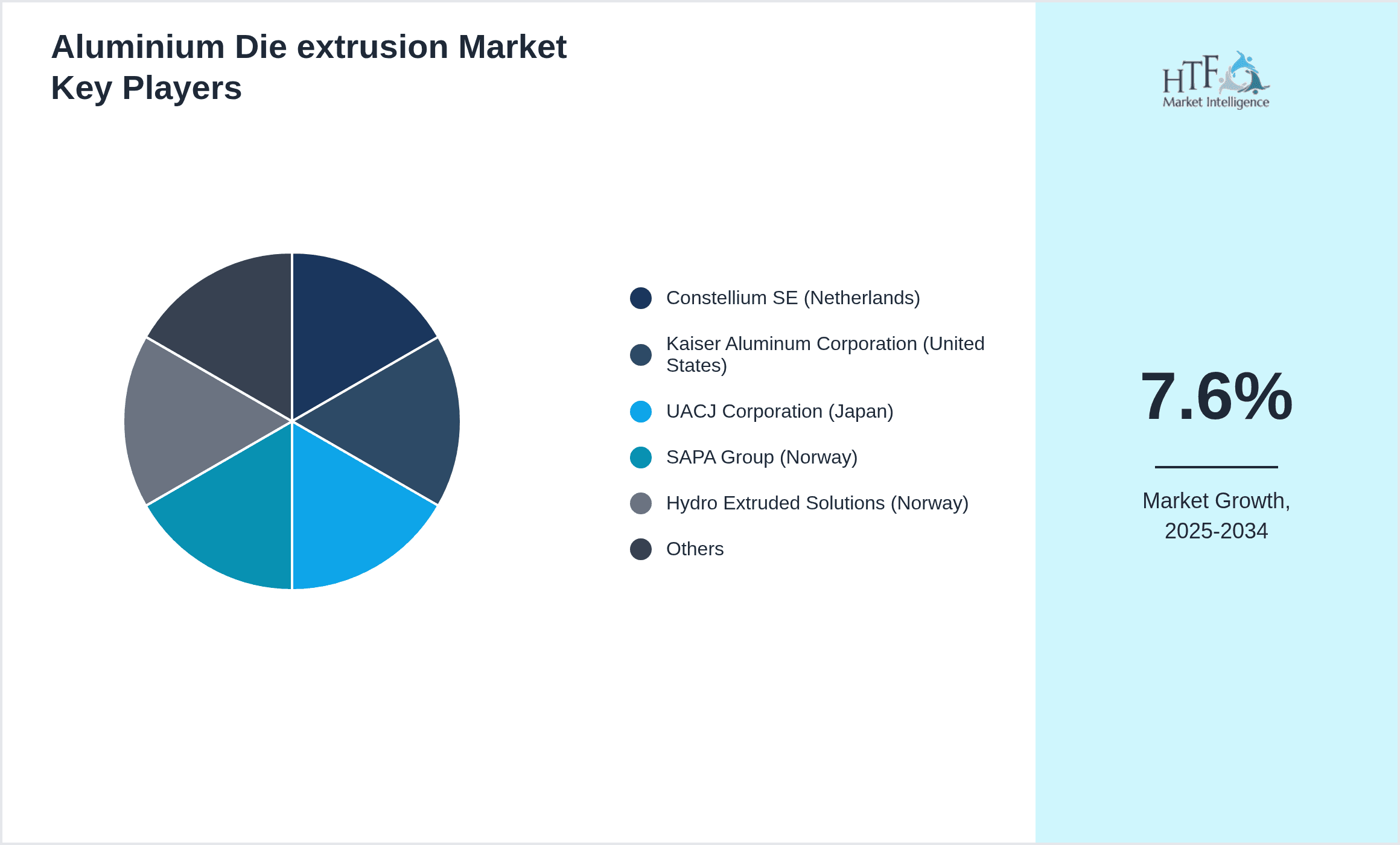
- •Constellium SE (Netherlands)
- •Kaiser Aluminum Corporation (United States)
- •UACJ Corporation (Japan)
- •SAPA Group (Norway)
- •Hydro Extruded Solutions (Norway)
- •Liaoning Zhongwang Group Co., Ltd. (China)
- •Alcoa Corporation (United States)
- •Ningbo Zhongwang Group (China)
- •Amari Aluminium Public Company Limited (Thailand)
- •Novelis Inc. (United States)
- •Rheinische Aluminiumwerke (Germany)
- •Aludium (Spain)
- •Century Aluminum Company (United States)
- •Impexmetal S.A. (Poland)
- •Aluminium Bahrain B.S.C. (Bahrain)
- •Norsk Hydro ASA (Norway)
- •Furukawa Electric Co., Ltd. (Japan)
- •China Zhongwang Holdings Limited (China)
- •Gulf Extrusions (United Arab Emirates)
- •Pace Industries (United States)
- •Hydro Aluminium Rolled Products GmbH (Germany)
- •Aluminium Bahrain (Bahrain)
- •Evergreen Aluminium Corporation (Taiwan)
- •ElvalHalcor Hellenic Copper and Aluminium Industry S.A. (Greece)
- •Gränges AB (Sweden)

Market Breakdown
- •By Product Type
- ◦Direct Extrusion
- ◦Indirect Extrusion
- ◦Impact Extrusion
- ◦Hydrostatic Extrusion
- ◦Other Extrusion Methods
- •By Application
- ◦Automotive
- ◦Construction
- ◦Electrical & Electronics
- ◦Aerospace
- ◦Industrial Machinery
- •By End-Use Industry
- ◦Transportation
- ◦Building & Construction
- ◦Consumer Goods
- ◦Industrial Equipment
- •By Distribution Channel
- ◦Direct Sales
- ◦Distributors
- ◦Online Platforms
Growth Dynamics
- •Rising demand for lightweight and fuel-efficient vehicles is significantly driving the aluminium die extrusion market, as automotive manufacturers seek to reduce vehicle weight and emissions. This trend is supported by stringent environmental regulations and consumer preference for sustainable transportation solutions.
- •Expansion in the construction sector, particularly in emerging economies, fuels demand for aluminium extrusions used in window frames, curtain walls, and structural components due to their durability and corrosion resistance. Urbanization and infrastructure development projects are key contributors.
- •Technological advancements in extrusion processes, such as hydrostatic extrusion, are enhancing product precision and reducing manufacturing costs, thereby attracting increased adoption across aerospace and electronics industries requiring complex, high-strength components.
- •Increased focus on recycling and sustainability encourages manufacturers to use aluminium die extrusions with high recyclability, aligning with global environmental goals and reducing raw material dependency, which positively impacts market growth.
- •Government incentives and policies promoting lightweight material usage in transportation and construction sectors stimulate investments in aluminium die extrusion capabilities, further accelerating market expansion.
- •Rising industrial automation and adoption of Industry 4.0 technologies in extrusion plants improve operational efficiency and product consistency, supporting higher production volumes and meeting growing market demand.
- •The growing trend of customized extrusion profiles tailored to specific application requirements drives innovation and market differentiation among key players, fostering competitive advantages.

Market Trends
- •The adoption of lightweight aluminium extrusions in electric vehicles (EVs) is accelerating, as automakers aim to optimize battery range and vehicle efficiency, making aluminium die extrusion a critical component in EV manufacturing supply chains.
- •Integration of digital twin technology and real-time process monitoring in extrusion manufacturing enhances quality control and reduces downtime, reflecting a shift towards smart factory environments.
- •Sustainability-driven product development is leading to increased use of recycled aluminium and environmentally friendly extrusion processes, aligning with circular economy principles and regulatory requirements.
- •Collaborations between extrusion companies and end-use industries foster co-development of innovative lightweight components, accelerating product adoption and expanding market reach across sectors like aerospace and industrial machinery.
- •Advancements in alloy composition and heat treatment techniques are enabling enhanced mechanical properties and corrosion resistance, broadening the scope of aluminium die extrusion applications.
- •Growing demand for architectural aluminium extrusions with complex designs is driving adoption of advanced extrusion methods such as hydrostatic and impact extrusion, meeting aesthetic and functional requirements.
- •Enhanced global supply chain integration supports faster delivery and customization capabilities, improving customer responsiveness and market competitiveness.
Market Opportunities
- •Emerging markets in Asia-Pacific and Latin America offer significant growth potential due to rapid industrialization, urbanization, and increasing infrastructure investments requiring aluminium extrusion solutions.
- •Development of new extrusion alloys and composite materials presents opportunities for product differentiation and entry into high-performance sectors such as aerospace and defense.
- •Expansion of electric vehicle production globally creates demand for lightweight aluminium components, offering lucrative opportunities for extrusion manufacturers to supply tailored solutions.
- •Digitalization and Industry 4.0 integration in extrusion manufacturing opens avenues for operational excellence, cost reduction, and product innovation, enhancing market competitiveness.
- •Strategic partnerships and mergers can enable technology sharing, capacity expansion, and access to new geographic markets, accelerating growth trajectories.
- •Growing emphasis on sustainability and circular economy principles encourages development of eco-friendly extrusion processes and recycled aluminium products, meeting regulatory and consumer demands.
- •Customization demands from end-use industries for complex profiles and specialized applications drive innovation and premium pricing opportunities.
Market Challenges
- •Volatility in raw material aluminium prices can impact production costs and profit margins, creating uncertainty for extrusion manufacturers and affecting pricing strategies.
- •High capital investment required for advanced extrusion technologies and automation limits market entry for smaller players and constrains capacity expansion.
- •Stringent environmental regulations on emissions and waste management require continuous compliance efforts, increasing operational complexities and costs.
- •Supply chain disruptions, including logistics challenges and geopolitical tensions, can hinder raw material availability and timely delivery of finished products.
- •Competition from alternative lightweight materials such as composites and plastics may reduce aluminium extrusion demand in certain applications.
- •Technical challenges in producing complex extrusion profiles with tight tolerances require skilled labor and advanced equipment, posing operational risks.
- •Market fragmentation and regional regulatory variations complicate standardization and increase compliance costs for multinational extrusion companies.
Regulatory Framework
- •The European Union's REACH regulation (2018-2025) mandates strict control over chemical substances used in aluminium extrusion processes, ensuring environmental safety and worker health, influencing material selection and processing techniques.
- •The U.S. Environmental Protection Agency (EPA) Clean Air Act amendments between 2019 and 2025 impose limits on emissions from metal manufacturing plants, requiring extrusion facilities to adopt cleaner technologies and monitoring systems.
- •China's National Development and Reform Commission introduced energy efficiency standards for aluminium extrusion in 2020, promoting sustainable manufacturing practices and reducing carbon footprint across the industry.
- •The Occupational Safety and Health Administration (OSHA) regulations (2017-2025) in North America enforce workplace safety standards specific to extrusion operations, mandating protective measures and employee training to minimize hazards.
- •Government incentives and subsidies for using recycled aluminium and energy-efficient extrusion equipment have been implemented in several regions from 2019 to 2025, encouraging sustainable growth and innovation within the market.
Market Intelligence
- •15th January 2025, Constellium SE launched an advanced aluminium extrusion solution tailored for electric vehicle battery enclosures, featuring enhanced thermal management and structural integrity. This product aims to support the growing EV market by providing lightweight, high-strength components that improve battery safety and vehicle efficiency. The launch is part of Constellium’s strategic focus on sustainable mobility solutions and innovation in extrusion technology. This development is expected to strengthen the company's position in the automotive sector and drive revenue growth over the forecast period. Source: Official Constellium Press Release.
- •10th March 2025, Kaiser Aluminum Corporation announced a strategic partnership with a leading aerospace OEM to co-develop next-generation aluminium extrusions with superior fatigue resistance and corrosion protection. The collaboration leverages Kaiser’s extrusion expertise and the OEM’s application knowledge to accelerate product development cycles and optimize component performance. This initiative aligns with increasing aerospace industry demands for lightweight and durable materials, enhancing Kaiser’s market penetration and innovation capabilities. The partnership also includes joint investment in R&D facilities to support future extrusion advancements. Source: Kaiser Aluminum Corporate Communications.
- •22nd May 2024, UACJ Corporation completed the acquisition of a regional extrusion specialist to expand its production capacity in Southeast Asia, enhancing service offerings to automotive and construction clients. This acquisition strengthens UACJ’s footprint in a high-growth market, enabling faster delivery and localized customization of aluminium profiles. The move supports UACJ’s strategic growth plan focusing on emerging markets and diversified application sectors. The integration aims to realize operational synergies and broaden product portfolios, positioning UACJ as a formidable player in the Asia-Pacific extrusion industry. Source: UACJ Investor Relations Release.
- •Market Intelligence: Recent developments and industry insights are being monitored. For latest updates, consult official company announcements and industry publications.
Regional Outlook
The North America currently holds a significant share of the market, primarily due to several key factors: increasing consumption rates, a burgeoning population, and robust economic momentum. These elements collectively drive demand, positioning this region as a leader in the market. On the other hand, Asia-Pacific is rapidly emerging as the fastest-growing area within the industry. This remarkable growth can be attributed to swift infrastructure development, the expansion of various industrial sectors, and a marked increase in consumer demand. These dynamics make this region a crucial player in shaping future market growth.
In our report, we cover a comprehensive analysis of the following regions and countries:
- North America
- LATAM
- West Europe
- Central & Eastern Europe
- Northern Europe
- Southern Europe
- East Asia
- Southeast Asia
- South Asia
- Central Asia
- Oceania
- MEA
| Feature | Details |
|---|---|
| Base Year Market Size | USD 12.8 Billion |
| Forecast Year Market Size | USD 25.7 Billion |
| CAGR | 7.6% |
| Forecast Period | 2026 to 2033 |
| YoY Growth | 7.4% |
| Scope of Report | Market is segmented by Product Type (Direct Extrusion, Indirect Extrusion, Impact Extrusion, Hydrostatic Extrusion, Other Extrusion Methods), Application (Automotive, Construction, Electrical & Electronics, Aerospace, Industrial Machinery), End-Use Industry (Transportation, Building & Construction, Consumer Goods, Industrial Equipment), Distribution Channel (Direct Sales, Distributors, Online Platforms) |
| Regions Covered | North America, LATAM, West Europe, Central & Eastern Europe, Northern Europe, Southern Europe, East Asia, Southeast Asia, South Asia, Central Asia, Oceania, MEA |
| Key Companies | Constellium SE (Netherlands), Kaiser Aluminum Corporation (United States), UACJ Corporation (Japan), SAPA Group (Norway), Hydro Extruded Solutions (Norway), Liaoning Zhongwang Group Co., Ltd. (China), Alcoa Corporation (United States), Ningbo Zhongwang Group (China), Amari Aluminium Public Company Limited (Thailand), Novelis Inc. (United States), Rheinische Aluminiumwerke (Germany), Aludium (Spain), Century Aluminum Company (United States), Impexmetal S.A. (Poland), Aluminium Bahrain B.S.C. (Bahrain), Norsk Hydro ASA (Norway), Furukawa Electric Co., Ltd. (Japan), China Zhongwang Holdings Limited (China), Gulf Extrusions (United Arab Emirates), Pace Industries (United States), Hydro Aluminium Rolled Products GmbH (Germany), Aluminium Bahrain (Bahrain), Evergreen Aluminium Corporation (Taiwan), ElvalHalcor Hellenic Copper and Aluminium Industry S.A. (Greece), Gränges AB (Sweden) |
Global Aluminium Die Extrusion Market Size, Growth & Revenue 2025-2034 - Table of Contents
Multidisciplinary researcher with 10+ years of experience uncovering insights across diverse domains focused on uncovering insights that drive informed decisions.
Frequently Asked Questions (FAQ):
The Compact Track Loaders market is expected to see value worth 5.3 Billion in 2025.
North America currently leads the market with approximately 45% market share, followed by Europe at 28% and Asia-Pacific at 22%. The remaining regions account for 5% of the global market.
Key growth drivers include increasing construction activities, rising demand for versatile equipment in agriculture, technological advancements in track loader design, and growing preference for compact equipment in urban construction projects.