
Global Agricultural Aircrafts Market - Outlook 2025-2034
Global Agricultural Aircrafts Market is segmented by Product Type (Fixed-Wing Aircraft, Rotary-Wing Aircraft, Unmanned Aerial Vehicles (UAVs), Hybrid Aircraft, Electric Aircraft), Application (Crop Dusting, Aerial Seeding, Fertilizer Spreading, Pest Control, Fire Fighting), End-Use Industry (Large-Scale Commercial Farms, Government Agricultural Departments, Agricultural Service Providers, Research and Development Organizations), Distribution Channel (Direct Sales, Dealerships and Distributors, Online Platforms), and Geography (North America, LATAM, West Europe, Central & Eastern Europe, Northern Europe, Southern Europe, East Asia, Southeast Asia, South Asia, Central Asia, Oceania, MEA)
Pricing
Report Overview
Executive Summary
- •The global Agricultural Aircrafts Market comprises specialized aircraft engineered specifically for various farming activities like crop dusting, aerial seeding, fertilizer application, pest control, and firefighting. This market includes fixed-wing and rotary-wing aircraft, unmanned aerial vehicles (UAVs), hybrid, and electric models designed to optimize agricultural input distribution, enhance yield, and improve operational efficiency. Agricultural aircrafts enable rapid coverage of large farmland areas, reducing manual labor and ensuring precision in application, thus supporting sustainable agricultural practices. The market is influenced by advancements in aviation technology, growing adoption of precision agriculture, and rising awareness of environmental regulations. The industry encompasses manufacturers, service providers, and technology developers offering integrated solutions for crop management and aerial application. Increasing demand for food production and the need to minimize chemical overuse further expand the market scope, making agricultural aircrafts a critical component of modern agricultural infrastructure worldwide.
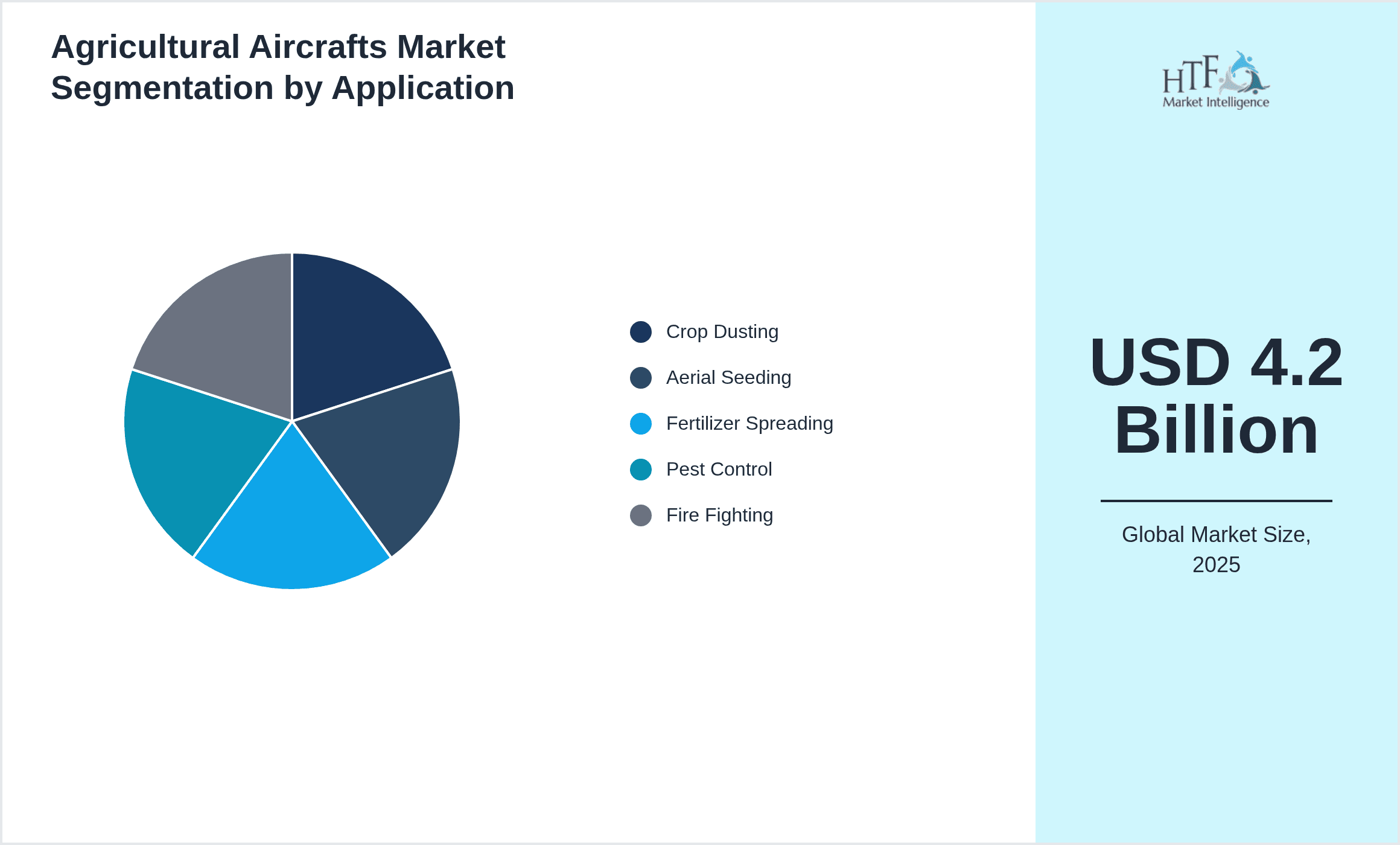
- •Key market highlights include a robust CAGR of 9.14% projected from 2025 to 2034, driven by technological innovations such as UAV deployment and electric propulsion. The global market size is expected to more than double, reaching USD 9.5 Billion by 2034, up from USD 4.2 Billion in 2025. North America currently dominates the market due to established agricultural aviation infrastructure and regulatory frameworks, while Asia-Pacific is the fastest-growing region propelled by expanding farmland and increasing mechanization. Fixed-wing aircraft remain the leading product type, favored for their efficiency over large areas, but unmanned aerial vehicles are rapidly gaining traction due to cost-effectiveness and precision capabilities. Crop dusting retains the largest application share, followed by aerial seeding, reflecting ongoing demand for efficient crop protection and cultivation techniques.
- •From a strategic standpoint, agricultural aircrafts provide significant value to large-scale farmers, agricultural service providers, and government agencies focused on food security and sustainable farming. The technology facilitates optimized input use, reduced environmental footprint, and enhanced yield quality. Market stakeholders benefit from continuous innovation, including automation, remote piloting, and eco-friendly aircraft designs, positioning agricultural aviation as a pivotal enabler of future farming practices. The rising regulatory emphasis on precision and environmentally safe applications further underscores the market's importance. Overall, the global Agricultural Aircrafts Market represents a convergence of traditional aviation expertise and modern agri-tech solutions, delivering substantial economic and environmental benefits across diverse geographic regions.

Competitive Landscape
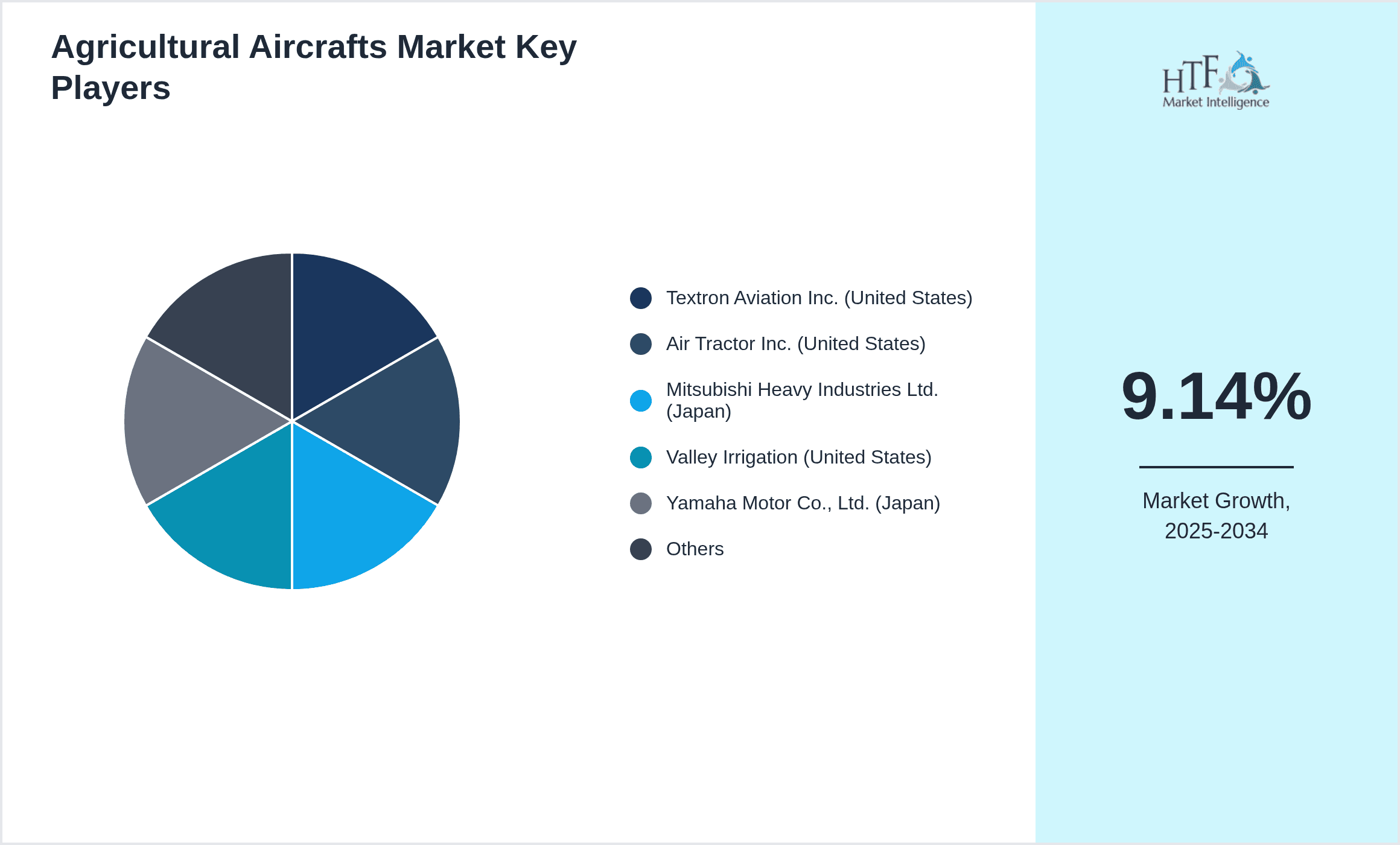
The global Agricultural Aircrafts Market is highly competitive, characterized by a mix of established aerospace manufacturers and emerging technology innovators. Market leaders focus on product innovation, expanding UAV capabilities, and integrating electric propulsion systems to meet evolving agricultural demands. Competition centers on enhancing flight efficiency, payload capacity, and precision application technologies while reducing operational costs and environmental impact. Strategic partnerships, research collaborations, and targeted acquisitions are common tactics to strengthen market positioning and broaden technology portfolios. Companies leverage advanced materials, avionics, and software integration to differentiate offerings. Additionally, regional players are gaining prominence by catering to localized farming needs and regulatory requirements. The rivalry intensifies as new entrants introduce disruptive technologies such as hybrid and fully electric agricultural drones, challenging traditional fixed-wing and rotary-wing models. Pricing strategies, after-sales service networks, and pilot training programs also influence competitive dynamics. This complex landscape fosters innovation and drives continuous improvements, shaping the future trajectory of agricultural aviation worldwide.
Leading Companies in Agricultural Aircrafts Market
- •Textron Aviation Inc. (United States)
- •Air Tractor Inc. (United States)
- •Mitsubishi Heavy Industries Ltd. (Japan)
- •Valley Irrigation (United States)
- •Yamaha Motor Co., Ltd. (Japan)
- •DJI Innovations (China)
- •PrecisionHawk Inc. (United States)
- •Elbit Systems Ltd. (Israel)
- •Boeing Company (United States)
- •AgEagle Aerial Systems Inc. (United States)
- •Honeywell International Inc. (United States)
- •Kubota Corporation (Japan)
- •SenseFly (Switzerland)
- •AeroVironment Inc. (United States)
- •Valqari Corporation (United States)
- •Elbit Systems (Israel)
- •PrecisionHawk (United States)
- •Northrop Grumman Corporation (United States)
- •Parrot SA (France)
- •Agco Corporation (United States)
- •Lockheed Martin Corporation (United States)
- •Valley Irrigation (United States)
- •Yuneec International (China)
- •Precision Hawk (United States)
- •Textron Aviation (United States)
Market Breakdown
- •By Product Type
- ◦Fixed-Wing Aircraft
- ◦Rotary-Wing Aircraft
- ◦Unmanned Aerial Vehicles (UAVs)
- ◦Hybrid Aircraft
- ◦Electric Aircraft
- •By Application
- ◦Crop Dusting
- ◦Aerial Seeding
- ◦Fertilizer Spreading
- ◦Pest Control
- ◦Fire Fighting
- •By End-Use Industry
- ◦Large-Scale Commercial Farms
- ◦Government Agricultural Departments
- ◦Agricultural Service Providers
- ◦Research and Development Organizations
- •By Distribution Channel
- ◦Direct Sales
- ◦Dealerships and Distributors
- ◦Online Platforms
Growth Dynamics
The global Agricultural Aircrafts Market growth is primarily driven by the rising demand for efficient and scalable farming practices. Increasing global food demand necessitates rapid and uniform application of fertilizers, pesticides, and seeds across vast farmlands. Technological advancements, especially in UAVs and electric aircraft, enhance precision and reduce operational costs, encouraging adoption. Government initiatives promoting sustainable agriculture and subsidies for modern equipment further stimulate growth. Additionally, integration with precision agriculture technologies, such as GPS and remote sensing, allows for optimized input management, reducing waste and environmental impact. These factors collectively contribute to steady market expansion, particularly in emerging economies where mechanization is accelerating. As farming becomes more data-driven and automated, agricultural aircrafts become essential tools for crop management, fueling robust growth dynamics across all regions.

Market Trends
One prominent trend in the Agricultural Aircrafts Market is the rapid adoption of unmanned aerial vehicles (UAVs) for crop monitoring and precision spraying. UAVs offer enhanced accuracy and reduced chemical usage, aligning with environmental sustainability goals. Another significant trend is the development of electric and hybrid agricultural aircraft that reduce carbon emissions and noise pollution, meeting increasing regulatory demands. Integration of IoT and AI technologies enables real-time data collection and automated flight controls, improving efficiency. Additionally, collaborations between aerospace companies and agricultural firms are fostering innovative product offerings. The trend towards digitization and smart farming practices is reshaping the market landscape, enabling farmers to make informed decisions and optimize resource allocation.
Market Opportunities
Emerging markets in Asia-Pacific and Latin America present significant growth opportunities due to expanding arable land and increasing mechanization. The rising acceptance of UAVs and electric aircraft in these regions, driven by cost effectiveness and environmental benefits, opens new avenues. Additionally, increasing government support for sustainable agriculture and precision farming practices creates demand for advanced agricultural aircraft solutions. There is potential for product innovation focused on payload capacity, flight endurance, and autonomous operation to cater to diverse crop types and environmental conditions. Partnerships between technology firms and agricultural stakeholders can accelerate market penetration. Furthermore, service-based business models, such as aerial application as a service, can attract small and medium-sized farms that lack capital for aircraft ownership, expanding the customer base.
Market Challenges
High initial capital investment and maintenance costs for agricultural aircraft, especially fixed-wing and rotary-wing types, pose barriers to adoption among small and medium-sized farms. Regulatory complexities and stringent certification processes for UAVs and manned aircraft increase time-to-market and operational hurdles. Additionally, shortage of skilled pilots and operators limits market expansion in developing regions. Weather dependency and operational risks related to aerial application also restrict usage. Environmental concerns and public perception about chemical spraying from aircraft can trigger resistance. Logistics challenges in remote areas, infrastructure limitations, and competition from alternative ground-based application methods create further obstacles. Addressing these challenges requires technological innovation, regulatory harmonization, and increased stakeholder education to unlock the full market potential.
Regulatory Framework
Between 2020 and 2025, regulatory bodies worldwide have implemented stricter safety and environmental standards impacting the Agricultural Aircrafts Market. Regulations concerning UAV operation have been formalized, requiring pilot certifications, flight permissions, and geo-fencing to ensure safe usage in agricultural zones. Emission norms targeting reductions in carbon footprint have accelerated the development of electric and hybrid aircraft. Agencies have also introduced guidelines for chemical application rates and buffer zones to mitigate environmental contamination. Compliance with these regulations necessitates investment in technology upgrades and operator training. Moreover, regional variations in airspace control and agricultural chemical laws require manufacturers and service providers to adapt products and services to local requirements, adding complexity but enhancing market professionalism and safety standards.
Market Intelligence
- •15th January 2025, DJI Innovations launched the Agras T30 electric UAV designed specifically for large-scale crop dusting with enhanced payload capacity and flight endurance, targeting Asia-Pacific and Latin America markets. The drone integrates advanced AI-powered flight planning and real-time spraying adjustments to optimize input use and reduce environmental impact. This product strengthens DJI’s position as a leader in agricultural UAVs and accelerates adoption of electric aircraft technologies globally. Source: DJI Official Press Release.
- •10th March 2025, Textron Aviation unveiled an upgraded fixed-wing agricultural aircraft featuring hybrid propulsion systems aimed at reducing fuel consumption and emissions. The new model incorporates advanced avionics and precision spraying technology, improving operational efficiency and compliance with emerging environmental regulations. This initiative reflects the industry’s pivot towards sustainable aviation solutions in agriculture. Source: Textron Aviation Corporate News.
- •Recent market developments and strategic initiatives are continuously tracked through industry publications, company announcements, and regulatory filings. For the most current information, stakeholders are advised to monitor official corporate communications and recognized market intelligence platforms.
- •Recent market developments and strategic initiatives are continuously tracked through industry publications, company announcements, and regulatory filings. For the most current information, stakeholders are advised to monitor official corporate communications and recognized market intelligence platforms.
Regional Outlook
The North America currently holds a significant share of the market, primarily due to several key factors: increasing consumption rates, a burgeoning population, and robust economic momentum. These elements collectively drive demand, positioning this region as a leader in the market. On the other hand, Asia-Pacific is rapidly emerging as the fastest-growing area within the industry. This remarkable growth can be attributed to swift infrastructure development, the expansion of various industrial sectors, and a marked increase in consumer demand. These dynamics make this region a crucial player in shaping future market growth.
In our report, we cover a comprehensive analysis of the following regions and countries:
- North America
- LATAM
- West Europe
- Central & Eastern Europe
- Northern Europe
- Southern Europe
- East Asia
- Southeast Asia
- South Asia
- Central Asia
- Oceania
- MEA
| Feature | Details |
|---|---|
| Base Year Market Size | USD 4.2 Billion |
| Forecast Year Market Size | USD 9.5 Billion |
| CAGR | 9.14% |
| Forecast Period | 2026 to 2033 |
| YoY Growth | 9.14% |
| Scope of Report | Market is segmented by Product Type (Fixed-Wing Aircraft, Rotary-Wing Aircraft, Unmanned Aerial Vehicles (UAVs), Hybrid Aircraft, Electric Aircraft), Application (Crop Dusting, Aerial Seeding, Fertilizer Spreading, Pest Control, Fire Fighting), End-Use Industry (Large-Scale Commercial Farms, Government Agricultural Departments, Agricultural Service Providers, Research and Development Organizations), Distribution Channel (Direct Sales, Dealerships and Distributors, Online Platforms) |
| Regions Covered | North America, LATAM, West Europe, Central & Eastern Europe, Northern Europe, Southern Europe, East Asia, Southeast Asia, South Asia, Central Asia, Oceania, MEA |
| Key Companies | Textron Aviation Inc. (United States), Air Tractor Inc. (United States), Mitsubishi Heavy Industries Ltd. (Japan), Valley Irrigation (United States), Yamaha Motor Co., Ltd. (Japan), DJI Innovations (China), PrecisionHawk Inc. (United States), Elbit Systems Ltd. (Israel), Boeing Company (United States), AgEagle Aerial Systems Inc. (United States), Honeywell International Inc. (United States), Kubota Corporation (Japan), SenseFly (Switzerland), AeroVironment Inc. (United States), Valqari Corporation (United States), Elbit Systems (Israel), PrecisionHawk (United States), Northrop Grumman Corporation (United States), Parrot SA (France), Agco Corporation (United States), Lockheed Martin Corporation (United States), Valley Irrigation (United States), Yuneec International (China), Precision Hawk (United States), Textron Aviation (United States) |
Global Agricultural Aircrafts Market - Outlook 2025-2034 - Table of Contents
Research enthusiast focused on transforming data uncovering into actionable insights through data-driven decision-making.
Frequently Asked Questions (FAQ):
The Market market is expected to see significant growth and value in 2025.
North America currently leads the market, followed by Europe and Asia-Pacific.
Key growth drivers include increasing activities, rising demand for innovative solutions, technological advancements, and growing preference for efficient products.