
Global Hardware Toolboxes Market Size, Growth & Revenue 2025-2034
Global Hardware Toolboxes Market is segmented by Product Type (Portable Toolboxes, Stationary Toolboxes, Metal Toolboxes, Plastic Toolboxes, Electronic Toolboxes), Application (Industrial, Automotive, Construction, Home Improvement, Others), End-Use Industry (Manufacturing, Automotive Repair, Construction, DIY/Home Use), Distribution Channel (Direct Sales, Retail Stores, E-commerce), and Geography (North America, LATAM, West Europe, Central & Eastern Europe, Northern Europe, Southern Europe, East Asia, Southeast Asia, South Asia, Central Asia, Oceania, MEA)
Pricing
Report Overview
Executive Summary
- •The global hardware toolboxes market is an integral segment within the broader tools and storage industry, characterized by the manufacture and distribution of containers designed to facilitate the organization, protection, and mobility of tools and hardware components. The market's scope spans various materials and designs, including portable and stationary toolboxes made from metal, plastic, and emerging composite materials. Applications extend across industrial settings, automotive repair, construction sites, home improvement projects, and other commercial uses. The value chain intricately connects raw material providers, manufacturers, distributors, and retailers to a diverse end-user base comprising professional tradespeople, industrial operators, mechanics, and DIY consumers. Technological advancements have introduced electronic toolboxes featuring integrated tracking, security, and organizational capabilities, catering to the evolving needs of modern users. The market is propelled by rising construction activities, automotive industry growth, and increasing consumer preference for portable, durable, and multifunctional storage solutions. Regional dynamics indicate North America as the dominant market due to high industrialization and infrastructure development, while Asia-Pacific is poised for rapid expansion driven by urbanization and rising disposable incomes. Overall, the hardware toolboxes market exhibits robust growth prospects fueled by innovation, expanding applications, and shifting consumer demands worldwide.
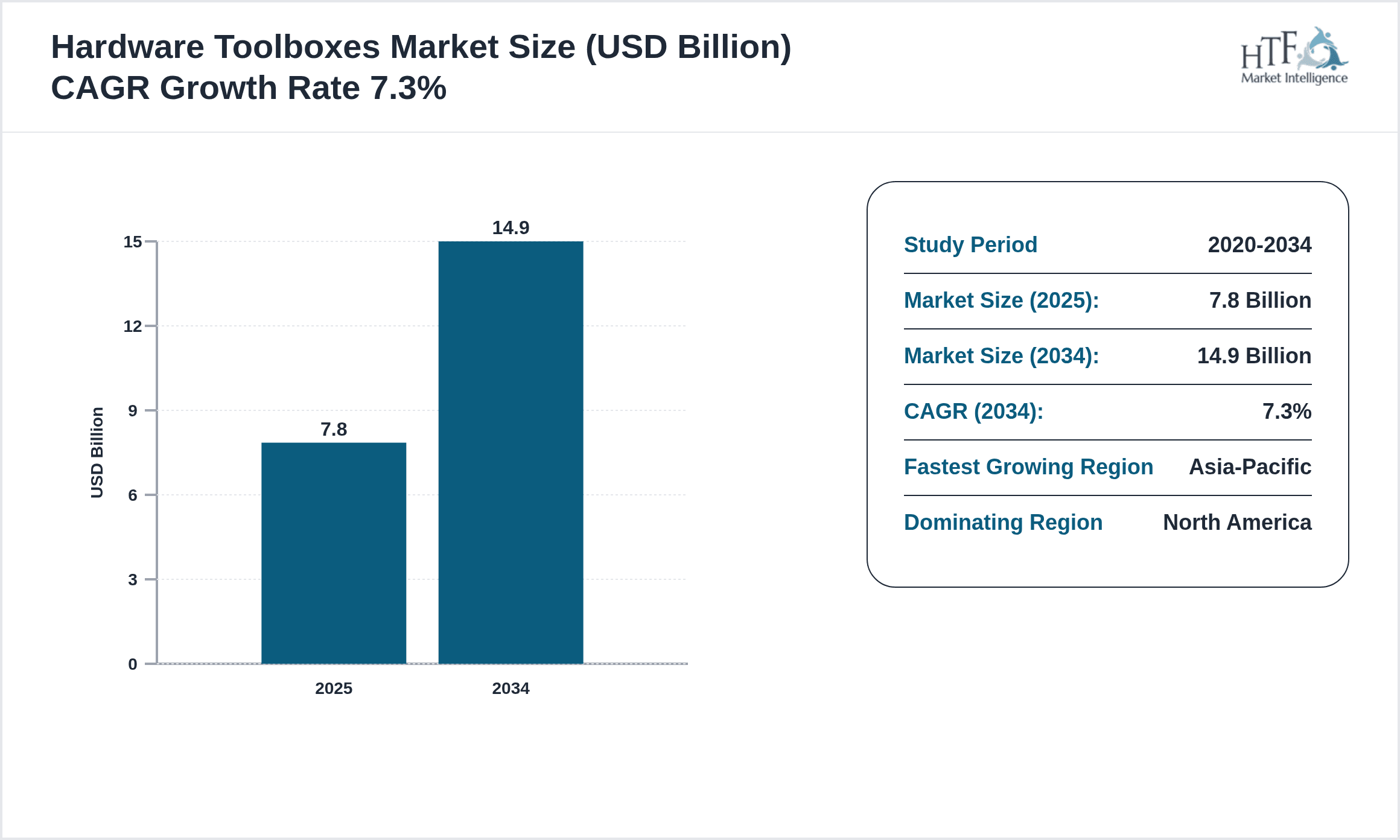
- •Key market highlights include a base year market value of USD 7.8 Billion in 2025, with a forecasted expansion to USD 14.9 Billion by 2034, reflecting a CAGR of approximately 7.3%. Year-on-year growth trends maintain stability at around 7.0%, underscoring steady demand and market resilience. Portable toolboxes remain the leading product type by market share, whereas electronic toolboxes represent the fastest-growing segment due to smart technology integration. Dominating regions include North America, supported by mature industrial sectors and strong consumer spending, while Asia-Pacific is identified as the fastest-growing region driven by burgeoning construction and automotive industries. The market benefits from expanding applications across industrial, automotive, and home improvement sectors, with manufacturers focusing on innovation and sustainability to capture emerging opportunities.
- •The value proposition of hardware toolboxes lies in their critical role in enhancing tool management efficiency, safety, and portability, thereby improving productivity across multiple industries and consumer segments. Strategic importance is evident as these tool storage solutions enable streamlined operations in construction, automotive maintenance, and manufacturing, reducing downtime and tool loss. For stakeholders including manufacturers, distributors, and end-users, the market offers opportunities for product differentiation through material innovation and smart features, aligning with trends toward digitalization and eco-friendly products. Investors and market participants stand to benefit from the sustained growth trajectory, supported by global infrastructure development, rising professional trades activity, and increasing DIY culture worldwide.
Competitive Landscape
The global hardware toolboxes market is marked by intense competition among established multinational corporations and emerging regional players, each striving to enhance market share through product innovation, strategic partnerships, and expansive distribution networks. Market dynamics are influenced by continuous technological advancements, particularly the integration of electronic features into traditional toolboxes, which facilitates inventory management and security, creating differentiation in a mature market. Competitive strategies frequently involve mergers and acquisitions to consolidate resources, expand product portfolios, and enter new geographic markets. Pricing strategies remain critical due to the presence of low-cost manufacturers primarily from Asia-Pacific, necessitating value-driven offerings from market leaders. Distribution channels are evolving with the rise of e-commerce platforms, enabling direct-to-consumer sales and enhanced customer engagement. Companies are also investing in sustainable materials and ergonomic designs to meet regulatory requirements and consumer expectations. Regional competition varies, with North America and Europe characterized by premium product offerings, while Asia-Pacific players focus on cost leadership and volume growth. Future competitive trends include increased focus on smart toolboxes, customization, and after-sales services to build brand loyalty and capitalize on the growing market demand.
Leading Companies in Hardware Toolboxes Market
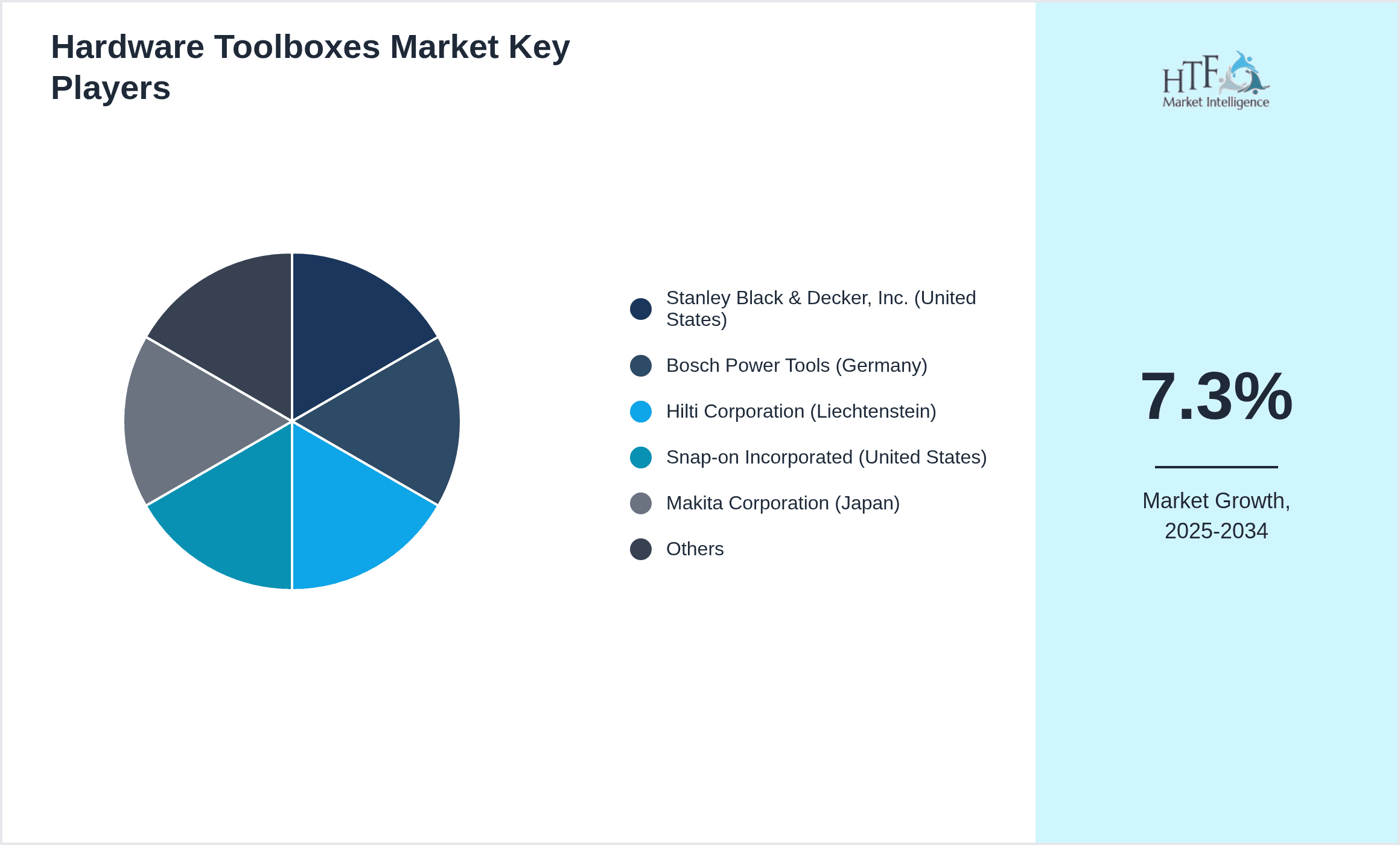
- •Stanley Black & Decker, Inc. (United States)
- •Bosch Power Tools (Germany)
- •Hilti Corporation (Liechtenstein)
- •Snap-on Incorporated (United States)
- •Makita Corporation (Japan)
- •DeWalt (United States)
- •Keter Group (Israel)
- •Bahco (Sweden)
- •Facom (France)
- •Irwin Tools (United States)
- •Proto Industrial Tools (United States)
- •Craftsman (United States)
- •Bessey Tools (Germany)
- •Gedore Group (Germany)
- •Tactix Limited (Hong Kong)
- •Wera Tools (Germany)
- •Klein Tools, Inc. (United States)
- •Ironside Tools (United States)
- •Williams Tools (United States)
- •Milwaukee Tool (United States)
- •Veto Pro Pac (United States)
- •Stanley Tools (United States)
- •Teng Tools (Sweden)
- •Facom SAS (France)
- •Hazet-Werke GmbH & Co. KG (Germany)
Market Breakdown
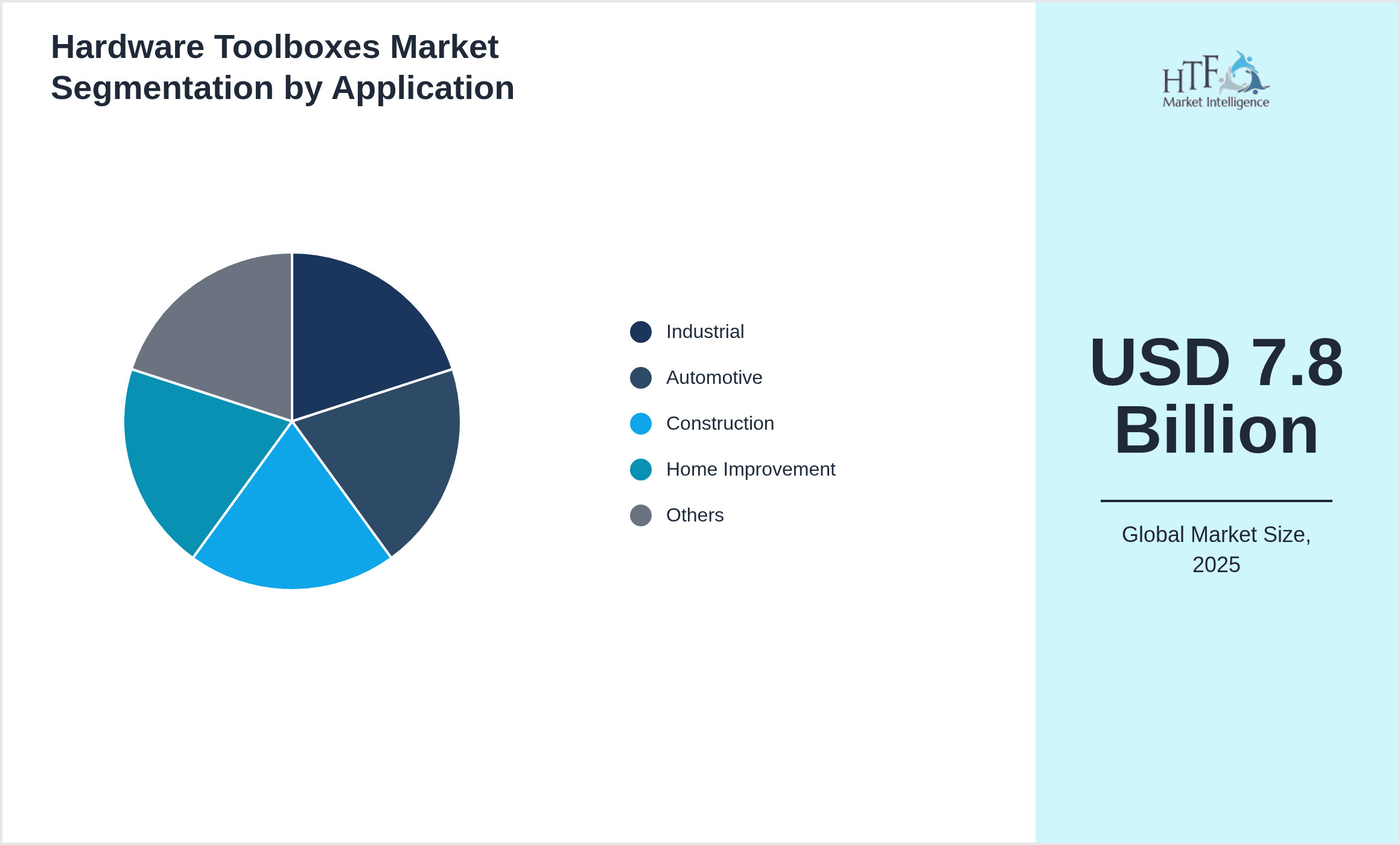
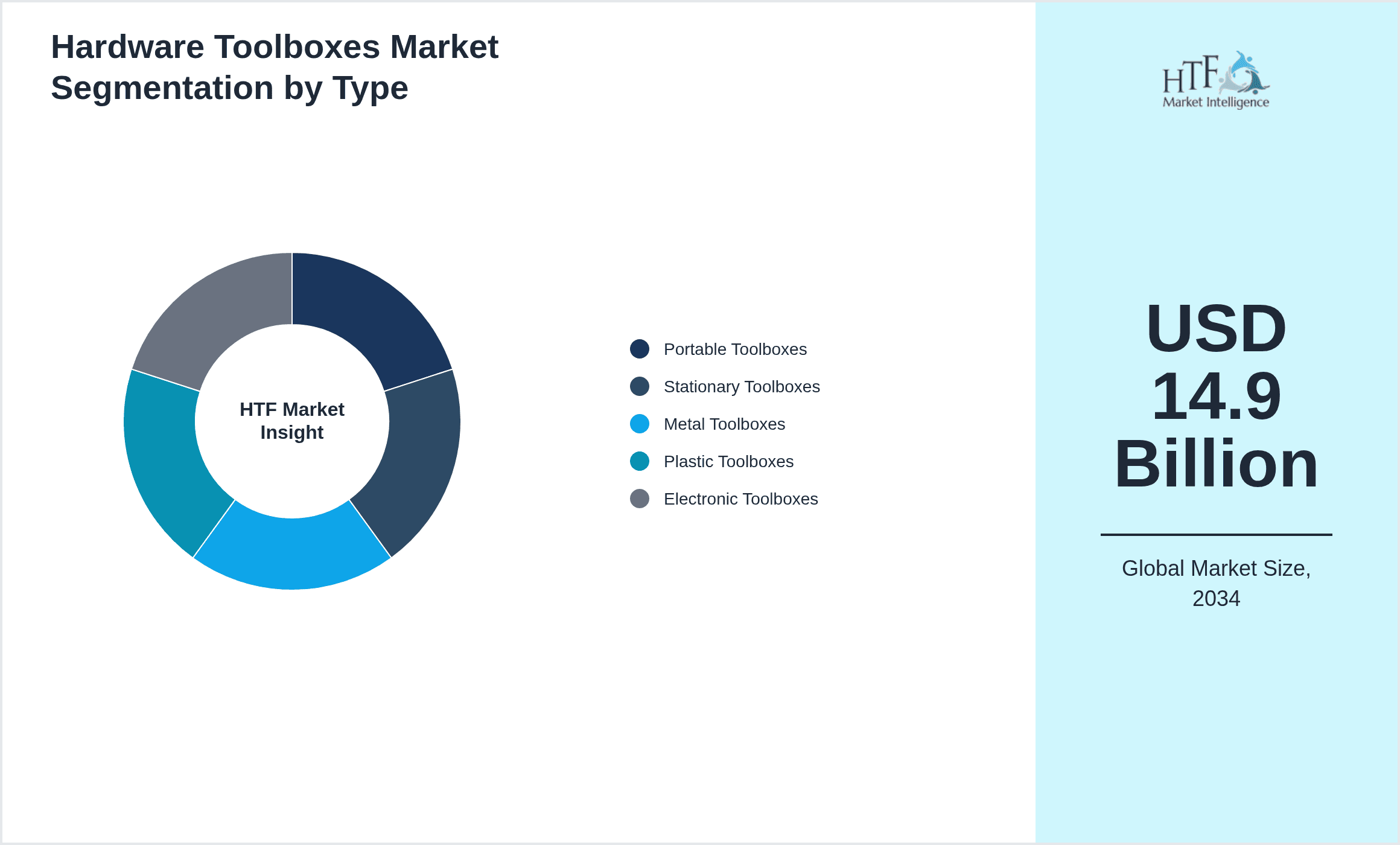
- •By Product Type
- ◦Portable Toolboxes
- ◦Stationary Toolboxes
- ◦Metal Toolboxes
- ◦Plastic Toolboxes
- ◦Electronic Toolboxes
- •By Application
- ◦Industrial
- ◦Automotive
- ◦Construction
- ◦Home Improvement
- ◦Others
- •By End-Use Industry
- ◦Manufacturing
- ◦Automotive Repair
- ◦Construction
- ◦DIY/Home Use
- •By Distribution Channel
- ◦Direct Sales
- ◦Retail Stores
- ◦E-commerce
Growth Dynamics
- •Increasing urbanization and infrastructure development worldwide are driving demand for durable and portable hardware toolboxes, especially in construction and industrial sectors where efficient tool management is essential for productivity and safety.
- •Rising adoption of smart technologies in tool storage, such as electronic toolboxes with integrated inventory tracking and security systems, is accelerating market growth by addressing modern user needs for convenience and loss prevention.
- •Expansion of the automotive repair and maintenance industry globally fuels demand for specialized toolboxes tailored to automotive tools, enhancing efficiency for mechanics and technicians in workshops and service centers.
- •The growing DIY culture and home improvement trend, supported by increasing disposable incomes and online retail penetration, are expanding the consumer base for compact and affordable portable toolboxes.
- •Sustainability initiatives and environmental regulations are prompting manufacturers to innovate with eco-friendly materials and manufacturing processes, catering to environmentally conscious customers and compliance requirements.
- •Investment in research and development to enhance toolbox ergonomics and durability is driving product innovation, allowing companies to differentiate offerings and meet diverse end-user demands across regions.
- •Strategic partnerships between manufacturers and distributors, along with expansion of e-commerce channels, are improving market reach and customer accessibility, contributing to steady market growth.
Market Trends
- •The integration of IoT and smart technology into hardware toolboxes is a significant trend, enabling real-time tracking, automated inventory management, and enhanced security, which improves user efficiency and reduces tool loss.
- •There is a growing preference for lightweight and durable materials such as high-grade plastics and composites over traditional metals, driven by portability requirements and ergonomic considerations among end users.
- •Sustainability-focused product development is gaining momentum, including the use of recycled materials and eco-friendly manufacturing processes, aligning with global environmental standards and consumer demand for green products.
- •E-commerce platforms are increasingly becoming key distribution channels, offering consumers greater convenience, customization options, and access to a wider range of hardware toolbox products.
- •Customization and modular designs allowing users to tailor toolboxes according to specific tool sets and application needs are emerging as differentiators among market players.
- •Collaborations between toolbox manufacturers and tool producers are fostering integrated solutions that enhance the compatibility and functionality of tool storage systems.
- •The rise of urban DIY communities and maker spaces is influencing market segmentation and targeting strategies, with tailored products designed for novice users and hobbyists.
Market Opportunities
- •Expanding construction and infrastructure projects in emerging economies present significant growth opportunities for portable and durable hardware toolboxes designed to meet rigorous on-site demands.
- •Developing smart electronic toolboxes with integrated digital features can tap into the growing market for high-tech storage solutions, appealing to professional users prioritizing efficiency and security.
- •Increasing online retail penetration provides opportunities for manufacturers to enhance direct-to-consumer sales channels, offering customization and faster delivery to meet evolving consumer expectations.
- •Collaborations with automotive and industrial tool manufacturers can create bundled product offerings, increasing value proposition and expanding customer base across sectors.
- •Sustainability-driven innovation in materials and manufacturing processes can attract environmentally-conscious customers and comply with tightening regulatory frameworks, opening new market segments.
- •Introduction of modular and customizable toolboxes allows targeting niche market segments such as specialized trades and hobbyists, enhancing market penetration and brand loyalty.
- •Geographical expansion into untapped regions such as Latin America and the Middle East & Africa can leverage increasing industrialization and urbanization trends to capture new revenue streams.
Market Challenges
- •Price sensitivity in emerging markets poses a challenge for premium hardware toolbox manufacturers, necessitating cost-effective production without compromising quality and features.
- •Competition from low-cost manufacturers and counterfeit products pressures market players to differentiate through innovation, quality assurance, and brand reputation.
- •Complex supply chain dynamics, including raw material price volatility and logistics disruptions, impact production costs and market availability of hardware toolboxes globally.
- •Adapting to diverse regulatory standards across regions requires manufacturers to invest in compliance and certification efforts, increasing operational complexity and costs.
- •Rapid technological changes necessitate continuous innovation, posing challenges for smaller players with limited R&D capabilities to keep pace with market leaders.
- •Consumer preference shifts towards digital and multifunctional tool storage solutions may marginalize traditional toolbox products if innovation lags behind market demand.
- •Environmental concerns and regulations may restrict use of certain materials or production methods, requiring investment in sustainable alternatives that may increase product prices.
Regulatory Framework
- •The Restriction of Hazardous Substances (RoHS) Directive, implemented between 2020 and 2025, mandates limitations on hazardous materials such as lead and cadmium in toolbox manufacturing, enhancing environmental safety and compliance across regions.
- •The European Union's Registration, Evaluation, Authorisation and Restriction of Chemicals (REACH) regulation requires manufacturers to disclose chemical use and ensure toolboxes meet safety standards, influencing material selection and production processes.
- •Occupational Safety and Health Administration (OSHA) standards in the United States impose requirements on tool storage safety to prevent workplace injuries, guiding design and usage protocols in industrial environments.
- •Environmental Protection Agency (EPA) regulations encourage manufacturers to adopt eco-friendly materials and waste reduction practices, impacting product lifecycle management from 2020 through 2025.
- •Country-specific mandates, such as China’s Green Manufacturing policies, enforce sustainability and energy efficiency in production processes, driving innovation in eco-friendly toolbox designs and manufacturing methods.
Market Intelligence
- •15th February 2025, Stanley Black & Decker, Inc. launched the 'SmartTech Toolbox' featuring integrated RFID tracking and Bluetooth connectivity designed for professional contractors. This product aims to reduce tool loss and improve inventory management through a user-friendly mobile app interface, enhancing on-site productivity. The launch aligns with growing demand for smart tool storage solutions and positions the company as a leader in integrating technology with traditional hardware products. This innovation is expected to drive market growth in electronic toolboxes globally. Source: Stanley Black & Decker Official Press Release
- •3rd May 2025, Bosch Power Tools introduced the 'EcoLine Toolbox' series made from 80% recycled plastics, targeting environmentally conscious consumers and complying with global sustainability regulations. The product line emphasizes durability and lightweight design, appealing to both industrial and DIY users. Bosch’s initiative reflects a strategic shift towards sustainable manufacturing practices, enhancing brand reputation and market penetration in Europe and Asia-Pacific regions. This launch is anticipated to influence competitive dynamics by setting new environmental standards in the toolbox market. Source: Bosch Corporate Website
- •28th August 2024, Hilti Corporation announced a strategic partnership with a leading IoT technology provider to develop next-generation smart toolboxes equipped with real-time location tracking and automated alerts for tool maintenance. The collaboration aims to integrate advanced sensor technology with Hilti’s robust toolbox designs, addressing growing demand in industrial and construction sectors. This initiative underscores the increasing importance of digital transformation in the hardware storage market and highlights opportunities for cross-industry innovation. The partnership is expected to accelerate adoption of electronic toolboxes globally. Source: Hilti Annual Report 2024
- •12th November 2024, Snap-on Incorporated completed acquisition of a regional toolbox manufacturer in Asia-Pacific to expand its footprint in emerging markets. The acquisition includes advanced manufacturing facilities and a diversified product portfolio, enabling Snap-on to enhance its competitive position and cater to rising demand in automotive and industrial applications. This strategic move reflects consolidation trends in the hardware toolboxes market and underscores the importance of geographic expansion for growth. The deal is expected to generate operational synergies and strengthen Snap-on’s global supply chain. Source: Snap-on Press Release
- •Recent market developments and strategic initiatives are continuously tracked through industry publications, company announcements, and regulatory filings. For the most current information, stakeholders are advised to monitor official corporate communications and recognized market intelligence platforms.
Regional Outlook
The North America currently holds a significant share of the market, primarily due to several key factors: increasing consumption rates, a burgeoning population, and robust economic momentum. These elements collectively drive demand, positioning this region as a leader in the market. On the other hand, Asia-Pacific is rapidly emerging as the fastest-growing area within the industry. This remarkable growth can be attributed to swift infrastructure development, the expansion of various industrial sectors, and a marked increase in consumer demand. These dynamics make this region a crucial player in shaping future market growth.
In our report, we cover a comprehensive analysis of the following regions and countries:
- North America
- LATAM
- West Europe
- Central & Eastern Europe
- Northern Europe
- Southern Europe
- East Asia
- Southeast Asia
- South Asia
- Central Asia
- Oceania
- MEA
| Feature | Details |
|---|---|
| Base Year Market Size | USD 7.8 Billion |
| Forecast Year Market Size | USD 14.9 Billion |
| CAGR | 7.3% |
| Forecast Period | 2026 to 2033 |
| YoY Growth | 7% |
| Scope of Report | Market is segmented by Product Type (Portable Toolboxes, Stationary Toolboxes, Metal Toolboxes, Plastic Toolboxes, Electronic Toolboxes), Application (Industrial, Automotive, Construction, Home Improvement, Others), End-Use Industry (Manufacturing, Automotive Repair, Construction, DIY/Home Use), Distribution Channel (Direct Sales, Retail Stores, E-commerce) |
| Regions Covered | North America, LATAM, West Europe, Central & Eastern Europe, Northern Europe, Southern Europe, East Asia, Southeast Asia, South Asia, Central Asia, Oceania, MEA |
| Key Companies | Stanley Black & Decker, Inc. (United States), Bosch Power Tools (Germany), Hilti Corporation (Liechtenstein), Snap-on Incorporated (United States), Makita Corporation (Japan) |
Global Hardware Toolboxes Market Size, Growth & Revenue 2025-2034 - Table of Contents
Research enthusiast focused on transforming data uncovering into actionable insights through data-driven decision-making.
Frequently Asked Questions (FAQ):
The Compact Track Loaders market is expected to see value worth 5.3 Billion in 2025.
North America currently leads the market with approximately 45% market share, followed by Europe at 28% and Asia-Pacific at 22%. The remaining regions account for 5% of the global market.
Key growth drivers include increasing construction activities, rising demand for versatile equipment in agriculture, technological advancements in track loader design, and growing preference for compact equipment in urban construction projects.