
Global AI in Aerospace Engineering Market Size, Growth & Revenue 2024-2034
Global AI in Aerospace Engineering Market is segmented by Product Type (Machine Learning, Natural Language Processing, Computer Vision, Robotics Process Automation, Expert Systems), Application (Predictive Maintenance, Autonomous Flight Control, Design Optimization, Supply Chain Management, Quality Assurance), End-Use Industry (Commercial Aerospace, Defense Aerospace, Space Exploration, Unmanned Aerial Vehicles (UAVs)), Distribution Channel (Direct OEM Sales, System Integrators, Aftermarket Services), and Geography (North America, LATAM, West Europe, Central & Eastern Europe, Northern Europe, Southern Europe, East Asia, Southeast Asia, South Asia, Central Asia, Oceania, MEA)
Pricing
Report Overview
Executive Summary
- •The global AI in Aerospace Engineering market represents the application of artificial intelligence technologies to revolutionize aerospace design, manufacturing, and operational domains. This market integrates various AI subfields such as machine learning, natural language processing, computer vision, and robotics process automation to enhance predictive maintenance, autonomous flight control, design optimization, and supply chain management. AI facilitates real-time data analytics, automation of complex processes, and improved safety measures across commercial and defense aerospace sectors. Growing technological advancements, increasing demand for efficiency, and the need for reduced operational costs drive adoption. The market also witnesses strong collaborations between aerospace manufacturers and AI technology firms, fostering innovation and enabling smarter aerospace solutions that meet stringent regulatory and environmental standards. Overall, this market is pivotal in shaping the future of aerospace engineering by delivering intelligent, efficient, and cost-effective aerospace systems globally.
- •Key market highlights include a robust CAGR of approximately 13.76% from 2024 to 2034, driven by rapid digital transformation in aerospace manufacturing and operations. The base market size in 2024 stands at USD 12.5 Billion, expected to grow to USD 45.8 Billion by 2034. North America leads the market due to advanced aerospace infrastructure and high adoption of AI technologies, while Asia-Pacific shows the fastest growth owing to increasing aerospace manufacturing investments and government initiatives. Machine learning dominates the product type segment, with robotics process automation emerging as the fastest-growing technology. Predictive maintenance remains the largest application area, closely followed by autonomous flight control. These dynamics highlight the strategic importance of AI in streamlining aerospace engineering workflows and boosting operational efficiency worldwide.
- •The value proposition of AI in aerospace engineering lies in its ability to enhance safety, optimize design, reduce maintenance costs, and enable autonomous operations. Stakeholders including aerospace manufacturers, defense organizations, AI technology developers, and regulatory bodies benefit from improved operational insights and predictive capabilities. The integration of AI accelerates innovation cycles, supports sustainable aerospace practices by reducing resource wastage, and ensures compliance with evolving safety standards. This strategic importance is underscored by significant investments and partnerships aimed at developing next-generation aerospace systems powered by AI, positioning the market as a crucial enabler of future aerospace advancements.

Competitive Landscape
The competitive environment in the global AI in Aerospace Engineering market is characterized by intense rivalry among leading aerospace manufacturers, AI technology providers, and software developers. Companies differentiate themselves through innovation in AI algorithms, strategic collaborations, and comprehensive solution offerings that integrate AI across aerospace design and operational stages. Market leaders invest heavily in research and development to enhance predictive analytics, autonomous systems, and intelligent supply chain management. Strategic partnerships and acquisitions are common, aimed at expanding technological capabilities and market reach. Pricing strategies emphasize value-based pricing reflecting the complexity and critical nature of aerospace AI applications. Distribution channels include direct sales to aerospace OEMs and collaborations with defense agencies, underscoring high entry barriers. Regional competition varies with North America and Europe focusing on high-end innovation, while Asia-Pacific emphasizes rapid adoption and scaling. The market is expected to witness consolidation as firms seek to strengthen competitive advantages and respond to emerging regulatory frameworks.
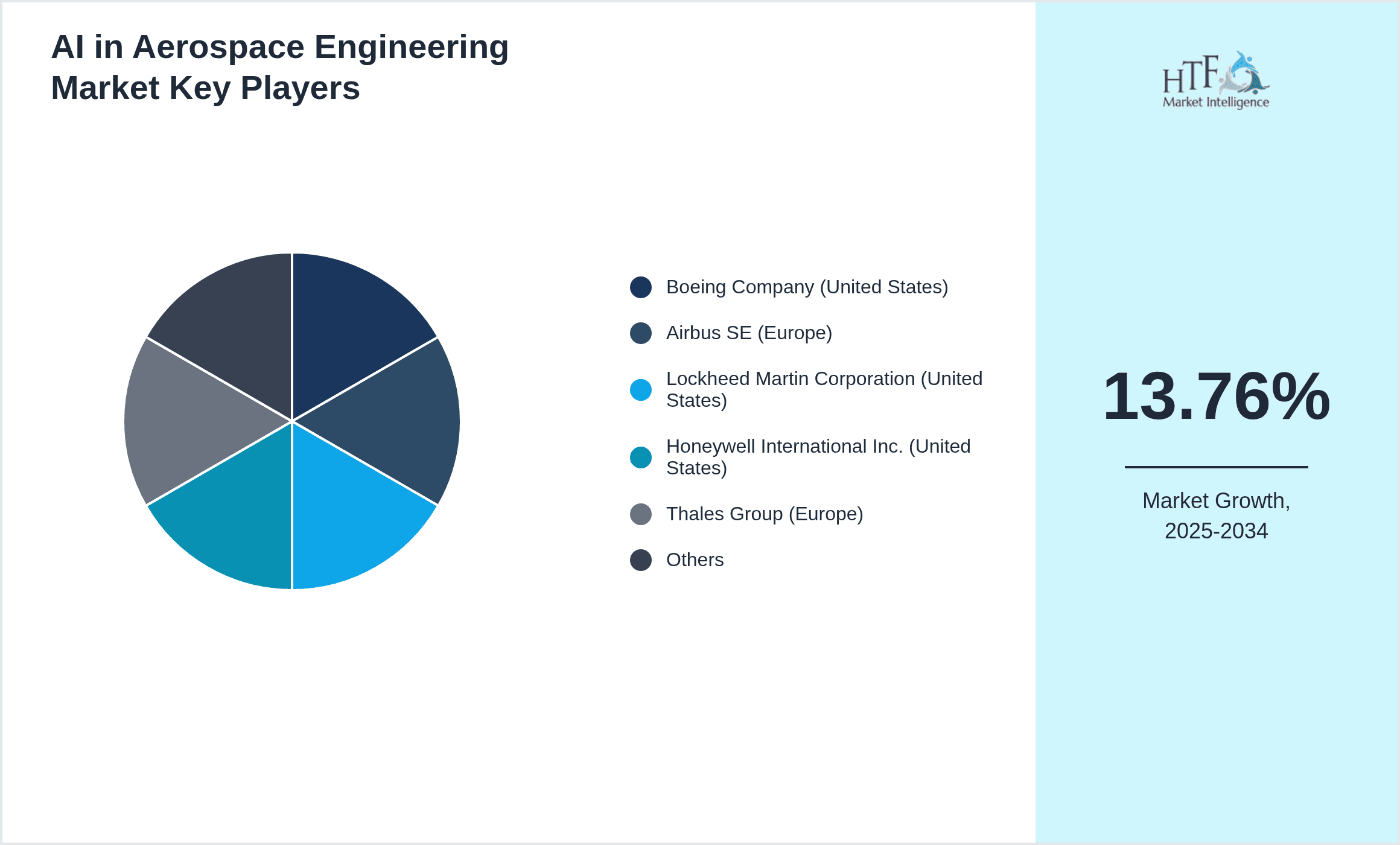
Prominent Players in AI in Aerospace Engineering Market
- •Boeing Company (United States)
- •Airbus SE (Europe)
- •Lockheed Martin Corporation (United States)
- •Honeywell International Inc. (United States)
- •Thales Group (Europe)
- •General Electric Company (United States)
- •Raytheon Technologies Corporation (United States)
- •Dassault Aviation (Europe)
- •Safran SA (Europe)
- •Northrop Grumman Corporation (United States)
- •BAE Systems plc (Europe)
- •GE Aviation (United States)
- •United Technologies Corporation (United States)
- •Rolls-Royce Holdings plc (Europe)
- •L3Harris Technologies, Inc. (United States)
- •Mitsubishi Heavy Industries, Ltd. (Asia-Pacific)
- •Honeywell Aerospace (United States)
- •BAE Systems Applied Intelligence (Europe)
- •Textron Inc. (United States)
- •Leonardo S.p.A. (Europe)
- •Embraer S.A. (Latin America)
- •Bombardier Inc. (North America)
- •SAAB AB (Europe)
- •Kongsberg Gruppen ASA (Europe)
- •General Dynamics Corporation (United States)

Market Breakdown
- •By Product Type
- ◦Machine Learning
- ◦Natural Language Processing
- ◦Computer Vision
- ◦Robotics Process Automation
- ◦Expert Systems
- •By Application
- ◦Predictive Maintenance
- ◦Autonomous Flight Control
- ◦Design Optimization
- ◦Supply Chain Management
- ◦Quality Assurance
- •By End-Use Industry
- ◦Commercial Aerospace
- ◦Defense Aerospace
- ◦Space Exploration
- ◦Unmanned Aerial Vehicles (UAVs)
- •By Distribution Channel
- ◦Direct OEM Sales
- ◦System Integrators
- ◦Aftermarket Services
Growth Dynamics
- •The increasing demand for predictive maintenance solutions is a significant growth driver, reducing downtime and operational costs for aerospace operators by enabling real-time fault detection and prognosis through AI algorithms.
- •Advancements in autonomous flight control systems, fueled by AI capabilities, are transforming the aerospace landscape by improving flight safety, operational efficiency, and reducing pilot workload in both commercial and military aircraft.
- •The growing adoption of machine learning and computer vision in aerospace design optimization accelerates innovation cycles, allowing engineers to simulate complex scenarios and enhance aircraft performance and fuel efficiency.
- •Government initiatives and increased investments in aerospace digital transformation encourage the integration of AI technologies, fostering collaborations between aerospace manufacturers and AI technology providers worldwide.
- •The rise of unmanned aerial vehicles (UAVs) and space exploration missions creates new applications for AI in navigation, control, and mission planning, further expanding the market opportunities.
- •The push towards sustainable aerospace operations promotes AI-driven solutions for optimizing supply chain management, reducing waste, and enhancing resource utilization across manufacturing and maintenance.
- •Increasing availability of big data and cloud computing infrastructure supports the deployment of AI-powered analytics in aerospace engineering, enabling scalable and efficient solutions.

Market Trends
- •Integration of AI with Internet of Things (IoT) sensors in aerospace equipment is becoming prevalent, enabling continuous monitoring and data-driven decision-making in maintenance and operations.
- •The adoption of edge computing is emerging as a trend, facilitating real-time AI processing onboard aircraft to enhance responsiveness and reduce latency in autonomous functions.
- •Collaborations between aerospace manufacturers and AI startups are increasing, fostering innovation in niche AI applications tailored to aerospace engineering challenges.
- •Sustainability-focused AI solutions are gaining traction, with companies developing models to reduce carbon footprint and optimize fuel consumption in aerospace operations.
- •AI-driven digital twins are increasingly utilized for virtual simulation and predictive analytics, aiding in design validation and maintenance planning.
- •Regulatory agencies are progressively incorporating AI standards and certifications, influencing the development and deployment of AI technologies in aerospace.
- •The trend towards multi-modal AI systems combining computer vision, NLP, and machine learning enhances aerospace system intelligence and operational flexibility.
Market Opportunities
- •Expanding AI applications in space exploration missions offer vast growth potential, including autonomous navigation, robotic maintenance, and data analytics for satellite systems.
- •Emerging markets in Asia-Pacific present untapped demand for AI-enabled aerospace engineering solutions, supported by increasing aerospace manufacturing investments and government incentives.
- •The integration of AI with next-generation materials and additive manufacturing techniques opens opportunities for innovative aerospace components with enhanced performance and reduced weight.
- •Development of AI-powered cybersecurity measures for aerospace systems addresses growing threats and regulatory requirements, creating a niche market segment.
- •Strategic partnerships and joint ventures between AI companies and aerospace OEMs can accelerate technology adoption and market penetration globally.
- •AI-driven optimization of supply chains can significantly reduce costs and improve efficiency, especially in the wake of global logistics disruptions.
- •Customization of AI solutions for defense aerospace applications to enhance mission-critical operations offers lucrative opportunities for specialized providers.
Market Challenges
- •High initial investment and integration complexity pose significant barriers for aerospace companies seeking to adopt AI technologies at scale.
- •Data privacy and security concerns, especially in defense aerospace applications, limit the sharing and utilization of critical operational data required for effective AI implementation.
- •The shortage of skilled professionals with expertise in both aerospace engineering and advanced AI techniques hampers rapid market growth and innovation.
- •Regulatory uncertainties and the evolving nature of AI-related standards create compliance challenges for manufacturers and technology providers.
- •Interoperability issues between legacy aerospace systems and new AI platforms slow integration and increase operational risks.
- •High cost sensitivity within the aerospace industry demands that AI solutions deliver clear, quantifiable ROI, which can be difficult to demonstrate initially.
- •Resistance to change and trust issues among aerospace stakeholders may delay adoption of autonomous and AI-driven systems.
Regulatory Framework
- •Between 2023 and 2024, the International Civil Aviation Organization (ICAO) introduced guidelines for AI system certification in aerospace, emphasizing safety, transparency, and accountability, which significantly impact AI deployment strategies.
- •The European Union Aviation Safety Agency (EASA) enacted regulations in 2023 mandating rigorous testing and validation of AI algorithms used in autonomous flight control systems to ensure operational reliability.
- •In 2023, the U.S. Federal Aviation Administration (FAA) updated its framework to include AI-enabled predictive maintenance systems under its safety oversight, requiring compliance with cybersecurity and data integrity standards.
- •Regional mandates in Asia-Pacific countries between 2022 and 2024 focus on encouraging AI innovation in aerospace while imposing strict data sovereignty and privacy requirements to protect national security interests.
- •Government initiatives worldwide offer incentives and support programs fostering AI adoption in aerospace engineering, including funding for R&D and public-private partnerships aimed at advancing AI safety and performance standards.
Market Intelligence
- •15th February 2025, Boeing Company announced the launch of its advanced AI-driven predictive maintenance platform designed to integrate with existing aircraft systems. This platform leverages machine learning algorithms and real-time sensor data to forecast equipment failures and optimize maintenance schedules, thereby reducing downtime and operational costs. Boeing aims to deploy this solution across its commercial and defense aerospace fleets, enhancing reliability and safety standards while offering customers substantial cost savings. The platform's modular design supports scalability and integration with third-party aerospace systems, positioning Boeing as a leader in aerospace AI innovation. Source: Boeing Official Press Release
- •10th January 2025, Airbus SE unveiled its autonomous flight control system powered by artificial intelligence and computer vision technologies. This system enhances pilot assistance through real-time environmental analysis, adaptive decision-making, and fail-safe mechanisms. Targeting both commercial airlines and military applications, Airbus's innovation promises to improve flight safety and operational efficiency while reducing pilot workload. The company plans to conduct extensive testing throughout 2025 to meet stringent regulatory standards before full-scale deployment. This initiative aligns with Airbus's strategic focus on digital transformation and sustainable aerospace solutions. Source: Airbus Corporate News
- •22nd March 2025, Honeywell International Inc. announced a strategic partnership with a leading AI startup to co-develop robotics process automation solutions tailored for aerospace supply chain management. The collaboration aims to integrate AI-driven automation in inventory control, procurement, and logistics, targeting increased efficiency and reduced lead times. Honeywell expects this partnership to accelerate digital transformation efforts within its aerospace division and provide competitive advantages in global markets. This move reflects the growing trend of aerospace companies leveraging AI partnerships to enhance operational agility. Source: Honeywell Press Release
- •5th April 2025, Lockheed Martin Corporation completed the acquisition of an AI-based aerospace analytics firm specializing in natural language processing and predictive analytics. The acquisition enables Lockheed Martin to incorporate advanced AI capabilities into its defense aerospace platforms, enhancing mission planning, threat detection, and maintenance optimization. This strategic move strengthens Lockheed Martin's position in the AI aerospace market and supports its commitment to innovation-driven defense solutions. The integration process is underway with expected operational synergies realized by late 2025. Source: Lockheed Martin Official Announcement
Regional Outlook
The North America currently holds a significant share of the market, primarily due to several key factors: increasing consumption rates, a burgeoning population, and robust economic momentum. These elements collectively drive demand, positioning this region as a leader in the market. On the other hand, Asia-Pacific is rapidly emerging as the fastest-growing area within the industry. This remarkable growth can be attributed to swift infrastructure development, the expansion of various industrial sectors, and a marked increase in consumer demand. These dynamics make this region a crucial player in shaping future market growth.
In our report, we cover a comprehensive analysis of the following regions and countries:
- North America
- LATAM
- West Europe
- Central & Eastern Europe
- Northern Europe
- Southern Europe
- East Asia
- Southeast Asia
- South Asia
- Central Asia
- Oceania
- MEA
| Feature | Details |
|---|---|
| Base Year Market Size | USD 12.5 Billion |
| Forecast Year Market Size | USD 45.8 Billion |
| CAGR | 13.76% |
| Forecast Period | 2026 to 2033 |
| YoY Growth | 12.98% |
| Scope of Report | Market is segmented by Product Type (Machine Learning, Natural Language Processing, Computer Vision, Robotics Process Automation, Expert Systems), Application (Predictive Maintenance, Autonomous Flight Control, Design Optimization, Supply Chain Management, Quality Assurance), End-Use Industry (Commercial Aerospace, Defense Aerospace, Space Exploration, Unmanned Aerial Vehicles (UAVs)), Distribution Channel (Direct OEM Sales, System Integrators, Aftermarket Services) |
| Regions Covered | North America, LATAM, West Europe, Central & Eastern Europe, Northern Europe, Southern Europe, East Asia, Southeast Asia, South Asia, Central Asia, Oceania, MEA |
| Key Companies | Boeing Company (United States), Airbus SE (Europe), Lockheed Martin Corporation (United States), Honeywell International Inc. (United States), Thales Group (Europe) |
Global AI in Aerospace Engineering Market Size, Growth & Revenue 2024-2034 - Table of Contents
Frequently Asked Questions (FAQ):
The Compact Track Loaders market is expected to see value worth 5.3 Billion in 2025.
North America currently leads the market with approximately 45% market share, followed by Europe at 28% and Asia-Pacific at 22%. The remaining regions account for 5% of the global market.
Key growth drivers include increasing construction activities, rising demand for versatile equipment in agriculture, technological advancements in track loader design, and growing preference for compact equipment in urban construction projects.