
Global Folding Ladders Market Size, Growth & Revenue 2024-2034
Global Folding Ladders Market is segmented by Product Type (Step Ladders, Extension Ladders, Platform Ladders, Telescoping Ladders, Multi-Position Ladders), Application (Residential Use, Commercial Use, Industrial Use, Maintenance, Outdoor Activities), End-Use Industry (Construction, Manufacturing, Retail, Facility Management), Distribution Channel (Offline Retail, E-commerce, Direct Sales), and Geography (North America, LATAM, West Europe, Central & Eastern Europe, Northern Europe, Southern Europe, East Asia, Southeast Asia, South Asia, Central Asia, Oceania, MEA)
Pricing
Report Overview
Executive Summary
- •The global folding ladders market is defined by portable, foldable ladder solutions designed for diverse applications including residential, commercial, industrial, maintenance, and outdoor activities. This market covers multiple ladder types such as step ladders, extension ladders, platform ladders, telescoping ladders, and multi-position ladders, each offering unique features catering to specific user needs. The market scope extends through manufacturing, distribution, and end-use, emphasizing innovations in lightweight materials, enhanced safety mechanisms, and multifunctional designs. Rising urbanization, growth in construction and maintenance activities, and consumer inclination towards DIY projects are key factors expanding market reach. Additionally, regulatory compliance and safety standards globally influence product development and market acceptance. The folding ladders market is characterized by competitive dynamics involving multinational companies and regional manufacturers, focusing on product differentiation, channel expansion, and strategic partnerships to capture market share worldwide. Increasing demand in emerging economies and advancements in manufacturing technology further accelerate market growth.
- •Key market highlights include the forecasted growth from USD 3.2 billion in 2024 to USD 7.9 billion by 2034, reflecting a robust CAGR of 9.4%. Step ladders dominate product type segments due to their widespread utility and affordability, whereas telescoping ladders exhibit the fastest growth driven by their compactness and versatility. North America leads the regional market share with mature infrastructure and high adoption rates, while Asia-Pacific is the fastest growing region fueled by rapid urbanization and industrialization. Residential and commercial applications together constitute the majority of market consumption, supported by growing safety awareness and adoption of ergonomic ladder designs. Competitive strategies focus on innovation, safety enhancements, and expansion into untapped markets, contributing to dynamic market evolution.
- •The folding ladders market presents substantial value for stakeholders including manufacturers, distributors, retailers, and end-users by offering innovative, space-saving, and safe access solutions. Its strategic importance spans construction, maintenance, logistics, and household sectors, addressing growing needs for flexible working height solutions. The evolving market landscape encourages investment in R&D and sustainable materials to meet increasing safety regulations and customer expectations. Additionally, the market’s global nature provides opportunities for cross-regional collaborations and technological integration, enhancing product portfolios and competitive positioning. Stakeholders benefit from insights into emerging trends, regional growth patterns, and consumer preferences, enabling informed decision-making and strategic planning.

Competitive Landscape
The competitive environment in the global folding ladders market is marked by intense rivalry between established multinational corporations and emerging regional players. Market leaders differentiate through continuous innovation, focusing on lightweight materials such as aluminum and fiberglass, safety enhancements including anti-slip features and locking mechanisms, and ergonomic designs that improve usability. Strategic partnerships, mergers, and acquisitions are common to expand product portfolios and geographic reach. Pricing strategies vary with premium products targeting professional users and cost-effective models catering to residential customers. Distribution channels encompass direct sales, retail outlets, and e-commerce platforms, emphasizing accessibility and customer convenience. Regulatory compliance with international safety standards acts as both a competitive barrier and a driver of product development. Going forward, companies aim to leverage digital marketing, sustainable manufacturing, and smart ladder technologies to maintain and grow their market shares globally.
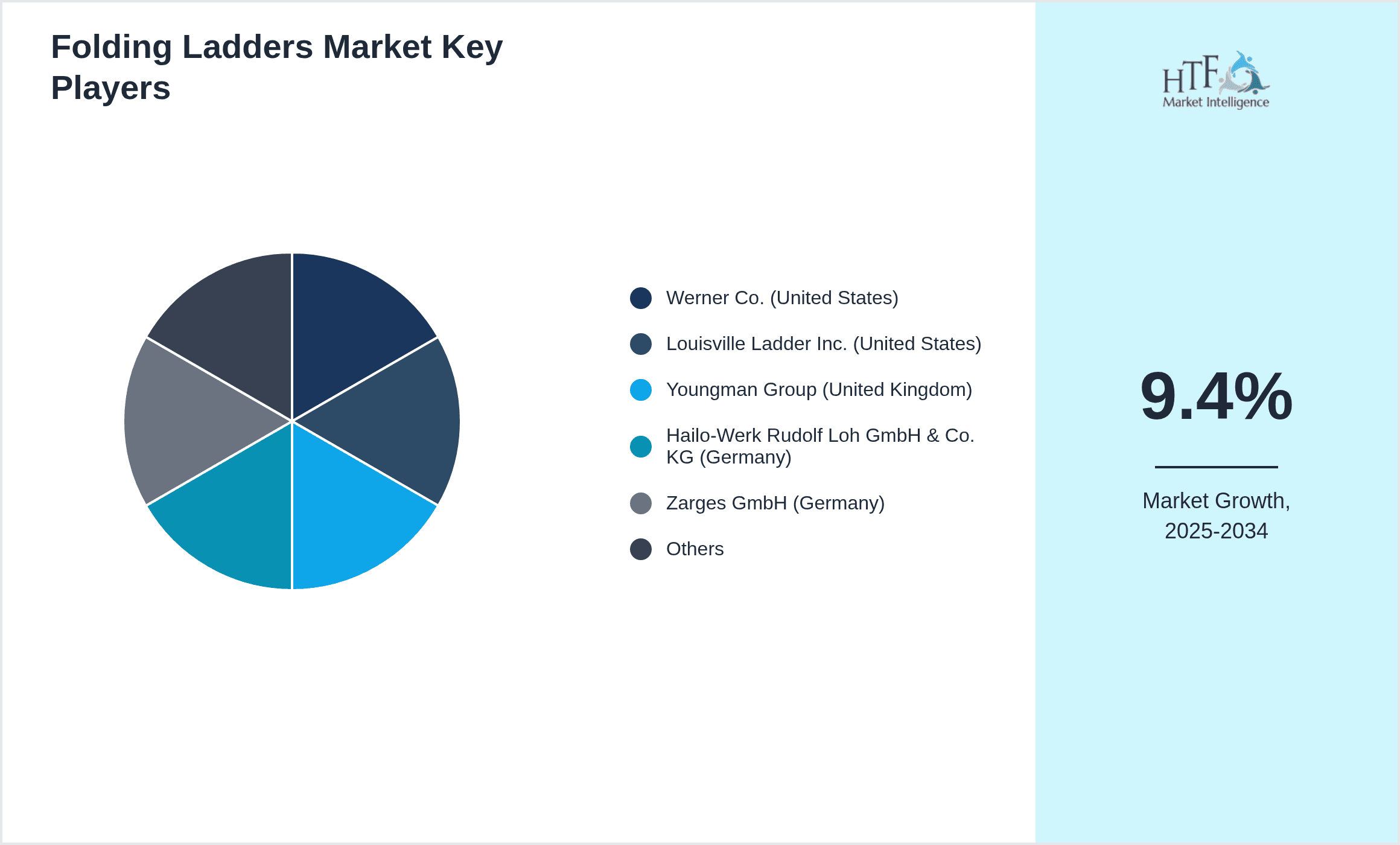
Prominent Players in Folding Ladders Market
- •Werner Co. (United States)
- •Louisville Ladder Inc. (United States)
- •Youngman Group (United Kingdom)
- •Hailo-Werk Rudolf Loh GmbH & Co. KG (Germany)
- •Zarges GmbH (Germany)
- •Abru Industries Ltd. (India)
- •WAKÜ Leiter- und Gerüstsysteme GmbH (Germany)
- •Gierre S.p.A (Italy)
- •Xtend & Climb (United States)
- •B&Q plc (United Kingdom)
- •Telesteps AB (Sweden)
- •Alcoa Corporation (United States)
- •Little Giant Ladder Systems (United States)
- •Keller Group (United States)
- •Krause-Werk GmbH & Co. KG (Germany)
- •Facal Industries Ltda. (Brazil)
- •Sumner Manufacturing Co. (United States)
- •Svelt S.p.A (Italy)
- •Alumet Systems (Canada)
- •Louisville Ladder Canada (Canada)
- •National Ladder Corporation (United States)
- •Hailo-Werk USA (United States)
- •Zarges UK Ltd. (United Kingdom)
- •Little Giant Ladder Systems Canada (Canada)
- •Xtend & Climb Europe (Europe)

Market Breakdown
- •By Product Type
- ◦Step Ladders
- ◦Extension Ladders
- ◦Platform Ladders
- ◦Telescoping Ladders
- ◦Multi-Position Ladders
- •By Application
- ◦Residential Use
- ◦Commercial Use
- ◦Industrial Use
- ◦Maintenance
- ◦Outdoor Activities
- •By End-Use Industry
- ◦Construction
- ◦Manufacturing
- ◦Retail
- ◦Facility Management
- •By Distribution Channel
- ◦Offline Retail
- ◦E-commerce
- ◦Direct Sales
Growth Dynamics
- •Rising urbanization and infrastructural development globally drive increasing demand for folding ladders, especially in residential and commercial construction sectors where space efficiency and portability are critical. The expanding DIY culture encourages homeowners to purchase versatile ladder types for maintenance and renovation tasks, further propelling market growth.
- •Technological advancements in materials such as lightweight aluminum alloys and fiberglass composites enhance product durability and safety, attracting professional users and industrial buyers. Additionally, integration of safety features like slip-resistant steps and locking mechanisms elevates user confidence and compliance with stringent safety regulations.
- •The growth of e-commerce platforms has significantly broadened market access, allowing manufacturers and retailers to reach a wider consumer base efficiently. Online sales channels provide consumers with comparative product information and customer reviews, simplifying purchase decisions and increasing market penetration.
- •Government initiatives promoting workplace safety and regulations mandating compliance with international ladder safety standards incentivize manufacturers to innovate and improve product quality. Such regulatory frameworks enhance market credibility and stimulate demand among commercial and industrial users.
- •Emerging economies in Asia-Pacific and Latin America exhibit rapidly growing construction and industrial sectors, creating lucrative opportunities for folding ladder manufacturers. Increasing disposable incomes and evolving consumer preferences for ergonomic and compact ladder designs are key factors accelerating regional market expansion.

Market Trends
- •The adoption of telescoping and multi-position ladders is gaining momentum due to their compact storage and multifunctional usage, aligning with consumer demand for space-saving solutions. Manufacturers are prioritizing design innovations to enhance portability without compromising safety and stability.
- •Sustainability trends influence material selection, with a shift towards eco-friendly and recyclable materials in ladder manufacturing. Companies incorporate green practices to appeal to environmentally conscious consumers and comply with emerging regulatory standards.
- •Integration of smart technologies such as digital height indicators and safety sensors in folding ladders is emerging, aimed at improving user experience and operational safety. Early adopters of such innovations gain competitive advantages in premium market segments.
- •The market is witnessing an increased focus on ergonomic designs that reduce user fatigue and enhance comfort during prolonged use. Features like adjustable steps and padded grips are becoming standard in new product releases.
- •Collaborations between ladder manufacturers and safety certification bodies are on the rise, facilitating faster market approvals and boosting consumer trust. These partnerships accelerate product launches and market acceptance globally.
- •Retailers and manufacturers are strengthening their omnichannel presence, blending offline and online sales strategies to optimize customer reach and experience. This trend supports personalized marketing and after-sales services, enhancing brand loyalty.
- •Increasing demand for customized ladder solutions tailored to specific industry requirements is driving the development of specialized folding ladder variants. Such customization enhances utility in sectors like manufacturing and facility management.
Market Opportunities
- •Expanding construction activities in emerging markets provide significant growth potential for folding ladder manufacturers, particularly for products engineered to meet local standards and environmental conditions. Targeted marketing and distribution strategies can capitalize on these opportunities.
- •The increasing trend of smart homes and automated maintenance systems opens avenues for integrating folding ladders with IoT-enabled features, enhancing safety and functionality. Innovation in smart ladder technology can position companies as market leaders.
- •Rising e-commerce penetration in regions with previously limited access to quality ladder products presents an untapped distribution channel. Strategic partnerships with online marketplaces can accelerate market expansion and consumer reach.
- •Investments in research and development focused on lightweight, durable, and environmentally sustainable materials can yield competitive advantages. Offering eco-friendly ladder solutions aligns with global sustainability goals and consumer preferences.
- •Collaborations with construction firms and facility management companies for bulk supply contracts represent lucrative opportunities. Tailoring products to meet specific industry demands can foster long-term partnerships and steady revenue streams.
- •Geographical expansion into underpenetrated regions such as Latin America and the Middle East can diversify revenue sources and mitigate risks associated with mature markets. Localized production and distribution can optimize costs and market responsiveness.
- •Product line diversification to include accessories and complementary safety equipment can enhance overall market offering and increase customer lifetime value. Bundled solutions appeal to professional users seeking comprehensive safety packages.
Market Challenges
- •High production costs of advanced materials such as fiberglass can limit affordability, particularly in price-sensitive markets, constraining market penetration of premium folding ladder models. Balancing cost and quality remains a critical challenge for manufacturers.
- •Stringent safety regulations and certification processes across different regions create compliance complexities and delay product launches. Navigating diverse regulatory frameworks demands significant investment in testing and documentation.
- •Intense competition from low-cost manufacturers, especially in emerging markets, exerts pricing pressure and can erode profit margins for established players. Differentiation through innovation and branding is essential to maintain market position.
- •Limited consumer awareness about the importance of ladder safety features and standards in certain regions hampers demand for high-quality products. Educational initiatives require collaboration between manufacturers and regulatory bodies.
- •Supply chain disruptions caused by geopolitical tensions and raw material shortages impact production schedules and cost structures, posing risks to timely market delivery and pricing stability.
- •The challenge of designing ladders that balance portability, stability, and load capacity requires continuous R&D investment. Failure to meet evolving consumer expectations can result in loss of market share.
- •Counterfeit products and lack of standardization in certain regions undermine brand reputation and consumer trust, necessitating robust quality control measures and legal enforcement.
Regulatory Framework
- •Between 2019 and 2024, multiple regions implemented updated ladder safety regulations including the adoption of ISO 14122 standards, mandating enhanced stability and strength criteria for folding ladders. These regulations require manufacturers to upgrade product designs and undergo rigorous testing to ensure compliance, elevating overall market safety standards.
- •The European Union reinforced directive 2001/45/EC in 2021, emphasizing workplace ladder safety with stricter enforcement and penalties for non-compliance. This has led to increased demand for certified folding ladders in commercial and industrial sectors within Europe.
- •In North America, OSHA updated its ladder safety guidelines in 2022, introducing more comprehensive inspection protocols and user training requirements. Manufacturers have responded by integrating user-friendly safety features and providing educational materials.
- •Asia-Pacific countries, including Japan and Australia, have introduced region-specific safety mandates between 2020 and 2023, focusing on product labeling and consumer awareness. These policies aim to reduce ladder-related accidents and promote quality products in growing construction markets.
- •Government incentives promoting workplace safety and sustainable manufacturing practices have been introduced globally, encouraging companies to adopt eco-friendly materials and processes in ladder production. Such policies support long-term market sustainability and innovation.
Market Intelligence
- •12th January 2025, Werner Co. launched its latest line of telescoping folding ladders featuring enhanced locking mechanisms and lightweight aluminum alloys designed for ease of transport and increased safety. Targeting professional contractors and DIY enthusiasts, this product line aims to capture the growing demand for compact and versatile ladder solutions. The launch is supported by a comprehensive marketing campaign emphasizing durability and compliance with updated safety standards. This initiative is expected to strengthen Werner Co.'s leadership position in the folding ladders market globally. Source: Werner Co. Official Press Release
- •22nd March 2025, Zarges GmbH introduced innovative multi-position ladders equipped with smart sensors that alert users to unsafe angles and load limits. This technology integration represents a significant advancement in ladder safety, combining traditional ladder functionality with modern IoT capabilities. The product targets industrial users and facility management sectors seeking enhanced workplace safety. Early market reception indicates strong interest, positioning Zarges as a pioneer in smart ladder technology. Source: Zarges GmbH Corporate News
- •15th February 2025, Louisville Ladder Inc. announced a strategic partnership with a leading e-commerce platform to expand its global distribution network. This collaboration aims to increase online accessibility of Louisville’s folding ladder products, supplemented by virtual customer support and detailed product demonstrations. The initiative responds to shifting consumer purchasing behaviors favoring online channels and is projected to boost sales across North America, Europe, and Asia-Pacific. Source: Louisville Ladder Inc. Press Release
- •8th April 2025, Youngman Group completed the acquisition of a regional ladder manufacturer in Southeast Asia to strengthen its presence in the fast-growing Asia-Pacific market. This acquisition provides access to local manufacturing capabilities and distribution networks, enabling Youngman to offer competitively priced products tailored to regional preferences. The move aligns with company growth strategies focused on geographic expansion and product portfolio diversification. Source: Youngman Group Corporate Announcement
Regional Outlook
The North America currently holds a significant share of the market, primarily due to several key factors: increasing consumption rates, a burgeoning population, and robust economic momentum. These elements collectively drive demand, positioning this region as a leader in the market. On the other hand, Asia-Pacific is rapidly emerging as the fastest-growing area within the industry. This remarkable growth can be attributed to swift infrastructure development, the expansion of various industrial sectors, and a marked increase in consumer demand. These dynamics make this region a crucial player in shaping future market growth.
In our report, we cover a comprehensive analysis of the following regions and countries:
- North America
- LATAM
- West Europe
- Central & Eastern Europe
- Northern Europe
- Southern Europe
- East Asia
- Southeast Asia
- South Asia
- Central Asia
- Oceania
- MEA
| Feature | Details |
|---|---|
| Base Year Market Size | USD 3.2 Billion |
| Forecast Year Market Size | USD 7.9 Billion |
| CAGR | 9.4% |
| Forecast Period | 2026 to 2033 |
| YoY Growth | 9% |
| Scope of Report | Market is segmented by Product Type (Step Ladders, Extension Ladders, Platform Ladders, Telescoping Ladders, Multi-Position Ladders), Application (Residential Use, Commercial Use, Industrial Use, Maintenance, Outdoor Activities), End-Use Industry (Construction, Manufacturing, Retail, Facility Management), Distribution Channel (Offline Retail, E-commerce, Direct Sales) |
| Regions Covered | North America, LATAM, West Europe, Central & Eastern Europe, Northern Europe, Southern Europe, East Asia, Southeast Asia, South Asia, Central Asia, Oceania, MEA |
| Key Companies | Werner Co. (United States), Louisville Ladder Inc. (United States), Youngman Group (United Kingdom), Hailo-Werk Rudolf Loh GmbH & Co. KG (Germany), Zarges GmbH (Germany), Abru Industries Ltd. (India), WAKÜ Leiter- und Gerüstsysteme GmbH (Germany), Gierre S.p.A (Italy), Xtend & Climb (United States), B&Q plc (United Kingdom), Telesteps AB (Sweden), Alcoa Corporation (United States), Little Giant Ladder Systems (United States), Keller Group (United States), Krause-Werk GmbH & Co. KG (Germany), Facal Industries Ltda. (Brazil), Sumner Manufacturing Co. (United States), Svelt S.p.A (Italy), Alumet Systems (Canada), Louisville Ladder Canada (Canada), National Ladder Corporation (United States), Hailo-Werk USA (United States), Zarges UK Ltd. (United Kingdom), Little Giant Ladder Systems Canada (Canada), Xtend & Climb Europe (Europe) |
Global Folding Ladders Market Size, Growth & Revenue 2024-2034 - Table of Contents
Frequently Asked Questions (FAQ):
The Compact Track Loaders market is projected to grow at a CAGR of 6.8% from 2025 to 2030, driven by increasing demand in construction and agricultural sectors.
North America currently leads the market with approximately 45% market share, followed by Europe at 28% and Asia-Pacific at 22%. The remaining regions account for 5% of the global market.
Key growth drivers include increasing construction activities, rising demand for versatile equipment in agriculture, technological advancements in track loader design, and growing preference for compact equipment in urban construction projects.