
Asia-Pacific Commercial Baggage Handling System Market - Outlook 2025-2034
Asia-Pacific Commercial Baggage Handling System Market is segmented by Product Type (Automated Baggage Handling Systems, Semi-Automated Baggage Handling Systems, Manual Baggage Handling Systems, Integrated Software Solutions, Security Screening Systems), Application (Airport Terminals, Cargo Handling, Logistics Facilities, Airlines, Ground Handling Services), End-Use Industry (Commercial Airports, Cargo and Freight Operators, Airline Operators, Logistics Service Providers), Distribution Channel (Direct Sales, System Integrators, Third-Party Distributors), and Geography (Japan, China, Southeast Asia, India, Australia, South Korea, Others)
Pricing
Report Overview
Executive Summary
- •The Asia-Pacific Commercial Baggage Handling System market represents a critical infrastructure segment facilitating efficient baggage processing across airports, airlines, and logistics hubs within the region. This market comprises a diverse portfolio of systems including fully automated baggage handling setups, semi-automated conveyors, manual handling processes, integrated software platforms for baggage tracking and sorting, and security screening devices ensuring compliance with safety regulations. The market’s scope spans passenger terminals, cargo handling zones, airlines’ ground operations, and logistics facilities, aimed at improving baggage throughput, reducing mishandling, and enhancing passenger satisfaction. Rapid growth in air travel in Asia-Pacific, accompanied by increasing airport modernization programs and stringent security mandates, fuels demand for advanced baggage handling solutions. Integration of Internet of Things (IoT), artificial intelligence, and robotics within these systems further elevates operational efficiency and reliability. The market is characterized by intense competition among global and regional players innovating to meet evolving capacity and security needs. Key applications include airport terminals, cargo logistics, airline ground handling, and security screening, all contributing to a dynamic and fast-growing industry landscape.
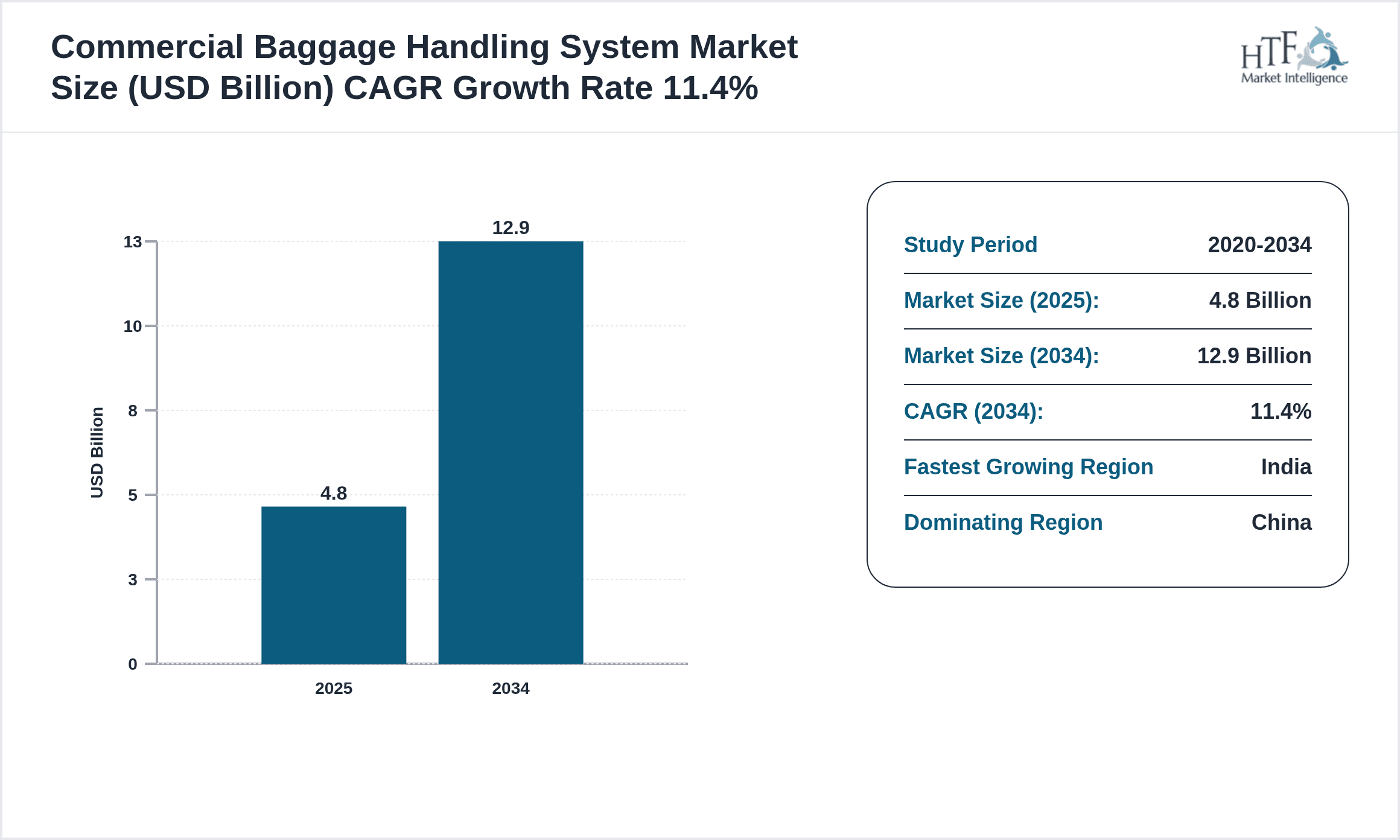
- •Key highlights include a base market size of USD 4.8 Billion in 2025, with projections indicating growth to USD 12.9 Billion by 2034, reflecting a robust CAGR of 11.4%. The dominance of automated baggage handling systems underscores the trend towards technology-driven efficiency. China currently leads the regional market share, while India is poised as the fastest-growing country, driven by expansion in airport infrastructure and rising passenger volumes. The market’s strategic importance is underpinned by its role in enhancing airport operational throughput, reducing baggage mishandling, and adhering to increasingly strict security standards.
- •This market offers significant value propositions to airport authorities, airlines, and logistics operators by delivering scalable, secure, and cost-effective baggage management solutions. Stakeholders benefit from reduced operational delays, improved passenger experience, and compliance with regulatory security frameworks. Strategic investments in software integration and automation technologies position companies for long-term growth in the Asia-Pacific aviation ecosystem, which continues to expand rapidly amidst evolving travel demands and technological advancements.
Competitive Landscape
Competition in the Asia-Pacific Commercial Baggage Handling System market is intense and shaped by a combination of technological innovation, strategic partnerships, and regional market penetration. Leading companies focus on developing integrated systems that combine automation with sophisticated software for real-time baggage tracking and security compliance. Product differentiation is achieved through innovations in AI-driven sortation algorithms, IoT-enabled monitoring, and enhanced screening technologies, which reduce errors and improve throughput. Market leaders adopt aggressive pricing strategies and expand distribution networks to capture emerging markets within Asia-Pacific. Mergers and acquisitions are common as firms seek to consolidate technology portfolios and regional presence. The competitive environment also reflects a blend of global multinational corporations and regional specialists who tailor solutions to specific country needs. Regulatory adherence and customization for large-scale airport modernization projects are critical competitive factors. Future trends indicate increased collaboration across the value chain and focus on sustainability, driving competition towards eco-efficient and cost-effective baggage handling solutions.
Leading Companies in Commercial Baggage Handling System Market
- •Daifuku Co., Ltd. (Japan)
- •BEUMER Group GmbH & Co. KG (Germany)
- •Siemens AG (Germany)
- •Honeywell International Inc. (United States)
- •Siemens Logistics GmbH (Germany)
- •Vanderlande Industries B.V. (Netherlands)
- •Mitsubishi Heavy Industries, Ltd. (Japan)
- •CITIC Pacific Special Steel Group Limited (China)
- •SICK AG (Germany)
- •Toshiba Corporation (Japan)
- •ABB Ltd. (Switzerland)
- •Nedap N.V. (Netherlands)
- •Thyssenkrupp AG (Germany)
- •Zhejiang Dahua Technology Co., Ltd. (China)
- •Fives Group (France)
- •Daifuku Co., Ltd. (Japan)
- •Hitachi, Ltd. (Japan)
- •Honeywell Intelligrated (United States)
- •Panasonic Corporation (Japan)
- •KION Group AG (Germany)
- •Fujitsu Limited (Japan)
- •China National Machinery Industry Corporation (China)
- •Schindler Group (Switzerland)
- •Samsung SDS Co., Ltd. (South Korea)
- •LG CNS Co., Ltd. (South Korea)
Market Breakdown
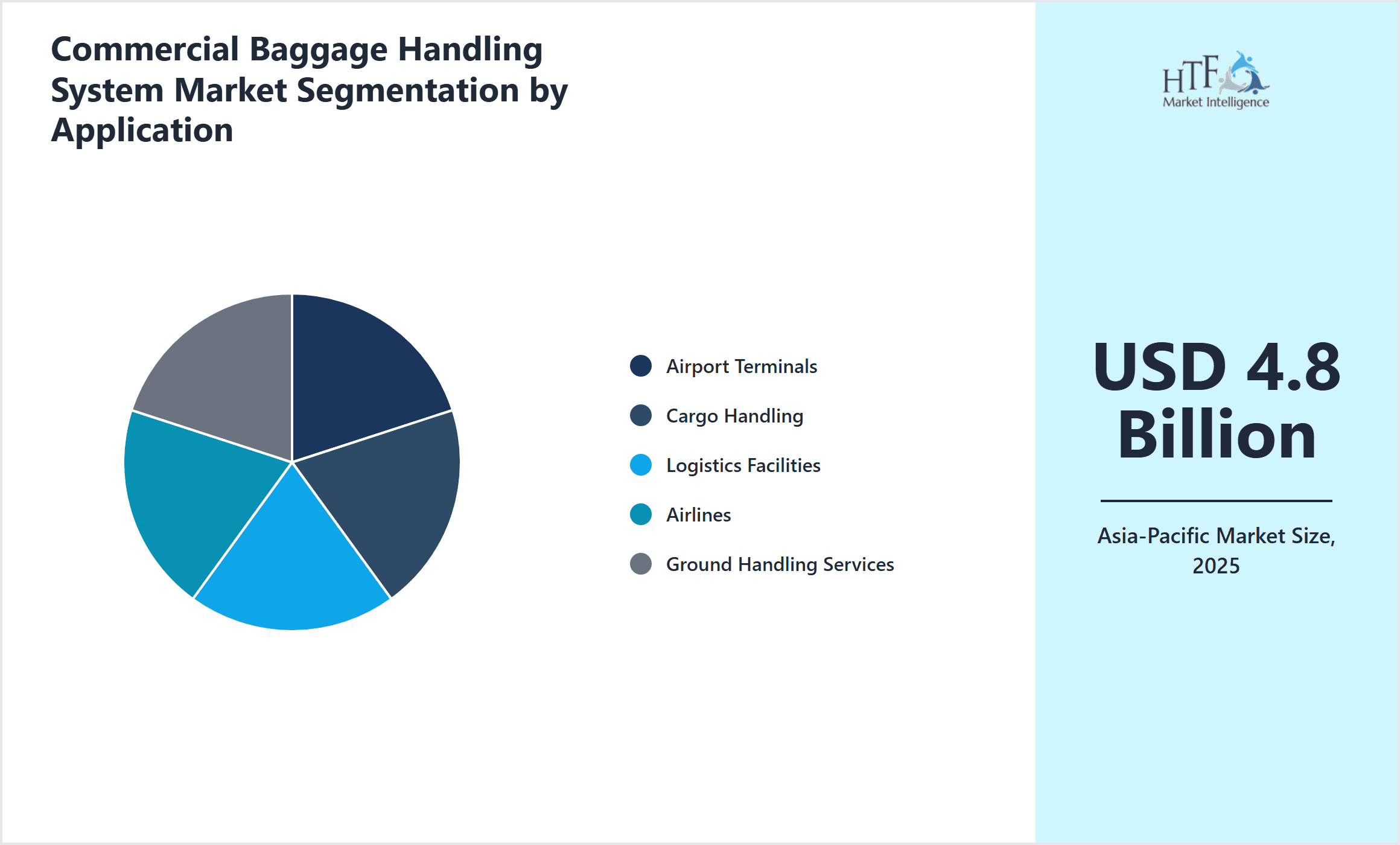
- •By Product Type
- ◦Automated Baggage Handling Systems
- ◦Semi-Automated Baggage Handling Systems
- ◦Manual Baggage Handling Systems
- ◦Integrated Software Solutions
- ◦Security Screening Systems
- •By Application
- ◦Airport Terminals
- ◦Cargo Handling
- ◦Logistics Facilities
- ◦Airlines
- ◦Ground Handling Services
- •By End-Use Industry
- ◦Commercial Airports
- ◦Cargo and Freight Operators
- ◦Airline Operators
- ◦Logistics Service Providers
- •By Distribution Channel
- ◦Direct Sales
- ◦System Integrators
- ◦Third-Party Distributors
Growth Dynamics
- •The Asia-Pacific region's rapid expansion in air travel and airport infrastructure modernization drives demand for advanced baggage handling systems. Increasing passenger volumes necessitate efficient and automated solutions to minimize delays and baggage mishandling, thus propelling market growth significantly.
- •Government initiatives aimed at enhancing airport security and compliance with international aviation standards have led to the adoption of integrated security screening and baggage tracking systems, further accelerating market development.
- •Technological advancements such as AI-enabled sorting, IoT-based baggage tracking, and robotic automation improve operational efficiency and reduce human errors, encouraging stakeholders to invest in modern baggage handling infrastructure.
- •Rising demand from emerging economies within Asia-Pacific, including India and Southeast Asia, fueled by increasing air traffic and tourism, supports sustained market expansion and creates new business opportunities.
- •Collaborations between system providers and airport authorities focusing on smart airport initiatives contribute to market momentum by integrating baggage handling with overall airport management systems.

Market Trends
- •The adoption of AI and machine learning algorithms in baggage sorting and tracking is becoming prevalent, enabling predictive maintenance and real-time decision-making to enhance baggage processing speed and accuracy.
- •Sustainability is gaining traction, with airports and system providers focusing on energy-efficient conveyor systems and eco-friendly materials to reduce the environmental footprint of baggage handling operations.
- •Integration of cloud-based software platforms allows centralized monitoring and control of baggage handling systems across multiple airports, facilitating seamless coordination and data analytics.
- •The rise of contactless technologies and automation in baggage screening aligns with post-pandemic safety protocols, reducing human contact and enhancing passenger confidence.
- •Collaborative ecosystems involving technology vendors, airport authorities, and airlines foster innovation and accelerate the deployment of next-generation baggage handling solutions tailored to regional needs.

Market Opportunities
- •Expanding infrastructure in developing Asia-Pacific countries offers considerable opportunities for vendors to deploy scalable and customized baggage handling solutions aligned with regional growth trajectories.
- •Emerging trends in smart airport development encourage the integration of AI, IoT, and robotics, creating avenues for innovative product offerings and enhanced service delivery.
- •Growing emphasis on passenger experience drives demand for real-time baggage tracking applications, presenting opportunities for software solution providers to innovate and capture new market segments.
- •Partnerships with local governments and airport authorities for modernization projects can unlock long-term contracts and drive steady revenue growth for system integrators and manufacturers.
- •Increasing investments in security infrastructure due to evolving regulatory requirements offer potential for companies specializing in advanced screening and compliance technologies.
Market Challenges
- •High initial capital expenditure for deploying automated baggage handling systems limits adoption among smaller airports and logistics operators, creating barriers to market penetration.
- •Complex integration of new systems with existing airport infrastructure and legacy software can delay implementation and increase operational risks.
- •Stringent regulatory compliance and varying standards across Asia-Pacific countries complicate product standardization and increase time-to-market for new solutions.
- •Skilled labor shortages for operating and maintaining advanced baggage handling technology pose operational challenges, especially in emerging markets.
- •Cybersecurity risks associated with connected baggage handling systems require constant vigilance and investment in robust digital security measures.
Regulatory Framework
- •Between 2020 and 2025, several Asia-Pacific countries implemented updated aviation security regulations mandating enhanced baggage screening protocols and real-time tracking capabilities, requiring market players to upgrade systems accordingly.
- •The International Civil Aviation Organization (ICAO) guidelines adopted regionally emphasize risk-based screening and integration of automated baggage handling technologies to improve security and efficiency.
- •Data protection regulations across countries like Japan, Australia, and India have influenced the design of software solutions to ensure passenger data privacy within baggage tracking systems.
- •Environmental regulations promoting energy efficiency and waste reduction have led to the adoption of sustainable materials and energy-saving components in baggage handling equipment manufacturing.
- •Government incentives and funding programs in countries such as India and China support airport modernization projects, including investments in advanced baggage handling infrastructures to boost regional connectivity.
Market Intelligence
- •15th January 2025, Daifuku Co., Ltd. launched an advanced AI-powered baggage sorting system tailored for large-scale Asia-Pacific airports. The system integrates machine learning algorithms to optimize sortation routes, reduce errors, and provide real-time baggage tracking via IoT sensors. Targeting high-traffic hubs in China and India, the product aims to enhance throughput and reduce passenger wait times. This launch aligns with growing demand for automation driven by expanding air travel and infrastructure upgrades in the region. The company projects significant adoption among major airport authorities seeking to modernize baggage handling processes with smart technology. Source: Daifuku Official Press Release
- •20th March 2025, Honeywell International Inc. introduced a new integrated software platform that combines baggage tracking, security screening data, and operational analytics for Asia-Pacific airports. This cloud-based solution enables centralized control across multiple terminals and supports compliance with evolving regional security mandates. Designed for scalability, the platform facilitates seamless integration with existing airport management systems while enhancing incident response and resource allocation. Honeywell’s innovation addresses rising passenger volumes and complex logistics challenges faced by airports in India, Southeast Asia, and Australia. Industry experts expect this technology to set new benchmarks for efficiency and safety in the commercial baggage handling sector. Source: Honeywell Corporate Announcement
- •5th May 2025, Siemens AG announced a strategic partnership with leading Indian airport operator GMR Group to deploy state-of-the-art automated baggage handling systems at new and existing terminals. The collaboration focuses on integrating robotics and AI-driven solutions to optimize baggage throughput and reduce mishandling rates. Siemens’ technology will support GMR’s expansion plans, including the modernization of Delhi and Hyderabad airports, anticipated to serve increasing passenger traffic over the next decade. This alliance highlights growing industry emphasis on smart airport infrastructure and cross-sector collaboration to meet Asia-Pacific’s evolving aviation demands. Source: Siemens Press Release
- •10th June 2025, Mitsubishi Heavy Industries, Ltd. completed the acquisition of a regional baggage handling systems provider based in Southeast Asia, expanding its footprint in emerging markets. This strategic move enhances Mitsubishi’s capability to deliver customized turnkey solutions encompassing conveyors, sorters, and security screening integration. The acquisition aims to leverage local expertise and accelerate deployment timelines in fast-growing airports across Indonesia, Malaysia, and Vietnam. Industry analysts view this consolidation as a key development reinforcing Mitsubishi’s position in the competitive Asia-Pacific market landscape. Source: Mitsubishi Heavy Industries Corporate News
Regional Outlook
The China currently holds a significant share of the market, primarily due to several key factors: increasing consumption rates, a burgeoning population, and robust economic momentum. These elements collectively drive demand, positioning this region as a leader in the market. On the other hand, India is rapidly emerging as the fastest-growing area within the industry. This remarkable growth can be attributed to swift infrastructure development, the expansion of various industrial sectors, and a marked increase in consumer demand. These dynamics make this region a crucial player in shaping future market growth.
In our report, we cover a comprehensive analysis of the following regions and countries:
- Japan
- China
- Southeast Asia
- India
- Australia
- South Korea
- Others
| Feature | Details |
|---|---|
| Base Year Market Size | USD 4.8 Billion |
| Forecast Year Market Size | USD 12.9 Billion |
| CAGR | 11.4% |
| Forecast Period | 2026 to 2033 |
| YoY Growth | 11% |
| Scope of Report | Market is segmented by Product Type (Automated Baggage Handling Systems, Semi-Automated Baggage Handling Systems, Manual Baggage Handling Systems, Integrated Software Solutions, Security Screening Systems), Application (Airport Terminals, Cargo Handling, Logistics Facilities, Airlines, Ground Handling Services), End-Use Industry (Commercial Airports, Cargo and Freight Operators, Airline Operators, Logistics Service Providers), Distribution Channel (Direct Sales, System Integrators, Third-Party Distributors) |
| Regions Covered | Japan, China, Southeast Asia, India, Australia, South Korea, Others |
| Key Companies | Daifuku Co., Ltd. (Japan), BEUMER Group GmbH & Co. KG (Germany), Siemens AG (Germany), Honeywell International Inc. (United States), Siemens Logistics GmbH (Germany), Vanderlande Industries B.V. (Netherlands), Mitsubishi Heavy Industries, Ltd. (Japan), CITIC Pacific Special Steel Group Limited (China), SICK AG (Germany), Toshiba Corporation (Japan), ABB Ltd. (Switzerland), Nedap N.V. (Netherlands), Thyssenkrupp AG (Germany), Zhejiang Dahua Technology Co., Ltd. (China), Fives Group (France), Daifuku Co., Ltd. (Japan), Hitachi, Ltd. (Japan), Honeywell Intelligrated (United States), Panasonic Corporation (Japan), KION Group AG (Germany), Fujitsu Limited (Japan), China National Machinery Industry Corporation (China), Schindler Group (Switzerland), Samsung SDS Co., Ltd. (South Korea), LG CNS Co., Ltd. (South Korea) |
Asia-Pacific Commercial Baggage Handling System Market - Outlook 2025-2034 - Table of Contents
Frequently Asked Questions (FAQ):
The Compact Track Loaders market is projected to grow at a CAGR of 6.8% from 2025 to 2030, driven by increasing demand in construction and agricultural sectors.
North America currently leads the market with approximately 45% market share, followed by Europe at 28% and Asia-Pacific at 22%. The remaining regions account for 5% of the global market.
Key growth drivers include increasing construction activities, rising demand for versatile equipment in agriculture, technological advancements in track loader design, and growing preference for compact equipment in urban construction projects.