
Global Automotive Engine Belt & Hose Market Size, Growth & Revenue 2024-2034
Global Automotive Engine Belt & Hose Market is segmented by Product Type (Timing Belts, Serpentine Belts, V-Belts, Radiator Hoses, Heater Hoses), Application (Passenger Vehicles, Commercial Vehicles, Off-Highway Vehicles, Electric Vehicles, Aftermarket), End-Use Industry (Automotive OEM, Aftermarket, Agriculture, Construction Equipment), Distribution Channel (Direct OEM Supply, Aftermarket Distributors, Online Retail), and Geography (North America, LATAM, West Europe, Central & Eastern Europe, Northern Europe, Southern Europe, East Asia, Southeast Asia, South Asia, Central Asia, Oceania, MEA)
Pricing
Report Overview
Executive Summary
- •The global Automotive Engine Belt & Hose market is a vital segment within the automotive components industry, focusing on belts and hoses that are essential for engine function and vehicle reliability. This market includes diverse product types such as timing belts, serpentine belts, V-belts, radiator hoses, and heater hoses which serve critical roles like power transmission and fluid conveyance in combustion engines and electric vehicles. These products cater to segments including passenger vehicles, commercial vehicles, off-highway vehicles, electric vehicles, and aftermarket services. The market's growth is driven by rising automotive production worldwide, increasing vehicle electrification, and regulatory demands for higher durability and emission standards. Industry players are innovating with materials like reinforced rubber and composites to enhance product longevity and efficiency. The market spans globally across North America, Europe, Asia-Pacific, Latin America, and the Middle East & Africa, with Asia-Pacific emerging as a significant growth hub due to expanding automotive manufacturing and consumer base. This comprehensive analysis covers current market dynamics, segmentation, growth drivers, competitive landscape, and future outlook for 2024-2034.
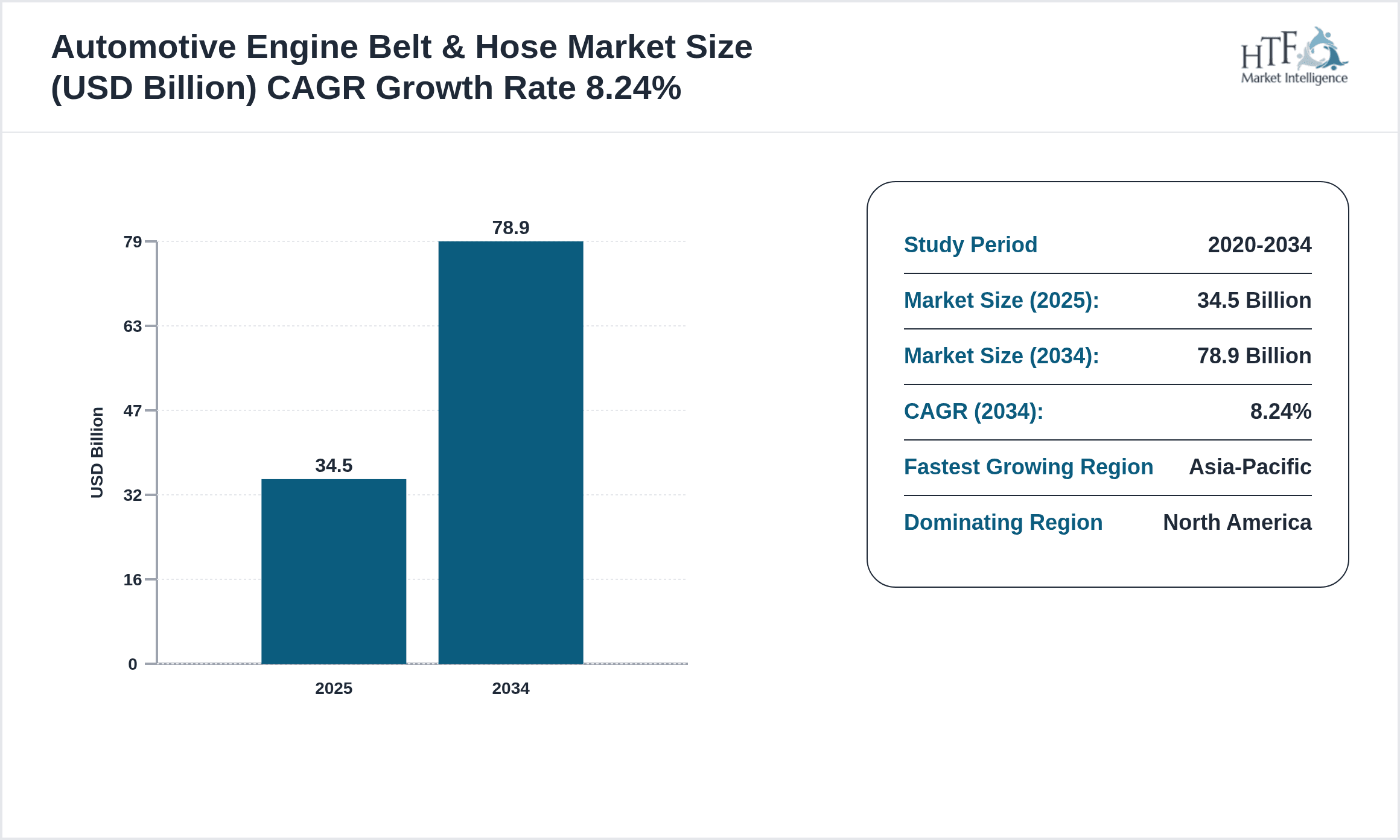
- •Key market highlights include a base market size of USD 34.5 Billion in 2024, forecasted to reach USD 78.9 Billion by 2034, demonstrating a robust CAGR of 8.24%. Timing belts maintain dominance in product types due to their critical function in engine timing and reliability, while serpentine belts are rapidly gaining due to their application in modern engine architectures. Passenger vehicles remain the leading application segment, followed by commercial vehicles and the rapidly expanding electric vehicle sector. North America leads regionally, benefiting from advanced automotive technology adoption and aftermarket demand, whereas Asia-Pacific is the fastest growing region propelled by burgeoning automotive manufacturing and increasing vehicle sales in emerging economies.
- •The value proposition of the Automotive Engine Belt & Hose market lies in its foundational role in vehicle operation, impacting engine efficiency, emission compliance, and overall vehicle lifespan. Stakeholders including manufacturers, automotive OEMs, aftermarket suppliers, and end-users benefit from innovations improving product durability and performance. Strategic importance is heightened by the shift towards electric and hybrid vehicles requiring specialized belts and hoses, as well as growing maintenance and replacement demand in mature markets. The market also presents opportunities for material innovations and regional expansions, responding to evolving automotive technologies and consumer preferences.
Competitive Landscape
The competitive landscape of the global Automotive Engine Belt & Hose market is characterized by intense rivalry among established global manufacturers and emerging regional players. Companies compete through continuous innovation in product design, material technology, and manufacturing processes to enhance durability, efficiency, and compliance with stringent environmental regulations. Strategic partnerships, mergers, and acquisitions are common approaches to expand product portfolios and geographic presence. Pricing strategies are carefully balanced with quality and technological advancements to maintain competitiveness. Distribution channels including OEM supply and aftermarket sales play a crucial role in market positioning. Companies invest heavily in R&D to develop belts and hoses compatible with electric and hybrid vehicles, aiming to capture future market growth. Barriers to entry remain moderate due to capital intensity and technological expertise required, fostering a competitive yet dynamic market environment with evolving consumer demands and regulatory landscapes.
Leading Companies in Automotive Engine Belt & Hose Market
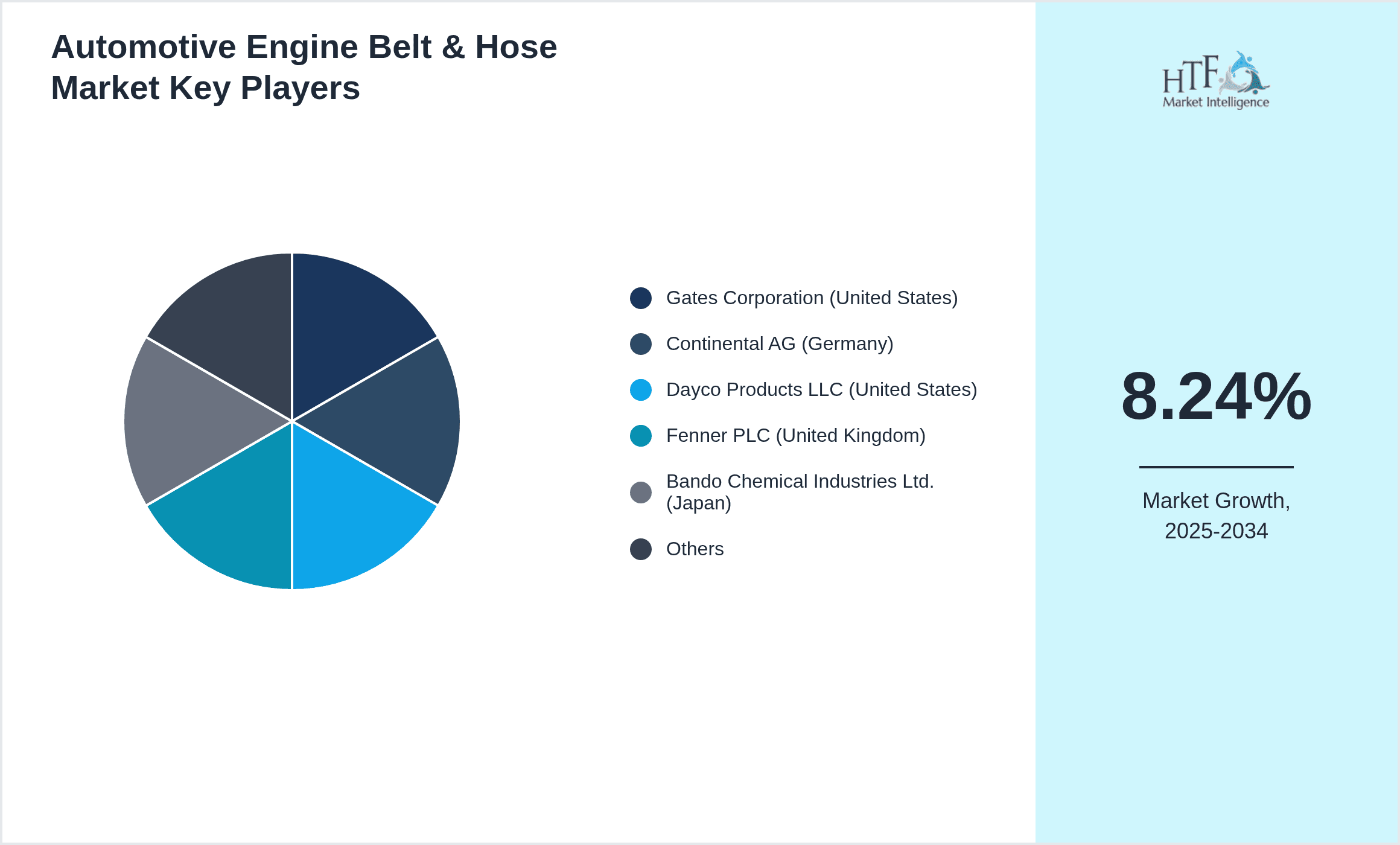
- •Gates Corporation (United States)
- •Continental AG (Germany)
- •Dayco Products LLC (United States)
- •Fenner PLC (United Kingdom)
- •Bando Chemical Industries Ltd. (Japan)
- •Mitsuboshi Belting Ltd. (Japan)
- •SKF Group (Sweden)
- •Tsubakimoto Chain Co. (Japan)
- •Hutchinson Group (France)
- •Dayu Industrial Co., Ltd. (China)
- •Kenda Rubber Industrial Co., Ltd. (Taiwan)
- •Mitsui Chemicals, Inc. (Japan)
- •BorgWarner Inc. (United States)
- •Continental ContiTech (Germany)
- •Cheng Shin Rubber Industry Co., Ltd. (Taiwan)
- •Yokohama Rubber Company (Japan)
- •Sumitomo Riko Company Limited (Japan)
- •Dayang Rubber Group (China)
- •Veyance Technologies Inc. (United States)
- •Hercules Hoist Corporation (United States)
- •Shandong Linglong Tire Co., Ltd. (China)
- •Molded Parts Company (United States)
- •Kuraray Co., Ltd. (Japan)
- •Gates Europe BVBA (Belgium)
- •Bridgestone Corporation (Japan)
Market Breakdown
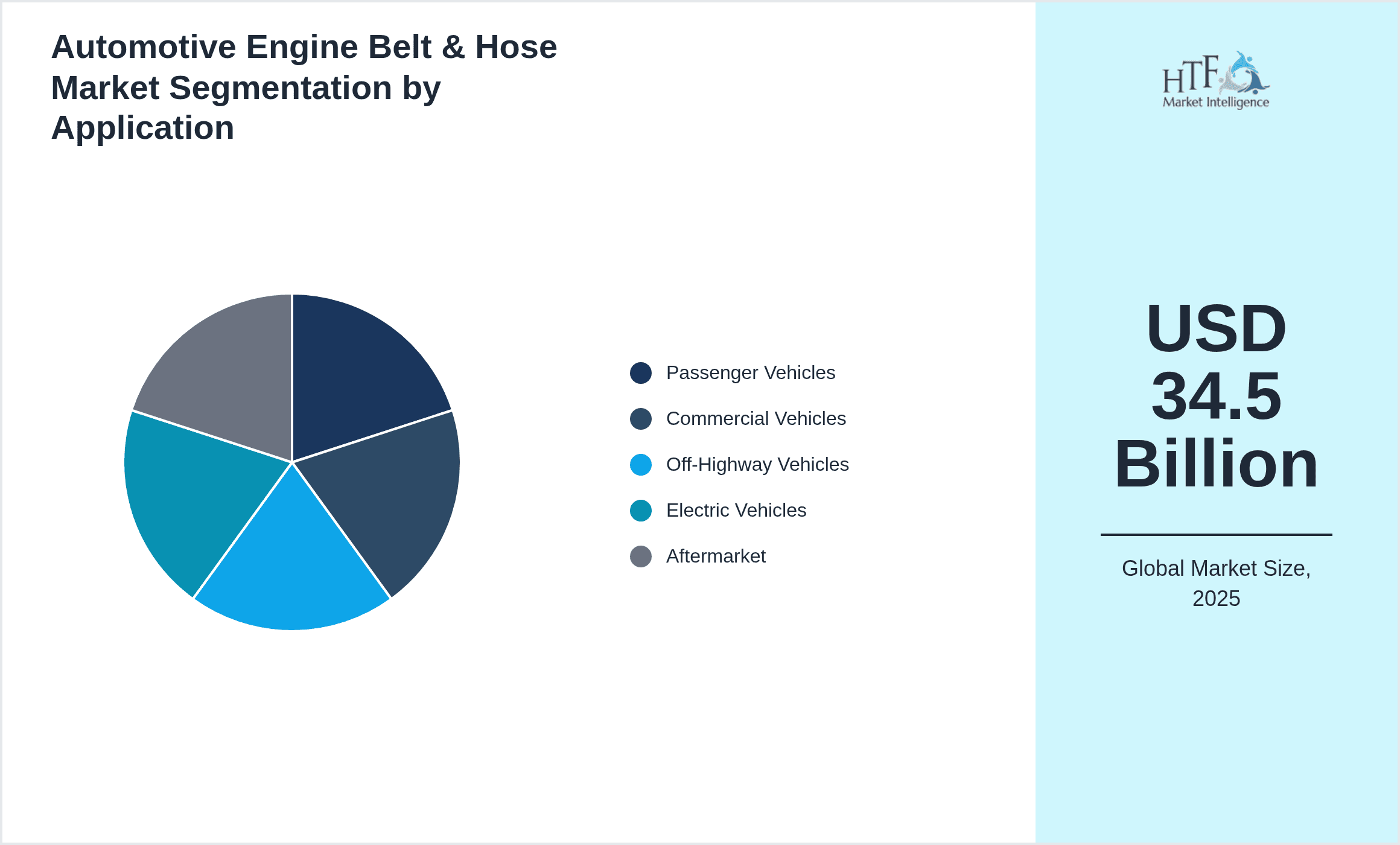
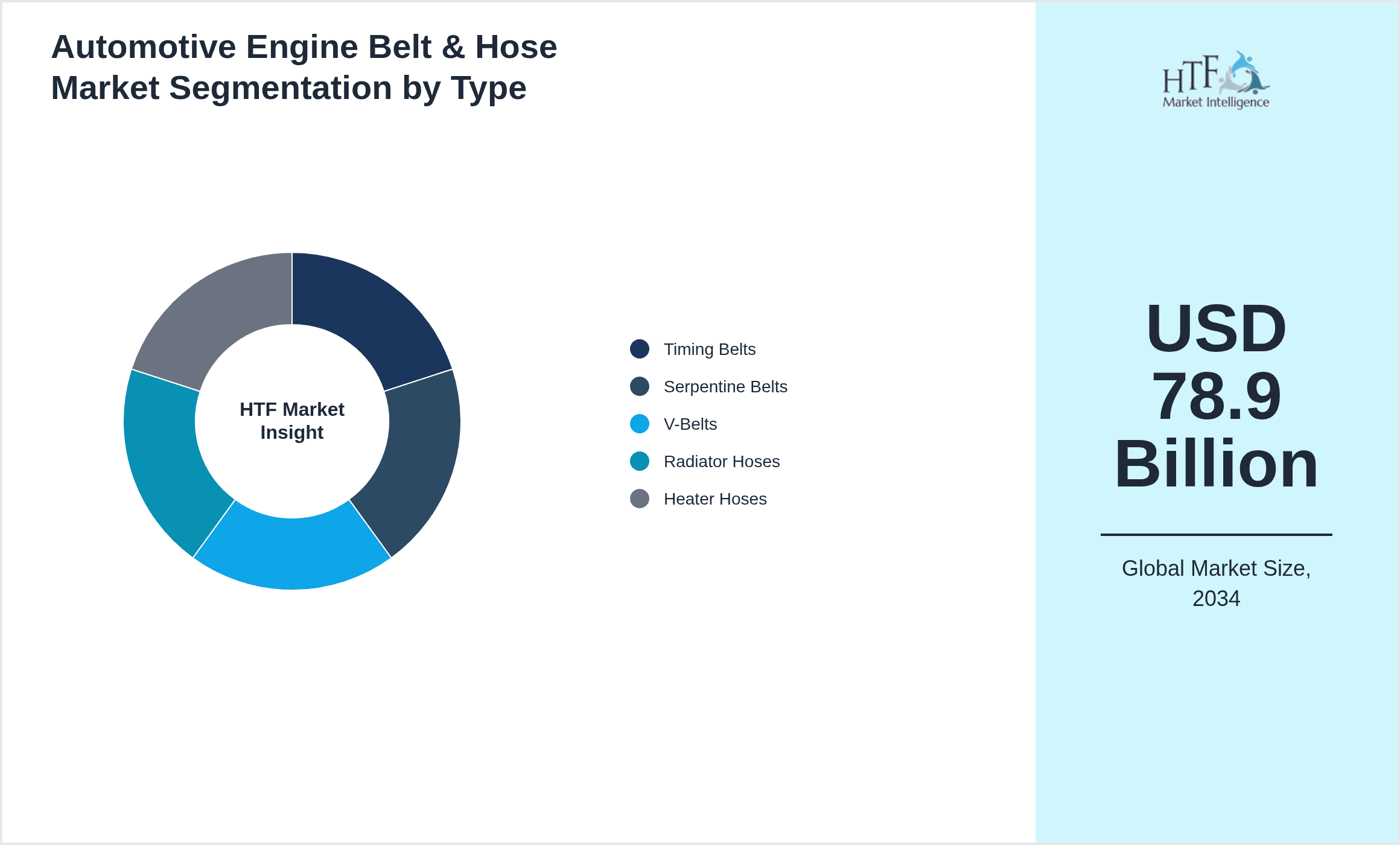
- •By Product Type
- ◦Timing Belts
- ◦Serpentine Belts
- ◦V-Belts
- ◦Radiator Hoses
- ◦Heater Hoses
- •By Application
- ◦Passenger Vehicles
- ◦Commercial Vehicles
- ◦Off-Highway Vehicles
- ◦Electric Vehicles
- ◦Aftermarket
- •By End-Use Industry
- ◦Automotive OEM
- ◦Aftermarket
- ◦Agriculture
- ◦Construction Equipment
- •By Distribution Channel
- ◦Direct OEM Supply
- ◦Aftermarket Distributors
- ◦Online Retail
Growth Dynamics
- •Rising global vehicle production, particularly in emerging markets, is a major growth driver, fueling demand for reliable engine belts and hoses. Increased adoption of electric and hybrid vehicles necessitates specialized belts and hoses, expanding product applications and innovation opportunities.
- •Technological advancements in materials, such as reinforced rubber and composites, enhance product durability and thermal resistance, driving customer preference and supporting longer replacement cycles.
- •Stringent environmental regulations worldwide compel manufacturers to design belts and hoses that improve engine efficiency and reduce emissions, pushing market expansion and product upgrades.
- •Growing aftermarket demand due to rising vehicle parc and aging fleets contributes to sustained market growth, with consumers seeking high-quality replacement parts.
- •Expansion of distribution channels, including e-commerce and direct OEM supply, improves market accessibility, facilitating faster product adoption and increasing sales volume globally.
- •Increasing investments in automotive R&D foster innovation in belt and hose technologies, enabling companies to develop high-performance solutions catering to evolving engine architectures.
- •Emerging economies' infrastructure development and increasing disposable income drive vehicle ownership rates, consequently boosting demand for engine belts and hoses across segments.
Market Trends
- •The market is witnessing a shift towards eco-friendly materials and sustainable manufacturing processes, aligning with global environmental initiatives and consumer preferences for green products.
- •Integration of smart sensors in belts and hoses for real-time monitoring of wear and performance is gaining traction, enhancing predictive maintenance and reducing downtime.
- •An increase in collaborations between automotive OEMs and component manufacturers accelerates innovation, enabling faster introduction of advanced belt and hose solutions tailored to electric vehicles.
- •The rising demand for lightweight vehicles is influencing product design, with manufacturers focusing on reducing component weight without compromising durability or performance.
- •Growth in the electric vehicle segment is encouraging the development of specialized hoses and belts compatible with electric powertrains, broadening market applications.
- •Digitalization of supply chains and enhanced distribution networks improve operational efficiency and customer reach, fostering competitive advantages for key players.
- •Emerging aftermarket platforms and online retail channels are reshaping purchasing behaviors, providing consumers with greater product variety and ease of access.
Market Opportunities
- •Significant growth potential exists in developing markets where rising vehicle ownership and infrastructure improvements create demand for durable engine belts and hoses.
- •Innovation in hybrid and electric vehicle-compatible belts and hoses offers opportunities to capture new segments and establish early market leadership.
- •Expansion into aftermarket segments through digital platforms can increase market penetration and customer engagement globally.
- •Strategic partnerships with automotive OEMs for co-development of tailored solutions can enhance product differentiation and customer loyalty.
- •Development of smart belt and hose systems with embedded sensors presents avenues for value-added services and recurring revenue streams.
- •Geographic expansion into high-growth regions such as Asia-Pacific and Latin America can leverage increasing automotive production and sales.
- •Sustainability-focused product development responding to regulatory pressures and consumer demand can improve brand reputation and market share.
Market Challenges
- •Fluctuating raw material prices, especially for rubber and synthetic compounds, pose cost pressures impacting profit margins and pricing strategies.
- •Stringent regulatory compliance requirements increase product development complexity and time-to-market, challenging manufacturers' agility.
- •Intense competition from low-cost regional manufacturers pressures established players to innovate while maintaining competitive pricing.
- •Technological challenges in developing belts and hoses compatible with rapidly evolving electric vehicle architectures require significant R&D investment.
- •Supply chain disruptions caused by global events and geopolitical tensions affect production continuity and raw material availability.
- •Market fragmentation and varying regional standards complicate global product standardization and scalability.
- •Consumer awareness and preference for aftermarket quality vary significantly, affecting demand consistency and brand loyalty in replacement segments.
Regulatory Framework
- •From 2019 to 2024, global automotive emission regulations such as Euro 6 and EPA Tier 3 standards have mandated the use of high-performance engine belts and hoses to reduce leakage and improve engine efficiency, compelling manufacturers to upgrade product specifications accordingly.
- •Safety standards introduced in North America and Europe require rigorous testing of belt and hose durability under extreme conditions, ensuring reliability and reducing vehicle recalls.
- •Environmental regulations promoting the use of recyclable and sustainable materials in automotive components have influenced product design and manufacturing processes globally.
- •Regional mandates in Asia-Pacific countries are increasingly enforcing quality certifications and compliance audits for automotive parts, enhancing product quality and safety standards.
- •Government incentives in Europe and North America supporting electric vehicle adoption have indirectly driven innovation in compatible engine belts and hoses, aligning product development with future mobility trends.
Market Intelligence
- •15th January 2025, Gates Corporation launched a new series of high-performance serpentine belts engineered for electric and hybrid vehicles. These belts feature advanced composite materials that offer improved flexibility and durability, addressing the specific demands of electric powertrains. The launch aims to capture the growing EV market share by providing OEMs with reliable and efficient belt solutions that enhance vehicle performance and reduce maintenance costs. Gates' strategic emphasis on sustainability and innovation aligns with global automotive trends, positioning the company strongly in the evolving engine belt sector. Source: Official Gates Corporation press release.
- •20th March 2025, Continental AG introduced an innovative radiator hose with integrated temperature sensors capable of real-time monitoring, enhancing engine cooling system reliability. Targeted at commercial and passenger vehicles, this product utilizes smart technology to predict failures and optimize maintenance schedules, reducing downtime and operational costs. Continental's move reflects increasing market demand for intelligent automotive components and supports the company's strategy to lead in connected vehicle technologies. This launch is expected to influence aftermarket and OEM sectors globally. Source: Continental AG official announcement.
- •10th February 2025, Dayco Products LLC announced a strategic partnership with a leading electric vehicle manufacturer to co-develop customized timing belts for next-generation EV platforms. The collaboration focuses on creating belts with enhanced strength and heat resistance to meet the unique requirements of electric powertrains. This initiative is set to accelerate Dayco's penetration into the EV segment and diversify its product portfolio, strengthening its competitive position in the global market. The partnership underscores the growing synergy between component suppliers and OEMs in the automotive industry. Source: Dayco corporate news.
- •5th April 2025, Fenner PLC completed the acquisition of a regional hose manufacturing company in Asia-Pacific, expanding its production capacity and geographic footprint. This acquisition enables Fenner to better serve the rapidly growing automotive markets in emerging economies with localized solutions and faster delivery. It also enhances Fenner's product range with specialized hoses designed for electric and hybrid vehicles. The move aligns with Fenner's growth strategy focused on innovation, regional expansion, and strengthening supply chain resilience. Source: Fenner press release.
Regional Outlook
The North America currently holds a significant share of the market, primarily due to several key factors: increasing consumption rates, a burgeoning population, and robust economic momentum. These elements collectively drive demand, positioning this region as a leader in the market. On the other hand, Asia-Pacific is rapidly emerging as the fastest-growing area within the industry. This remarkable growth can be attributed to swift infrastructure development, the expansion of various industrial sectors, and a marked increase in consumer demand. These dynamics make this region a crucial player in shaping future market growth.
In our report, we cover a comprehensive analysis of the following regions and countries:
- North America
- LATAM
- West Europe
- Central & Eastern Europe
- Northern Europe
- Southern Europe
- East Asia
- Southeast Asia
- South Asia
- Central Asia
- Oceania
- MEA
| Feature | Details |
|---|---|
| Base Year Market Size | USD 34.5 Billion |
| Forecast Year Market Size | USD 78.9 Billion |
| CAGR | 8.24% |
| Forecast Period | 2026 to 2033 |
| YoY Growth | 8.24% |
| Scope of Report | Market is segmented by Product Type (Timing Belts, Serpentine Belts, V-Belts, Radiator Hoses, Heater Hoses), Application (Passenger Vehicles, Commercial Vehicles, Off-Highway Vehicles, Electric Vehicles, Aftermarket), End-Use Industry (Automotive OEM, Aftermarket, Agriculture, Construction Equipment), Distribution Channel (Direct OEM Supply, Aftermarket Distributors, Online Retail) |
| Regions Covered | North America, LATAM, West Europe, Central & Eastern Europe, Northern Europe, Southern Europe, East Asia, Southeast Asia, South Asia, Central Asia, Oceania, MEA |
| Key Companies | Gates Corporation (United States), Continental AG (Germany), Dayco Products LLC (United States), Fenner PLC (United Kingdom), Bando Chemical Industries Ltd. (Japan), Mitsuboshi Belting Ltd. (Japan), SKF Group (Sweden), Tsubakimoto Chain Co. (Japan), Hutchinson Group (France), Dayu Industrial Co., Ltd. (China), Kenda Rubber Industrial Co., Ltd. (Taiwan), Mitsui Chemicals, Inc. (Japan), BorgWarner Inc. (United States), Continental ContiTech (Germany), Cheng Shin Rubber Industry Co., Ltd. (Taiwan), Yokohama Rubber Company (Japan), Sumitomo Riko Company Limited (Japan), Dayang Rubber Group (China), Veyance Technologies Inc. (United States), Hercules Hoist Corporation (United States), Shandong Linglong Tire Co., Ltd. (China), Molded Parts Company (United States), Kuraray Co., Ltd. (Japan), Gates Europe BVBA (Belgium), Bridgestone Corporation (Japan) |
Global Automotive Engine Belt & Hose Market Size, Growth & Revenue 2024-2034 - Table of Contents
Frequently Asked Questions (FAQ):
The Compact Track Loaders market is expected to see value worth 5.3 Billion in 2025.
North America currently leads the market with approximately 45% market share, followed by Europe at 28% and Asia-Pacific at 22%. The remaining regions account for 5% of the global market.
Key growth drivers include increasing construction activities, rising demand for versatile equipment in agriculture, technological advancements in track loader design, and growing preference for compact equipment in urban construction projects.