
Global Canned Fruits & Vegetables Market Scope & Changing Dynamics 2025-2034
Global Canned Fruits & Vegetables Market is segmented by Product Type (Canned Fruits, Canned Vegetables, Mixed Canned Products, Organic Canned Products, Frozen Canned Products), Application (Household Consumption, Foodservice, Industrial Use, Retail, Others), End-Use Industry (Food and Beverage Manufacturing, Hospitality and Catering, Retail Chains, Institutional Buyers), Distribution Channel (Supermarkets and Hypermarkets, Convenience Stores, Online Retail, Foodservice Distribution), and Geography (North America, LATAM, West Europe, Central & Eastern Europe, Northern Europe, Southern Europe, East Asia, Southeast Asia, South Asia, Central Asia, Oceania, MEA)
Pricing
Report Overview
Executive Summary
- •The global canned fruits and vegetables market comprises preserved fruits and vegetables packaged primarily in metal cans to offer extended shelf life, convenience, and year-round availability. This market includes a diverse product portfolio ranging from canned tomatoes, peas, and corn to canned peaches, pineapples, and mixed vegetable assortments, including organic and frozen variations. Thermal processing and advanced packaging technologies such as vacuum sealing and aseptic filling play a crucial role in maintaining product safety and nutritional value. The market caters to multiple applications including household consumption, foodservice outlets like restaurants and cafeterias, industrial food processors, and retail channels including supermarkets and convenience stores. Rising urbanization, changing consumer lifestyles favoring convenient and ready-to-eat foods, and increasing awareness about food preservation and sustainability are primary factors influencing market dynamics. The competitive landscape features global and regional players innovating in product variety, packaging, and distribution. Regulatory frameworks governing food safety, labeling, and environmental standards further shape market operations. Regional diversity with dominance of North America in market share and Asia-Pacific as the fastest-growing region underscores the geographic variation in demand and growth drivers. Overall, the market is positioned for steady growth driven by evolving consumer preferences, technological advancements, and expanding distribution networks globally.
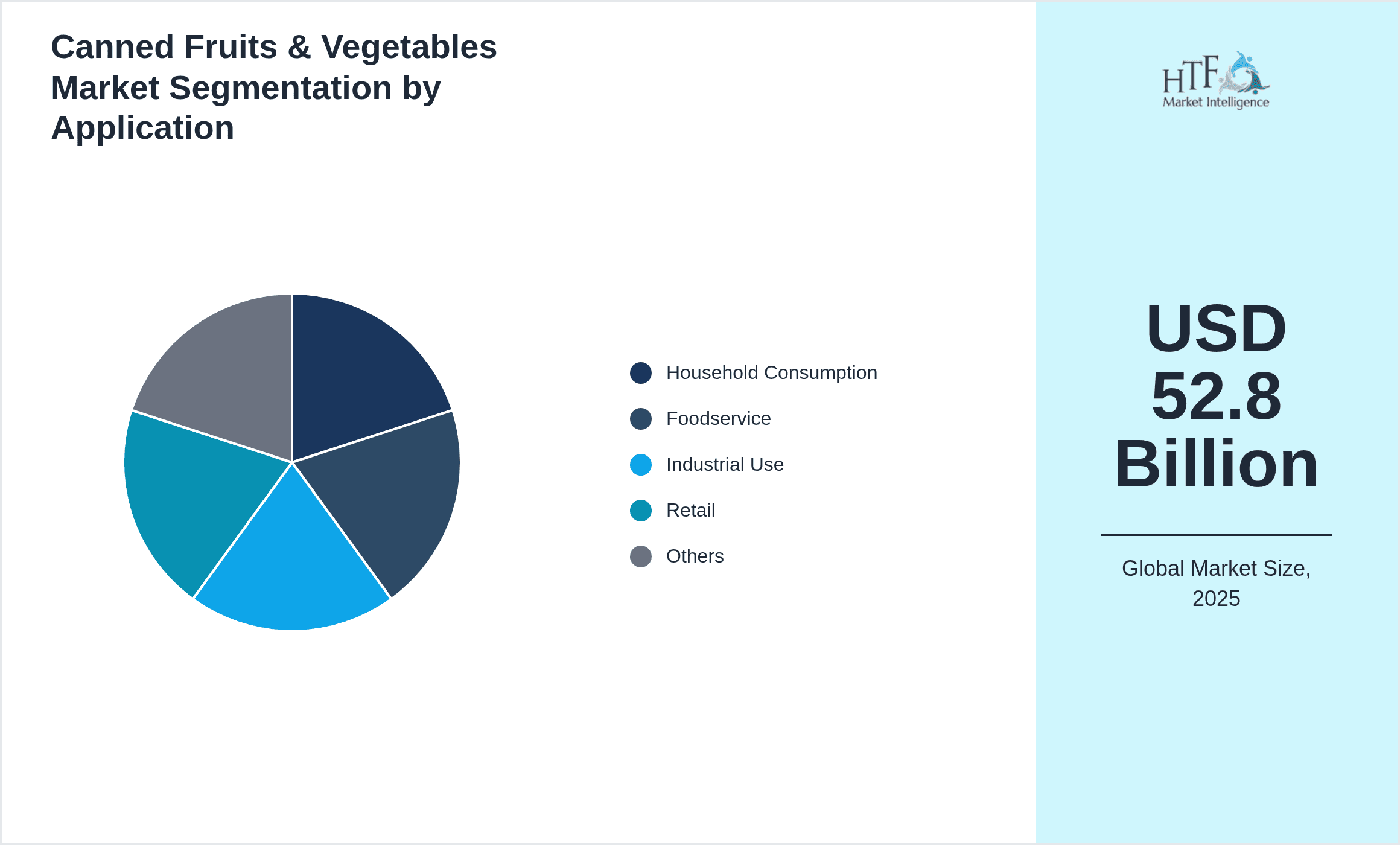
- •In 2025, the global canned fruits and vegetables market is estimated at USD 52.8 billion and is forecast to reach USD 83.4 billion by 2034, reflecting a CAGR of 5.6%. The year-on-year growth rate is projected at 5.4%, indicating sustained demand and expanding market penetration across key regions. North America remains the dominating region due to high consumption levels, established distribution infrastructure, and strong food safety regulations. Meanwhile, Asia-Pacific is anticipated to be the fastest-growing region due to rising urban populations, increasing disposable incomes, and growing preference for convenience foods. The organic canned products segment is witnessing the fastest growth, fueled by consumer inclination towards health-conscious and environmentally friendly food options. Leading product types such as canned vegetables continue to dominate the market, supported by robust demand from both household and commercial segments. These market highlights point to a dynamic industry adapting to global consumption trends and technological innovations.
- •The canned fruits and vegetables market offers significant value to food manufacturers, retailers, and consumers by providing accessible, nutritious, and shelf-stable food products. Its strategic importance lies in enabling year-round availability of seasonal produce, reducing food waste through preservation, and meeting the needs of busy lifestyles with ready-to-use options. Stakeholders benefit from diversified product portfolios, technological advancements in packaging, and expanding global supply chains. Moreover, the market supports sustainability initiatives by promoting longer shelf life and reducing transportation frequency. For investors and industry players, the market presents opportunities in product innovation, emerging regional markets, and value-added organic segments. Overall, the market’s growth trajectory aligns with evolving consumer behavior, technological progress, and regulatory support, making it a critical component of the global food industry ecosystem.

Competitive Landscape
The competitive environment of the global canned fruits and vegetables market is characterized by intense rivalry among multinational corporations and regional producers focusing on product innovation, quality, and distribution efficiency. Companies employ diverse competitive strategies including extensive research and development to introduce organic and mixed canned varieties, strategic partnerships to enhance supply chain reach, and mergers and acquisitions to consolidate market presence. Innovation in packaging technologies such as BPA-free cans and eco-friendly materials is a key differentiator driving consumer preference. Pricing strategies vary from premium pricing for organic and specialty products to competitive pricing for mass-market offerings. Distribution channels encompass supermarkets, online retail platforms, and foodservice providers, enabling wide market penetration. Barriers to entry include stringent food safety regulations, capital-intensive production facilities, and established brand loyalty. Regional competition is shaped by localized consumer preferences and availability of raw materials. Future trends indicate increasing emphasis on sustainability, digital transformation in marketing and sales, and adoption of advanced preservation technologies to maintain competitive advantages in a growing global market.
Prominent Players in Canned Fruits & Vegetables Market
- •Del Monte Foods, Inc. (United States)
- •Green Giant (United States)
- •Bonduelle S.A. (France)
- •Conagra Brands, Inc. (United States)
- •Kraft Heinz Company (United States)
- •Ardo Group (Belgium)
- •Crown Holdings, Inc. (United States)
- •H.J. Heinz Company (United States)
- •Jiangxi Zhengbang Technology Co., Ltd. (China)
- •Dole Food Company, Inc. (United States)
- •Greenyard NV (Belgium)
- •Lotte Food Co., Ltd. (South Korea)
- •Geest Plc (United Kingdom)
- •S&W Fine Foods, Inc. (United States)
- •McCall Farms, Inc. (United States)
- •La Costeña (Mexico)
- •Agrana Beteiligungs-AG (Austria)
- •Libby's (United States)
- •Snack Brands Australia Pty Ltd (Australia)
- •Olam International (Singapore)
- •Sakata Seed Corporation (Japan)
- •Bonduelle Americas (United States)
- •Goya Foods, Inc. (United States)
- •Hortex Group (Poland)
- •Ting Hsin International Group (Taiwan)
Market Breakdown
- •By Product Type
- ◦Canned Fruits
- ◦Canned Vegetables
- ◦Mixed Canned Products
- ◦Organic Canned Products
- ◦Frozen Canned Products
- •By Application
- ◦Household Consumption
- ◦Foodservice
- ◦Industrial Use
- ◦Retail
- ◦Others
- •By End-Use Industry
- ◦Food and Beverage Manufacturing
- ◦Hospitality and Catering
- ◦Retail Chains
- ◦Institutional Buyers
- •By Distribution Channel
- ◦Supermarkets and Hypermarkets
- ◦Convenience Stores
- ◦Online Retail
- ◦Foodservice Distribution
Growth Dynamics
The global canned fruits and vegetables market growth is propelled by increasing consumer demand for convenient and shelf-stable food products. Rising urbanization and hectic lifestyles are encouraging consumers to opt for ready-to-use canned foods that reduce preparation time and extend product longevity. Technological advancements in preservation and packaging, such as vacuum sealing and BPA-free cans, enhance product safety and attract health-conscious buyers. Additionally, the growing popularity of organic canned fruits and vegetables aligns with the rising trend of healthy eating and environmental awareness. Expansion of modern retail formats and e-commerce platforms is further facilitating market penetration globally. Economic growth in emerging regions like Asia-Pacific is fueling disposable income, driving demand for premium and specialty canned products. Moreover, the increasing incidence of food insecurity in certain regions is encouraging stockpiling and consumption of preserved foods. Collectively, these factors create a robust environment for sustained growth in the canned fruits and vegetables market worldwide.

Market Trends
The canned fruits and vegetables market is witnessing a trend toward organic and clean-label products as consumers become more health-conscious and environmentally aware. Companies are innovating with natural preservatives and sustainable packaging solutions to meet these demands. There is also a growing inclination toward mixed and ready-to-cook canned assortments that cater to busy households seeking convenience without compromising nutrition. Digital transformation in retail, including online grocery shopping and home delivery, is reshaping distribution channels and expanding customer reach. Additionally, regional preferences for specific fruits and vegetables are influencing product portfolios and marketing strategies. The integration of traceability technologies is enhancing consumer trust and transparency. These evolving trends signal a shift toward more personalized, sustainable, and accessible canned food options globally.

Market Opportunities
Emerging markets in Asia-Pacific and Latin America offer significant growth opportunities due to rising urban populations, increasing disposable incomes, and expanding modern retail infrastructure. There is a considerable untapped potential in organic and specialty canned products driven by consumer interest in health and wellness. Innovations in packaging that improve sustainability and reduce environmental impact present avenues for product differentiation and competitive advantage. Expansion of online retail platforms and direct-to-consumer sales channels can enhance market access and customer engagement. Additionally, product diversification into ethnic and exotic fruit and vegetable canned assortments can cater to evolving consumer tastes. Strategic collaborations and partnerships among manufacturers, suppliers, and retailers can facilitate efficient supply chains and market penetration. These opportunities position the canned fruits and vegetables market for robust future growth by aligning with consumer preferences and technological advancements.
Market Challenges
The canned fruits and vegetables market faces challenges including stringent regulatory compliance related to food safety, labeling, and packaging standards which increase operational costs and complexity. Consumer concerns regarding BPA and chemical residues in cans have led to demand for safer alternatives, requiring investment in new packaging technologies. Price volatility of raw materials such as fruits and vegetables due to seasonal fluctuations and climate change impacts supply stability and profit margins. Intense competition from fresh, frozen, and dried alternatives limits market growth potential in certain segments. Additionally, logistical difficulties in global supply chains, exacerbated by geopolitical tensions and pandemic-related disruptions, pose distribution challenges. Educating consumers about nutritional value and dispelling misconceptions about canned food quality remain ongoing obstacles. Addressing these challenges requires coordinated efforts in innovation, compliance, and consumer outreach.
Regulatory Framework
- •Between 2020 and 2025, food safety and packaging regulations have tightened globally, significantly impacting the canned fruits and vegetables market. The implementation of stricter standards for permissible levels of BPA and other chemical residues in packaging materials has mandated manufacturers to adopt alternative solutions such as BPA-free cans and eco-friendly coatings. The Codex Alimentarius Commission’s updated guidelines emphasize product labeling transparency, including nutritional information and origin, enhancing consumer awareness and compliance requirements. Regional regulations such as the U.S. FDA's Food Safety Modernization Act (FSMA) and the European Union’s General Food Law have introduced rigorous hazard analysis and preventive controls, compelling producers to enhance quality assurance processes. Environmental regulations targeting sustainable packaging and waste reduction have also gained prominence, encouraging use of recyclable and biodegradable materials. Compliance with these evolving regulatory landscapes necessitates ongoing investment in research, quality management systems, and supply chain monitoring to ensure market access and consumer safety.
- •The enforcement mechanisms for these regulations involve periodic inspections, certification requirements, and penalties for non-compliance, which vary by region but are becoming increasingly stringent. Stakeholders must maintain detailed documentation and traceability systems to satisfy regulatory audits. Industry adaptation includes collaboration with regulatory bodies and participation in standard-setting organizations to align product innovation with legal requirements. Regulatory harmonization efforts, particularly between major markets like North America and Europe, are facilitating smoother cross-border trade and reducing entry barriers. Additionally, government incentives and support programs are emerging to encourage sustainable manufacturing practices and innovation in food preservation technologies. These policy frameworks collectively shape the competitive environment and guide strategic planning for market participants.
- •Safety standards specifically address microbial control, thermal processing validation, and shelf-life testing to ensure product integrity throughout distribution and storage. Environmental norms focus on reducing carbon footprints and promoting circular economy principles within packaging and logistics. Operational guidelines recommend best practices for ingredient sourcing, traceability, and consumer communication to build trust and brand loyalty. These comprehensive regulatory measures contribute to protecting public health and the environment while fostering industry growth through innovation and quality assurance.
- •Country-specific mandates, such as China’s Food Safety Law and India’s Food Safety and Standards Authority regulations, have introduced localized requirements on product registration, labeling languages, and import-export documentation. Timelines for implementation have been phased to allow industry adjustment but require proactive compliance strategies. Regional trade agreements increasingly incorporate food safety and quality standards, impacting global supply chains and market access.
- •Government initiatives promoting food security and sustainable agriculture are providing incentives for canned food production and consumption, recognizing its role in minimizing food wastage and ensuring year-round nutritional availability. Support programs include grants for technology adoption, research funding, and marketing assistance aimed at expanding domestic and international markets. These policy developments are integral to the evolving regulatory landscape influencing the canned fruits and vegetables sector.
Market Intelligence
- •15th January 2025, Del Monte Foods, Inc. announced the launch of its new line of organic canned vegetables targeting health-conscious consumers in North America and Europe. The product range features BPA-free packaging and incorporates advanced thermal processing to preserve nutrients and flavor better than traditional methods. Del Monte aims to capitalize on the rising demand for clean-label and organic foods, positioning the new line as a premium offering in retail and foodservice channels. The company expects this launch to strengthen its market share and meet emerging consumer preferences for sustainability and health. Strategic marketing campaigns and collaborations with major supermarket chains are planned to maximize reach and impact. Source: Official Del Monte Foods Press Release
- •3rd March 2025, Bonduelle S.A. introduced an innovative mixed canned fruit and vegetable product designed for convenience and nutritional balance. Leveraging sustainable packaging technology, the product maintains freshness and extends shelf life while appealing to environmentally conscious consumers. Bonduelle’s initiative aligns with current market trends emphasizing organic and mixed assortments, targeting both retail consumers and institutional buyers. The company forecasts strong adoption in Asia-Pacific and Europe, supported by its robust distribution network and R&D capabilities. This launch exemplifies Bonduelle’s commitment to innovation and market leadership in the canned fruits and vegetables segment. Source: Bonduelle Official Website
- •28th May 2025, Kraft Heinz Company announced a strategic partnership with a leading packaging technology firm to develop recyclable and BPA-free cans for its canned fruits and vegetables portfolio. This collaboration aims to address growing consumer concerns about packaging safety and environmental impact, positioning Kraft Heinz as a sustainability leader in the global canned food market. The initiative includes investment in research and pilot production facilities, with plans to implement new packaging standards across North America and Europe by 2026. The partnership is expected to enhance brand reputation and meet increasingly stringent regulatory requirements. Source: Kraft Heinz Corporate Communication
- •Market Intelligence: Recent developments and industry insights are being monitored. For latest updates, consult official company announcements and industry publications.
Regional Outlook
The North America currently holds a significant share of the market, primarily due to several key factors: increasing consumption rates, a burgeoning population, and robust economic momentum. These elements collectively drive demand, positioning this region as a leader in the market. On the other hand, Asia-Pacific is rapidly emerging as the fastest-growing area within the industry. This remarkable growth can be attributed to swift infrastructure development, the expansion of various industrial sectors, and a marked increase in consumer demand. These dynamics make this region a crucial player in shaping future market growth.
In our report, we cover a comprehensive analysis of the following regions and countries:
- North America
- LATAM
- West Europe
- Central & Eastern Europe
- Northern Europe
- Southern Europe
- East Asia
- Southeast Asia
- South Asia
- Central Asia
- Oceania
- MEA
| Feature | Details |
|---|---|
| Base Year Market Size | USD 52.8 Billion |
| Forecast Year Market Size | USD 83.4 Billion |
| CAGR | 5.6% |
| Forecast Period | 2026 to 2033 |
| YoY Growth | 5.4% |
| Scope of Report | Market is segmented by Product Type (Canned Fruits, Canned Vegetables, Mixed Canned Products, Organic Canned Products, Frozen Canned Products), Application (Household Consumption, Foodservice, Industrial Use, Retail, Others), End-Use Industry (Food and Beverage Manufacturing, Hospitality and Catering, Retail Chains, Institutional Buyers), Distribution Channel (Supermarkets and Hypermarkets, Convenience Stores, Online Retail, Foodservice Distribution) |
| Regions Covered | North America, LATAM, West Europe, Central & Eastern Europe, Northern Europe, Southern Europe, East Asia, Southeast Asia, South Asia, Central Asia, Oceania, MEA |
| Key Companies | Del Monte Foods, Inc. (United States), Green Giant (United States), Bonduelle S.A. (France), Conagra Brands, Inc. (United States), Kraft Heinz Company (United States), Ardo Group (Belgium), Crown Holdings, Inc. (United States), H.J. Heinz Company (United States), Jiangxi Zhengbang Technology Co., Ltd. (China), Dole Food Company, Inc. (United States), Greenyard NV (Belgium), Lotte Food Co., Ltd. (South Korea), Geest Plc (United Kingdom), S&W Fine Foods, Inc. (United States), McCall Farms, Inc. (United States), La Costeña (Mexico), Agrana Beteiligungs-AG (Austria), Libby's (United States), Snack Brands Australia Pty Ltd (Australia), Olam International (Singapore), Sakata Seed Corporation (Japan), Bonduelle Americas (United States), Goya Foods, Inc. (United States), Hortex Group (Poland), Ting Hsin International Group (Taiwan) |
Global Canned Fruits & Vegetables Market Scope & Changing Dynamics 2025-2034 - Table of Contents
Frequently Asked Questions (FAQ):
The Compact Track Loaders market is projected to grow at a CAGR of 6.8% from 2025 to 2030, driven by increasing demand in construction and agricultural sectors.
North America currently leads the market with approximately 45% market share, followed by Europe at 28% and Asia-Pacific at 22%. The remaining regions account for 5% of the global market.
Key growth drivers include increasing construction activities, rising demand for versatile equipment in agriculture, technological advancements in track loader design, and growing preference for compact equipment in urban construction projects.