
Global Laboratory Information Management System Market Size, Growth & Revenue 2024-2034
Global Laboratory Information Management System (Lims) Market is segmented by Product Type (On-Premise Laboratory Information Management System, Cloud-Based Laboratory Information Management System, Web-Based Laboratory Information Management System, Open-Source Laboratory Information Management System, Mobile Laboratory Information Management System), Application (Clinical Diagnostics, Pharmaceutical Research, Environmental Testing, Food & Beverage Testing, Academic Research), End-User Industry (Healthcare & Hospitals, Pharmaceutical & Biotechnology, Environmental Agencies, Food & Beverage Industry), Distribution Channel (Direct Sales, Third-Party Distributors, Online Platforms), and Geography (North America, LATAM, West Europe, Central & Eastern Europe, Northern Europe, Southern Europe, East Asia, Southeast Asia, South Asia, Central Asia, Oceania, MEA)
Pricing
Report Overview
Executive Summary
- •The global Laboratory Information Management System (LIMS) market represents a critical segment within the laboratory informatics industry, offering comprehensive software platforms that streamline laboratory operations across multiple sectors including clinical diagnostics, pharmaceutical research, environmental testing, food & beverage, and academic research. These systems facilitate efficient sample management, data processing, regulatory compliance, and workflow automation. The market spans various deployment models such as on-premise, cloud-based, web-based, open-source, and mobile LIMS, providing versatile solutions tailored to organizational scales and needs. The increasing adoption of cloud technologies and mobile platforms is transforming laboratory management by enhancing data accessibility and collaboration. Furthermore, the market is influenced by stringent regulatory requirements, growing demand for data integrity, and the need for operational efficiency in laboratories worldwide. This dynamic environment fosters innovation and continuous development of LIMS capabilities to address evolving laboratory challenges on a global scale.
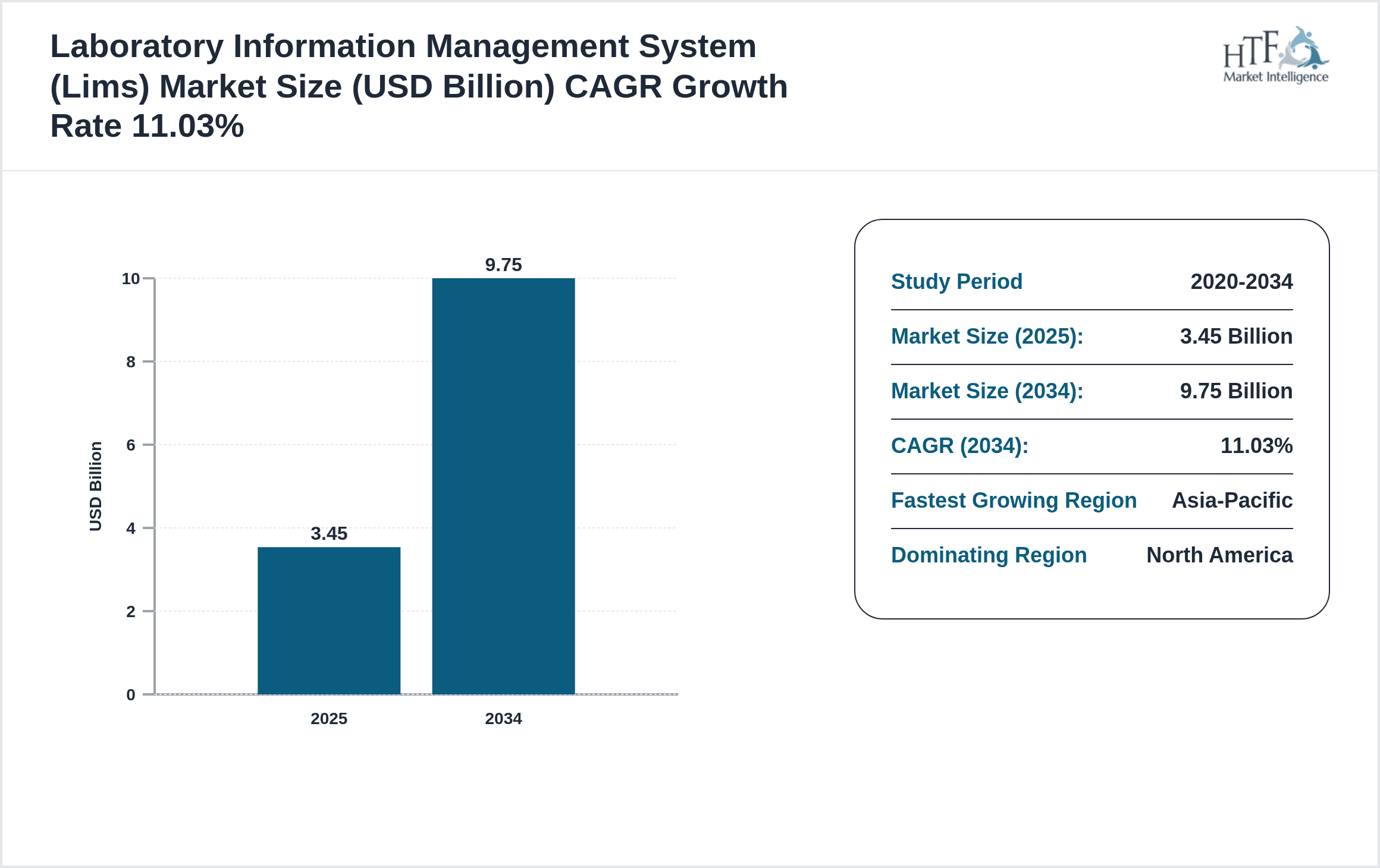
- •Key market highlights include a base market size of USD 3.45 Billion in 2024, with projections estimating growth to USD 9.75 Billion by 2034, reflecting a robust CAGR of 11.03%. North America currently dominates the market due to advanced healthcare infrastructure and early technology adoption, while Asia-Pacific is the fastest-growing region driven by expanding pharmaceutical and research activities. Cloud-Based LIMS leads product types, favored for flexibility and scalability, whereas Mobile LIMS exhibits the highest growth trajectory fueled by increasing demand for remote laboratory management. Clinical diagnostics remains the leading application segment, supported by rising healthcare diagnostics and personalized medicine trends. The market is characterized by competitive innovation, strategic partnerships, and continuous technological advancements shaping its future trajectory.
- •The Laboratory Information Management System market delivers significant value propositions by enhancing laboratory productivity, ensuring compliance with complex regulatory standards, and facilitating data-driven decision-making. For stakeholders including healthcare providers, pharmaceutical companies, environmental agencies, and academic institutions, LIMS offers strategic advantages in reducing operational costs, improving data accuracy, and accelerating research and diagnostic processes. The integration of cloud and mobile technologies expands accessibility, enabling global collaboration and real-time data management. This market’s strategic importance is underscored by its role in supporting innovation, quality assurance, and regulatory adherence across critical laboratory domains worldwide.
Competitive Landscape
The global Laboratory Information Management System market is highly competitive, characterized by a diverse mix of established multinational corporations and innovative niche players. Companies compete by leveraging technological innovation, strategic partnerships, and comprehensive product portfolios to capture market share. Innovation focuses heavily on cloud integration, mobile functionalities, and AI-driven analytics to enhance user experience and operational efficiency. Market rivalry is intensified by rapid technological advancements and the increasing demand for customizable solutions tailored to specific laboratory workflows. Strategic collaborations and mergers & acquisitions have become prominent strategies to expand geographic reach and broaden service offerings. Pricing strategies, customer support, and compliance capabilities also serve as crucial differentiators. The competitive environment fosters continuous development, with companies investing significantly in research and development to maintain leadership and respond effectively to evolving market needs and regulatory landscapes globally.
Key Players in Laboratory Information Management System Market
- •Thermo Fisher Scientific Inc. (United States)
- •LabWare, Inc. (United States)
- •STARLIMS Corporation (United States)
- •Abbott Informatics (United States)
- •Autoscribe Informatics Ltd. (United Kingdom)
- •Siemens Healthineers (Germany)
- •Agilent Technologies, Inc. (United States)
- •LabVantage Solutions, Inc. (United States)
- •PerkinElmer, Inc. (United States)
- •Dassault Systèmes SE (France)
- •AbbVie Inc. (United States)
- •Oracle Corporation (United States)
- •SAP SE (Germany)
- •IBM Corporation (United States)
- •Labtronics Pvt. Ltd. (India)
- •LabCollector (France)
- •CloudLIMS Inc. (United States)
- •LabKey Software Inc. (United States)
- •Labguru (Israel)
- •LabWare Asia Pacific (Singapore)
- •AgileBio, Inc. (United States)
- •LabLynx, Inc. (United States)
- •Benchling, Inc. (United States)
- •Autoscribe Informatics Asia (Singapore)
- •LabVantage Solutions Europe (Germany)
Market Breakdown
- •By Product Type
- ◦On-Premise Laboratory Information Management System
- ◦Cloud-Based Laboratory Information Management System
- ◦Web-Based Laboratory Information Management System
- ◦Open-Source Laboratory Information Management System
- ◦Mobile Laboratory Information Management System
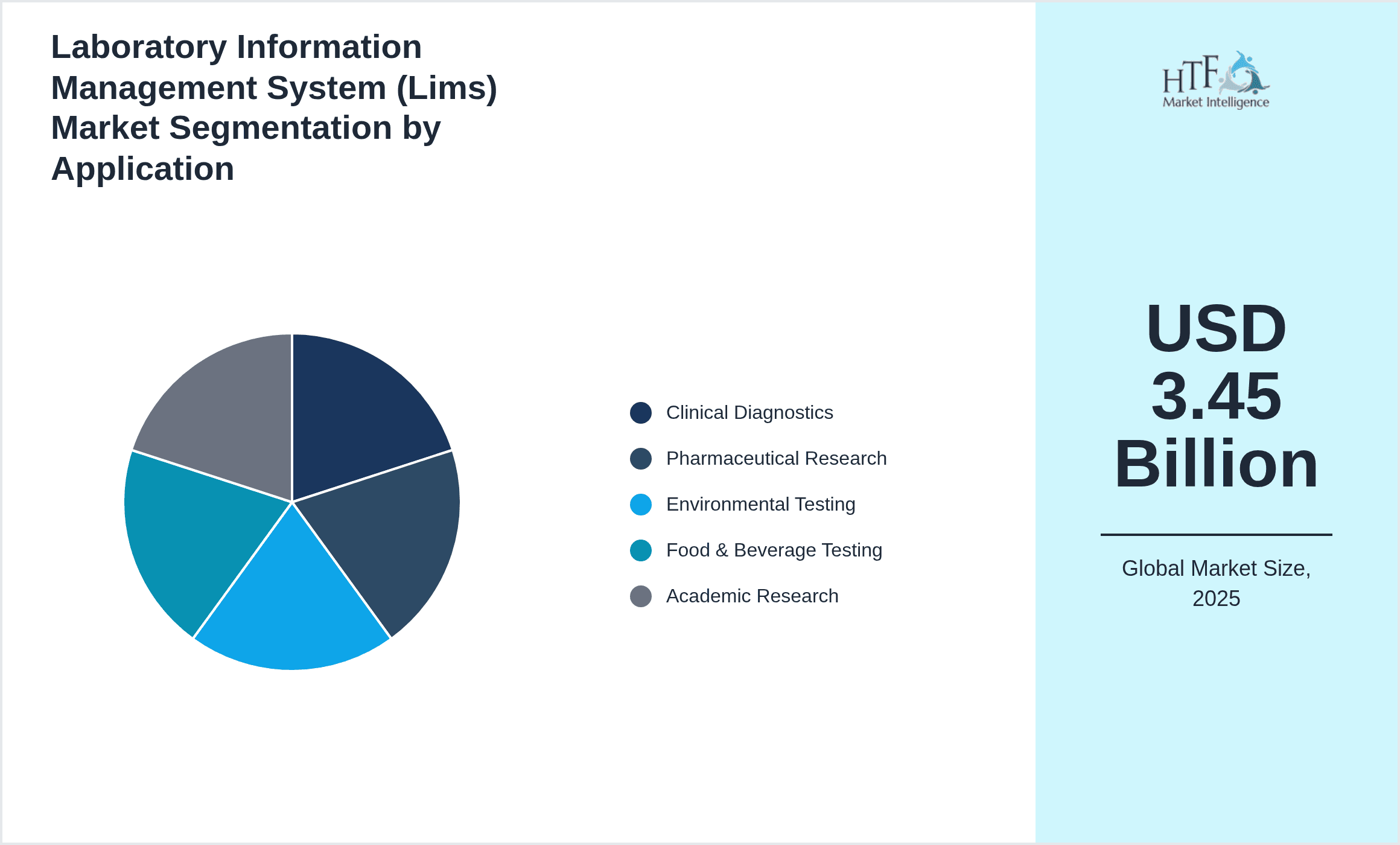
- •By Application
- ◦Clinical Diagnostics
- ◦Pharmaceutical Research
- ◦Environmental Testing
- ◦Food & Beverage Testing
- ◦Academic Research
- •By End-User Industry
- ◦Healthcare & Hospitals
- ◦Pharmaceutical & Biotechnology
- ◦Environmental Agencies
- ◦Food & Beverage Industry
- •By Distribution Channel
- ◦Direct Sales
- ◦Third-Party Distributors
- ◦Online Platforms
Growth Dynamics
- •The growing demand for automation and digital transformation in laboratories globally is a key driver, enhancing operational efficiency and reducing human error in data management processes.
- •Increasing regulatory requirements for data integrity, traceability, and compliance in clinical and pharmaceutical sectors are propelling LIMS adoption to ensure standardized laboratory workflows.
- •Advancements in cloud computing and mobile technologies are enabling scalable, flexible, and remote laboratory management solutions, accelerating market growth particularly in emerging economies.
- •Rising investments in research and development activities by pharmaceutical and biotech companies globally are fueling demand for advanced LIMS to manage complex data and workflows.
- •The expansion of clinical diagnostics and personalized medicine is increasing the need for efficient data management systems capable of handling large volumes of patient data securely and accurately.
- •Government initiatives promoting digital health infrastructure and smart laboratories are fostering market expansion through funding and supportive policies.
- •Strategic collaborations between software providers and laboratory service companies are enhancing market penetration and product innovation, driving sustained growth.

Market Trends
- •The adoption of cloud-based LIMS solutions is rapidly increasing due to their scalability, cost-effectiveness, and ease of integration with other digital platforms, revolutionizing traditional lab management.
- •Integration of artificial intelligence and machine learning within LIMS platforms is enabling predictive analytics and enhanced decision-making capabilities in laboratory workflows.
- •Mobile LIMS applications are gaining traction, allowing laboratory personnel to access and manage data remotely, thus improving operational flexibility and real-time monitoring.
- •Sustainability and energy efficiency concerns are driving the development of eco-friendly and paperless LIMS solutions, aligning with global environmental initiatives.
- •Increased collaboration between LIMS providers and cloud service companies is fostering ecosystem development, offering comprehensive laboratory informatics solutions.
- •Customization and modularity of LIMS software are becoming key market differentiators, enabling tailored solutions to specific laboratory requirements.
- •The shift towards decentralized and point-of-care testing is influencing LIMS designs to support distributed data management and interoperability across multiple sites.

Market Opportunities
- •Expanding applications of LIMS in emerging markets present significant growth potential due to increasing healthcare infrastructure development and research activities.
- •Untapped segments such as environmental testing and food safety offer lucrative opportunities for LIMS providers to introduce specialized solutions.
- •Investment in AI-powered LIMS platforms allows for innovation in data analytics, predictive maintenance, and workflow optimization, opening new market avenues.
- •Geographic expansion through partnerships and joint ventures in Asia-Pacific and Latin America can enhance market reach and revenue streams.
- •Development of mobile and IoT-integrated LIMS solutions offers opportunities to serve laboratories seeking real-time data access and remote management capabilities.
- •Strategic acquisitions targeting niche technology providers can bolster product portfolios and accelerate innovation.
- •Increasing demand for compliance automation and data security solutions creates avenues for introducing advanced regulatory-compliant LIMS products.
Market Challenges
- •High initial investment costs and complex implementation processes of LIMS solutions pose adoption barriers, especially for small and medium-sized laboratories.
- •Integration challenges with legacy laboratory systems and diverse data formats can impede seamless LIMS deployment and interoperability.
- •Concerns related to data privacy, cybersecurity, and regulatory compliance require continuous updates and robust security protocols, increasing operational complexity.
- •Shortage of skilled IT professionals with expertise in laboratory informatics limits effective system management and user training.
- •Competitive pricing pressures and rapid technological changes necessitate ongoing innovation and cost optimization by LIMS providers.
- •Variability in regulatory standards across regions complicates product standardization and market entry strategies.
- •Resistance to change and lack of awareness among end-users about benefits of advanced LIMS solutions hinder market penetration.
Regulatory Framework
- •The FDA's 21 CFR Part 11 regulation, enforced between 2019 and 2024, mandates electronic records and signatures compliance, necessitating LIMS solutions to incorporate stringent audit trails and data security features to ensure market acceptance.
- •The European Union's In Vitro Diagnostic Regulation (IVDR) implemented in 2022 requires enhanced traceability and performance evaluation, driving LIMS providers to adapt software functionalities to meet these compliance demands.
- •HIPAA regulations in the United States, updated in 2021, emphasize patient data privacy and security, compelling LIMS systems used in clinical diagnostics to integrate advanced encryption and access control mechanisms.
- •The General Data Protection Regulation (GDPR) enforced from 2018 to 2023 across Europe imposes strict data processing and storage rules, influencing LIMS software design to ensure compliance with personal data protection standards.
- •Recent government initiatives promoting digital health infrastructure, such as the US Health IT Strategic Plan 2020-2025, encourage adoption of interoperable and standardized LIMS platforms, supporting market growth through policy incentives.
Market Intelligence
- •15th January 2025, Thermo Fisher Scientific Inc. launched an advanced cloud-based LIMS platform integrating AI-driven analytics and real-time data visualization, targeting pharmaceutical and clinical laboratories to enhance decision-making and operational efficiency. This offering aims to simplify complex laboratory workflows and improve regulatory compliance through automated reporting features. The platform supports multi-site collaboration with enhanced cybersecurity protocols, positioning Thermo Fisher as a leader in digital laboratory transformation. Source: Official Thermo Fisher Scientific press release.
- •10th March 2025, LabWare, Inc. introduced its latest web-based LIMS solution featuring mobile access and IoT integration capabilities, enabling laboratories to manage samples and data remotely with increased accuracy and speed. The innovation addresses growing demand for flexible, scalable laboratory management tools in research and clinical settings worldwide. This launch strengthens LabWare’s competitive positioning by expanding its cloud ecosystem and supporting compliance with evolving regulatory standards globally. Source: LabWare corporate announcement.
- •22nd May 2024, STARLIMS Corporation announced a strategic partnership with a leading cloud services provider to enhance its LIMS offerings with advanced data analytics, AI capabilities, and secure cloud infrastructure. This collaboration aims to accelerate digital transformation across pharmaceutical and environmental testing laboratories, improving data integrity and operational responsiveness. The initiative reflects market trends toward integrated, intelligent laboratory management solutions with scalable cloud platforms. Source: STARLIMS official press release.
- •5th August 2024, Abbott Informatics completed the acquisition of a niche open-source LIMS developer to broaden its portfolio with customizable and cost-effective solutions tailored for academic and smaller research laboratories. This strategic move enhances Abbott's market penetration in emerging segments and supports innovation-driven growth by integrating community-driven software development models. Source: Abbott Informatics corporate website.
Regional Outlook
The North America currently holds a significant share of the market, primarily due to several key factors: increasing consumption rates, a burgeoning population, and robust economic momentum. These elements collectively drive demand, positioning this region as a leader in the market. On the other hand, Asia-Pacific is rapidly emerging as the fastest-growing area within the industry. This remarkable growth can be attributed to swift infrastructure development, the expansion of various industrial sectors, and a marked increase in consumer demand. These dynamics make this region a crucial player in shaping future market growth.
In our report, we cover a comprehensive analysis of the following regions and countries:
- North America
- LATAM
- West Europe
- Central & Eastern Europe
- Northern Europe
- Southern Europe
- East Asia
- Southeast Asia
- South Asia
- Central Asia
- Oceania
- MEA
| Feature | Details |
|---|---|
| Base Year Market Size | USD 3.45 Billion |
| Forecast Year Market Size | USD 9.75 Billion |
| CAGR | 11.03% |
| Forecast Period | 2026 to 2033 |
| YoY Growth | 11.03% |
| Scope of Report | Market is segmented by Product Type (On-Premise Laboratory Information Management System, Cloud-Based Laboratory Information Management System, Web-Based Laboratory Information Management System, Open-Source Laboratory Information Management System, Mobile Laboratory Information Management System), Application (Clinical Diagnostics, Pharmaceutical Research, Environmental Testing, Food & Beverage Testing, Academic Research), End-User Industry (Healthcare & Hospitals, Pharmaceutical & Biotechnology, Environmental Agencies, Food & Beverage Industry), Distribution Channel (Direct Sales, Third-Party Distributors, Online Platforms) |
| Regions Covered | North America, LATAM, West Europe, Central & Eastern Europe, Northern Europe, Southern Europe, East Asia, Southeast Asia, South Asia, Central Asia, Oceania, MEA |
| Key Companies | Thermo Fisher Scientific Inc. (United States), LabWare, Inc. (United States), STARLIMS Corporation (United States), Abbott Informatics (United States), Autoscribe Informatics Ltd. (United Kingdom), Siemens Healthineers (Germany), Agilent Technologies, Inc. (United States), LabVantage Solutions, Inc. (United States), PerkinElmer, Inc. (United States), Dassault Systèmes SE (France), AbbVie Inc. (United States), Oracle Corporation (United States), SAP SE (Germany), IBM Corporation (United States), Labtronics Pvt. Ltd. (India), LabCollector (France), CloudLIMS Inc. (United States), LabKey Software Inc. (United States), Labguru (Israel), LabWare Asia Pacific (Singapore), AgileBio, Inc. (United States), LabLynx, Inc. (United States), Benchling, Inc. (United States), Autoscribe Informatics Asia (Singapore), LabVantage Solutions Europe (Germany) |
Global Laboratory Information Management System Market Size, Growth & Revenue 2024-2034 - Table of Contents
Multidisciplinary researcher with 10+ years of experience uncovering insights across diverse domains focused on uncovering insights that drive informed decisions.
Frequently Asked Questions (FAQ):
The Compact Track Loaders market is projected to grow at a CAGR of 6.8% from 2025 to 2030, driven by increasing demand in construction and agricultural sectors.
North America currently leads the market with approximately 45% market share, followed by Europe at 28% and Asia-Pacific at 22%. The remaining regions account for 5% of the global market.
Key growth drivers include increasing construction activities, rising demand for versatile equipment in agriculture, technological advancements in track loader design, and growing preference for compact equipment in urban construction projects.