
Global Telecom Billing Software Market Size, Growth & Revenue 2025-2034
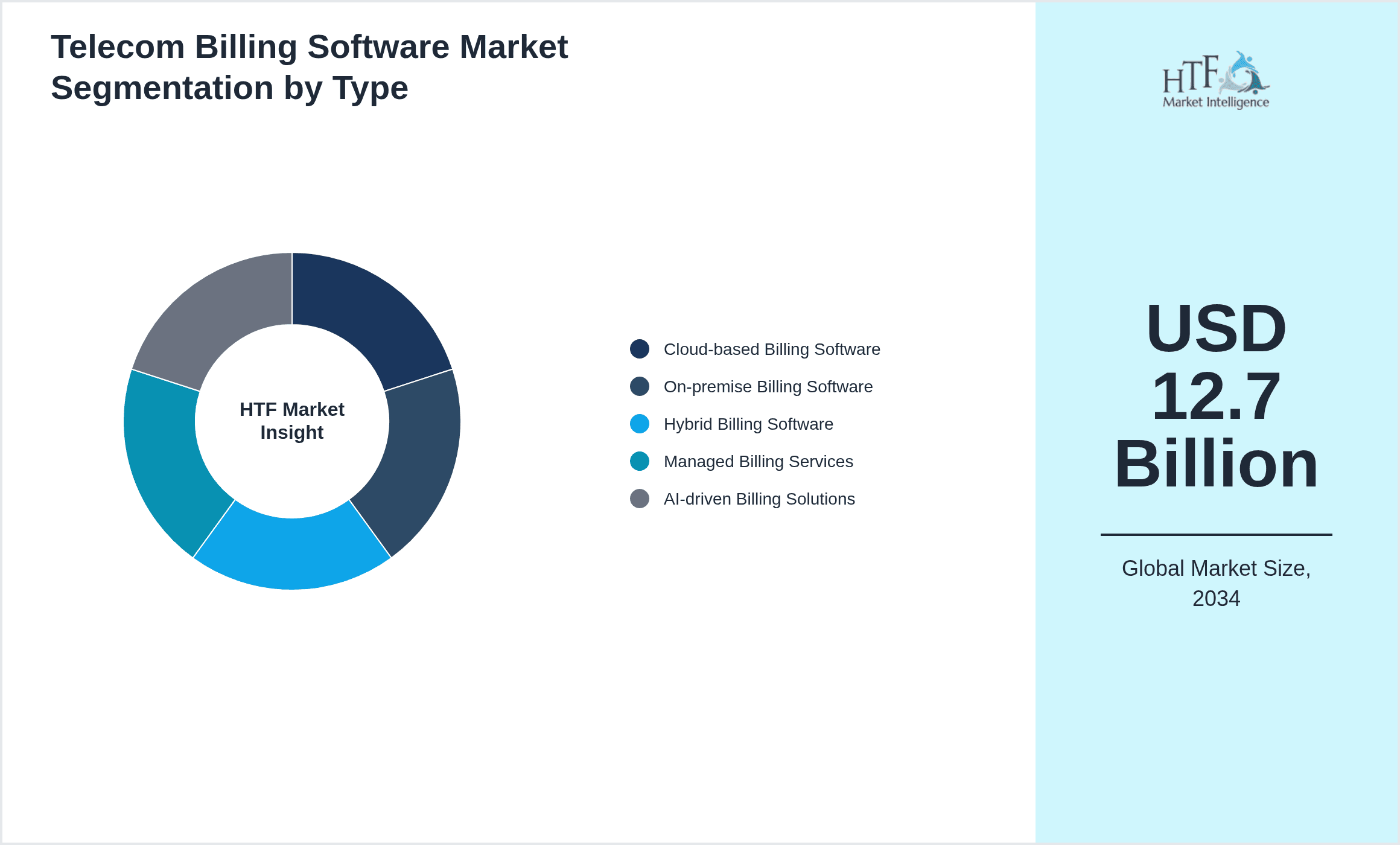
Global Telecom Billing Software Market is segmented by Product Type (Cloud-based Billing Software, On-premise Billing Software, Hybrid Billing Software, Managed Billing Services, AI-driven Billing Solutions), Application (Postpaid Billing, Prepaid Billing, Roaming Billing, Mediation, Invoice Management), End-Use Industry (Mobile Network Operators, Internet Service Providers, Satellite Communication Providers, Cable and Broadband Providers), Distribution Channel (Direct Sales, Channel Partners, Online Platforms), and Geography (North America, LATAM, West Europe, Central & Eastern Europe, Northern Europe, Southern Europe, East Asia, Southeast Asia, South Asia, Central Asia, Oceania, MEA)
Pricing
Report Overview
Executive Summary
- •The global Telecom Billing Software market is a critical segment within the telecommunications industry, addressing the growing demand for efficient, automated billing processes. This market involves software solutions that support comprehensive billing operations such as prepaid, postpaid, roaming, mediation, and invoice management, enabling telecom providers to streamline revenue management and enhance customer experience. The software solutions vary from traditional on-premise systems to modern cloud-based and hybrid platforms, integrating advanced technologies including AI and machine learning to provide predictive analytics and fraud detection. Key end users include mobile network operators, Internet service providers, and satellite communication companies worldwide, reflecting the market's broad applicability. The value chain includes software vendors, system integrators, and service providers, collaborating to deliver scalable and customizable billing solutions. Increasing adoption of digital services, complex pricing models, and growing mobile subscriber bases drive market expansion. Additionally, regulatory requirements and the need for real-time billing and reporting further stimulate innovation and deployment of advanced billing software across regions.
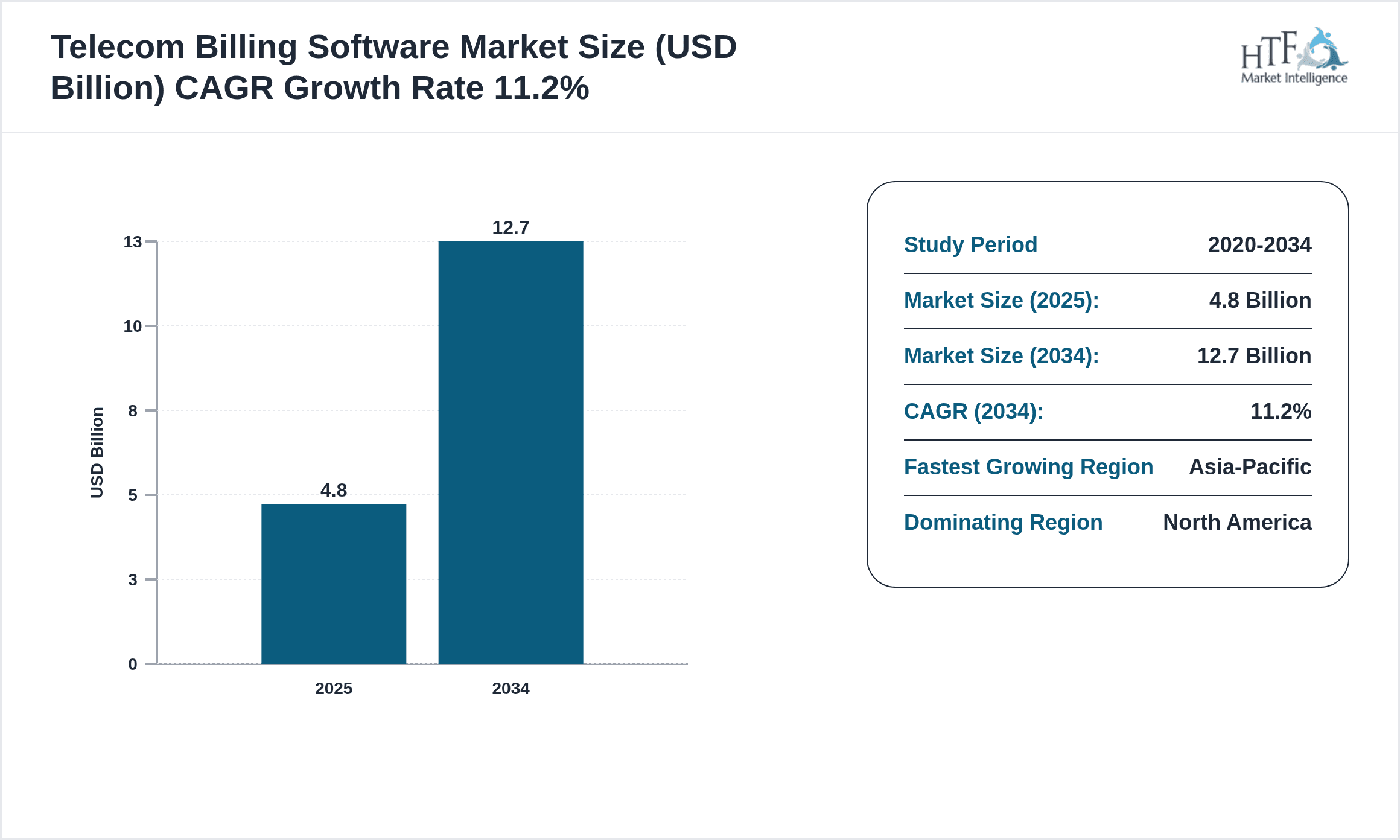
- •Market highlights indicate a robust growth trajectory with the global Telecom Billing Software market valued at USD 4.8 Billion in 2025, projected to reach USD 12.7 Billion by 2034, exhibiting a CAGR of 11.2%. The rise of cloud-based billing solutions and AI-driven software types represent the fastest growing segments, propelled by the telecom industry's digital transformation and demand for flexible, scalable billing systems. North America currently dominates the market due to advanced telecom infrastructure and early technology adoption, while Asia-Pacific emerges as the fastest growing region, driven by rapid mobile penetration and expanding telecom services. The market's growth is supported by increasing investments in next-generation billing platforms and strategic partnerships among technology providers and telecom operators.
- •Telecom billing software offers significant value propositions by enabling efficient revenue management, reducing billing errors, and supporting complex pricing strategies across multiple services and regions. This market is strategically important for telecom operators to maintain compliance with regulatory standards, optimize operational costs, and enhance customer satisfaction through transparent and timely billing. The integration of AI and cloud technologies further positions these solutions as essential tools for future-proofing telecom service delivery and capitalizing on emerging digital revenue streams. Overall, the market continues to evolve with increasing adoption of innovative billing models and automation, making it a focal point for stakeholders including software vendors, telecom companies, and investors.
Competitive Landscape
The global Telecom Billing Software market features intense competition characterized by rapid technological innovation, strategic partnerships, and market consolidation through mergers and acquisitions. Leading players focus on enhancing product differentiation by integrating AI, cloud computing, and analytics capabilities to meet evolving customer demands. Competitive strategies include expanding service portfolios, entering new geographic markets, and fostering strong relationships with telecom operators to secure long-term contracts. The market is also witnessing increased collaboration between software vendors and system integrators to offer end-to-end billing solutions that encompass mediation, rating, and customer management functionalities. Pricing strategies are adapted to cater to diverse customer segments, ranging from large-scale operators requiring bespoke solutions to smaller providers opting for SaaS-based offerings. Regional competition varies, with North American and European companies leading innovation, while Asia-Pacific players leverage cost advantages and growing telecom infrastructure. Future competition is expected to intensify as new entrants focus on AI-driven and IoT-enabled billing platforms, creating higher barriers to entry and accelerating market evolution.
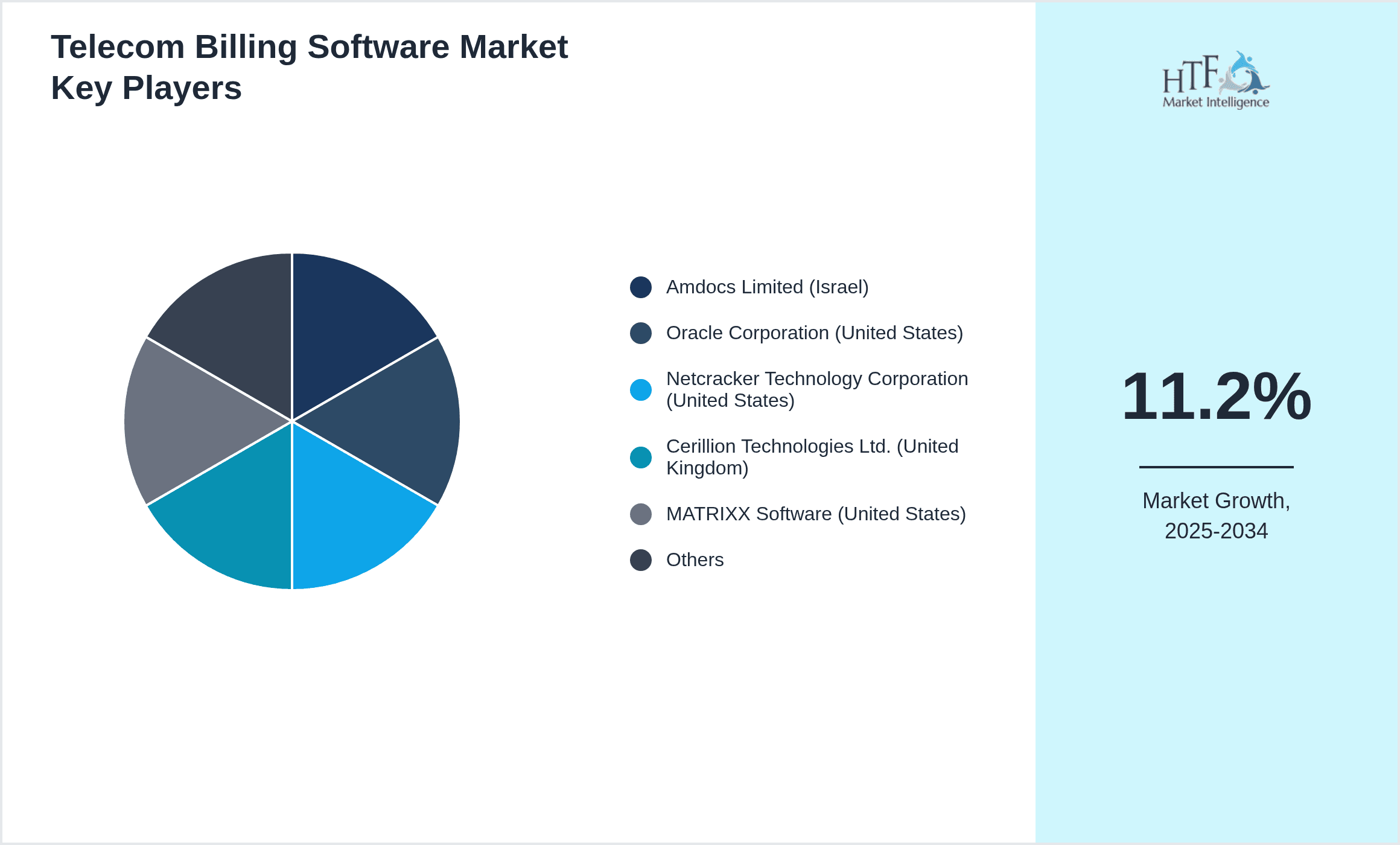
Leading Companies in Telecom Billing Software Market
- •Amdocs Limited (Israel)
- •Oracle Corporation (United States)
- •Netcracker Technology Corporation (United States)
- •Cerillion Technologies Ltd. (United Kingdom)
- •MATRIXX Software (United States)
- •Comarch SA (Poland)
- •Huawei Technologies Co., Ltd. (China)
- •Nokia Corporation (Finland)
- •Ericsson AB (Sweden)
- •CSG Systems International, Inc. (United States)
- •Cognizant Technology Solutions (United States)
- •SAP SE (Germany)
- •Netmind S.A. (Chile)
- •Subex Limited (India)
- •Optiva Inc. (Canada)
- •Intec Telecom Systems (Israel)
- •Sigma Systems (Canada)
- •Openet Telecom (Ireland)
- •Aptitude Software (United Kingdom)
- •SAP Concur (United States)
- •Fujitsu Limited (Japan)
- •ZTE Corporation (China)
- •Tata Consultancy Services (India)
- •Infosys Limited (India)
- •Accenture plc (Ireland)

Market Breakdown
- •By Product Type
- ◦Cloud-based Billing Software
- ◦On-premise Billing Software
- ◦Hybrid Billing Software
- ◦Managed Billing Services
- ◦AI-driven Billing Solutions
- •By Application
- ◦Postpaid Billing
- ◦Prepaid Billing
- ◦Roaming Billing
- ◦Mediation
- ◦Invoice Management
- •By End-Use Industry
- ◦Mobile Network Operators
- ◦Internet Service Providers
- ◦Satellite Communication Providers
- ◦Cable and Broadband Providers
- •By Distribution Channel
- ◦Direct Sales
- ◦Channel Partners
- ◦Online Platforms
Growth Dynamics
- •Rapid digitization and the expansion of telecom services globally are driving the demand for advanced billing software that supports multi-service and multi-channel billing, enabling operators to manage complex pricing models efficiently.
- •The increasing adoption of cloud computing allows telecom companies to reduce infrastructure costs and improve scalability, significantly boosting the growth of cloud-based billing solutions.
- •AI and machine learning integration in billing systems enhance fraud detection, revenue assurance, and predictive analytics, facilitating more accurate billing processes and customer personalization.
- •Regulatory compliance requirements for transparent and real-time billing across different regions encourage the deployment of sophisticated billing software to meet legal standards and customer expectations.
- •The rise of IoT and 5G networks introduces new revenue streams and complex billing scenarios, necessitating innovative billing solutions capable of handling diverse data and service types.
- •Telecom operators' strategic investments in upgrading legacy billing systems to next-generation platforms support market growth by improving operational efficiency and customer experience.
- •Increasing competition among telecom providers compels the adoption of flexible and customizable billing software to differentiate offerings and attract diverse customer segments.
Market Trends
- •The shift towards cloud-native billing platforms is a dominant trend, offering enhanced agility, faster deployment, and cost efficiency compared to traditional on-premise systems, with companies like Amdocs and Oracle leading adoption.
- •Integration of AI-driven analytics tools into billing software enables telecom operators to optimize pricing strategies and detect revenue leakages proactively, enhancing profitability and customer retention.
- •There is a growing trend of convergence between billing and customer relationship management (CRM) systems, allowing unified customer data management and improved service personalization.
- •Sustainability initiatives are influencing billing software development, with providers focusing on energy-efficient cloud operations and reducing paper billing through digital invoicing solutions.
- •Telecom billing solutions are increasingly supporting real-time charging and settlement to accommodate dynamic pricing models and instant service activation required by emerging 5G and IoT services.
- •Collaboration between software vendors and telecom operators is intensifying to co-develop tailored billing platforms aligned with evolving industry standards and customer expectations.
- •The market is witnessing a rise in subscription-based billing models, reflecting the broader shift in telecom services towards bundled and value-added offerings.
Market Opportunities
- •Expanding telecom penetration in emerging economies presents significant growth opportunities for billing software vendors to tap into new user bases requiring scalable and affordable solutions.
- •The evolution of 5G and IoT technologies opens avenues for innovative billing models that cater to diverse service consumption patterns and device ecosystems.
- •Cloud migration initiatives by telecom operators offer vendors the chance to provide flexible, pay-as-you-go billing platforms, reducing upfront costs and accelerating adoption.
- •Artificial intelligence and machine learning integration in billing systems creates potential for advanced revenue assurance, personalized pricing, and fraud prevention solutions.
- •Partnerships with OTT service providers enable telecom billing software companies to expand their offerings to new digital services and content delivery platforms.
- •Increasing regulatory focus on billing transparency and customer data protection drives demand for compliant and secure billing solutions across global markets.
- •Development of unified billing platforms that consolidate multiple services and payment methods can enhance customer experience and increase operator revenue streams.
Market Challenges
- •High complexity in integrating billing software with legacy telecom infrastructure poses significant technical challenges and increases deployment timelines and costs.
- •Data security and privacy concerns remain critical, requiring continuous updates to billing platforms to comply with global regulations such as GDPR and CCPA.
- •Rapid technology evolution demands continuous innovation from software providers, leading to intense R&D investments and potential obsolescence of existing solutions.
- •Price sensitivity among telecom operators in emerging markets limits willingness to invest in advanced billing solutions, affecting vendor profit margins and market penetration.
- •The fragmentation of telecom markets and diverse regulatory environments complicate the standardization of billing solutions across multiple regions and service types.
- •Competition from in-house developed billing systems by large telecom operators challenges third-party software vendors’ market share and growth prospects.
- •Supply chain disruptions and shortage of skilled IT professionals can delay software deployment and impact service quality in certain regions.
Regulatory Framework
- •The European Union's General Data Protection Regulation (GDPR), implemented between 2018 and 2025, mandates stringent data privacy standards impacting billing software design and operation across telecom operators in Europe and beyond.
- •The Federal Communications Commission (FCC) regulations in the United States, enforced from 2020 to 2025, require transparency in billing practices and prohibit hidden fees, influencing software functionality and reporting capabilities.
- •Telecom Regulatory Authority of India (TRAI) guidelines enacted between 2019 and 2025 impose compliance on real-time billing and customer information security, driving adoption of advanced billing solutions in the Indian market.
- •The Asia-Pacific Economic Cooperation (APEC) framework on cross-border data flow and cybersecurity, developed during 2021-2025, affects billing software vendors with multinational telecom clients requiring secure and compliant data handling.
- •The Middle East and Africa telecommunication regulatory bodies have introduced mandates between 2020 and 2025 focusing on billing accuracy, fraud prevention, and consumer protection, compelling telecom operators to upgrade billing infrastructures accordingly.
Market Intelligence
- •15th March 2025, Amdocs Limited announced the launch of its next-generation cloud-native billing platform designed to support 5G and IoT services. The solution features AI-driven analytics for real-time revenue assurance and customer personalization, targeting telecom operators seeking scalable and flexible billing systems. This launch is positioned to enhance Amdocs' market leadership in cloud-based telecom billing, addressing the growing complexity of multi-service billing environments and accelerating digital transformation initiatives. The platform also integrates seamless migration capabilities from legacy systems, reducing operational disruptions. Source: Amdocs Official Press Release
- •22nd June 2025, Oracle Corporation introduced a comprehensive AI-powered fraud detection module within its telecom billing software suite. The innovation leverages machine learning algorithms to identify and mitigate fraudulent activities in real-time, improving revenue protection for telecom operators globally. Oracle’s solution supports multi-vendor environments and complies with international regulatory standards, enhancing its appeal in diverse markets. This strategic enhancement aligns with the increasing demand for secure and transparent billing solutions amid rising cyber threats. Source: Oracle Corporate News
- •10th September 2025, Netcracker Technology Corporation announced a strategic partnership with a leading cloud service provider to co-develop hybrid billing solutions that combine on-premise and cloud capabilities. This collaboration aims to offer telecom operators enhanced flexibility, scalability, and cost-effectiveness in managing their billing operations. The joint initiative also focuses on integrating advanced analytics and customer engagement tools to optimize billing accuracy and user experience. This partnership marks a significant step towards addressing diverse customer requirements and accelerating market penetration in Asia-Pacific and Europe. Source: Netcracker Press Release
- •5th December 2024, Cerillion Technologies Ltd. completed the acquisition of a niche AI-based billing analytics startup to strengthen its portfolio of intelligent billing solutions. This move enhances Cerillion's capabilities in providing predictive revenue assurance and dynamic pricing models, catering to evolving telecom market demands. The acquisition supports Cerillion's growth strategy focused on innovation and expanding its customer base across North America and Europe. It also reinforces the company's position in the competitive telecom billing software landscape by integrating cutting-edge AI technology. Source: Cerillion Official Statement
Regional Outlook
The North America currently holds a significant share of the market, primarily due to several key factors: increasing consumption rates, a burgeoning population, and robust economic momentum. These elements collectively drive demand, positioning this region as a leader in the market. On the other hand, Asia-Pacific is rapidly emerging as the fastest-growing area within the industry. This remarkable growth can be attributed to swift infrastructure development, the expansion of various industrial sectors, and a marked increase in consumer demand. These dynamics make this region a crucial player in shaping future market growth.
In our report, we cover a comprehensive analysis of the following regions and countries:
- North America
- LATAM
- West Europe
- Central & Eastern Europe
- Northern Europe
- Southern Europe
- East Asia
- Southeast Asia
- South Asia
- Central Asia
- Oceania
- MEA
| Feature | Details |
|---|---|
| Base Year Market Size | USD 4.8 Billion |
| Forecast Year Market Size | USD 12.7 Billion |
| CAGR | 11.2% |
| Forecast Period | 2026 to 2033 |
| YoY Growth | 10.7% |
| Scope of Report | Market is segmented by Product Type (Cloud-based Billing Software, On-premise Billing Software, Hybrid Billing Software, Managed Billing Services, AI-driven Billing Solutions), Application (Postpaid Billing, Prepaid Billing, Roaming Billing, Mediation, Invoice Management), End-Use Industry (Mobile Network Operators, Internet Service Providers, Satellite Communication Providers, Cable and Broadband Providers), Distribution Channel (Direct Sales, Channel Partners, Online Platforms) |
| Regions Covered | North America, LATAM, West Europe, Central & Eastern Europe, Northern Europe, Southern Europe, East Asia, Southeast Asia, South Asia, Central Asia, Oceania, MEA |
| Key Companies | Amdocs Limited (Israel), Oracle Corporation (United States), Netcracker Technology Corporation (United States), Cerillion Technologies Ltd. (United Kingdom), MATRIXX Software (United States) |
Global Telecom Billing Software Market Size, Growth & Revenue 2025-2034 - Table of Contents
Research enthusiast focused on transforming data uncovering into actionable insights through data-driven decision-making.
Frequently Asked Questions (FAQ):
The Market market is projected to grow at a steady CAGR from 2025 to 2030, driven by increasing demand and expansion in various applications.
North America currently leads the market, followed by Europe and Asia-Pacific.
Key growth drivers include increasing activities, rising demand for innovative solutions, technological advancements, and growing preference for efficient products.