
Global Customer Experience Enterprise Software Market - Outlook 2024-2034
Global Customer Experience (CX) Enterprise Software Market is segmented by Type (Cloud-based Customer Experience Software, On-premise Customer Experience Software, Hybrid Customer Experience Software, AI-Driven Customer Experience Software, Mobile-Enabled Customer Experience Software), Application (Customer Service, Marketing Automation, Sales Enablement, Analytics & Feedback Management, Omnichannel Engagement), Deployment Model (Public Cloud, Private Cloud, On-premise, Hybrid Cloud), Industry Vertical (Retail, Banking, Financial Services & Insurance (BFSI), Healthcare, Telecommunications, Manufacturing), and Geography (North America, LATAM, West Europe, Central & Eastern Europe, Northern Europe, Southern Europe, East Asia, Southeast Asia, South Asia, Central Asia, Oceania, MEA)
Pricing
Report Overview
Executive Summary
- •The Global Customer Experience (CX) Enterprise Software Market is a dynamic and rapidly expanding sector focused on delivering sophisticated software solutions to enhance customer interactions across industries. It comprises diverse software types including cloud-based, on-premise, hybrid, AI-driven, and mobile-enabled platforms that enable enterprises to personalize customer service, automate marketing efforts, empower sales teams, and analyze customer feedback and behaviors. The market addresses the needs of businesses seeking to strengthen customer loyalty and optimize operational efficiencies through integrated CX solutions. Key applications span customer service, marketing automation, sales enablement, analytics, and omnichannel engagement, reflecting the comprehensive nature of CX software in today’s digital economy. The increasing adoption of AI, machine learning, and big data analytics fuels innovation and customization, enabling real-time decision-making and predictive capabilities. Geographically, North America leads in market size due to technological maturity, while Asia-Pacific emerges as the fastest-growing region owing to digital transformation initiatives. The market’s relevance spans retail, BFSI, healthcare, telecom, and manufacturing sectors, highlighting its broad industry applicability and strategic importance in driving business growth and competitive advantage.
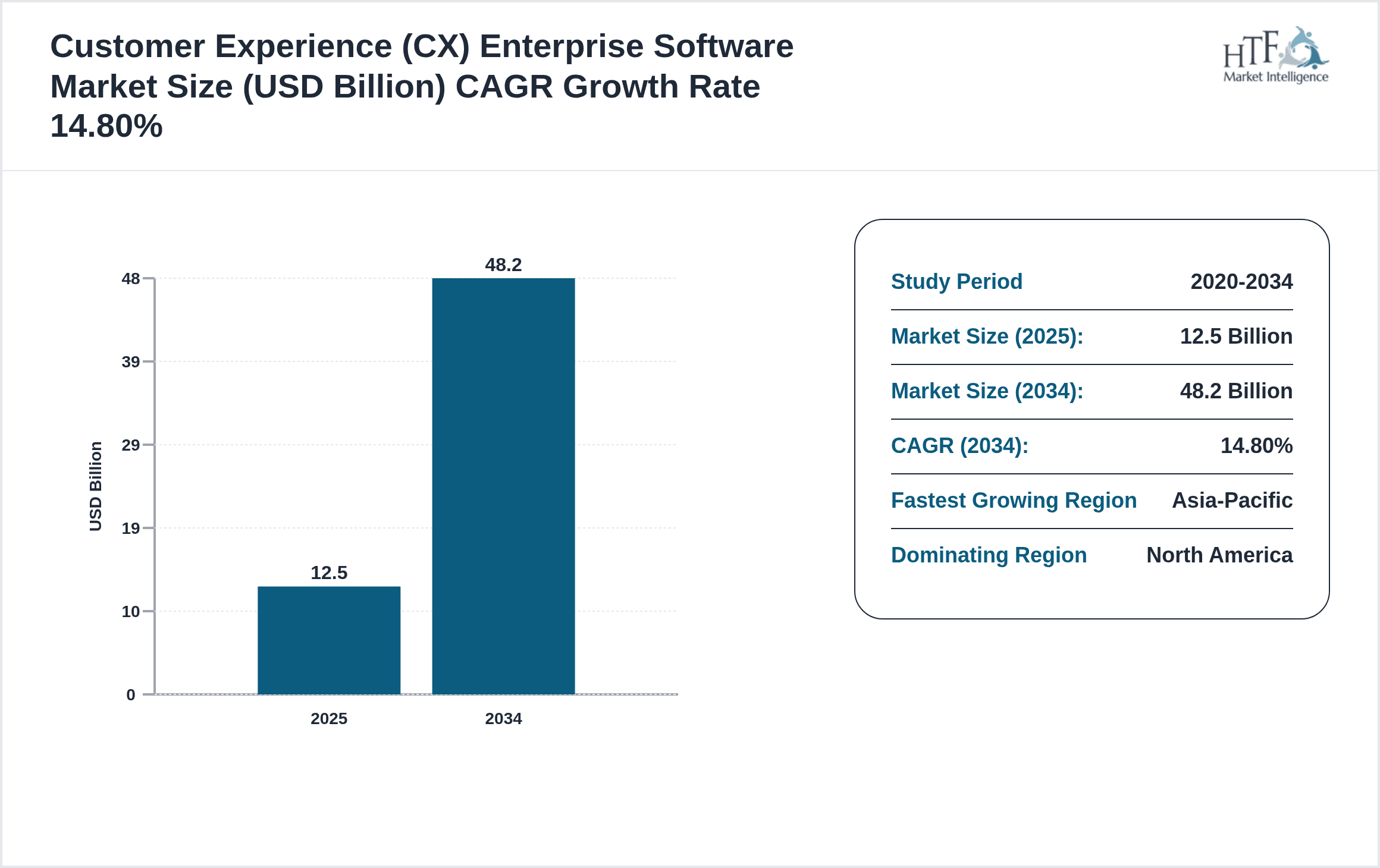
- •Key market highlights indicate a robust CAGR of 14.8% from 2024 to 2034, with the market size expected to grow from USD 12.5 Billion in 2024 to USD 48.2 Billion by 2034. Cloud-based software remains the dominant type, offering scalability and flexibility, while AI-driven solutions exhibit the fastest growth due to rising demand for intelligent automation. Customer service and marketing automation lead applications, reflecting enterprises’ focus on enhancing engagement and operational efficiency. North America dominates the market due to advanced infrastructure, while Asia-Pacific’s rapid digital adoption drives its status as the fastest-growing region. These dynamics underscore evolving customer expectations and technological advancements shaping the CX software landscape globally.
- •The value proposition of the CX enterprise software market lies in its capacity to transform customer engagement by integrating technology with business processes. It enables organizations to gain actionable insights from customer data, personalize interactions, automate workflows, and unify communication channels, thereby increasing customer satisfaction and retention. This strategic importance extends across industries, supporting digital transformation goals and competitive differentiation. Stakeholders including software vendors, service providers, and end-users benefit from continuous innovation, cloud adoption, and AI integration, which collectively drive market expansion and resilience in an increasingly customer-centric business environment.
Competitive Landscape
The competitive landscape of the Global Customer Experience Enterprise Software Market is characterized by intense rivalry among established multinational corporations and innovative emerging players. Market leaders leverage continuous product innovation, strategic partnerships, and acquisitions to expand their portfolios and regional footprints. Differentiation is achieved through AI integration, cloud capabilities, and omnichannel support, catering to evolving enterprise demands. Pricing strategies vary from subscription-based models to enterprise licensing, influencing customer acquisition and retention. The market also faces moderate entry barriers due to technological complexity and customer trust requirements, fostering competition centered on service excellence and solution scalability. Regional competition is notable, with North America hosting many headquarters of leading vendors, while Asia-Pacific's growing vendor ecosystem introduces competitive pressures. Future trends include increased focus on AI-driven personalization, embedded analytics, and industry-specific CX solutions, shaping competitive dynamics and innovation trajectories.
Leading Companies in Customer Experience Enterprise Software Market
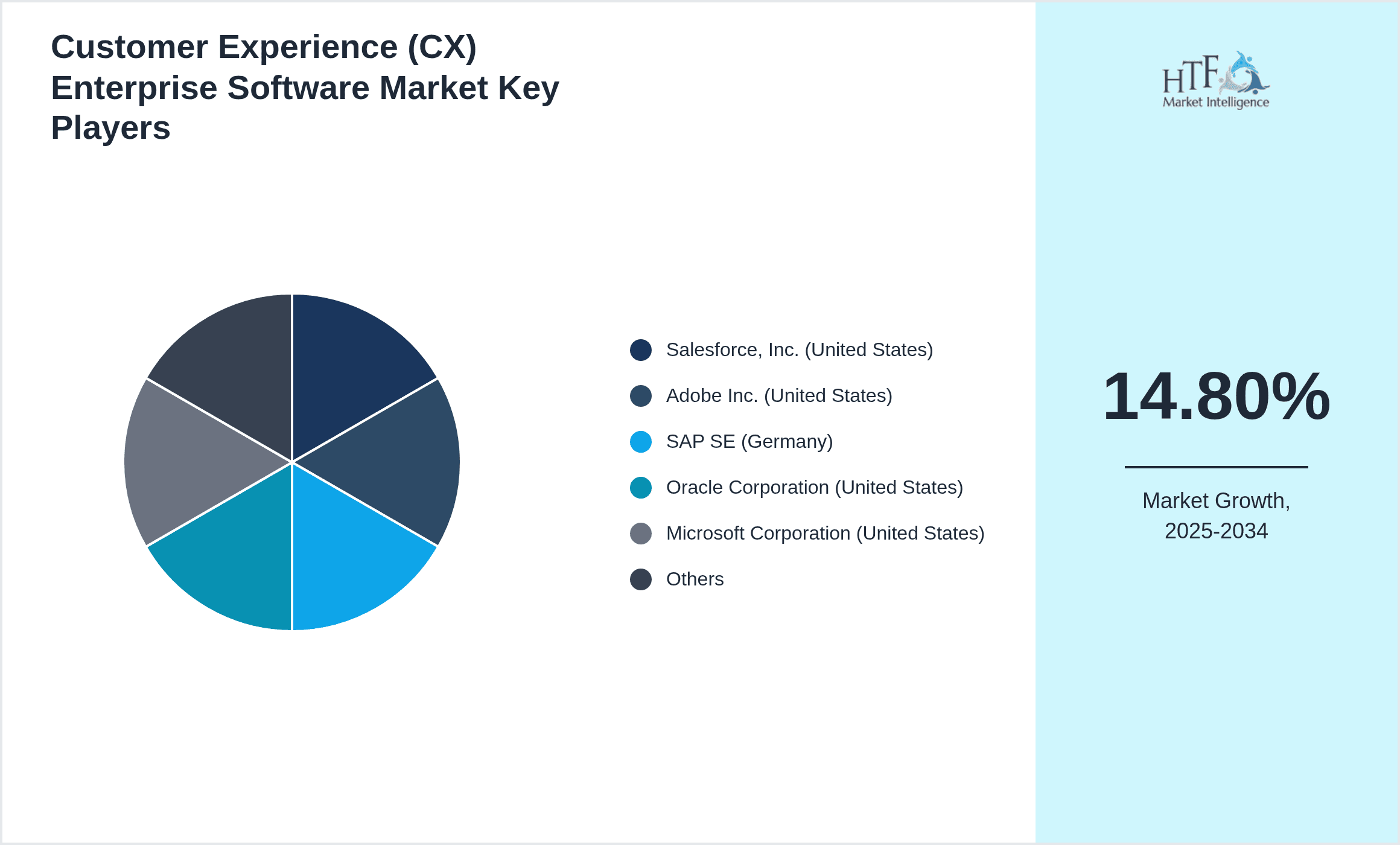
- •Salesforce, Inc. (United States)
- •Adobe Inc. (United States)
- •SAP SE (Germany)
- •Oracle Corporation (United States)
- •Microsoft Corporation (United States)
- •Zendesk, Inc. (United States)
- •Freshworks Inc. (United States)
- •Genesys Telecommunications Laboratories, Inc. (United States)
- •NICE Ltd. (Israel)
- •ServiceNow, Inc. (United States)
- •HubSpot, Inc. (United States)
- •Qualtrics International Inc. (United States)
- •Pegasystems Inc. (United States)
- •Verint Systems Inc. (United States)
- •SugarCRM Inc. (United States)
- •Khoros, LLC (United States)
- •Zoho Corporation (India)
- •Twilio Inc. (United States)
- •Interaction Associates, Inc. (United States)
- •Medallia, Inc. (United States)
- •LivePerson, Inc. (United States)
- •Sprinklr, Inc. (United States)
- •ClickSoftware Technologies Ltd. (Israel)
- •Clarabridge, Inc. (United States)
- •Genesys Cloud Services (United States)
Market Breakdown
- •By Type
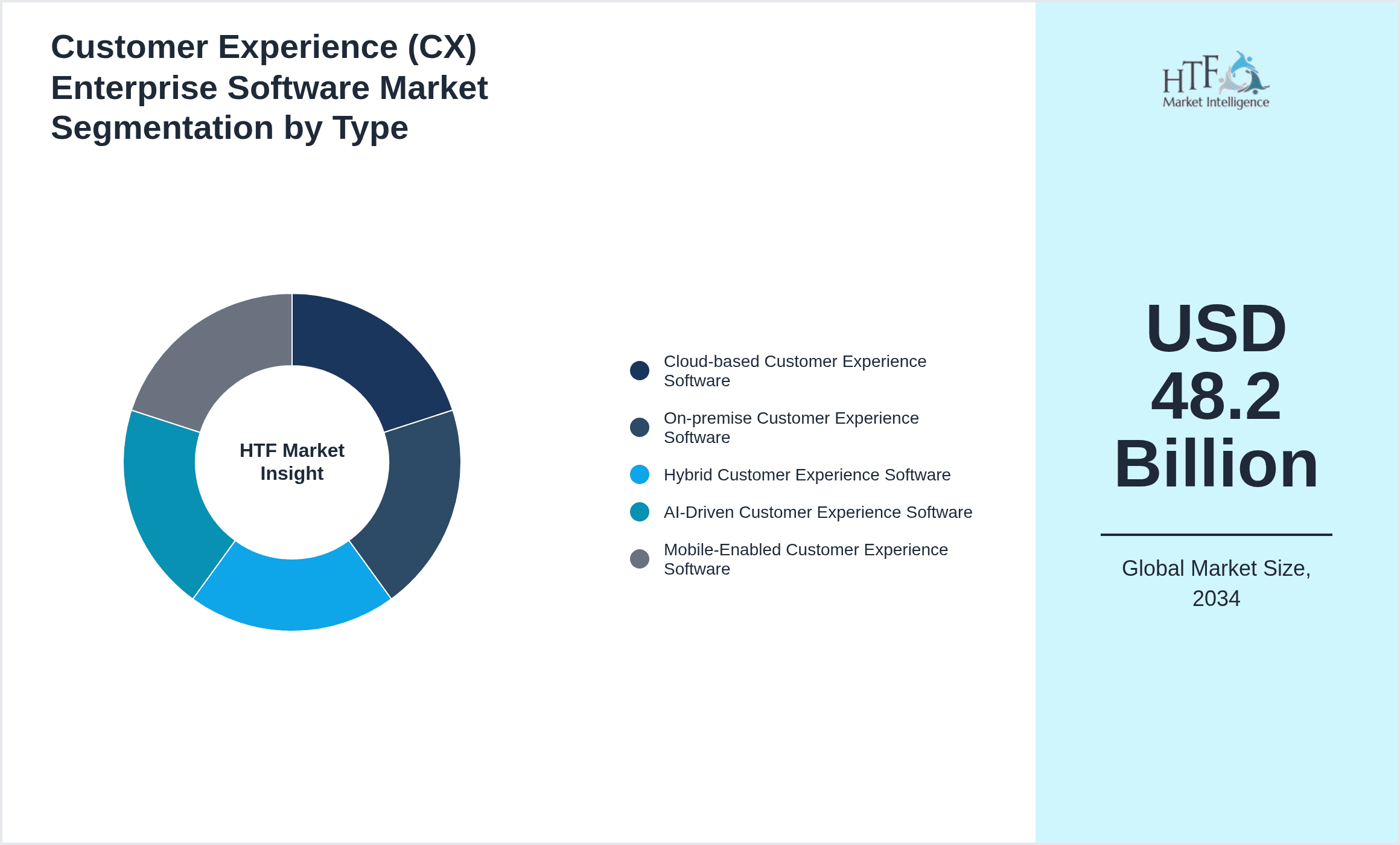
- ◦Cloud-based Customer Experience Software
- ◦On-premise Customer Experience Software
- ◦Hybrid Customer Experience Software
- ◦AI-Driven Customer Experience Software
- ◦Mobile-Enabled Customer Experience Software
- •By Application
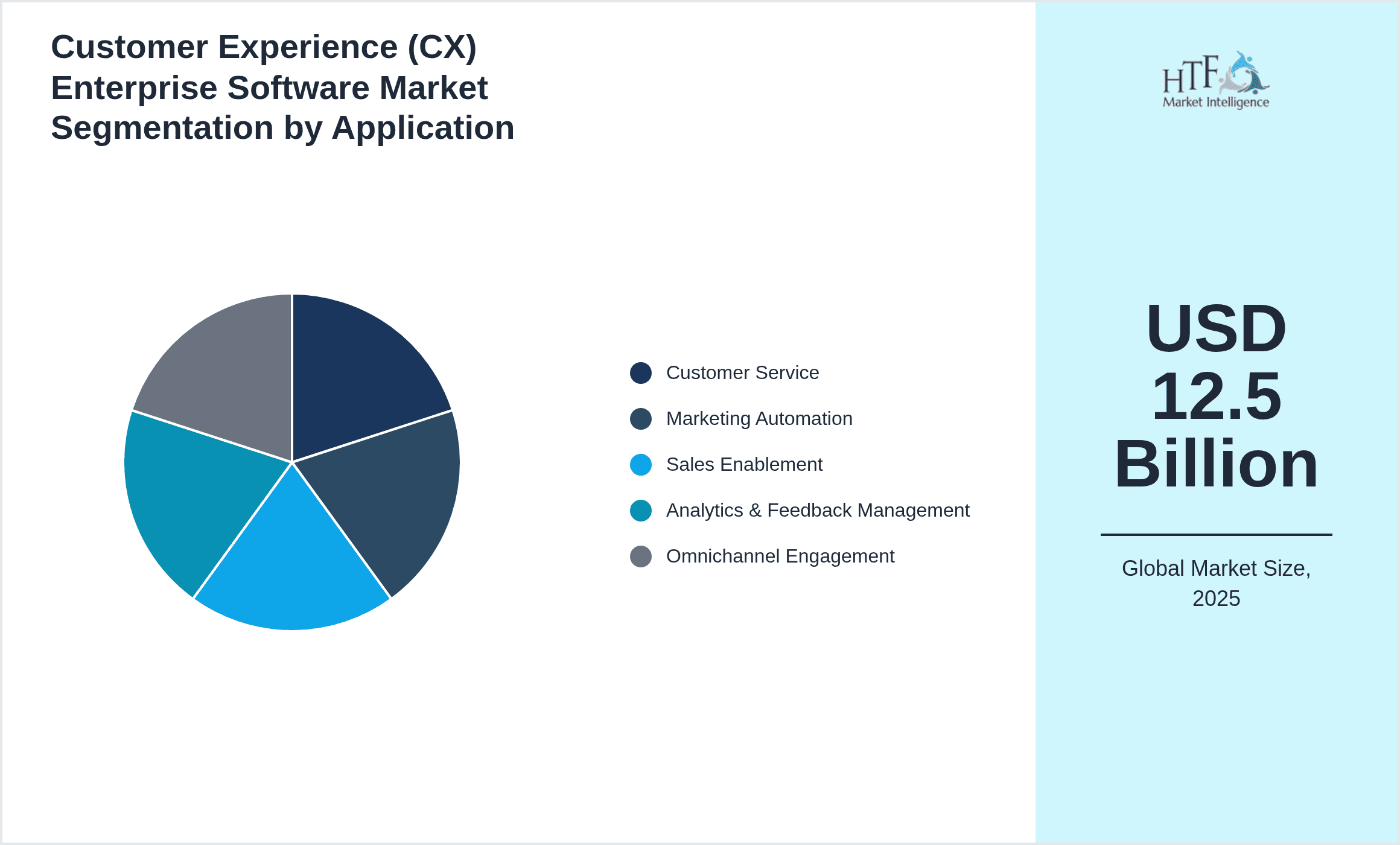
- ◦Customer Service
- ◦Marketing Automation
- ◦Sales Enablement
- ◦Analytics & Feedback Management
- ◦Omnichannel Engagement
- •By Deployment Model
- ◦Public Cloud
- ◦Private Cloud
- ◦On-premise
- ◦Hybrid Cloud
- •By Industry Vertical
- ◦Retail
- ◦Banking, Financial Services & Insurance (BFSI)
- ◦Healthcare
- ◦Telecommunications
- ◦Manufacturing
Growth Dynamics
- •The global shift towards digital transformation drives significant growth in the CX enterprise software market, with enterprises investing heavily to enhance customer engagement and operational efficiencies. Cloud adoption facilitates scalable CX solutions, enabling businesses to rapidly deploy and customize software to meet evolving customer demands.
- •Integration of artificial intelligence and machine learning accelerates market expansion by enabling predictive analytics, personalized recommendations, and automated customer interactions, resulting in improved satisfaction and loyalty.
- •The rise of omnichannel engagement strategies compels organizations to adopt comprehensive CX software that unifies communication across online, mobile, and physical channels, thus enhancing customer experience consistency and reach.
- •Growing demand for real-time customer feedback and analytics propels adoption of advanced CX platforms with embedded data visualization and sentiment analysis capabilities, allowing proactive service improvements.
- •Increasing competition and customer expectations in sectors such as retail and BFSI necessitate sophisticated CX tools, driving vendors to innovate and expand their offerings with AI-driven and mobile-enabled solutions.
- •Government initiatives promoting digital economy and data protection influence enterprises to invest in compliant and secure CX software, thereby fostering market growth in regulated industries.
- •Strategic partnerships between CX software providers and cloud infrastructure companies enhance solution robustness and global reach, creating new growth avenues and competitive advantages.
Market Trends
- •The adoption of AI-powered chatbots and virtual assistants is increasing rapidly, enabling 24/7 customer support and reducing operational costs, as seen with deployments by leading CX software vendors in 2024.
- •Personalization through data analytics is becoming a market norm, with enterprises leveraging customer journey mapping tools to tailor experiences across multiple touchpoints effectively.
- •Cloud-native CX solutions are gaining preference over traditional on-premise models due to their scalability, lower upfront costs, and faster integration with other enterprise systems.
- •Integration of CX platforms with social media and messaging apps enables real-time engagement, expanding customer reach and feedback collection capabilities.
- •Sustainability and ethical data usage are emerging as critical factors, with CX software incorporating features to ensure compliance with global data privacy regulations and ethical AI practices.
- •Increased focus on mobile-enabled CX tools reflects the growing mobile user base, providing seamless experiences and engagement through smartphones and tablets.
- •Expansion of industry-specific CX solutions tailored to unique sectoral requirements enhances adoption, particularly in healthcare and BFSI, where regulatory compliance is paramount.
Market Opportunities
- •Emerging economies in Asia-Pacific present substantial growth opportunities due to increasing digital infrastructure investments and rising demand for advanced CX solutions among SMEs and large enterprises.
- •The integration of augmented reality (AR) and virtual reality (VR) into CX platforms offers innovative avenues for immersive customer engagement, opening new market segments.
- •Developing AI-driven predictive analytics and sentiment analysis tools allows providers to offer proactive customer service capabilities, differentiating their products in a competitive market.
- •Expansion into underpenetrated industry verticals such as manufacturing and telecommunications can unlock new revenue streams, particularly with customized CX solutions addressing sector-specific challenges.
- •Strategic alliances with cloud infrastructure providers and telecom operators facilitate enhanced service delivery and geographic expansion, especially in emerging markets.
- •Increasing demand for compliance with evolving data privacy laws creates opportunities for CX software with built-in regulatory features, appealing to highly regulated sectors.
- •The growing trend of remote work boosts demand for collaborative and cloud-based CX tools, enabling seamless customer interactions irrespective of location.
Market Challenges
- •Data privacy concerns and stringent regulatory requirements pose significant challenges, requiring CX software providers to invest heavily in security and compliance features to maintain customer trust.
- •High implementation costs and complexity of integrating CX software with legacy systems hinder adoption, particularly among small and medium-sized enterprises with limited IT budgets.
- •Rapid technological changes demand continuous innovation from vendors, creating pressure to regularly update software capabilities and maintain competitive relevance.
- •Lack of skilled professionals to manage and optimize CX platforms limits effective deployment and utilization, affecting overall market growth.
- •Interoperability issues among disparate enterprise systems complicate seamless data flow, reducing the effectiveness of CX solutions and increasing operational costs.
- •Competitive pricing pressures from numerous vendors may constrain profit margins, necessitating differentiation through innovation and service quality.
- •Resistance to change within organizations can delay adoption of new CX technologies, impacting market penetration rates.
Regulatory Framework
- •Between 2019 and 2024, the implementation of the General Data Protection Regulation (GDPR) and similar data privacy laws globally mandated stringent customer data handling and consent protocols, significantly impacting CX software development and deployment.
- •Industry-specific regulations, such as HIPAA in healthcare and PCI DSS in financial services, require CX platforms to incorporate robust security and compliance features, influencing vendor offerings and customer requirements.
- •The introduction of the California Consumer Privacy Act (CCPA) in 2020 further tightened data protection norms in North America, compelling CX enterprises to enhance transparency and user control over personal data.
- •Emerging regulations in Asia-Pacific, including the Personal Data Protection Act (PDPA) in Singapore and similar laws in Japan and Australia, are shaping market dynamics by enforcing local compliance standards for CX software providers.
- •Government initiatives promoting digital transformation and cybersecurity investments support the adoption of compliant CX solutions, fostering a regulatory environment conducive to market growth.
Market Intelligence
- •15th January 2025, Salesforce, Inc. launched its new AI-powered Customer 360 platform, integrating advanced machine learning algorithms to provide predictive customer insights, personalized marketing automation, and real-time service enhancements. This platform aims to streamline customer engagement processes across multiple industries, enhancing operational efficiency and driving customer loyalty through intelligent automation. The launch represents Salesforce’s commitment to maintaining leadership in the CX software market by leveraging AI to meet evolving enterprise needs. Salesforce targets sectors such as retail, healthcare, and BFSI with this offering, expecting accelerated adoption in North America and Asia-Pacific regions. Source: Salesforce official press release
- •22nd March 2025, Adobe Inc. introduced Adobe Experience Cloud 2025 edition featuring enhanced omnichannel capabilities, including improved integration with social media platforms and augmented reality-based customer engagement tools. This upgrade supports enterprises in delivering seamless, immersive experiences across digital and physical touchpoints, responding to growing demand for innovative customer interaction methods. The product update strengthens Adobe’s position in the global CX market and is expected to drive significant growth in Europe and North America. Adobe emphasizes data privacy compliance and AI-driven personalization as core components of the new edition. Source: Adobe corporate announcement
- •30th April 2025, Microsoft Corporation announced a strategic partnership with Twilio Inc. to integrate Twilio’s communication APIs into Microsoft Dynamics 365 Customer Insights, enabling enhanced real-time omnichannel engagement across voice, SMS, and chat platforms. This collaboration aims to deliver comprehensive CX solutions that combine Microsoft’s enterprise software capabilities with Twilio’s communication infrastructure, targeting global enterprises seeking unified customer interaction management. The partnership is poised to reinforce Microsoft’s competitive edge in cloud-based CX software, particularly in North America and Europe. Source: Microsoft press release
- •10th June 2025, Zendesk, Inc. completed the acquisition of AI startup Ada Support to bolster its AI-driven customer service offerings. The acquisition enables Zendesk to integrate sophisticated chatbot and automation technologies into its CX platform, enhancing capabilities in predictive support and reducing response times. This move aligns with Zendesk’s strategy to expand its AI portfolio and improve customer experience efficiency, primarily targeting markets in North America and Asia-Pacific. The integration is expected to accelerate adoption among mid-sized enterprises seeking scalable AI solutions. Source: Zendesk corporate communications
Regional Outlook
The North America currently holds a significant share of the market, primarily due to several key factors: increasing consumption rates, a burgeoning population, and robust economic momentum. These elements collectively drive demand, positioning this region as a leader in the market. On the other hand, Asia-Pacific is rapidly emerging as the fastest-growing area within the industry. This remarkable growth can be attributed to swift infrastructure development, the expansion of various industrial sectors, and a marked increase in consumer demand. These dynamics make this region a crucial player in shaping future market growth.
In our report, we cover a comprehensive analysis of the following regions and countries:
- North America
- LATAM
- West Europe
- Central & Eastern Europe
- Northern Europe
- Southern Europe
- East Asia
- Southeast Asia
- South Asia
- Central Asia
- Oceania
- MEA
| Feature | Details |
|---|---|
| Base Year Market Size | USD 12.5 Billion |
| Forecast Year Market Size | USD 48.2 Billion |
| CAGR | 14.8% |
| Forecast Period | 2026 to 2033 |
| YoY Growth | 14% |
| Scope of Report | Market is segmented by Type (Cloud-based Customer Experience Software, On-premise Customer Experience Software, Hybrid Customer Experience Software, AI-Driven Customer Experience Software, Mobile-Enabled Customer Experience Software), Application (Customer Service, Marketing Automation, Sales Enablement, Analytics & Feedback Management, Omnichannel Engagement), Deployment Model (Public Cloud, Private Cloud, On-premise, Hybrid Cloud), Industry Vertical (Retail, Banking, Financial Services & Insurance (BFSI), Healthcare, Telecommunications, Manufacturing) |
| Regions Covered | North America, LATAM, West Europe, Central & Eastern Europe, Northern Europe, Southern Europe, East Asia, Southeast Asia, South Asia, Central Asia, Oceania, MEA |
| Key Companies | Salesforce, Inc. (United States), Adobe Inc. (United States), SAP SE (Germany), Oracle Corporation (United States), Microsoft Corporation (United States), Zendesk, Inc. (United States), Freshworks Inc. (United States), Genesys Telecommunications Laboratories, Inc. (United States), NICE Ltd. (Israel), ServiceNow, Inc. (United States), HubSpot, Inc. (United States), Qualtrics International Inc. (United States), Pegasystems Inc. (United States), Verint Systems Inc. (United States), SugarCRM Inc. (United States), Khoros, LLC (United States), Zoho Corporation (India), Twilio Inc. (United States), Interaction Associates, Inc. (United States), Medallia, Inc. (United States), LivePerson, Inc. (United States), Sprinklr, Inc. (United States), ClickSoftware Technologies Ltd. (Israel), Clarabridge, Inc. (United States), Genesys Cloud Services (United States) |
Global Customer Experience Enterprise Software Market - Outlook 2024-2034 - Table of Contents
Multidisciplinary researcher with 10+ years of experience uncovering insights across diverse domains focused on uncovering insights that drive informed decisions.
Frequently Asked Questions (FAQ):
The Compact Track Loaders market is projected to grow at a CAGR of 6.8% from 2025 to 2030, driven by increasing demand in construction and agricultural sectors.
North America currently leads the market with approximately 45% market share, followed by Europe at 28% and Asia-Pacific at 22%. The remaining regions account for 5% of the global market.
Key growth drivers include increasing construction activities, rising demand for versatile equipment in agriculture, technological advancements in track loader design, and growing preference for compact equipment in urban construction projects.