
Global Online Brand Protection Software Market Size, Growth & Revenue 2025-2034
Global Online Brand Protection Software Market is segmented by Type (Trademark Monitoring, Domain Monitoring, Copyright Protection, Anti-Counterfeiting, Reputation Management), Application (E-commerce Platforms, Social Media Monitoring, Digital Advertising, Intellectual Property Management, Counterfeit Detection), Deployment Model (Cloud-based, On-premise, Hybrid), Service Type (Monitoring Services, Enforcement Services, Consulting Services, Legal Support Services), and Geography (North America, LATAM, West Europe, Central & Eastern Europe, Northern Europe, Southern Europe, East Asia, Southeast Asia, South Asia, Central Asia, Oceania, MEA)
Pricing
Report Overview
Executive Summary
- •Online Brand Protection Software represents a critical suite of digital solutions aimed at securing brand identity and intellectual property across digital platforms worldwide. This market includes tools that monitor and enforce trademark rights, domain integrity, copyright protections, anti-counterfeiting efforts, and reputation management to combat digital threats affecting brand equity. The scope of this market extends across diverse industries such as retail, technology, pharmaceuticals, and consumer goods, emphasizing the protection against counterfeit goods, unauthorized use of trademarks, and fraudulent digital content. Given the exponential rise of e-commerce and social media platforms, brands face increased risk from infringement and reputational harm, driving demand for sophisticated brand protection software. These solutions enable companies to proactively detect infringements, automate legal enforcement actions, and maintain consumer trust, thereby underpinning their competitive positioning in a digital-first economy.
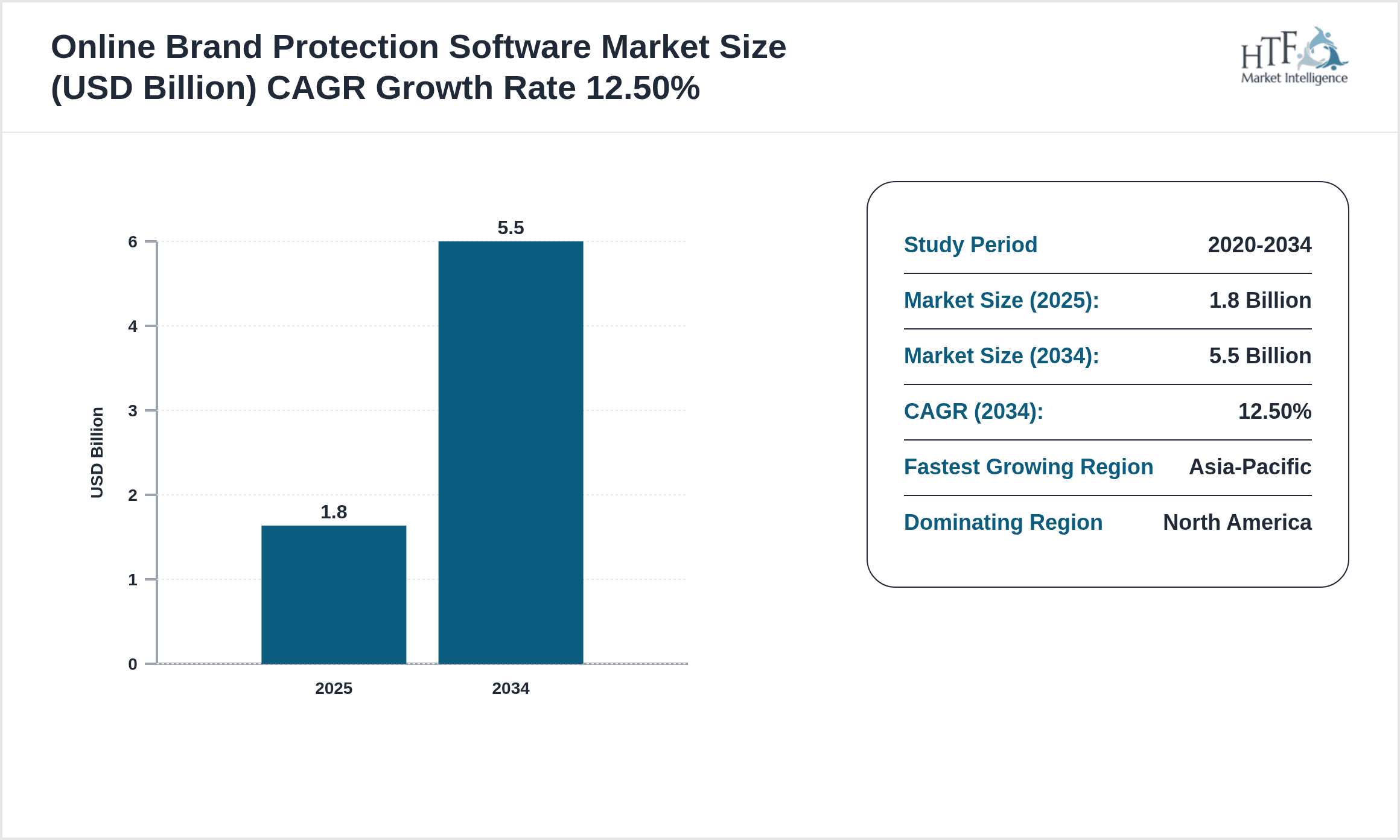
- •The global Online Brand Protection Software market exhibits robust growth driven by surging global e-commerce transactions, heightened cybercrime activities, and intensified regulatory scrutiny over intellectual property rights. The market size is poised to expand from USD 1.8 Billion in 2025 to USD 5.5 Billion by 2034, registering a CAGR of 12.5 percent. North America currently leads the market due to widespread adoption among enterprises and advanced cybersecurity frameworks, while Asia-Pacific emerges as the fastest-growing region owing to rapid digitalization and increasing counterfeit risks. Trademark Monitoring remains the dominant product segment, while Anti-Counterfeiting solutions demonstrate the highest growth rates fueled by the proliferation of counterfeit goods online. These dynamics indicate a strategic imperative for organizations to invest in comprehensive brand protection technologies to mitigate risks and capitalize on market opportunities.
- •Investment in Online Brand Protection Software offers significant value propositions by safeguarding brand reputation, reducing revenue losses from counterfeit products, and ensuring regulatory compliance. These solutions empower businesses to monitor brand usage across multiple digital channels, enabling real-time detection and swift mitigation of infringement activities. The strategic importance of brand protection extends to maintaining customer loyalty, enhancing market credibility, and supporting global expansion strategies. For stakeholders including brand owners, legal teams, e-commerce platforms, and cybersecurity providers, the market delivers critical tools that align with evolving digital risk landscapes and intellectual property enforcement requirements. Consequently, the market's growth trajectory reflects the increasing prioritization of brand security as a fundamental component of corporate risk management frameworks.
Competitive Landscape
The competitive environment in the Online Brand Protection Software market is characterized by aggressive innovation, strategic partnerships, and geographic expansion to capture emerging opportunities. Leading firms leverage advanced technologies such as artificial intelligence, machine learning, and big data analytics to enhance detection accuracy and response speed against brand infringements. Companies adopt multi-pronged strategies including mergers and acquisitions to consolidate market share and broaden solution portfolios. Collaborative alliances with e-commerce giants, legal entities, and cybersecurity firms enhance service integration and market penetration. Pricing strategies emphasize subscription-based models with scalable offerings to accommodate enterprises of varying sizes. Regional competition intensifies with local players adapting solutions to comply with jurisdiction-specific regulations. Future competitive trends indicate deeper investments in predictive analytics, automated enforcement, and cloud-based deployment to sustain market leadership and address evolving digital threats.
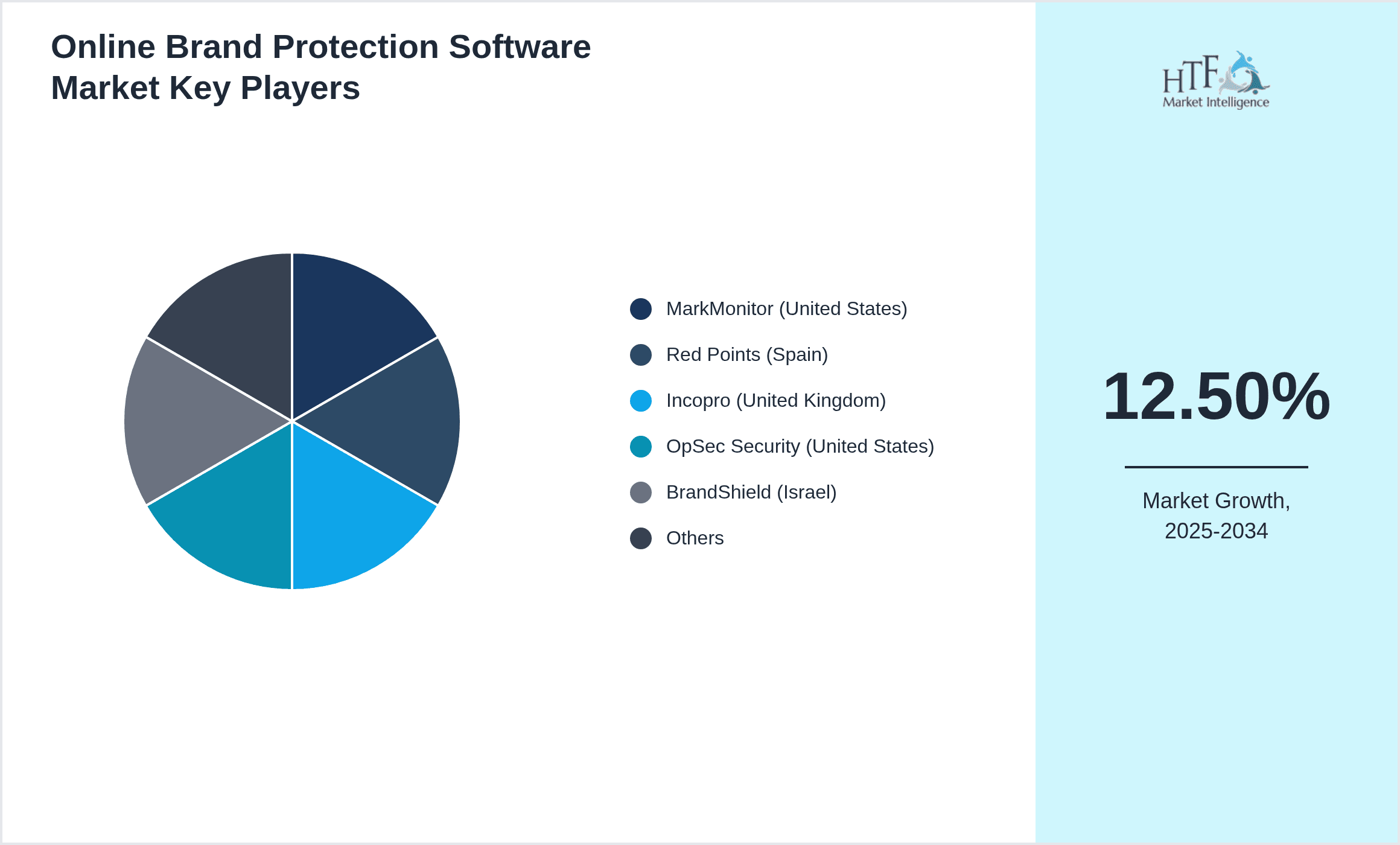
Leading Companies in Online Brand Protection Software Market
- •MarkMonitor (United States)
- •Red Points (Spain)
- •Incopro (United Kingdom)
- •OpSec Security (United States)
- •BrandShield (Israel)
- •ComplyAdvantage (United Kingdom)
- •CSC Digital Brand Services (United States)
- •Corsearch (United States)
- •NetNames (United Kingdom)
- •SonicWall (United States)
- •ZeroFOX (United States)
- •Protect Brands (United Kingdom)
- •Kaspersky Lab (Russia)
- •CybelAngel (France)
- •BrandVerity (United States)
- •SafeBrands (United States)
- •WatchGuard (United States)
- •IP.Protection (United Kingdom)
- •Auth0 (United States)
- •Proofpoint (United States)
Market Breakdown
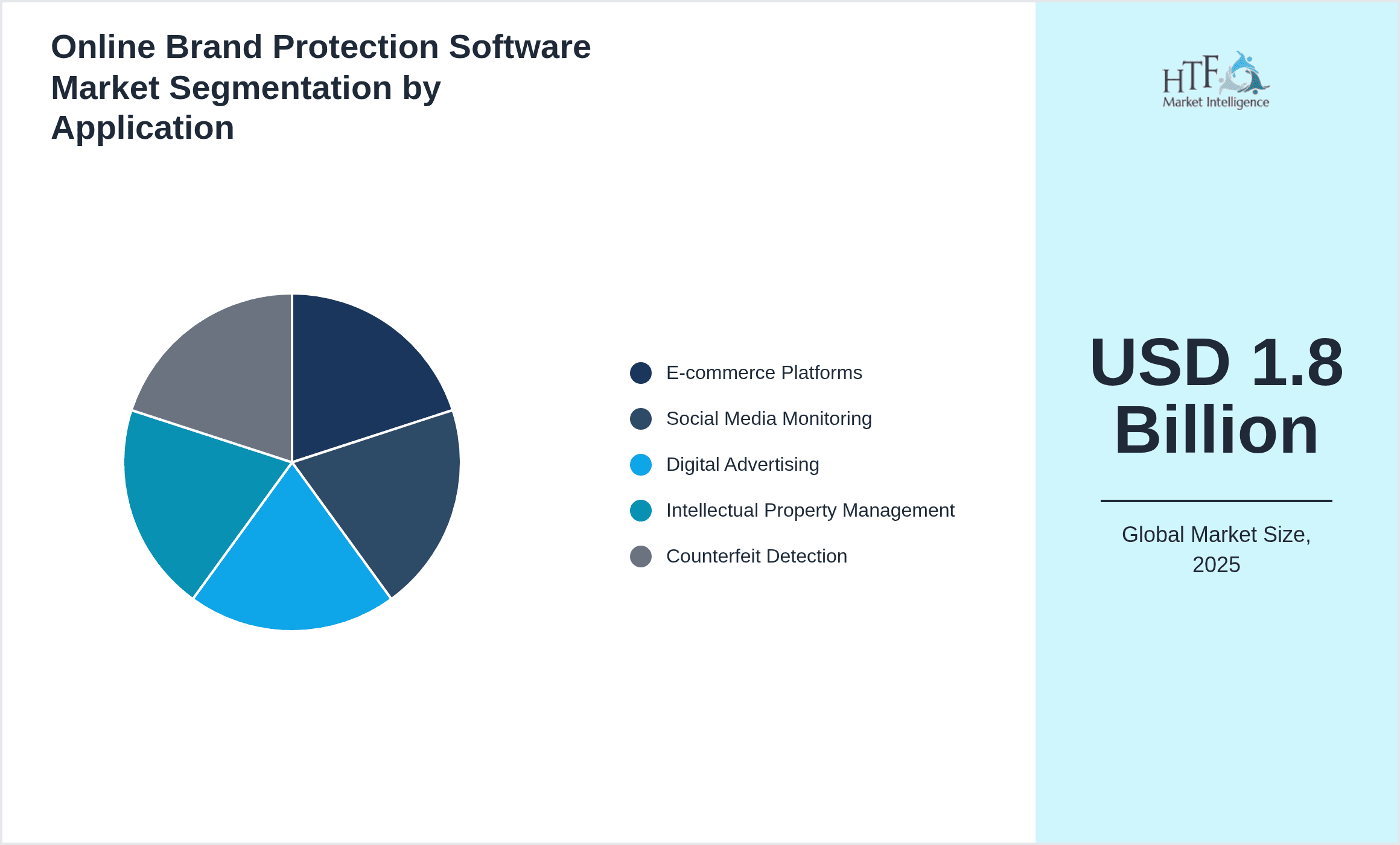
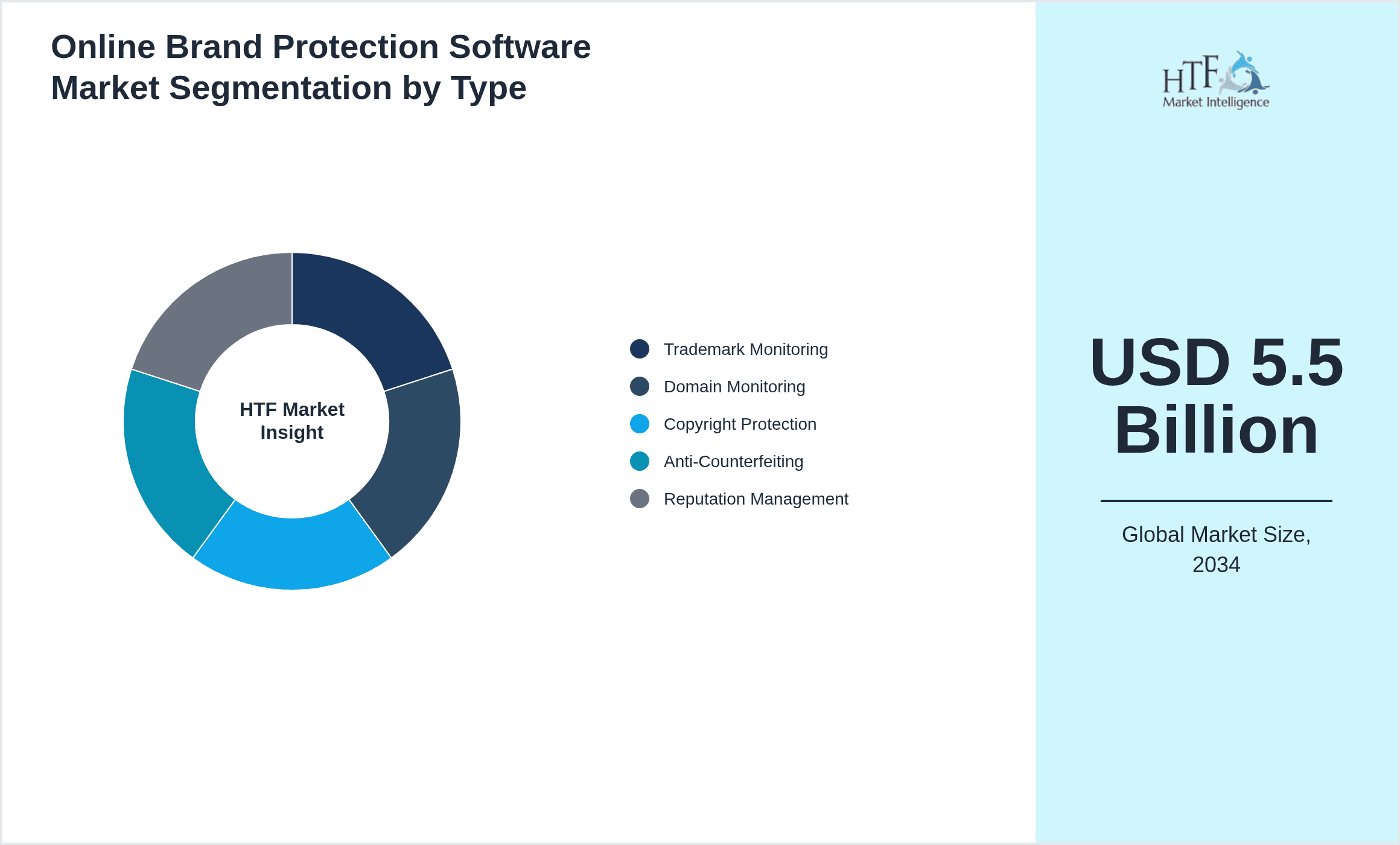
- •By Type
- ◦Trademark Monitoring
- ◦Domain Monitoring
- ◦Copyright Protection
- ◦Anti-Counterfeiting
- ◦Reputation Management
- •By Application
- ◦E-commerce Platforms
- ◦Social Media Monitoring
- ◦Digital Advertising
- ◦Intellectual Property Management
- ◦Counterfeit Detection
- •By Deployment Model
- ◦Cloud-based
- ◦On-premise
- ◦Hybrid
- •By Service Type
- ◦Monitoring Services
- ◦Enforcement Services
- ◦Consulting Services
- ◦Legal Support Services
Growth Dynamics
The global Online Brand Protection Software market experiences robust expansion fueled by the escalating digital footprint of brands and the corresponding rise in online infringement activities. Increasing e-commerce penetration exposes brands to risks such as counterfeit sales and unauthorized use of trademarks, prompting enterprises to adopt comprehensive protection solutions. Technological advancements including artificial intelligence and machine learning enhance real-time monitoring capabilities, enabling proactive threat detection and rapid enforcement. Recent events, such as the surge in counterfeit pharmaceuticals during the COVID-19 pandemic, have underscored the critical need for reliable anti-counterfeiting measures. Additionally, governments worldwide are strengthening intellectual property regulations, encouraging brand owners to invest in compliant protection frameworks. The proliferation of social media channels further amplifies brand exposure risks, driving demand for reputation management software. Thus, intertwined factors of technological innovation, regulatory enforcement, and growing digital commerce collectively propel market growth.
Market Trends
The Online Brand Protection Software market is witnessing transformative trends characterized by increased integration of AI-driven analytics and automated enforcement mechanisms. Companies are shifting towards cloud-based platforms to enable scalable and flexible deployments, facilitating global brand monitoring across multiple digital channels. There is a growing emphasis on harnessing big data to predict infringement patterns and tailor proactive strategies, enhancing operational efficiency. Strategic partnerships between software providers and e-commerce marketplaces are becoming prevalent, aiming to embed brand protection natively within digital sales ecosystems. Moreover, rising consumer awareness about counterfeit risks fuels demand for transparent brand protection measures, influencing product innovation. Emerging markets in Asia-Pacific and Latin America are adopting these solutions rapidly due to escalating counterfeit incidents and expanding online retail sectors. These trends collectively indicate a maturing market evolving towards intelligent, collaborative, and user-centric protection frameworks.
Market Opportunities
Expanding e-commerce adoption globally presents significant opportunities for Online Brand Protection Software providers to penetrate untapped markets and verticals. Emerging economies in Asia-Pacific and Latin America exhibit increasing digital retail activities coupled with rising counterfeit threats, creating demand for customized protection solutions. Integration of blockchain technology offers prospects for enhancing transparency and traceability in brand protection processes, appealing to industries such as luxury goods and pharmaceuticals. Additionally, increasing regulatory emphasis on intellectual property enforcement worldwide opens avenues for software providers to offer compliance-driven services. The rise of influencer marketing and social media commerce introduces new channels requiring dedicated brand monitoring and reputation management tools. Companies investing in AI-powered predictive analytics and automated enforcement gain competitive advantages by delivering faster, more accurate protection. These factors collectively create fertile ground for innovation, market expansion, and strategic collaborations to capture future growth.
Market Challenges
The Online Brand Protection Software market faces challenges including the complexity of monitoring diverse digital channels and the sophistication of counterfeiters employing advanced evasion techniques. Fragmented regulatory environments across regions complicate uniform enforcement and compliance efforts, requiring localized adaptation of software solutions. High implementation costs and integration complexities hinder adoption among small and medium-sized enterprises, limiting market penetration. Recent incidents involving false positives in automated monitoring have raised concerns over accuracy and potential legal disputes, impacting user trust. Additionally, rapid technological evolution demands continuous investment in product innovation to maintain efficacy against emerging threats. Data privacy regulations also impose constraints on monitoring capabilities, necessitating careful balancing of brand protection and consumer rights. These challenges collectively necessitate strategic focus on technology refinement, regulatory alignment, and cost-effective solutions to sustain market growth.
Regulatory Framework
Recent regulatory developments have significantly influenced the Online Brand Protection Software market landscape. The European Union’s Digital Services Act, enacted in 2022, mandates increased accountability for online platforms in managing illegal content and counterfeit listings, thereby compelling brands and software providers to enhance monitoring and enforcement capabilities. Similarly, the United States’ Trademark Modernization Act of 2020 introduced streamlined procedures for trademark dispute resolutions, elevating the importance of real-time monitoring software. Data protection laws such as the General Data Protection Regulation enforce strict compliance requirements impacting how brand protection data is collected and processed. In Asia-Pacific, countries like India and China have strengthened intellectual property laws and enforcement mechanisms, fueling demand for sophisticated brand protection technologies. These evolving regulations necessitate continuous adaptation by market players to ensure compliance while effectively safeguarding brand assets across jurisdictions.
Market Intelligence
- •Recent market developments and strategic initiatives are continuously tracked through industry publications, company announcements, and regulatory filings. For the most current information, stakeholders are advised to monitor official corporate communications and recognized market intelligence platforms.
- •Recent market developments and strategic initiatives are continuously tracked through industry publications, company announcements, and regulatory filings. For the most current information, stakeholders are advised to monitor official corporate communications and recognized market intelligence platforms.
- •Recent market developments and strategic initiatives are continuously tracked through industry publications, company announcements, and regulatory filings. For the most current information, stakeholders are advised to monitor official corporate communications and recognized market intelligence platforms.
- •Recent market developments and strategic initiatives are continuously tracked through industry publications, company announcements, and regulatory filings. For the most current information, stakeholders are advised to monitor official corporate communications and recognized market intelligence platforms.
- •Source: Industry Publications, Company Websites, Regulatory Filings
Regional Outlook
The North America currently holds a significant share of the market, primarily due to several key factors: increasing consumption rates, a burgeoning population, and robust economic momentum. These elements collectively drive demand, positioning this region as a leader in the market. On the other hand, Asia-Pacific is rapidly emerging as the fastest-growing area within the industry. This remarkable growth can be attributed to swift infrastructure development, the expansion of various industrial sectors, and a marked increase in consumer demand. These dynamics make this region a crucial player in shaping future market growth.
In our report, we cover a comprehensive analysis of the following regions and countries:
- North America
- LATAM
- West Europe
- Central & Eastern Europe
- Northern Europe
- Southern Europe
- East Asia
- Southeast Asia
- South Asia
- Central Asia
- Oceania
- MEA
| Feature | Details |
|---|---|
| Base Year Market Size | USD 1.8 Billion |
| Forecast Year Market Size | USD 5.5 Billion |
| CAGR | 12.5% |
| Forecast Period | 2026 to 2033 |
| YoY Growth | 12.4% |
| Scope of Report | Market is segmented by Type (Trademark Monitoring, Domain Monitoring, Copyright Protection, Anti-Counterfeiting, Reputation Management), Application (E-commerce Platforms, Social Media Monitoring, Digital Advertising, Intellectual Property Management, Counterfeit Detection), Deployment Model (Cloud-based, On-premise, Hybrid), Service Type (Monitoring Services, Enforcement Services, Consulting Services, Legal Support Services) |
| Regions Covered | North America, LATAM, West Europe, Central & Eastern Europe, Northern Europe, Southern Europe, East Asia, Southeast Asia, South Asia, Central Asia, Oceania, MEA |
| Key Companies | MarkMonitor (United States), Red Points (Spain), Incopro (United Kingdom), OpSec Security (United States), BrandShield (Israel), ComplyAdvantage (United Kingdom), CSC Digital Brand Services (United States), Corsearch (United States), NetNames (United Kingdom), SonicWall (United States), ZeroFOX (United States), Protect Brands (United Kingdom), Kaspersky Lab (Russia), CybelAngel (France), BrandVerity (United States), SafeBrands (United States), WatchGuard (United States), IP.Protection (United Kingdom), Auth0 (United States), Proofpoint (United States) |
Global Online Brand Protection Software Market Size, Growth & Revenue 2025-2034 - Table of Contents
Frequently Asked Questions (FAQ):
The Compact Track Loaders market is projected to grow at a CAGR of 6.8% from 2025 to 2030, driven by increasing demand in construction and agricultural sectors.
North America currently leads the market with approximately 45% market share, followed by Europe at 28% and Asia-Pacific at 22%. The remaining regions account for 5% of the global market.
Key growth drivers include increasing construction activities, rising demand for versatile equipment in agriculture, technological advancements in track loader design, and growing preference for compact equipment in urban construction projects.